The 2026 Middle East Shipping Crisis: Navigating the Strait of Hormuz Closure and Global Supply Chain Paralysis
The global maritime industry is currently facing its most significant “black swan” event of the decade. Following the escalation of conflict on February 28, 2026, the official closure of the Strait of Hormuz has sent shockwaves through the global economy.
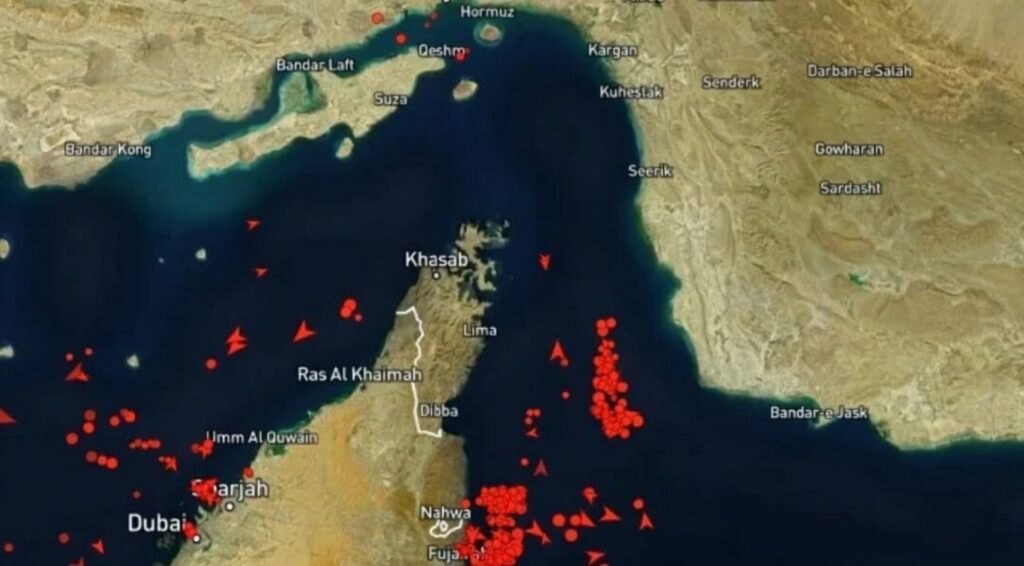
As of March 3, 2026, the Persian Gulf has effectively become a “floating parking lot.” At Kisun Shipping, we understand that for importers and exporters, information isn’t just power—it’s survival. This comprehensive report breaks down the technical data, carrier responses, and strategic maneuvers required to protect your cargo in this unprecedented era of volatility.
The Magnitude of the Bottleneck: 170 Vessels Stranded
According to synchronized tracking data and reports from Yihangyun, the closure has trapped approximately 170 container ships within the Persian Gulf. This represents a staggering 450,000 TEU (Twenty-foot Equivalent Units), accounting for roughly 1.4% of the entire global shipping capacity.
These vessels are not merely delayed; they are in a state of operational limbo. The drop in traffic through the Strait has been precipitous, with actual transit now approaching zero.
Vessels of Concern: High-Capacity Impact
Among the stranded fleet, several “Mega-Max” vessels are currently stationary, awaiting instructions in designated refuge areas:
- CMA CGM Everglade (15,254 TEU): Currently holding off the coast of Doha.
- MSC Grace (16,000 TEU): Anchored off the coast of Jebel Ali.
- MSC Francesca (11,660 TEU): Stationed off the coast of Doha.
The concentration of these ultra-large container vessels (ULCVs) in a confined maritime zone creates not only a logistics nightmare but a significant security challenge for the crew and the high-value cargo onboard.
Carrier Response Deep Dive: The Great Rerouting
The world’s leading shipping lines have moved from “monitoring” to “active emergency protocols.” Here is the current status of the “Big Six” carriers:
MSC (Mediterranean Shipping Company)
MSC has taken the most drastic stance by suspending all global cargo bookings to the Middle East indefinitely. Vessels already inside the Persian Gulf have been ordered to “safe havens,” prioritizing human life and vessel integrity above schedule reliability.
Maersk
The Danish giant has suspended all transits through the Strait of Hormuz and the Bab el-Mandeb Strait. Crucially, Maersk is rerouting its ME11 and MECL routes via the Cape of Good Hope. While this ensures the movement of goods, it adds significant transit time and fuel costs.
CMA CGM
Beyond rerouting via Africa, CMA CGM has implemented a blanket suspension on all refrigerated container (reefer) bookings for a massive geographic swathe, including Iraq, Saudi Arabia, the UAE, Qatar, and even parts of North Africa like Djibouti and Sudan. This is a critical blow to the global cold chain for perishables and pharmaceuticals.
Hapag-Lloyd, ONE, & COSCO
- Hapag-Lloyd: Official suspension of Hormuz transits with warnings of “indefinite delays” at Arabian Gulf ports.
- ONE Shipping: Implementing a voyage-by-voyage assessment, effectively treating every container as a unique risk profile.
- COSCO Shipping: Total suspension of transits based on safety protocols.
The Economic Fallout: War Risk Surcharges (WRS)
Logistics is an industry of math, and the math in March 2026 is expensive. To cover escalating security insurance and the immense fuel costs of the Cape of Good Hope detour, carriers have begun imposing War Risk Surcharges (WRS).
These surcharges are not optional. They reflect the reality of operating in a zone where the Iranian Islamic Revolutionary Guard Corps (IRGC) has explicitly stated that they will “crack down” on any vessel attempting to breach the closure. For shippers, this means the “all-in” freight rate is now a moving target.
The “Cape of Good Hope” Domino Effect
When the Strait of Hormuz and the Suez Canal routes are compromised, the world reverts to the 19th-century path around the southern tip of Africa. This is not a simple detour; it is a structural shock to the supply chain.
- Transit Time Increase: A typical voyage from Asia to Northern Europe or the UK now takes an additional 10 to 14 days.
- Capacity Redistribution: Because ships are spending more time at sea, the “effective” global capacity drops. There are fewer ships available to start new voyages, leading to “blank sailings” (canceled trips) in regions far away from the Middle East, such as the Trans-Pacific routes.
- Equipment Shortage: Empty containers are not returning to China fast enough, which will likely trigger a container shortage by Q2 2026.
Strategic Survival Guide: What Shippers Must Do Now
At Kisun Shipping, we believe in proactive resilience. If your supply chain relies on Middle Eastern hubs or Trans-Suez routes, consider these three “Authority Maneuvers”:
A. Pivot to Air Freight for High-Value Goods
When sea freight detours add two weeks to your lead time, air freight becomes a necessity rather than a luxury. We are currently helping clients move critical electronics and medical supplies via air to bypass the maritime blockade entirely.
- Explore our Air Freight Services for emergency capacity.
B. Review Marine Insurance Policies
Standard “All-Risk” insurance often has exclusions for war, civil unrest, or government seizure. Now is the time to verify if your cargo is covered under a “War Risk” clause. Kisun Shipping provides specialized Cargo Insurance Consulting to ensure your financial exposure is minimized.
C. Diversify Inventory Hubs
The “Just-in-Time” model is dead in 2026. We recommend moving toward a “Just-in-Case” strategy, utilizing warehouses in safer jurisdictions to buffer against the total closure of Hormuz.
Conclusion: A New Maritime Reality
The events of early 2026 remind us that the global supply chain is a fragile web. The closure of the Strait of Hormuz is not just a Middle Eastern problem; it is a global economic challenge that requires expert navigation.
Kisun Shipping remains committed to transparency and safety. We will continue to provide real-time updates as the situation evolves. In these turbulent times, having a partner who understands the “why” behind the delay is the only way to protect your “what.”
Need an immediate rerouting plan or a War Risk assessment for your cargo? Contact the Kisun Shipping Emergency Response Team Today.
May the world be at peace and trade be unimpeded.

China Logistics Expert
About the Author
Katherine Kang is a China-based logistics consultant with over 11 years of experience in international trade and freight forwarding. Specializing in helping SMEs import from China to the USA, Canada, and Europe, she focuses on compliant, cost-effective solutions to avoid delays, tariffs, and hidden fees. From anti-dumping guidance to CNY planning, Katherine has managed hundreds of shipments, saving clients 15-30% on average.
Connect with Katherine on LinkedIn or contact Kisun Shipping for a free import consultation.