

Saudi Customs 2026: The “Compliance Hammer” Has Dropped. Are You Ready?
If you are shipping to the Kingdom of Saudi Arabia (KSA) in 2026 with a 2024 mindset, your cargo isn’t just delayed—it’s in legal jeopardy.
We are only a quarter into 2026, and Saudi Arabia’s Zakat, Tax and Customs Authority (ZATCA) and the Saudi Standards, Metrology and Quality Organization (SASO) have already unleashed a series of radical updates. We’ve seen veteran importers hit with massive fines not because they were dishonest, but because they missed a single digital “Short Code” or used a 10-digit HS code instead of the new 12-digit standard.
At Kisun Shipping, we’ve deconstructed these “Major Initiatives” into a survival guide for international merchants. Here is the reality of shipping to Saudi Arabia today.
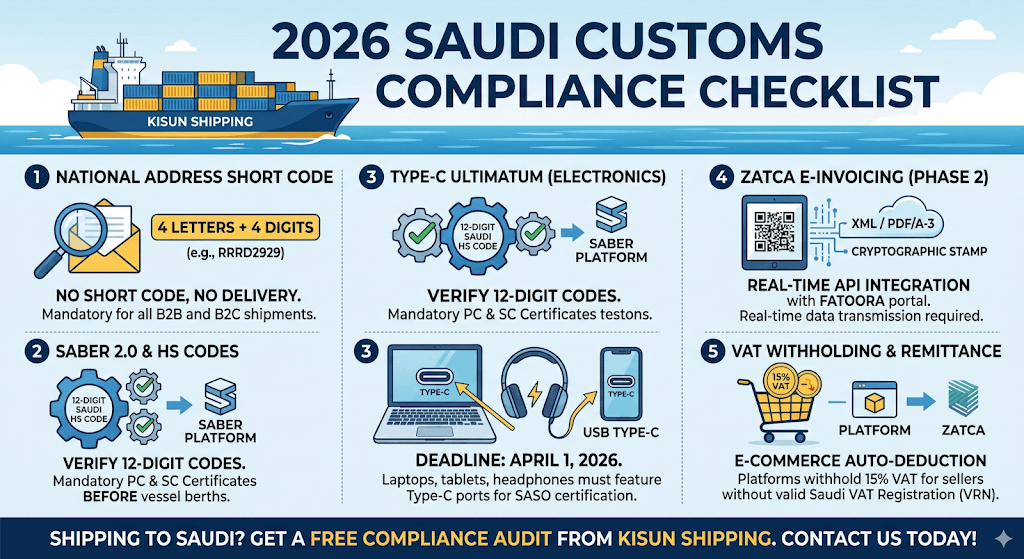
The “Short Code” Mandate: No Code, No Last-Mile
Effective January 1, 2026, the “informal landmarks” era is dead. Saudi Post (SPL) and the Transport General Authority (TGA) now mandate a National Address Short Code for every single shipment.
- What it is: An 8-character unique identifier (e.g.,
RRRD2929) consisting of 4 letters and 4 digits. - The Trap: Even if your goods clear the primary customs gate at Jeddah or Dammam, delivery companies are now legally required to reject parcels that lack this code.
- The Kisun Warning: Do not ship until you see that 8-character code on the commercial invoice. Without it, the cargo forecast cannot be entered into the carrier system, leading to expensive “dead storage” at the warehouse.
SABER 2.0: The 12-Digit HS Code & Type-C Revolution
The SABER platform remains the gatekeeper for all non-exempt goods, but in 2026, the gate has narrowed significantly.
1. The 12-Digit HS Code Shift
As of January 1, 2026, Saudi Arabia has transitioned to an extended 12-digit Customs Tariff Code.
- The Conflict: Many exporters still use the international 6-digit or the previous 10-digit versions. In 2026, the SABER platform will automatically reject PC (Product Conformity) applications that do not align with the new 12-digit Saudi-specific classification.
- Expert Tip: Verify your code on the official ZATCA/SASO portal. A 15% discrepancy exists between Chinese and Saudi classifications—don’t guess.
2. The Type-C Ultimatum (Phase 2)
Following the 2025 rollout, April 1, 2026, marks the expanded deadline for the Unified Charging Port Requirement.
- Mandatory: Laptops, tablets, headphones, and portable speakers must now feature USB Type-C ports to receive SASO certification.
- Outcome: Non-compliant electronics will be denied a PC certificate, making them legally unimportable.
3. The End of the “Commitment Letter”
The days of “clear now, certify later” via a Letter of Guarantee are gone. In 2026, the Two-Certificate Closed Loop (PC + SC) must be completed before the vessel berths. There is zero opportunity for post-arrival supplementation.
ZATCA Phase 2: When Your Invoice Becomes “Cryptographic”
If you think an Excel-generated invoice is enough, you’re about to trigger a tax audit.
E-Invoicing Phase 2 (Integration Phase) is now in full swing for nearly all business tiers.
- The Technology: Your invoicing solution must now integrate directly with the Fatoora portal via API.
- The Format: Invoices must be in XML or PDF/A-3 format, containing a cryptographic stamp (Hash) and a sequential, tamper-proof UUID.
- The Penalty: Non-compliance isn’t just a logistics delay; it’s a tax violation with fines ranging from 5,000 to 50,000 SAR.
VAT Withholding: The E-commerce “Safety Net”
For our Amazon Saudi Arabia and Noon sellers, 2026 brings a major cash-flow shift.
- The Rule: If you fail to provide a valid VAT Registration Number (VRN), the e-commerce platforms are now mandated by ZATCA to automatically withhold 15% VAT from your sales revenue and remit it directly to the government.
- The Kisun Advice: Registering for your own VAT number allows you to reclaim input VAT on your logistics and local costs. Letting the platform “auto-deduct” is the most expensive way to do business
The “Voluntary Disclosure” Lifeline
ZATCA has introduced a Voluntary Disclosure (VD) mechanism in 2026 for businesses that realize they’ve made a mistake (incorrect valuation, wrong HS code, etc.).
- The Benefit: If you admit the error before ZATCA finds it, they may waive the heavy penalties.
- The Strategy: We recommend a quarterly “Customs Health Check.” If you find a discrepancy, use the VD mechanism immediately.
Prohibited Items & Labeling: No Room for Error
While the list of prohibited items (alcohol, pork, etc.) remains strict, the “Made in China” requirement has become a major sticking point in 2026.
- Labeling: Every item must have a non-removable “Made in China” mark (engraved, stitched, or printed). Stickers are frequently rejected by inspectors at King Abdulaziz International Airport (JED).
Final Verdict: Compliance is Your Only Profit Margin
In 2026, Saudi Arabia is no longer a market for the “opportunistic” shipper; it is a market for the compliant professional.
At Kisun Shipping, we provide more than just freight. We provide the technical bridge between your factory in China and the ZATCA/SABER systems in Riyadh. Whether it’s verifying your 12-digit HS codes or ensuring your Address Short Code is valid, we handle the friction so you can focus on the sale.
Don’t let your 2026 growth get stuck in customs.
Contact Kisun Shipping for a Saudi Compliance Audit
Frequently Asked Questions (FAQ)
Q1: Is the Address Short Code required for both B2B and B2C shipments?

A: Yes. Whether it is a commercial container or a small e-commerce parcel, the 8-character Short Code is mandatory for all deliveries within the Kingdom as of January 2026.
Q2: My PC certificate is still valid but uses a 10-digit HS code. Do I need a new one?
A: While existing certificates technically remain valid until expiry, Saudi Customs will manually assign the new 12-digit codes during clearance, which often causes significant delays. We strongly recommend updating your SABER registrations to the 12-digit standard now.Q3: What is the tax threshold for commercial express shipments?
A: Commercial shipments valued over 1,000 SAR are subject to duties and the standard 15% VAT. For personal items, the duty-free allowance remains up to 5,000 SAR, but strict "personal use" quantity limits apply.
China Logistics Expert
About the Author
Katherine Kang is a China-based logistics consultant with over 11 years of experience in international trade and freight forwarding. Specializing in helping SMEs import from China to the USA, Canada, and Europe, she focuses on compliant, cost-effective solutions to avoid delays, tariffs, and hidden fees. From anti-dumping guidance to CNY planning, Katherine has managed hundreds of shipments, saving clients 15-30% on average.
Connect with Katherine on LinkedIn or contact Kisun Shipping for a free import consultation.