The End of the $800 De Minimis Exemption in 2026: China Small Packages Now Cost 2x More (And What Smart Importers Are Doing)
If your e-commerce business still relies on direct-from-China small parcels via air or express to serve US customers, this is your wake-up call.
The $800 De Minimis exemption (Section 321)—the century-old customs loophole that allowed millions of low-value parcels to enter the United States duty-free and with minimal scrutiny—is officially dead.
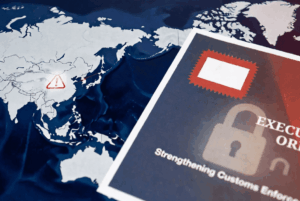
What started as a targeted suspension for goods originating from China and Hong Kong in May 2025 escalated into a global suspension by August 2025. As of the February 2026 Executive Order, this policy shift is locked in. There is no grandfather clause, no grace period, and no alternative loophole. US Customs and Border Protection (CBP) is now rigidly enforcing formal or informal entries, full duty collection, and tax assessments on every single package that crosses the border, regardless of its declared value.
At Kisun Shipping, we’ve spent the last few months auditing the supply chains of distressed sellers. We’ve seen clients’ landed costs double overnight. We’ve watched businesses lose 30% to 50% of their net margins within a matter of weeks. But we’ve also seen smart importers pivot away from the B2C direct-mail model, switch to overseas warehouses or strategic sea freight consolidation, and actually lower their total landed costs in this new regulatory environment.
This guide will break down the exact timeline of the De Minimis collapse, provide hard numbers on how much your costs have actually increased, analyze how industry giants are adapting, and lay out the three proven logistics strategies that will protect your margins in 2026.
What Actually Happened to De Minimis? (The 2025–2026 Regulatory Timeline)
The collapse of the De Minimis exemption was not a sudden accident; it was a targeted legislative takedown driven by the massive volume of B2C e-commerce parcels flooding US ports of entry. However, B2B importers bringing in samples, spare parts, and smaller wholesale orders have been caught directly in the crossfire.
To understand the enforcement reality on the ground today, you need to look at the legal timeline:
- May 2, 2025 (Executive Order 14256): The initial strike. The US government officially suspended the De Minimis exemption for all shipments originating from mainland China and Hong Kong. This required immediate customs entry for previously exempt goods.
- August 29, 2025 (Executive Order 14324): The global expansion. Realizing that companies were simply routing Chinese goods through third-party countries (like Mexico or Vietnam) to claim the exemption, the administration suspended the De Minimis provision globally.
- February 20, 2026: Reconfirmation and strict enforcement. Any speculation that the suspension was temporary ended here. The executive order was reconfirmed, with CBP dedicating massive new resources to auditing small parcels and issuing penalties for non-compliance.
The Immediate Result: The concept of “manifest-only clearance” is dead. Today, every single small parcel requires either a formal or informal entry. Duties must be paid based on the precise Harmonized System (HS) code.
Understanding the New Hidden Costs
It isn’t just the base tariff that is killing margins. It is the administrative overhead of customs clearance.
When you ship a $400 box of electronics via air express today, you are no longer just paying the carrier rate. You are now liable for:
- Standard Import Duties: Often ranging from 10% to 54% depending on the HS code and active Section 301 tariffs.
- Merchandise Processing Fee (MPF): Even if the calculated percentage is small, minimum MPF charges apply per entry.
- Customs Brokerage Fees: Brokers charge a flat fee for filing the entry. If you are importing 50 small packages directly to 50 different buyers, you are paying 50 separate broker fees instead of one.
The Mathematical Reality: Margin Destruction in Real Time
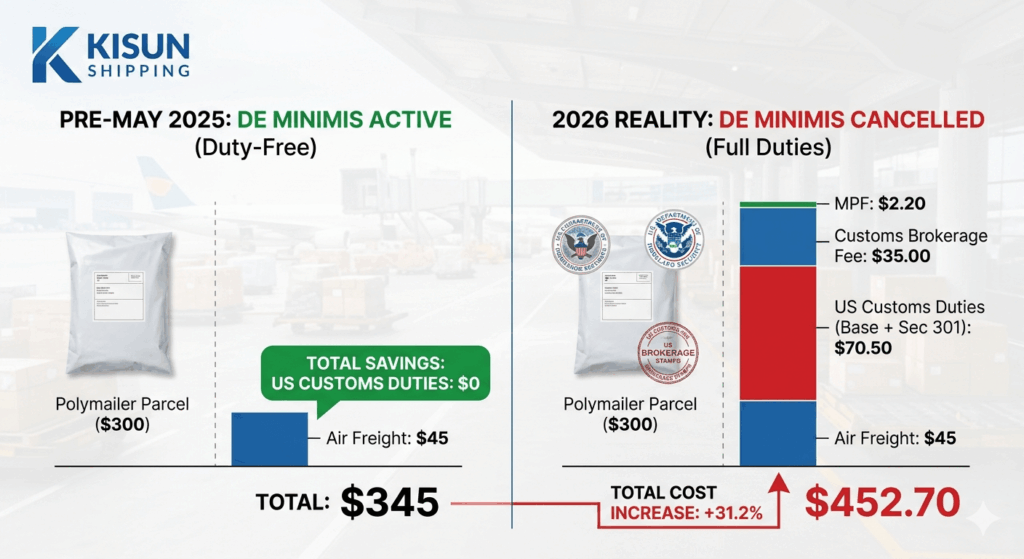
To illustrate exactly why the B2C air parcel model is collapsing, let’s look at a real-world cost comparison for a mid-sized US e-commerce seller importing apparel (subject to a standard 16% duty + 7.5% Section 301 tariff) with a declared factory value of $300.
| Cost Component | Pre-May 2025 (De Minimis Active) | 2026 Reality (De Minimis Dead) |
| Declared Goods Value | $300.00 | $300.00 |
| Air Freight / Express Cost | $45.00 | $45.00 |
| Import Duties (Base + Sec 301) | $0.00 (Exempt) | $70.50 (23.5% of value) |
| Merchandise Processing Fee (MPF) | $0.00 | $2.20 (Minimums may apply) |
| Customs Brokerage / Entry Fee | $0.00 | $35.00 (per parcel/informal entry) |
| Total Landed Cost | $345.00 | $452.70 |
| Increase in Logistics Cost | — | +31.2% per unit |
In this scenario, the importer is suddenly paying over $100 more per transaction. If your net margin on a $300 sale was $80, you are now operating at a net loss. This unit economics collapse is why you cannot simply “absorb” the new costs.
Why the “Temu and Shein” Models Collapsed (And What It Means for B2B)
The original target of these regulations was the ultra-fast-fashion and direct-to-consumer electronics giants. Companies like Temu and Shein built multi-billion dollar empires entirely reliant on the De Minimis loophole, flooding US cargo hubs with individually addressed bags.
When the loophole closed, their supply chains broke.
- Temu was forced to drastically pivot, acquiring massive US-based warehouse space and shifting to domestic fulfillment to survive the tariff hit.
- Shein had to raise consumer prices by 20% to 40% across the board and aggressively move production centers closer to the US market.
- Thousands of smaller drop-shippers simply went bankrupt, unable to absorb the dual blow of air freight costs and new CBP entry fees.
The B2B Implication: If multi-billion dollar conglomerates with unparalleled negotiating power could not absorb the death of De Minimis and stick with direct-air parcels, a mid-sized B2B importer certainly cannot. If you are still relying on air express for regular inventory replenishment in 2026, you are competing against companies that have already localized their inventory. You are paying double the shipping costs and experiencing longer customs delays.
(For deeper insights on how CBP handles entry inspections in 2026, review our [US Customs 5H Inspection Guide].)
The 3 Smart Ways Forward in 2026: Kisun Shipping Solutions
The era of lazy logistics is over. Protecting your margins in 2026 requires upfront planning, inventory forecasting, and a shift back to bulk ocean freight.At Kisun Shipping, we have spent the last year migrating our clients away from the small-parcel trap. Here are the three primary strategies that are actively lowering landed costs for US buyers right now.
Strategy 1: Switch to Overseas Warehousing + Domestic Fulfillment
Best for: Brands moving <500 consistent orders per month.
Stop shipping individual orders across the Pacific. The math no longer works. Instead, you must separate the international freight leg from the final-mile delivery.
- The Process: You ship bulk inventory via FCL (Full Container Load) or LCL (Less than Container Load) sea freight to a localized warehouse in the United States or Europe. You pay customs duties exactly once upon port entry.
- The Distribution: Your inventory sits in a 3PL facility. When a customer orders, the product is shipped domestically via UPS, FedEx, or USPS.
- The Advantage: There are absolutely no duties or customs delays on domestic shipments. Your customer gets their product in 2 days instead of 12, and your per-unit freight cost plummets.
Kisun Shipping provides end-to-end setup for Amazon FBA routing or integration with trusted 3PL partners in major hubs like Los Angeles, New York, and Chicago.
Strategy 2: Ocean Freight Consolidation (FCL or Buyer’s Consolidation)
Best for: Importers with $5,000+ in monthly purchasing volume across multiple vendors.
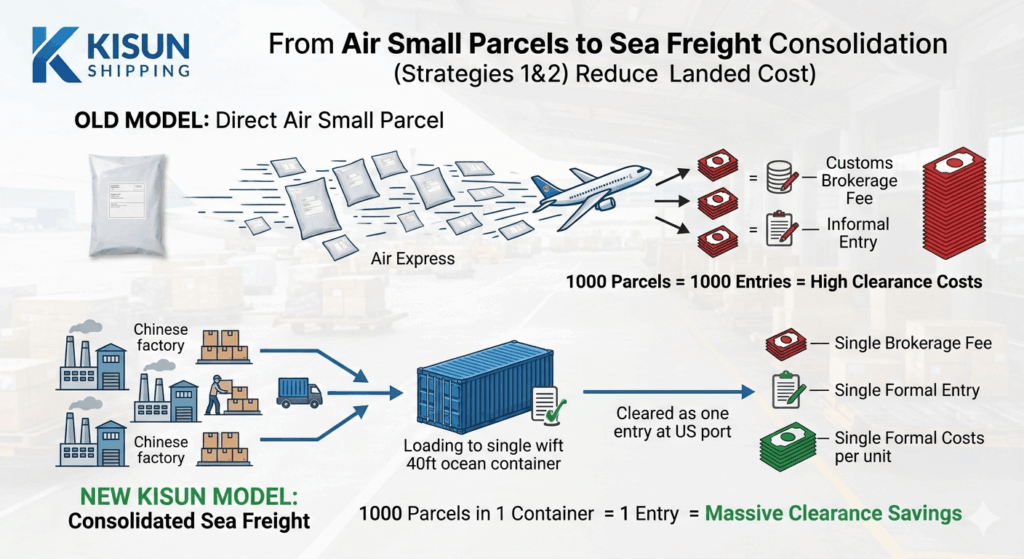
If you buy from multiple factories in China, having each factory send you small, individual air shipments is financial suicide under the new regulations. You will pay separate entry fees, separate broker fees, and maximum tariffs on every single box.
The Kisun Consolidation Solution: Instead of shipping direct, instruct all your Chinese suppliers to send their goods to Kisun’s export warehouses in Shenzhen, Ningbo, or Shanghai.
- We collect the loose cargo from multiple factories.
- We consolidate the freight into a single 20GP or 40GP container (Buyer’s Consolidation).
- We ship it across the ocean.
Upon arrival in the US, CBP treats this as one single customs entry. You pay one broker fee. You pay the minimum MPF once. Our data shows that clients adopting this method see their cost-per-piece drop by an average of 40% to 60% compared to legacy air small pack.
(Not sure which container type fits your volume? Read our definitive breakdown: [FCL vs LCL Shipping from China 2026].)
Strategy 3: Hybrid DDP Sea + Last-Mile (The Kisun Specialty)
Best for: Mid-volume sellers requiring absolute price transparency and operational simplicity.
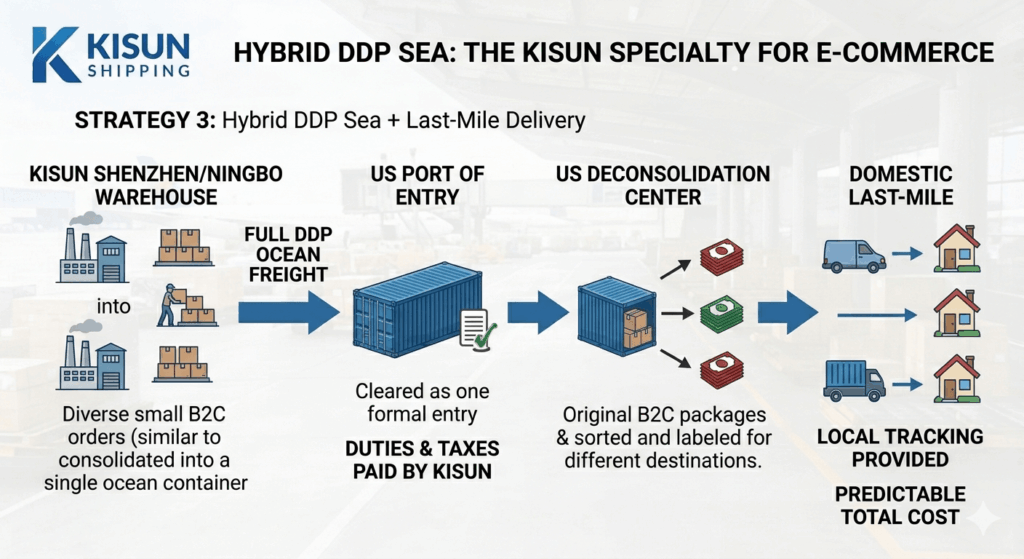
For businesses that do not want to manage US-based 3PL contracts but still need to escape the high costs of air express, our Hybrid DDP (Delivered Duty Paid) service is the optimal middle ground.
- How it works: You hand us the freight in China. We consolidate it into our own ocean containers and ship it to the US West Coast. We handle the bulk customs clearance, paying all duties and taxes at the port. Once cleared, we break the container down at our LA facility and hand the individual parcels directly to UPS or FedEx for the final domestic leg.
- Why it wins: You get the deep financial savings of ocean freight combined with the door-to-door convenience of express courier. Furthermore, Kisun provides a transparent, all-in per-kilogram rate upfront. No surprise CBP invoices three weeks after delivery.
(Explore our full routing capabilities here: [Shipping from China to USA].)
Frequently Asked Questions (2026 Update)
Q: Is the De Minimis exemption completely dead, or will it come back?

A: It is completely dead. Following the global suspension in August 2025 and the Executive Order reconfirmation in February 2026, CBP has integrated the collection of duties on sub-$800 packages into their permanent operating procedures. Do not build a business model hoping for its return.
Q: Will US retail prices continue to rise because of this?
A: Yes. Most major sellers have already passed on 20% to 40% increases to the consumer. Brands that attempt to absorb the new duties and clearance fees without optimizing their supply chain will simply bleed cash until they go out of business.Q: Can I technically still use air express for small parcels?
A: Technically, yes. Couriers like DHL and FedEx will still move the boxes. However, you or your customer will now be hit with full duties, advancement fees, and formal/informal entry charges. What used to be a cheap, frictionless transaction is now a premium service reserved only for high-margin, time-critical luxury goods.Q: What happens if I try to misdeclare the value under $800 anyway?
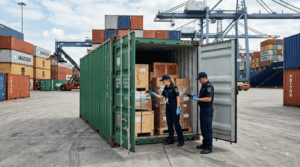
A: CBP is aggressively auditing manifests. Misdeclaring value or using vague HS codes to avoid the new rules will result in your goods being seized, severe financial penalties, and your company being flagged for continuous 5H inspections on all future imports. Do not risk your supply chain on outdated tricks.Final Warning: Adapt or Bleed Margins
The global supply chain underwent a fundamental rewrite between 2025 and 2026. The companies that are currently winning market share are the ones that accepted the death of the De Minimis loophole early and restructured their logistics around ocean freight consolidation and localized warehousing. The companies stubbornly clinging to the old direct-air model are slowly bleeding out their profit margins with every shipment they book.
At Kisun Shipping, we have already successfully transitioned dozens of former small-pack B2B sellers, cutting their total landed costs by 35% to 55% through proper container consolidation and DDP routing.
Stop guessing what your true landed costs are.
If you want to see the exact mathematical difference between your current setup and a modernized 2026 supply chain, we will do the math for you.
Next Step: Reply to us with your monthly volume or send us your last 3 months of packing lists. The Kisun team will run a comprehensive, free 2026 cost comparison—showing your current air/small pack costs versus our optimized Sea + Warehouse model—within 24 hours.

China Logistics Expert
About the Author
Katherine Kang is a China-based logistics consultant with over 11 years of experience in international trade and freight forwarding. Specializing in helping SMEs import from China to the USA, Canada, and Europe, she focuses on compliant, cost-effective solutions to avoid delays, tariffs, and hidden fees. From anti-dumping guidance to CNY planning, Katherine has managed hundreds of shipments, saving clients 15-30% on average.
Connect with Katherine on LinkedIn or contact Kisun Shipping for a free import consultation.