

China to Canada Customs Clearance 2026: The New Rules, the Traps, and How to Clear Cargo in 24 Hours
Many clients exporting to Canada for the first time assume that if they know how to ship to the US, Canada will be a breeze. This assumption usually costs them thousands of dollars in port storage fees.
The delays, unexpected inspections, and seized containers we see at the ports of Vancouver and Prince Rupert are rarely due to product defects. They happen because importers are trying to navigate the 2026 Canada Border Services Agency (CBSA) landscape using an outdated playbook.
Since the full implementation of the CARM system, the days of letting your customs broker handle everything in the background are officially over. The CBSA now requires unprecedented transparency and financial accountability directly from the importer.
If you want to protect your margins and ensure your cargo moves from the port to your warehouse without missing a beat, this guide breaks down the exact Canadian import clearance procedure for 2026, the five fatal mistakes 90% of importers make, and how Kisun Shipping engineers a seamless supply chain.
The 2026 Canadian Import Baseline: Your Mandatory Credentials
Before a single box leaves a factory in China, the importer of record must have their digital and legal paperwork perfectly aligned. In 2026, a Bill of Lading and a Commercial Invoice are useless if your corporate credentials are not active.
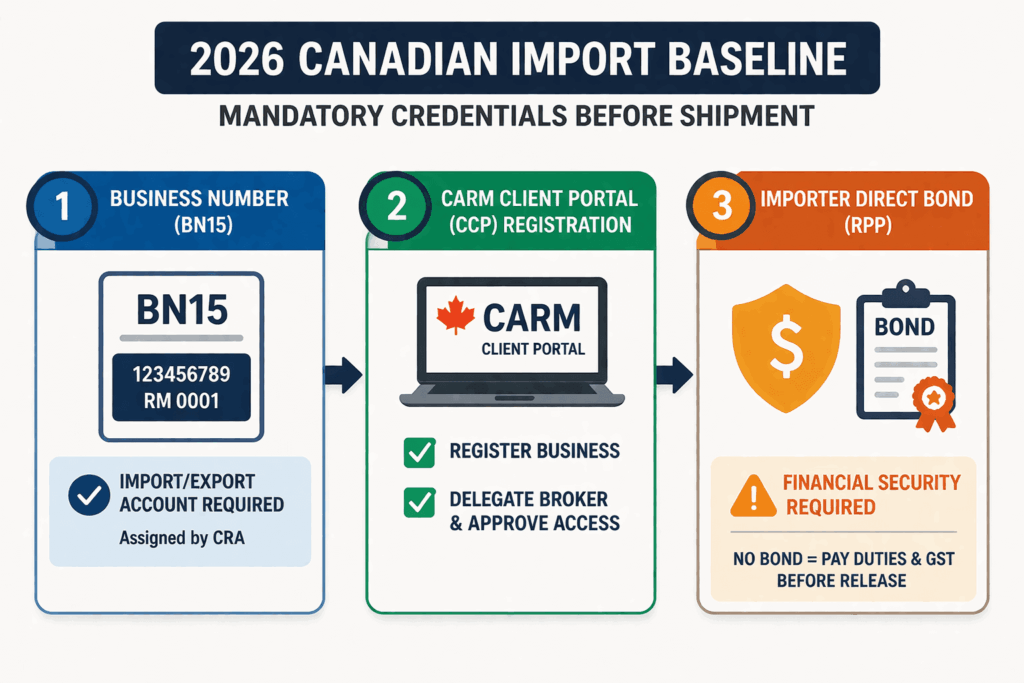
1. The Business Number (BN15)
You cannot import commercial goods into Canada without an Import/Export Account. This is a 15-digit number assigned by the Canada Revenue Agency (CRA). It typically looks like your 9-digit Business Number followed by “RM” and four digits (e.g., 123456789 RM 0001).
2. The CARM Client Portal (CCP) Registration
This is the biggest hurdle for new importers. The CBSA Assessment and Revenue Management (CARM) system is now mandatory for all commercial imports.
- You must register your business on the CARM portal.
- You must digitally delegate authority to your customs broker within the portal. If you do not click “approve” in the system, your broker is legally locked out and cannot clear your goods.
3. The Importer Direct Bond (Release Prior to Payment – RPP)
Under the old rules, your customs broker could use their own bond to clear your shipment, allowing you to pay duties later. This is no longer allowed. Under CARM rules, every importer must post their own financial security (an RPP bond) directly in the portal. Without this, you must pay all duties and GST in full before the CBSA will release your container.
The Step-by-Step Customs Clearance Workflow
Once your credentials are in place, the actual physical clearance process is highly efficient—provided your paperwork is flawless.
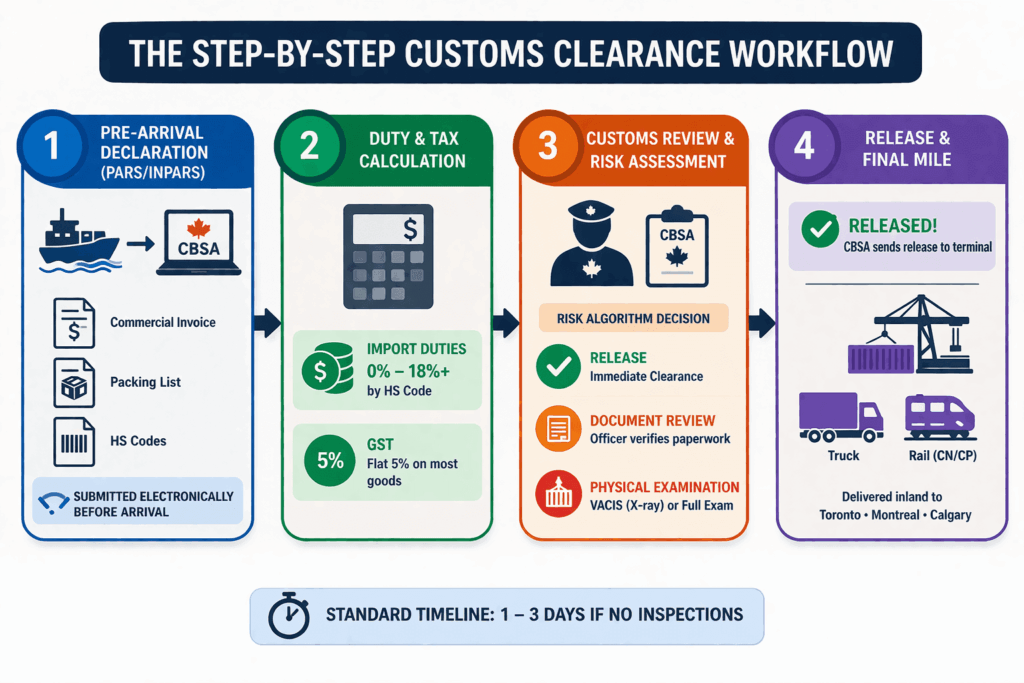
Step 1: The Pre-Arrival Declaration (PARS/INPARS)
Whether you are using shipping air freight from China to Canada or Sea Freight from China, your broker will use the Pre-arrival Review System (PARS). We submit your Commercial Invoice, Packing List, and HS Codes to the CBSA electronically while the vessel is still on the water.
Step 2: Duty and Tax Calculation
Based on the 10-digit Canadian HS code you declare, the CBSA calculates:
- Import Duties: Ranging from 0% to 18%+ depending on the product.
- GST (Goods and Services Tax): A flat 5% on most commercial goods. (Note: HST/PST is applied later depending on the province of sale, but CBSA only collects the 5% GST at the border).
Step 3: Customs Review and Risk Assessment
When the goods arrive, CBSA algorithms determine the risk level. They will issue one of three decisions:
- Release: The cargo is cleared immediately.
- Document Review: Customs officers manually verify your invoice and valuation.
- Physical Examination: The container is sent for a VACIS (X-ray) or a Full Physical Exam at a CBSA examination facility.
Step 4: Release and Final Mile
If cleared (and assuming your CARM RPP bond is active), the CBSA transmits a release notification to the terminal. The container is then picked up by truck or loaded onto the rail network (CN/CP) for inland delivery to Toronto, Montreal, or Calgary.
- Standard Timeline: 1–3 days if no inspections occur.
The 5 Common Pitfalls 90% of Clients Fall Into
At Kisun Shipping, we audit hundreds of supply chains. The same five errors cause almost all clearance delays in Canada.
Pitfall 1: Ignoring the CARM Transition
We still see importers who think their broker will handle the CARM registration for them. Brokers can guide you, but the importer must create the portal account and secure the RPP bond. If your cargo hits Vancouver and your CARM account isn’t set up, your container will sit on hold, racking up hundreds of dollars a day in demurrage fees.
Pitfall 2: Vague and Lazy Product Descriptions
CBSA officers despise generic invoices. Vague descriptions trigger automatic holds.
- Incorrect Declaration: “Clothes” or “Auto Parts”
- Correct Declaration: “Women’s 100% polyester knit pullover sweater” or “Steel brake rotors for passenger vehicles.”
Pitfall 3: HS Code Roulette (and AMPS Penalties)
Guessing your HS code to secure a lower duty rate is a dangerous game in Canada. The CBSA utilizes the Administrative Monetary Penalty System (AMPS). If they catch you misclassifying goods, they don’t just correct the tax; they issue immediate financial penalties that escalate with every offense.
Pitfall 4: Ignoring Other Government Departments (OGDs)
CBSA is just the gatekeeper. Other agencies have jurisdiction over specific goods:
- Transport Canada: E-bikes, lithium batteries, and vehicle parts.
- Health Canada: Cosmetics, supplements, and toys.
- CFIA (Canadian Food Inspection Agency): Wooden packaging (must have IPPC ISPM-15 stamps), plants, and food. If your goods require an OGD permit and you don’t have it, CBSA will deny entry.
Pitfall 5: The SIMA (Anti-Dumping) Trap
This is a massive financial trap for Chinese imports. Canada strictly enforces the Special Import Measures Act (SIMA). If you import specific goods—such as steel products, aluminum extrusions, or certain upholstered seating/furniture from China—you could be hit with anti-dumping duties exceeding 150% of the commercial value. Always check your HS codes against the current SIMA index before manufacturing begins.
Which Shipments Trigger CBSA Inspections?
Canadian Customs operates on a risk-based targeting system. While any shipment can be selected randomly, the following categories face significantly higher inspection rates in 2026:
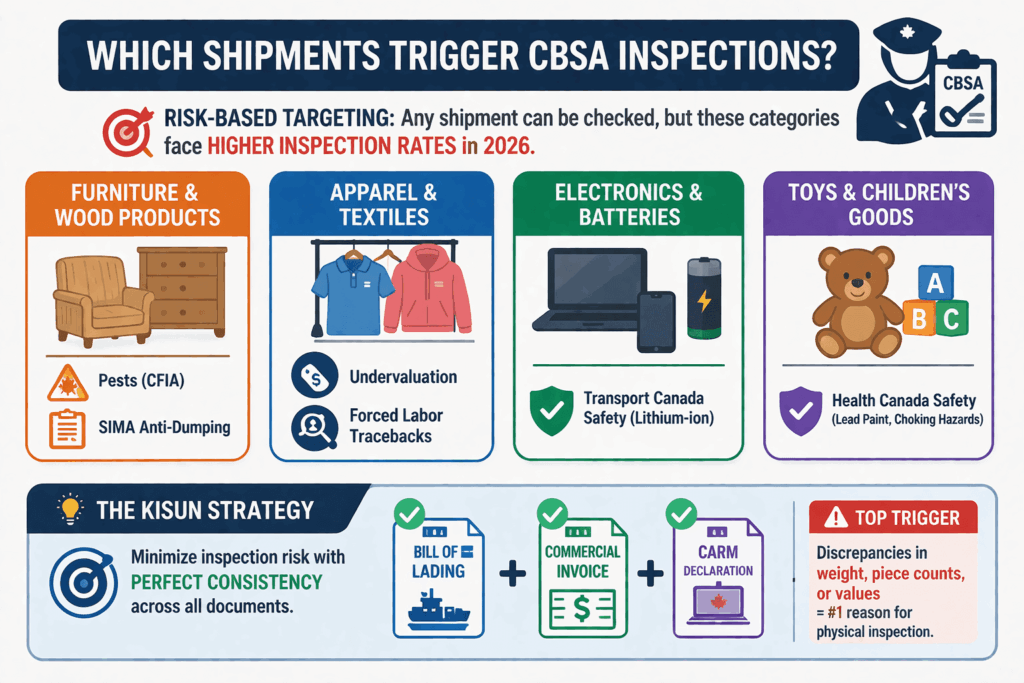
- Furniture & Wood Products: High risk for pests (CFIA inspections) and SIMA anti-dumping checks.
- Apparel & Textiles: High risk for undervaluation and forced labor tracebacks.
- Electronics & Batteries: Due to strict Transport Canada safety regulations regarding lithium-ion batteries.
- Toys and Children’s Goods: Monitored heavily for Health Canada safety compliance (lead paint, choking hazards).
The Kisun Strategy: To minimize inspection risks, ensure absolute consistency across your Bill of Lading, Commercial Invoice, and CARM declaration. Discrepancies in weight, piece counts, or values are the #1 trigger for a physical exam.
Frequently Asked Questions (FAQ)
Q: We usually ship DDP (Delivered Duty Paid) to our Canadian buyers. With the new 2026 CARM rules, can our freight forwarder still use their bond to clear the goods, or do we have to register ourselves?

A: This is the most common issue we see right now. Under the fully implemented CARM system, the old way is dead. You (or your non-resident importer entity) must register on the CARM Client Portal and post your own RPP bond. Your forwarder cannot use their bond for your commercial goods anymore. However, if you ship with Kisun Shipping, our compliance team will walk you through the exact steps to get your CCP account set up and bonded before your cargo even leaves China, so your DDP shipments won't get stuck at the border.
Q: I'm planning to import steel parts and wooden furniture from China to Vancouver. I heard Canada’s SIMA anti-dumping taxes can be crazy high. Can you check my products before we ship?
A: Absolutely, and you are right to be worried. SIMA duties can sometimes exceed 150% of your commercial invoice value, wiping out your entire profit margin. Before you even book a container, send us your 10-digit HS codes and product descriptions. Kisun’s customs experts will run a free pre-shipment audit against the latest CBSA SIMA index. If your product is flagged, we will advise you before you manufacture or ship.Q: My last shipment got held up in Prince Rupert for over a week because of customs. Do you guys wait until the ship arrives to start the clearance process?
A: No, that is a massive rookie mistake. At Kisun Shipping, we utilize the PARS (Pre-arrival Review System). We submit your commercial invoice, packing list, and HS codes to the CBSA electronically while your vessel is still in transit on the ocean. Assuming your CARM account is active and there are no random physical exams, your cargo is typically cleared for release the moment the container hits the terminal.Q: Our factory in China packs everything on solid wood pallets. Besides the ISPM-15 stamp, what else do we need to provide to avoid getting the container rejected by the CFIA?
A: The ISPM-15 (wheat stamp) proving fumigation or heat treatment is the absolute baseline. However, the CFIA also checks for visible signs of soil, bark, or live pests upon arrival. If they find anything, they will order the container to be fumigated at the port (which is very expensive) or immediately re-exported. We strongly advise our clients to either use treated, clearly stamped wood, or switch to plastic/plywood pallets to completely bypass this CFIA headache.Q: I need an all-in quote for a 40HQ container from Shenzhen to a warehouse in Toronto. Does your quote include the CBSA customs clearance fees and the rail routing?
A: Yes. When you request an all-in quote from Kisun Shipping, we provide a transparent, door-to-door cost for you,this includes the ocean freight to the west coast (Vancouver/Prince Rupert), the CN/CP rail routing to Toronto, the customs entry filing fees, and the final truck delivery to your warehouse. [Click here to get your exact routing quote within 24 hours.]Summary: Plan the Route, Protect the Margin
Canadian customs clearance is not inherently complex, but it is unforgiving of unpreparedness. The era of “we’ll figure it out when it gets to port” is over.
When targeting the Canadian market, the physical movement of the cargo (Export from China → Ocean Freight to Vancouver → Rail to Toronto) is only half the battle. The other half is data compliance.
Your 2026 Canadian Import Checklist:
✔ Ensure your BN15 is active and your CARM Client Portal is fully configured.
✔ Post your Importer Direct Bond (RPP) in the system.
✔ Verify all 10-digit Canadian HS codes and check for SIMA anti-dumping risks.
✔ Provide crystal-clear commercial invoices and ISPM-15 compliant wooden pallets.
At Kisun Shipping, we don’t just book space on a vessel. We pre-audit your commercial documents, align your HS codes, and ensure your CARM profile is ready to receive cargo.
Don’t let your cargo get trapped in Vancouver. Contact Kisun Shipping today to optimize your Canada routing and clearance strategy.

China Logistics Expert
About the Author
Katherine Kang is a China-based logistics consultant with over 11 years of experience in international trade and freight forwarding. Specializing in helping SMEs import from China to the USA, Canada, and Europe, she focuses on compliant, cost-effective solutions to avoid delays, tariffs, and hidden fees. From anti-dumping guidance to CNY planning, Katherine has managed hundreds of shipments, saving clients 15-30% on average.
Connect with Katherine on LinkedIn or contact Kisun Shipping for a free import consultation.