

The “Red Zone” of Saudi Customs: How to Clear the 4 Toughest Restricted Imports in 2026
In our previous guide on 2026 Saudi Customs & SABER Updates, we covered the baseline rules for getting standard commercial goods into the Kingdom. But what happens when your cargo isn’t “standard”?
If you are shipping pharmaceuticals, drones, telecom routers, or wooden products, you are entering the “Red Zone” of Saudi logistics.
At Kisun Shipping, we see merchants make the same costly mistake every week: They assume the SABER platform is the only hurdle. In reality, SABER is just the final checkpoint. For restricted items, you must first survive the labyrinth of Saudi Arabia’s specialized regulatory authorities. Ship a restricted item without the prerequisite agency permit, and your goods won’t just be delayed—they will be confiscated, destroyed, or subjected to fines up to five times the cargo’s value.
If you deal in any of the four categories below, here is the unfiltered 2026 playbook for getting your goods legally cleared and delivered.
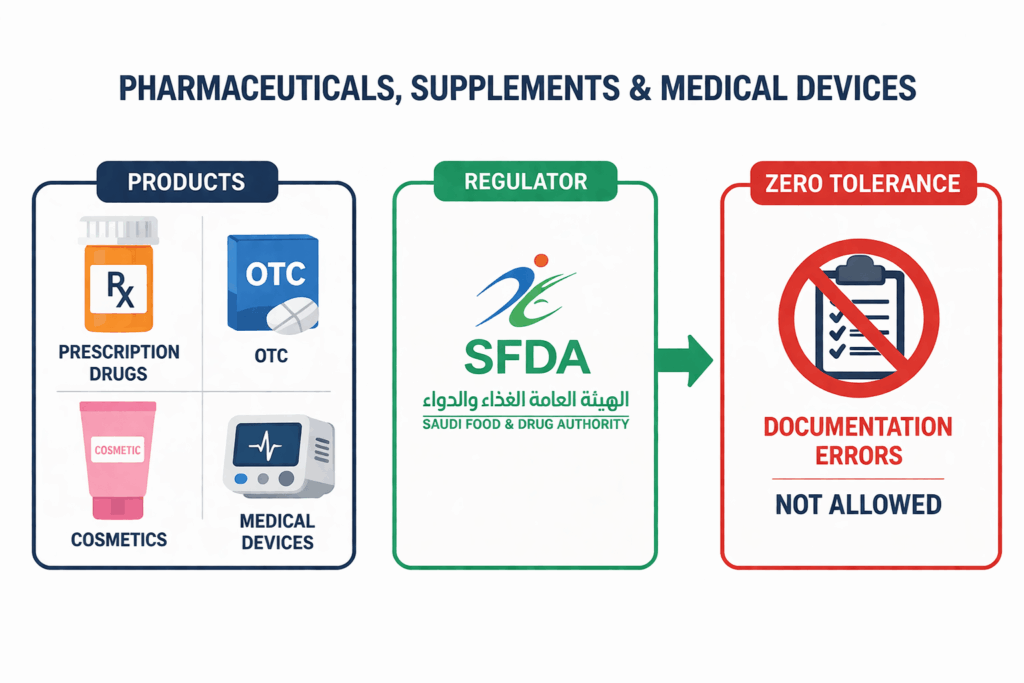
Pharmaceuticals, Supplements & Medical Devices
(Includes Prescription Drugs, OTC, Cosmetics, and Medical Equipment)
Saudi Arabia does not play games with public health. The SFDA (Saudi Food and Drug Authority) operates with zero tolerance for documentation errors. You cannot simply ship dietary supplements or medical devices to a warehouse in Jeddah and “figure it out later.”
The Regulatory Gatekeepers
- SFDA (Saudi Food and Drug Authority)
- MOH (Ministry of Health)
The 2026 Approval Workflow
- The Local Agent Mandate: If you are a non-resident foreign seller, you cannot register directly. You must designate a locally registered Saudi corporate agent.
- Product Registration (The Long Game): Before you even think about shipping, your local agent must register the product in the SFDA system. This requires submitting exhaustive data: GMP compliance, clinical trial data, pharmacology, and ISO 13485 (for medical devices).
- Per-Batch Import Permit: Once registered, every single shipment requires its own SFDA import permit.
- Customs Clearance Alignment: At the port, your broker must present the SFDA approval + SABER PC/SC + Commercial Invoice + Bill of Lading.
The “Trap Doors” to Avoid
- Arabic Labeling: Your packaging must have Arabic labels detailing ingredients, usage, contraindications, and importer info. A sticker slapped on at the last minute often results in rejection.
- Timelines: Initial product registration can take 3 to 6 months. Do not book ocean freight until the SFDA registration is fully approved. Once registered, per-batch permits take 1–3 days.
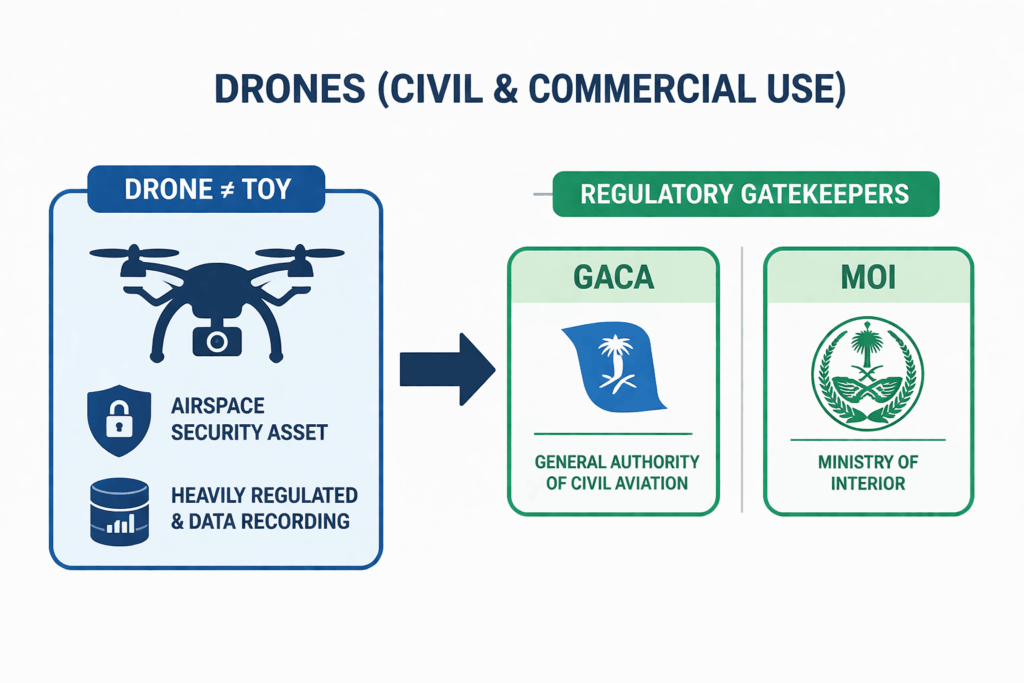
Drones (Civil & Commercial Use)
In Saudi Arabia, a drone is not viewed as a toy; it is treated as an airspace security asset. The Kingdom heavily regulates anything that flies and records data.
The Regulatory Gatekeepers
- GACA (General Authority of Civil Aviation)
- MOI (Ministry of Interior)
The 2026 Approval Workflow
- Operator & Agency Qualification: The local importing entity must have a GACA account and specific commercial aviation/operator credentials.
- Hardware Certification: You must submit the drone’s technical specs, flight control system data, and CE/FCC safety certificates.
- The “Intended Use” Filing: You cannot import drones to “sit on a shelf.” GACA requires you to specify the intended use (e.g., mapping, aerial photography) and the designated flight zones.
- Dual-Permit Issuance: After a 7–15 day review, GACA (with Ministry of Interior filing) issues an Import Permit AND a Flight Permit.
The “Trap Doors” to Avoid
- The “Luggage” Myth: Many assume they can bring commercial drones in via passenger luggage. In 2026, airport scanners will catch this, leading to immediate confiscation and potential entry bans for the traveler.
- Real-time Tracking: Commercial drones must often report flight paths in real-time. Only import models that comply with GACA’s software tracking requirements.
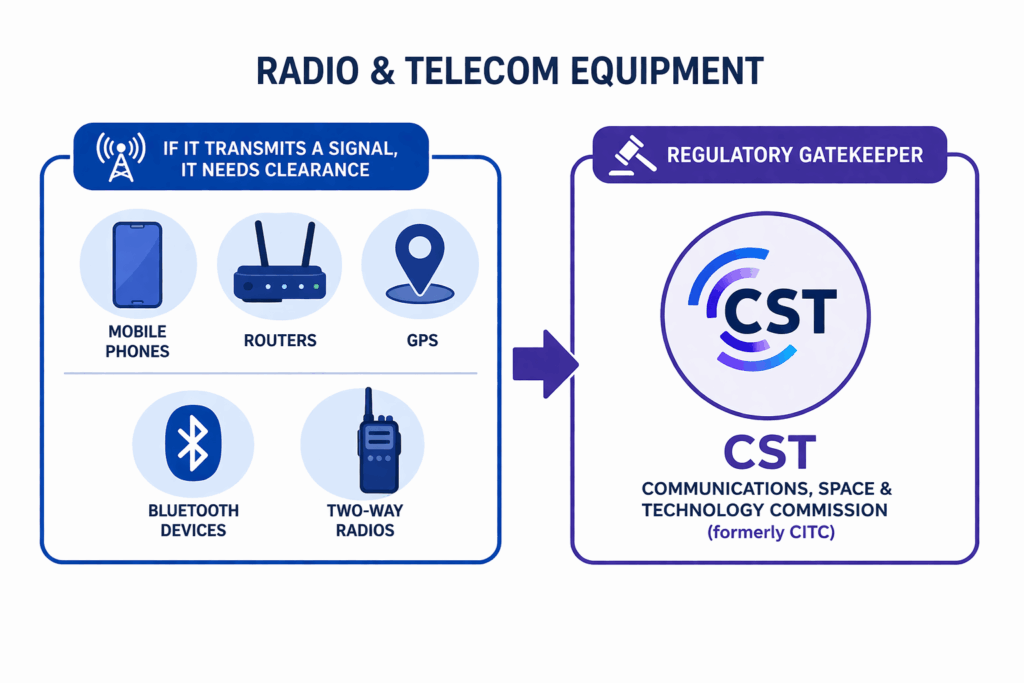
Radio & Telecom Equipment
(Mobile Phones, Routers, GPS, Bluetooth Devices, Two-Way Radios)
If your product transmits a signal, it requires specialized clearance. Expert Note: Many outdated guides still refer to the agency as CITC. As of recent restructuring, the agency is now the CST.
The Regulatory Gatekeepers
- CST (Communications, Space and Technology Commission – formerly CITC)
The 2026 Approval Workflow
- CST Account Registration: Your local Saudi agent logs into the CST portal.
- Type Approval: Before importing, the hardware must be approved. You must submit RF (Radio Frequency) test reports (like SAR and EMC) along with FCC/CE/IC certificates.
- Batch Import Permit: Apply for a CST import permit for the specific volume you are shipping. (Review takes 5–10 days).
- Labeling: Once approved, the equipment must bear the CST e-label before entering the Saudi market.
The “Trap Doors” to Avoid
- We often see importers assume a CE or FCC mark is “good enough” for Saudi Arabia. It is not. The CST requires those certificates as part of the application, but they do not replace the CST Type Approval. Shipping without CST clearance means the goods will be held at port demurrage until they are seized or re-exported.
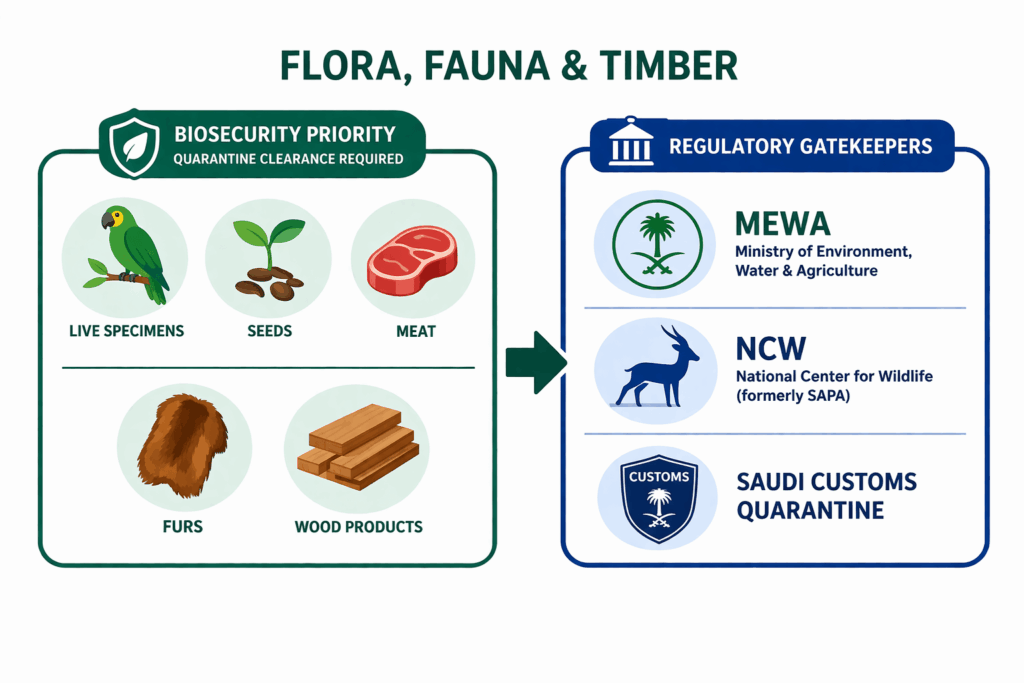
Flora, Fauna, and Timber
(Live Specimens, Seeds, Meat, Furs, and Wood Products)
Biosecurity is a massive priority for the Kingdom in 2026. Whether you are shipping live animals, agricultural seeds, or even wooden furniture, you must clear quarantine.
The Regulatory Gatekeepers
- MEWA (Ministry of Environment, Water and Agriculture)
- NCW (National Center for Wildlife – formerly SAPA)
- Saudi Customs Quarantine
The 2026 Approval Workflow
- MEWA/NCW Registration: Specify the species, origin, and intended use.
- Origin Quarantine Certificates: You must provide an official, government-issued document from your exporting country proving the goods come from a disease-free zone.
- MEWA Review: Takes roughly 7–20 days.
- Arrival Quarantine: Live specimens will undergo spot checks and mandatory isolation at the port of entry (7–30 days).
The “Trap Doors” to Avoid
- The Furniture Trap (Timber): If you are shipping wooden furniture or using raw wood pallets, you absolutely must have an IPPC Fumigation Certificate. Without proof that the wood has been treated for pests, Customs will destroy the pallets (and potentially the goods on them) at your expense.
The 5 Golden Rules for All Restricted Imports
If there is one section of this guide you share with your logistics team, make it this one. Navigating the SFDA, GACA, CST, and MEWA requires a unified strategy.
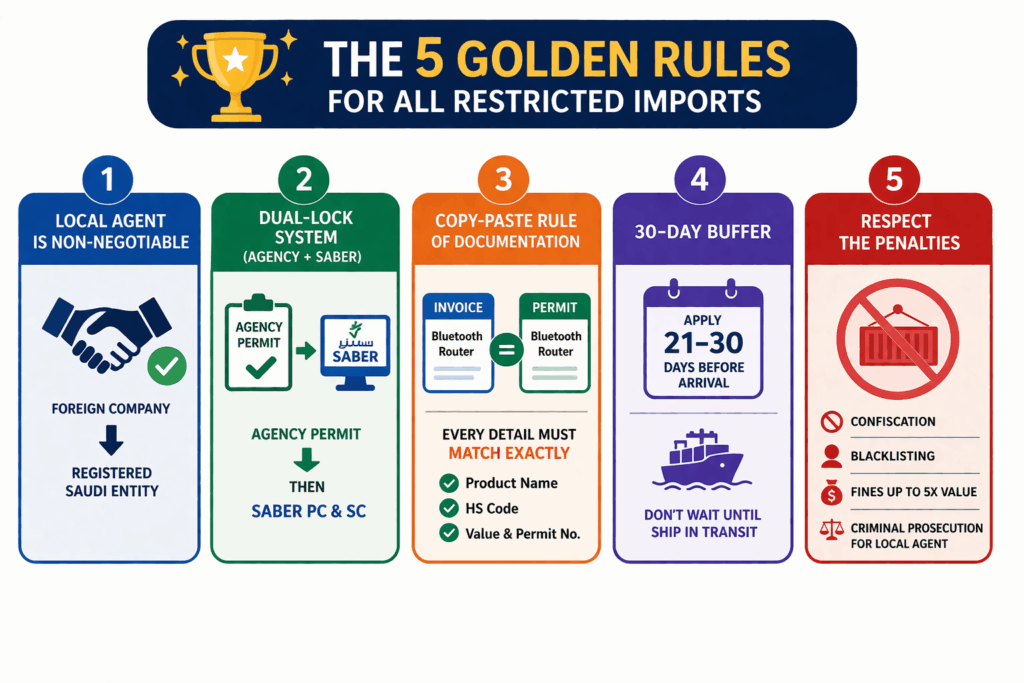
- The Local Agent is Non-Negotiable: If you are a foreign factory or trader, you cannot legally apply for these permits. You must partner with a registered Saudi entity who takes joint legal liability for the goods.
- The “Dual-Lock” System (Agency + SABER): An SFDA or CST permit does not replace SABER. You need the specialized agency permit first, which then allows you to generate your SABER Product Certificate (PC) and Shipment Certificate (SC). They are dual-mandatory.
- The “Copy-Paste” Rule of Documentation: In 2026, customs systems are fully automated. If your Commercial Invoice says “Bluetooth Router” but your CST permit says “Wireless Access Point,” the system will reject it. The HS Code, product name, declared value, and permit numbers must match down to the last letter across all documents.
- The 30-Day Buffer: Apply for per-batch import permits at least 21 to 30 days before your ship arrives at Jeddah or Dammam. Waiting until the vessel is in transit guarantees you will pay massive port storage fees.
- Respect the Penalties: Bypassing these agencies is treated as smuggling. Penalties include confiscation, blacklisting, fines up to 5x the cargo value, and potential criminal prosecution for the local agent.
Logistics is Easy. Compliance is Hard.
Anyone can put a box on a ship. Getting that box through Saudi Arabia’s restricted regulatory gates requires surgical precision.
At Kisun Shipping, we don’t manufacture your drugs, test your routers, or build your drones. But we are the experts who ensure that your hard-earned permits, your SABER certificates, and your ocean freight schedules align perfectly so you don’t lose a single dollar at the border.
Are you shipping restricted goods to Saudi Arabia this quarter? Don’t leave your compliance to chance.
Contact Kisun Shipping today to align your logistics and customs strategy.

China Logistics Expert
About the Author
Katherine Kang is a China-based logistics consultant with over 11 years of experience in international trade and freight forwarding. Specializing in helping SMEs import from China to the USA, Canada, and Europe, she focuses on compliant, cost-effective solutions to avoid delays, tariffs, and hidden fees. From anti-dumping guidance to CNY planning, Katherine has managed hundreds of shipments, saving clients 15-30% on average.
Connect with Katherine on LinkedIn or contact Kisun Shipping for a free import consultation.