Sea vs. Air vs. Rail Freight: The Ultimate Guide to Shipping from China in 2026
In today’s volatile global supply chain, relying on a single mode of transportation is a risky strategy. Whether you are an Amazon FBA seller importing electronics or a B2B distributor moving heavy machinery, your profit margins depend entirely on how you move your goods from China to the rest of the world.
Should you pay the premium for Air Freight? Is Sea Freight still the king of bulk? And where exactly does the “New Silk Road” Rail Freight fit in?
At Kisun Shipping, we handle thousands of TEUs and air pallets annually. In this comprehensive guide, we strip away the marketing fluff and give you the hard facts: a head-to-head comparison of Sea, Air, and Rail shipping, including realistic costs, transit times, and the geographical realities you must know before booking your next shipment.
Part 1: The Big Three – Decoding Your Freight Options
Every shipping method has its distinct advantages and critical limitations. Understanding the DNA of each mode is the first step to optimizing your logistics.
1. Sea Freight (Ocean Freight): The Heavyweight Champion
Sea freight remains the backbone of global trade, carrying over 80% of the world’s cargo. It operates in two main categories: FCL (Full Container Load) and LCL (Less than Container Load).
- The Advantages:
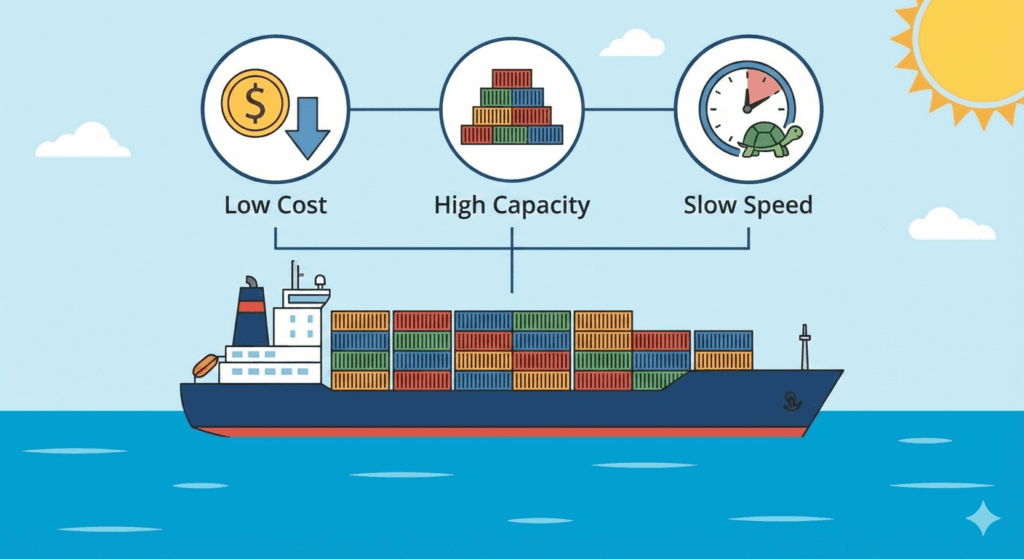
- Unbeatable Cost-Efficiency: For large volumes, nothing beats the ocean. It is the cheapest way to move goods over long distances.
- Capacity for Heavy/OOG Cargo: From 50-ton power transformers to heavy construction materials, ships can carry Out-of-Gauge (OOG) cargo that airplanes simply cannot.
- Eco-Friendly: Sea freight has the lowest carbon footprint (CO2 emissions per ton-mile) among the three modes.
- The Disadvantages:
- Slow Speed: It is the slowest option. Trans-Pacific or Asia-Europe routes can take anywhere from 20 to 45 days.
- Port Congestion Risks: Ships are vulnerable to port strikes, canal blockages (e.g., Suez or Panama Canal), and seasonal peak delays.
🔗 Explore Kisun Shipping’s Sea Freight Solutions & Secure Your Container Space Today
2. Air Freight: The Speed Demon
When time is money, Air Freight is the answer. It is utilized heavily for high-value, perishable, or urgently needed goods.
- The Advantages:
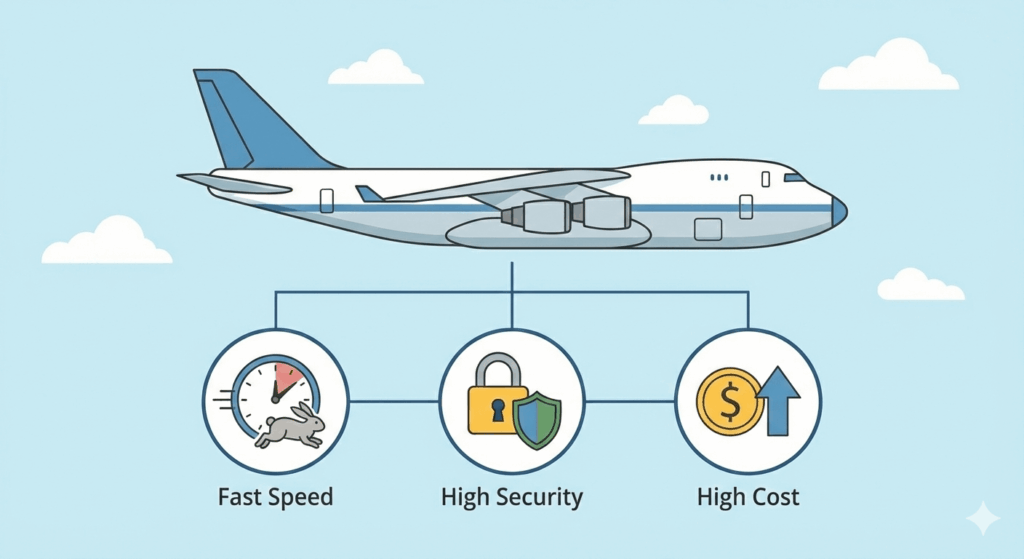
- Unmatched Speed: Cargo can move from a factory in Shenzhen to a warehouse in New York or London in just 3 to 7 days (including customs clearance).
- High Security: Airports have the strictest security protocols, significantly reducing the risk of theft and damage.
- Lower Inventory Costs: Because delivery is so fast, businesses can operate on a “just-in-time” inventory model, freeing up cash flow.
- The Disadvantages:
- Prohibitive Cost: Air freight can be 4 to 6 times more expensive than sea freight.
- Strict Weight and Size Limits: Airplanes have rigid cargo door dimensions and weight capacities.
- Dimensional Weight (Chargeable Weight): Airlines charge based on either actual weight or volumetric weight (whichever is greater). If you ship light, bulky items (like pillows), you will pay a fortune.
🔗 Need it there tomorrow? Discover Kisun Shipping’s Express Air Freight Services
3. Rail Freight: The Eurasian Sweet Spot
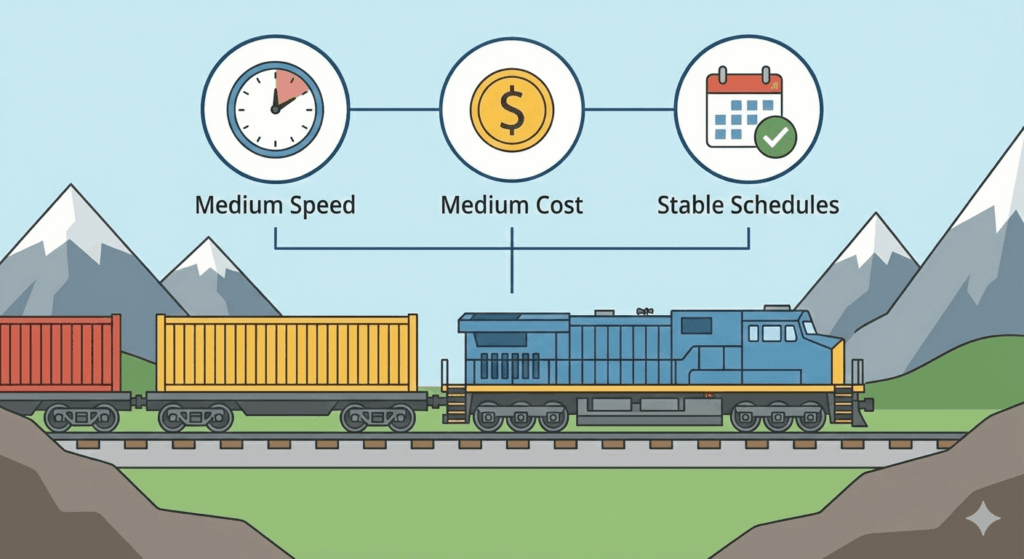
Over the last decade, the China Railway Express (CRE) has revolutionized trade. It serves as the perfect “middle ground” between the sluggishness of sea freight and the high cost of air freight.
- The Advantages:
- The Middle Ground: It is generally 50% faster than sea freight and up to 50% cheaper than air freight.
- Stable Schedules: Unlike ships delayed by typhoons, trains run on highly reliable schedules across the Eurasian landmass.
- Eco-Conscious: Rail freight emits significantly less CO2 than air freight, making it popular for European brands with strict ESG goals.
- The Disadvantages:
- Geographical Limitation (Crucial Fact): Rail freight is strictly limited to the Eurasian continent. It connects China to Central Asia, Russia, and Europe. There are NO freight trains connecting China to North America (USA/Canada) or South America.
- Winter Weather Disruptions: Severe winter weather in Kazakhstan or Russia can occasionally cause minor delays.
🔗 Connect to Europe Faster. Learn about Kisun Shipping’s Railway Freight Routes
Part 2: Head-to-Head Comparison (Time vs. Cost vs. Calculation)
To make the right choice, you need to understand how forwarders calculate costs.
The “Chargeable Weight” Trap
A critical difference between the modes is how volume is penalized:
- Sea Freight: Standard LCL ratio is 1 CBM = 1000 KG. You are almost always charged by volume (CBM) unless you are shipping extremely dense materials like steel.
- Air Freight: Standard ratio is 1 CBM = 167 KG. Volume is heavily penalized.
- Rail Freight: Standard LCL ratio is 1 CBM = 300 KG to 500 KG (depending on the route).
2026 Cost & Time Comparison Table (H2)
| Route (from Shanghai) | Sea Freight (40HQ) | Rail Freight(40HQ) | Air Freight (100kg) | Best For |
|---|---|---|---|---|
| To Germany (Europe) | $2,400 / 32 days | $5,300 / 18 days | $600 / 5 days | Rail for balance |
| To USA West Coast | $2,200 / 15 days | Not available | $650 / 4 days | Sea for volume |
| To USA East Coast | $2,850 / 35 days | Not available | $700 / 5 days | Sea or Air |
| To UK | $3,100 / 38 days | $6,000 / 20 days | $560 / 6 days | Rail for mid-urgency |
| To Australia | $1,800 / 18 days | Not available | $520 / 4 days | Sea |
Note: Freight rates fluctuate weekly based on GRIs (General Rate Increases) and fuel surcharges. Always consult Kisun Shipping for real-time market rates.
Part 3: Route-Specific Strategies – Shipping from China to the World
This is where many importers make costly mistakes. Your choice of transport is heavily dictated by geography. Here is the reality of global trade routes from China:
1. China to North America (USA & Canada)
Let’s debunk a common myth found online: You cannot ship goods by train from China to the USA or Canada. The Pacific Ocean is in the way, and there is no trans-Pacific railway bridge.
- Your Options: Sea Freight or Air Freight.
- The Strategy: * For 90% of B2B importers, Sea Freight (routing to the West Coast like Los Angeles/Long Beach, or East Coast like New York/Savannah) is the only economically viable option.
- If you have a high-margin product release (e.g., the latest smartphone accessories), use Air Freight for the initial batch, and send the remaining 80% via Sea Freight to balance your profit margins.
2. China to Europe (The Ultimate Battleground)
If your destination is Germany, Poland, France, or the UK, you have the luxury of choosing all three modes. This route is where Rail Freight truly shines.
- The Strategy:
- The Rail Advantage: Trains departing from Xi’an, Chongqing, or Yiwu can reach Duisburg (Germany) or Malaszewicze (Poland) in just 14-18 days. If your buyer in Europe needs goods quickly but refuses to pay air freight premiums, the China Railway Express is your best weapon.
- Sea Freight: Still the dominant force for low-value, bulky items heading to ports like Rotterdam, Hamburg, or Felixstowe.
- Air Freight: Reserved strictly for emergencies or high-tech components.
3. China to the Middle East & Africa
- Your Options: Predominantly Sea Freight and Air Freight.
- The Strategy: Ports like Jebel Ali (UAE), Jeddah (Saudi Arabia), and Mombasa (Kenya) are highly optimized for Chinese sea cargo. While there are some emerging rail links to the Middle East, Sea Freight remains the most stable and cost-effective channel for the vast majority of importers in these regions.
Part 4: The Kisun Shipping Decision Matrix (How to Choose?)
Still unsure? Ask yourself these four questions to determine your ideal shipping method:
1. What is the value-to-weight ratio of your cargo?
- High Value / Low Weight (e.g., Microchips, Designer jewelry): Air Freight. The cost of shipping is a tiny fraction of the product’s value.
- Low Value / High Weight (e.g., Tiles, Furniture, Plastics): Sea Freight. Air freight would cost more than the goods themselves.
2. What is your required lead time?
- Need it next week? Air Freight.
- Need it in 3 weeks (in Europe)? Rail Freight.
- Need it next month? Sea Freight.
3. What is your cash flow situation? Sea freight is cheap, but your capital is tied up in inventory floating on the ocean for 40 days. If you have tight cash flow and need to turn over inventory quickly to reinvest, paying slightly more for Rail or Air freight might actually be more profitable in the long run.
4. What are the product constraints? Air freight has severe restrictions on Dangerous Goods (DG), including lithium batteries, liquids, and strong magnets. While Sea and Rail can accommodate these with the right paperwork (like MSDS and UN38.3 reports), Air freight often rejects them or charges massive premiums.
FAQ: Shipping from China – Everything You Need to Know
Q1: Which is cheaper, LCL Sea Freight or Rail Freight?

A: Generally, LCL Sea Freight is the most economical option. However, when you factor in the "Total Landed Cost," Rail Freight can sometimes be more competitive for Europe-bound cargo. Because rail is faster, your capital is tied up for less time, and you can restock your inventory twice as fast as sea freight. If your goods have a high turnover rate, the speed of Rail Freight may outweigh the slight cost savings of Sea Freight.
Q2: Why can’t I ship from China to the USA by train?
A: This is due to geography. There is no transcontinental railway connecting Asia to North America across the Pacific Ocean. All "Rail" services mentioned for the US market are actually "Sea-Rail Multimodal" services, where goods travel by ship to a US West Coast port (like Los Angeles) and are then transferred to a domestic US train to reach inland destinations like Chicago or Dallas.Q3: What is the "Volumetric Weight" and why does it affect my Air Freight cost?
A: In Air Freight, space is limited. If you ship a large box of cotton (light but bulky), it takes up the same space as a small box of steel (heavy but compact). Airlines use a formula — (Length x Width x Height) / 6000 — to calculate the "Volumetric Weight." You will always be charged for whichever is higher: the actual weight or the volumetric weight.Kisun Tip: We recommend vacuum-packing soft goods to reduce volume and save up to 30% on air freight costs.
Q4: Can I ship products with batteries via all three modes?

A: Yes, but with different levels of difficulty.

Sea and Rail: Are the most "battery-friendly," provided you have the MSDS and UN38.3 reports.

Air Freight: Is very strict. Batteries must be handled as Dangerous Goods (DG), requiring specialized packaging and often incurring much higher surcharges. Some passenger flights may refuse batteries entirely, requiring a dedicated cargo plane.
Q5: How do I track my shipment once it leaves China?
A: At Kisun Shipping, we provide real-time tracking regardless of the mode:
Sea: Tracked via Container Number or Master Bill of Lading (MBL).
Air: Tracked via the Air Waybill (AWB) number on the airline’s website.
Rail: Tracked via GPS devices installed on the train or through the China Railway Express tracking platform.Conclusion: There is No “One Size Fits All”
The secret to a resilient supply chain is a multi-modal strategy. Smart importers don’t just use one method; they mix and match. They use Air Freight for urgent samples, Rail Freight to keep European distribution centers stocked, and Sea Freight for their major seasonal inventory builds.
At Kisun Shipping, we don’t just quote prices—we engineer logistics solutions. Our experts analyze your cargo dimensions, destination, and deadlines to recommend the most cost-effective routing. That’s why when customers come to ask us “what’s the price to Canada?” We usually will ask the shipment information, size&weight, delivery address to check the best logistic solutions for our customers.
Stop guessing and start optimizing. Whether you need to book a 40HQ container, charter a cargo plane, or reserve space on the China Railway Express, we have the network to make it happen smoothly.
[Contact Kisun Shipping Today for a Free, Multi-Modal Logistics Consultation.]

China Logistics Expert
About the Author
Katherine Kang is a China-based logistics consultant with over 11 years of experience in international trade and freight forwarding. Specializing in helping SMEs import from China to the USA, Canada, and Europe, she focuses on compliant, cost-effective solutions to avoid delays, tariffs, and hidden fees. From anti-dumping guidance to CNY planning, Katherine has managed hundreds of shipments, saving clients 15-30% on average.
Connect with Katherine on LinkedIn or contact Kisun Shipping for a free import consultation.