China Port Mastery: Why the Wrong Port Choice Could Ruin Your ROI
In the world of international trade, there is a common phrase: “Freight is cheap; logistics is expensive.” Many importers spend weeks negotiating a $100 discount on ocean freight, only to lose $1,000 because they chose a port that is 1,500 kilometers away from their factory. At Kisun Shipping, we’ve seen clients try to ship cargo from Shenzhen because the sea freight was $200 cheaper, not realizing their factory was in Qingdao. The result? A massive inland trucking bill and three days of wasted time.
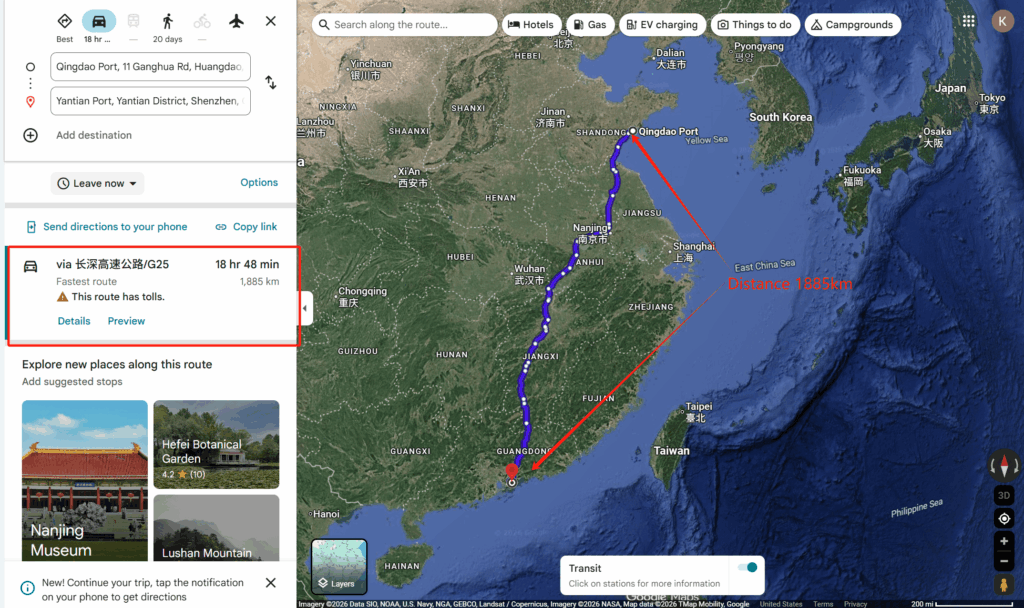
China is vast. The distance between its northernmost major port (Qingdao) and its southernmost (Shenzhen) is roughly 1,850 kilometers—equivalent to the distance between London and Rome.
This guide provides a professional deep dive into the Top 5 Ports of China. We will analyze their geography, industrial DNA, and operational “quirks” to help you make a strategic decision, not just a price-based one.
The Map of Power: North vs. South vs. Central
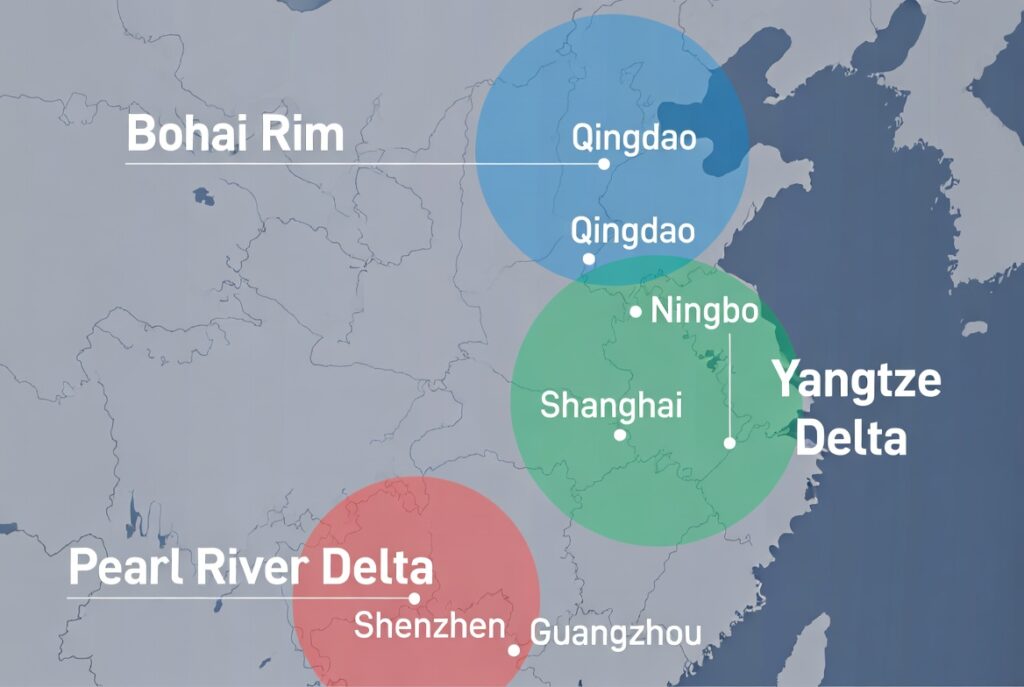
To understand Chinese logistics, you must first visualize the coastline. We divide the major ports into three strategic economic circles:
- The Bohai Economic Rim (North): Represented by Qingdao.
- The Yangtze River Delta (East/Central): The world’s busiest logistics hub, featuring Shanghai and Ningbo-Zhoushan.
- The Pearl River Delta (South): The high-tech manufacturing heartland, featuring Shenzhen and Guangzhou.
Shanghai Port (SHA): The “Complicated” Giant
Shanghai is the busiest container port in the world, but for a shipper, “biggest” does not always mean “easiest.”
- Geographic Logic: Located at the mouth of the Yangtze River. It serves the entire inland of China via water-to-water transshipment.
- Industrial DNA: High-end manufacturing, automotive (Tesla Giga Shanghai), chemicals, and fashion.
- The “Unsure Costs” (Operational Alert): Shanghai’s operation is split between Waigaoqiao (River Port) and Yangshan (Deep-Sea Port).
- Yangshan is located on an island connected by a 32km bridge. If there are high winds or fog, the bridge closes, and your cargo is stuck.
- Hidden Costs: Shanghai has strict customs and complex documentation. We often warn clients about “unexpected costs” here—from terminal handling surcharges to complex drayage fees. If you ship from Shanghai, you need a high buffer for both time and budget.
Ningbo-Zhoushan Port (NGB): The Efficient Alternative
Often seen as Shanghai’s “younger brother,” Ningbo is actually the world’s largest port by total cargo tonnage.
- Geographic Logic: Located just south of Shanghai, it has deep-water berths that can handle the world’s largest 24,000 TEU vessels.
- Industrial DNA: Small appliances, hardware, textiles (Shaoxing), and plastic products.
- Operational Note: Ningbo is often less congested than Shanghai. It is the preferred port for the “Zhejiang” manufacturing cluster. If your factory is in Yiwu or Ningbo, never use Shanghai—Ningbo is faster and the local logistics are more streamlined.
Qingdao Port (TAO): The Northern Gateway
Qingdao is the king of the north and is essential for anything involving heavy industry or cold chain.
- Geographic Logic: Located in Shandong province, facing Korea and Japan.
- Industrial DNA: Household appliances (Haier/Hisense), rubber and tires, beer, and agricultural products.
- Freight Reality: Qingdao often has the lowest “headline” sea freight rates for European and US routes because it is a starting point for many vessels. BUT beware: If your factory is south of the Yangtze River, the trucking cost to reach Qingdao will be $800–$1,500, making that “cheap freight” irrelevant.
Shenzhen Port (SZN): The Most “Exporter-Friendly”
If Shanghai is the complicated giant, Shenzhen is the efficient professional. For most international buyers, Shenzhen is the gold standard for logistics.
- Geographic Logic: Bordering Hong Kong, it is the gateway to the Pearl River Delta (PRD). It is divided into Yantian (for US/EU routes) and Shekou/Chiwan (for Southeast Asia/Regional).
- Industrial DNA: Electronics (Huawei/DJI), toys, LED lighting, and drones.
- Why it’s “Friendly”: * Streamlined Customs: Shenzhen has pioneered “paperless” and “pre-declaration” systems.
- Proximity: Most factories are within a 2-hour drive of the port.
- Lower Overall Cost: While the sea freight might be slightly higher than some northern ports, the lower inland trucking and efficient terminal operations usually lead to a lower total landed cost.
Guangzhou Port (CAN/Nansha): The Emerging Powerhouse
Guangzhou, specifically the Nansha Terminal, is the fastest-growing hub in South China.
- Geographic Logic: Deep in the Pearl River Delta.
- Industrial DNA: Heavy machinery, garments (the world’s capital of fast fashion), and furniture (Foshan).
- Operational Note: Nansha is often cheaper than Shenzhen in terms of terminal fees. However, it is further away from the eastern PRD factories. If your goods are from Foshan, Zhongshan, or Jiangmen, Guangzhou is your best bet.
Summary Table: Choosing the Right Port
| Port | Region | Primary Industry | Operation Complexity | Sea Freight Level |
| Shanghai | East | Tech, Auto, Luxury | High (Yangshan/Bridge) | Moderate |
| Ningbo | East | Small Appliances, Hardware | Moderate | Moderate |
| Shenzhen | South | Electronics, Consumer Goods | Low (Very Efficient) | Competitive |
| Guangzhou | South | Furniture, Garments, Auto | Moderate | Low |
| Qingdao | North | Heavy Machinery, Tires, Cold Chain | Moderate | Often Lowest |
Operational Precautions: How to Not Get Burned
- The 500km Rule: Generally, your factory should be within 500km of the port. Beyond that, the cost of inland trucking in China increases exponentially due to toll roads and fuel surcharges.
- Weather Hazards: * Summer (South): Shenzhen and Guangzhou face typhoons from July to September.
- Winter (North/East): Qingdao and Shanghai face heavy fog and gales that can close terminals for 24-48 hours.
- Customs Styles: Northern customs (Qingdao/Shanghai) tend to be more “by the book” and document-heavy. Southern customs (Shenzhen) are more digitalized and faster for e-commerce and consumer goods.
(Dealing with a sudden inspection at a US port? Our US Customs 5H Code Guide explains what happens once your cargo leaves China.)
Conclusion: Strategic Selection over Bottom-Price Hunting
Choosing a port in China isn’t about finding the cheapest number on a spreadsheet; it’s about understanding the Total Logistics Cost (TLC). By aligning your port selection with your factory’s location and your product category, you avoid the hidden “traps” of the Chinese logistics landscape.
At Kisun Shipping, we provide a free Route & Port Optimization Audit for all new clients. We don’t just give you a price; we give you a strategy.
Ready to find the most efficient route for your next shipment? 👉 Get an Optimized Quote Now or explore our Sea Freight Solutions.

China Logistics Expert
About the Author
Katherine Kang is a China-based logistics consultant with over 11 years of experience in international trade and freight forwarding. Specializing in helping SMEs import from China to the USA, Canada, and Europe, she focuses on compliant, cost-effective solutions to avoid delays, tariffs, and hidden fees. From anti-dumping guidance to CNY planning, Katherine has managed hundreds of shipments, saving clients 15-30% on average.
Connect with Katherine on LinkedIn or contact Kisun Shipping for a free import consultation.