
A Practical Guide to Supply Chain Mapping, Entity List Checks & Documentation
As an importer from China to USA, if you thought the Section 301 Tariffs were your biggest headache, or that passing a 5H Customs Inspection meant you were in the clear, think again.
In 2026, there is a significant regulatory challenge to profit margins sitting at the US border: the Uyghur Forced Labor Prevention Act (UFLPA).
Unlike almost any other US law, the UFLPA operates on a “Rebuttable Presumption.” In plain English, this means U.S. Customs and Border Protection (CBP) presumes your goods are restricted if they have even a hypothetical link to specific regions or entities, and the burden of proof is entirely on you to prove they aren’t.
By 2026, CBP’s mapping tools have become so sophisticated that “I didn’t know” is no longer a valid defense. It’s a point of serious audit risk.
What Actually Changed in 2026? (The Granular Enforcement Era)
The UFLPA isn’t new, but the way it’s enforced in 2026 has evolved. CBP has moved away from “broad strokes” and into “surgical precision.”
The Granular Dashboard
CBP’s Enforcement Statistics Dashboard now tracks individual transactions with granular precision. They aren’t just looking at the country of origin on your Bill of Lading. They are using AI-driven “Supply Chain Mapping” to look at Tier 2 and Tier 3 suppliers—the people who sell the raw materials to your factory.
The “Guilt by Association” Expansion
In 2026, the UFLPA Entity List has grown significantly. It now includes hundreds of companies involved in aluminum, PVC, and vinyl flooring, far beyond the original focus on cotton and polysilicon. If your supplier’s sub-supplier appears on this list, your entire shipment is “guilty” until you prove otherwise.
The 2026 “High-Risk” Hit List: Is Your Product Targeted?
While the UFLPA applies to all goods, CBP has “Priority Sectors.” If you are importing any of the following in 2026, your risk level is High:
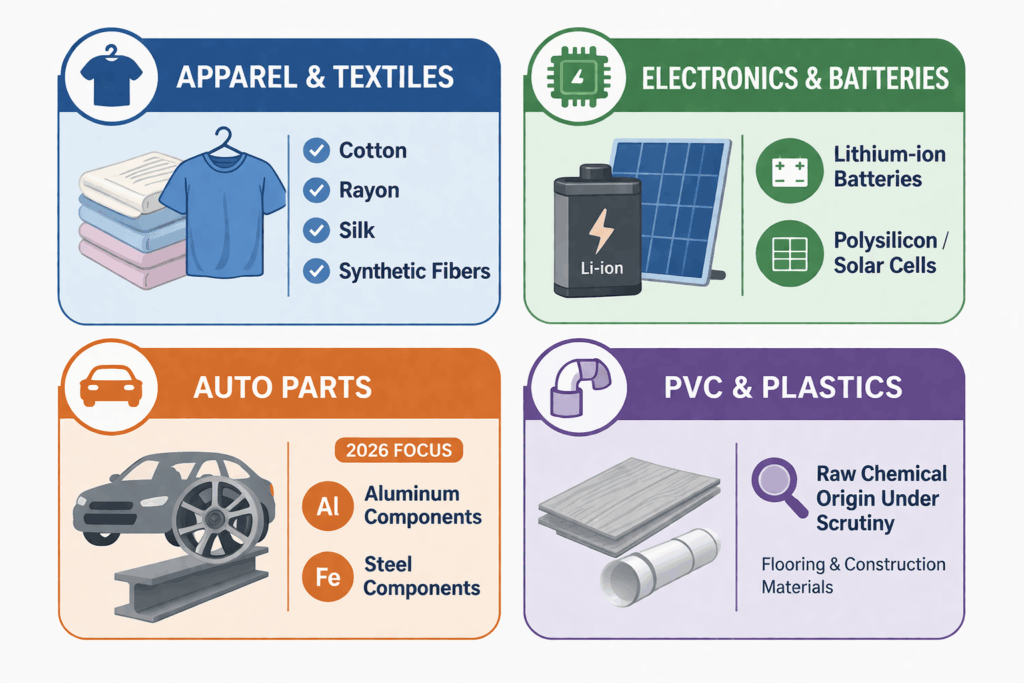
- Apparel & Textiles: This remains the #1 target. It’s not just about cotton anymore; rayon, silk, and synthetic fibers are under heavy scrutiny.
- Electronics & Batteries: Lithium-ion batteries and any component containing polysilicon (solar cells) or specific minerals are being flagged at record rates.
- Auto Parts: Aluminum and steel components are the “new” targets of 2026.
- PVC & Plastics: If you are in the flooring or construction material business, CBP is looking at the origin of your raw chemicals.
The SME Reality Check: If you import simple finished goods like wooden furniture, LED lights, or basic kitchenware, your risk is Low, but not zero. One “tainted” component in an LED driver can stop a $100,000 shipment.
The Anatomy of a Detention: What Happens When CBP Flags You?
When a shipment is flagged under UFLPA, you don’t get a “fix it” notice. You get a Detention Notice.
You then have a very short window to provide “Clear and Convincing Evidence.” This is the highest standard of proof in US law. A simple “Certificate of Origin” from your factory is essentially worthless in this scenario. CBP wants to see the “DNA” of your product—from the raw ore or fiber to the final stitch.
The 2026 Compliance Checklist: Proving the Negative
At Kisun Shipping, we tell our clients: Compliance starts at the purchase order, not at the port. Here is the practical framework we recommend for every US-bound shipment in 2026:
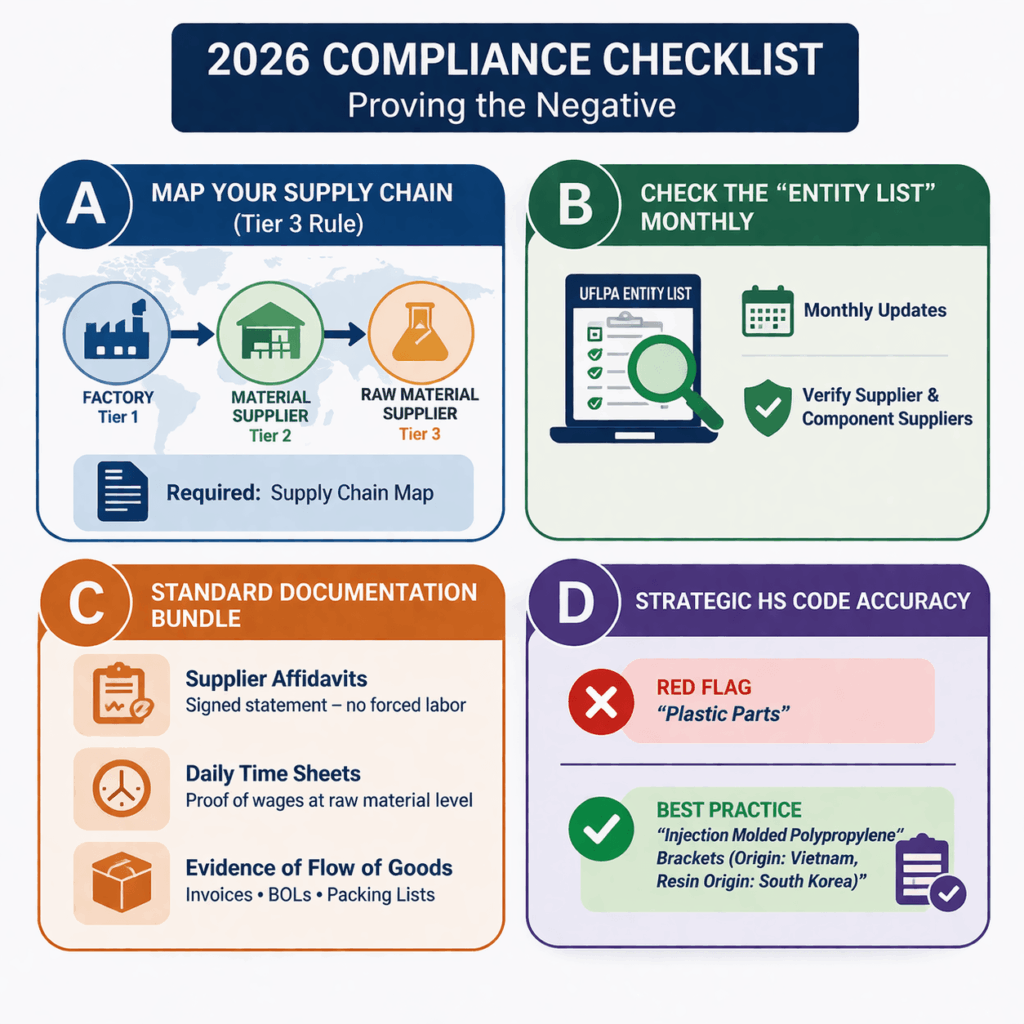
A. Map Your Supply Chain (The “Tier 3” Rule)
Don’t just ask your factory where they are. Ask them where they buy their raw materials.
- Required Doc: A comprehensive “Supply Chain Map” showing every facility involved in production.
B. Check the “Entity List” Monthly
The FLETF (Forced Labor Enforcement Task Force) frequently adds new companies to the ban list. Before you wire your deposit, verify your supplier AND their component suppliers against the current UFLPA Entity List.
C. The “Standard Documentation” Bundle
If you are audited, you will need:
- Supplier Affidavits: Signed statements confirming no forced labor was used.
- Daily Time Sheets: Proof of wages paid at the raw material level.
- Evidence of Flow of Goods: Invoices, BOLs, and packing lists for the internal movement of materials within the manufacturing country.
D. Strategic HS Code Accuracy
CBP’s automated systems flag shipments based on HS codes and keywords. If your description is “Plastic Parts,” it’s a red flag. If it’s “Injection Molded Polypropylene Brackets (Origin: Vietnam, Resin Origin: South Korea),” you are providing the transparency CBP craves.
Why Your Forwarder is Your Best Defense
In the old days, a freight forwarder just moved a box. In 2026, a forwarder must be a compliance gatekeeper.
At Kisun Shipping, we’ve integrated a “Compliance Flag” into our quoting process.
- Pre-Shipment Risk Checks: We scan your HS codes and supplier names against the latest enforcement data before the goods even leave the factory.
- The “Time is Money” Advantage: If a shipment is detained, having your documents organized before arrival can mean the difference between an 18-day release and a 3-month total loss.
The Bottom Line: Don’t Let “Ethical Risk” Kill Your Business
The UFLPA is not a “China problem”—it is a Global Transparency Problem. Whether you are shipping from major China ports or through a third-party hub, the US government expects you to be a detective.
Most SME importers with clean, simple supply chains will navigate 2026 without a single detention. But the ones who thrive are those who treat compliance as a competitive advantage. When your competitors’ goods are stuck in a 5-week customs hold, yours should be on the shelf.
Ready to audit your 2026 supply chain?
At Kisun Shipping, we offer a Free UFLPA Risk Assessment for every US-bound shipment. It takes us 10 minutes to run your HS codes and suppliers through our database, but it could save your business from a total seizure.
Contact Kisun Shipping for a Free Compliance Check Today
Frequently Asked Questions (FAQ) – UFLPA 2026
Q1: Does UFLPA only apply to goods made in China?

A: No. CBP flags goods from anywhere in the world (Vietnam, Mexico, India, etc.) if they contain components or raw materials from the Xinjiang region or from companies on the Entity List.
Q2: Can I just provide a Certificate of Origin to get my goods released?
A: No. A Certificate of Origin only proves where the final assembly happened. For UFLPA, you must provide "Clear and Convincing" evidence of the origin of the raw materials.Q3: What happens if my goods are permanently denied entry?
A: You have two choices: export the goods to a non-US destination (at your cost) or allow CBP to destroy them. You cannot "fix" a UFLPA violation once the goods are officially seized.Q4: How does UFLPA differ from a 5H Inspection?
A: A 5H Inspection is a physical exam to verify the contents and value of your shipment. A UFLPA detention is a legal hold to verify the ethics and origin of the labor used. You can pass a 5H and still be held for UFLPA.
China Logistics Expert
About the Author
Katherine Kang is a China-based logistics consultant with over 11 years of experience in international trade and freight forwarding. Specializing in helping SMEs import from China to the USA, Canada, and Europe, she focuses on compliant, cost-effective solutions to avoid delays, tariffs, and hidden fees. From anti-dumping guidance to CNY planning, Katherine has managed hundreds of shipments, saving clients 15-30% on average.
Connect with Katherine on LinkedIn or contact Kisun Shipping for a free import consultation.