
The 2026 US Customs 5H Crisis: Why Your Containers Are Being Returned (and How to Stop It)
For US-bound sellers, the post-Spring Festival period of 2026 has brought a chilling new reality. Ports like Los Angeles (LA) and Long Beach (LB) are no longer just busy hubs; they are the epicenters of a massive enforcement upgrade.
If you’ve seen the status code “5H” in your AMS/ACE tracking lately, you aren’t alone. Thousands of Chinese containers are currently facing forced returns or destruction. Unlike regular “random exams,” this new wave—led by the Fast Doc Review department—is a zero-tolerance crackdown.
(Before we dive in, if you’re looking for our standard shipping rates, check our How to Ship From China to the USA page for updated compliance-first options.)
What Exactly is a 5H Inspection?
In the US Customs Automated Commercial Environment (ACE), 5H is the detention code for an “Entry Processing HOLD.” Unlike a physical inspection (where a dog or an X-ray might look at your goods), 5H is a surgical strike on your paperwork. CBP has shifted its primary defense to the digital gate.
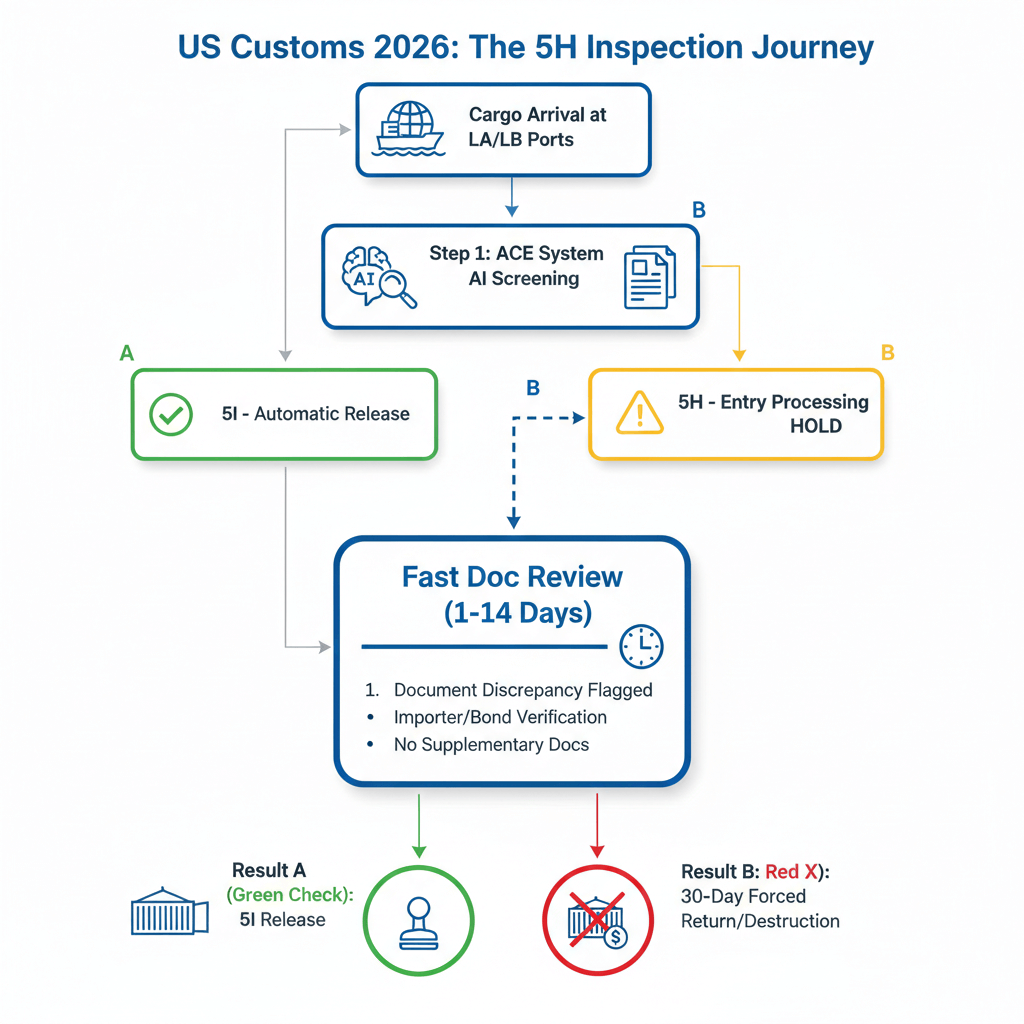
| Stage | Status Code | Description | Outcome |
| Step 1 | 5H (HOLD) | The system flags discrepancies in the Manifest, Invoice, or Importer Bond. | Goods are detained at the port. |
| Step 2 | Fast Doc Review | A specialized team (including Chinese logistics experts) verifies every detail. | Zero tolerance: No supplementary docs allowed. |
| Step 3 | 5I (RELEASE) | Documents match perfectly with CBP’s Big Data benchmarks. | Goods are cleared for delivery. |
| Step 4 | Detention/Return | Any flaw (value, description, ID) triggers an automatic refusal. | Forced return within 30 days. |
The 2026 Enforcement Upgrade: Why Now?
Why has the environment become so “aggressive”? US Customs didn’t just get stricter; they got smarter and better funded.
- The $20 Billion Task Force: The US Congress has injected massive capital into CBP specifically for enforcement. This funded the Fast Doc Review department—a team that now includes logistics veterans from China who understand every “trick” in the declaration book.
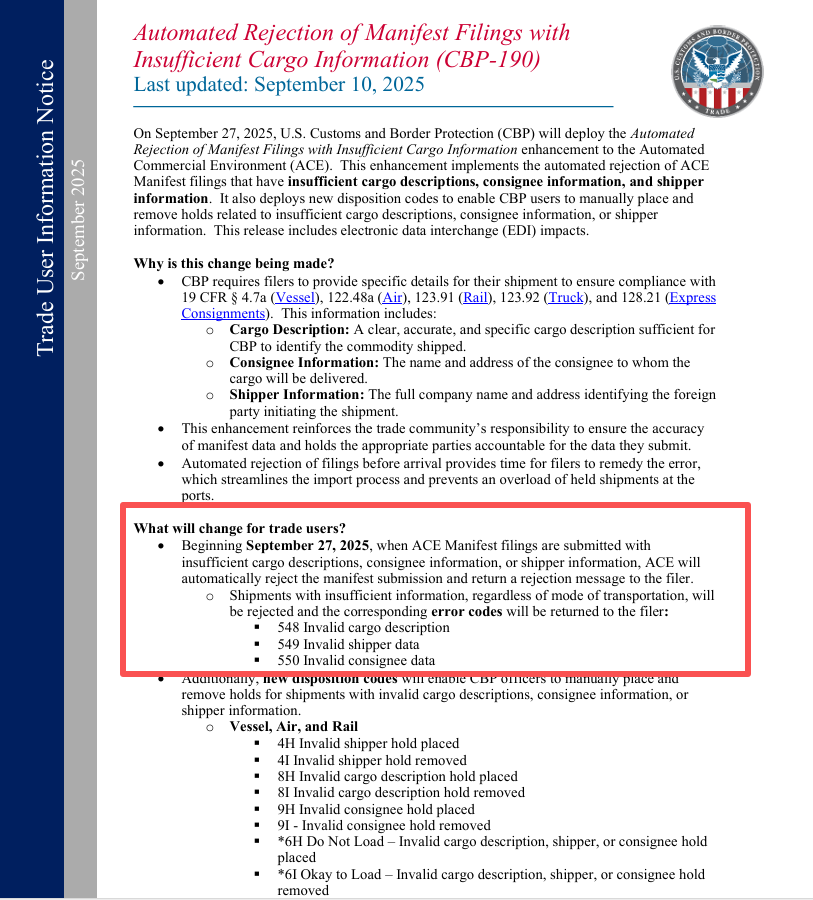
- ACE System Automation (Sept 2025): The ACE system no longer relies on manual sampling. It now uses AI to perform 100% manifest data quality reviews. If your declared price is 30% lower than the market average, the AI flags it before a human even sees it.
- The 30-Day Legal Trap: According to Title 19 of the US Code, if a determination isn’t made within 30 days of detention, it is legally considered a refusal of entry. There is no “waiting it out.”
6 Lifelines to Protect Your Shipment from 5H Returns
At Kisun Shipping, we believe compliance is the only way to protect your profit. To avoid the 5H trap, you must guard these six lifelines:
1. Real Value Declaration (No Under-declaring)
CBP now uses a “Price Benchmark Database.” If you declare a solid wood table at $5, the system knows you’re lying. Under-declaration is the #1 trigger for 5H holds.
2. Importer & Bond Authenticity
Identity verification is now mandatory.
- Non-US citizens must provide valid proof of residency/work (Visa, Green Card).
- “One-time” or “Shared” Bonds are dead. Using an invalid EIN or an expired Bond will lead to an immediate 30-day return order.
3. Kill the Vague Descriptions
Stop using “Daily Necessities” or “Accessories.”
Example: Instead of “Furniture,” write “Solid wood dining table, North American Oak, 120x80cm.”
4. The “Three-Document Consistency” Rule
The Commercial Invoice, Packing List, and Manifest must be mirror images of each other. Even a mismatch of one carton between the Invoice and Packing List will trigger an automated 5H flag.
5. HS Code Accuracy & AI Verification
CBP’s AI can now cross-reference HS codes with manifest images. If you classify a high-tax item under a low-tax code, the system will detect it.
6. Mandatory Certifications (CPSC, FCC, FDA)
For products involving intellectual property rights or requiring mandatory certifications such as FCC/CPSC, it is essential to ensure that all qualifications are complete and compliant. Given the current “zero tolerance” policy of customs, even the smallest flaw will be magnified, ultimately resulting in more harm than good.
FAQ: US Customs 5H Inspection & Cargo Detention
Q1: What exactly does the "5H" code mean in US customs clearance?

A: In the US Customs ACE (Automated Commercial Environment) system, the 5H code stands for an "Entry Processing HOLD." It means your shipment has been intercepted by the Fast Doc Review department for a rigorous audit of your declaration documents (Commercial Invoice, Packing List, Manifest, and Importer Bond) before any physical clearance is allowed.
Q2: What are the most common triggers for a 5H inspection in 2026?
A: The CBP's AI system automatically flags shipments for several key reasons:
1.Under-declared Value: Declaring a price significantly lower than the US market average.
2.Invalid Importer Bond: Using expired, shared, or unverified bonds.
3.Mismatched Documents: Any inconsistency between the Invoice, Packing List, and Manifest (e.g., mismatched quantities or weights).
4.Vague Descriptions: Using generic terms like "accessories" or "daily supplies" instead of specific material and usage descriptions.Q3: Can I submit supplementary documents to fix a 5H hold?
A: In most cases, no. The 2026 Fast Doc Review process operates on a "zero-tolerance" policy. Unlike traditional customs holds where you might be asked to explain a discrepancy, a 5H hold often leads to an immediate rejection if the initial data is deemed fraudulent or severely inaccurate. There is virtually no room for negotiation.Q4: What happens if a 5H hold cannot be resolved? (The 30-Day Rule)
A: Under Title 19 of the United States Code, if a determination is not made within 30 days of the cargo being detained, it is legally classified as an "automatic refusal of entry." The goods must be forcefully returned to the country of origin or destroyed under customs supervision. The seller is responsible for all return shipping costs, demurrage, and port storage fees.Q5: How can Kisun Shipping help me avoid 5H detentions at LA/LB ports?
A: At Kisun Shipping, we prioritize strict compliance to protect your supply chain. We offer a comprehensive Document Pre-Audit Service before your cargo leaves China. Our experts ensure your HS codes, valuations, and importer bonds perfectly align with CBP's 2026 standards, turning potential 5H holds into smooth 5I releases.The Bottom Line: Compliance is Your Only Exit
The era of “grey-area” customs clearance in the US is over. In 2026, the cost of a returned shipment—including double freight, port storage fees, and potential blacklisting—far outweighs the cost of duties.
What should you do right now?
- Audit your partners: Ensure your forwarder has a pre-review document team.
- Move fast: If you hit a 5H status, you have less than 14 days to provide a defense before the 30-day “Automatic Refusal” clock runs out.
At Kisun Shipping, we provide a full-spectrum document pre-audit service to ensure your “5H” always turns into a “5I.”
Want to check if your current manifest is 5H-compliant? Contact our US Compliance Experts Today or explore our comprehensive guide to US Shipping Regulations.

China Logistics Expert
About the Author
Katherine Kang is a China-based logistics consultant with over 11 years of experience in international trade and freight forwarding. Specializing in helping SMEs import from China to the USA, Canada, and Europe, she focuses on compliant, cost-effective solutions to avoid delays, tariffs, and hidden fees. From anti-dumping guidance to CNY planning, Katherine has managed hundreds of shipments, saving clients 15-30% on average.
Connect with Katherine on LinkedIn or contact Kisun Shipping for a free import consultation.