

New US Section 301 Tariffs March 2026: What China Importers Must Prepare For Now
If you’re importing from China right now, you probably felt the ground shake a little on March 11 and 12.
That’s when the U.S. Trade Representative quietly opened two new Section 301 investigations — one on “structural excess capacity” across 16 economies (with China front and center) and another on forced labor risks spanning 60 countries. Public comments close April 15, and the first wave of new tariffs or restrictions could land as early as Q3 2026.
I’ve been on the phone with clients all week. Some are panicking. Others are quietly moving inventory or changing sourcing. The ones who read our De Minimis article last month are already one step ahead — because this is basically De Minimis 2.0, but with much bigger numbers and longer timelines.
This isn’t theory. It’s happening now. Here’s exactly what changed, what it means for your next few shipments, and the practical moves we’re telling every client to make before the next shoe drops.
Quick links to our related guides (so you can jump straight to what matters):
What Exactly Happened in March 2026 (The Timeline That Matters)
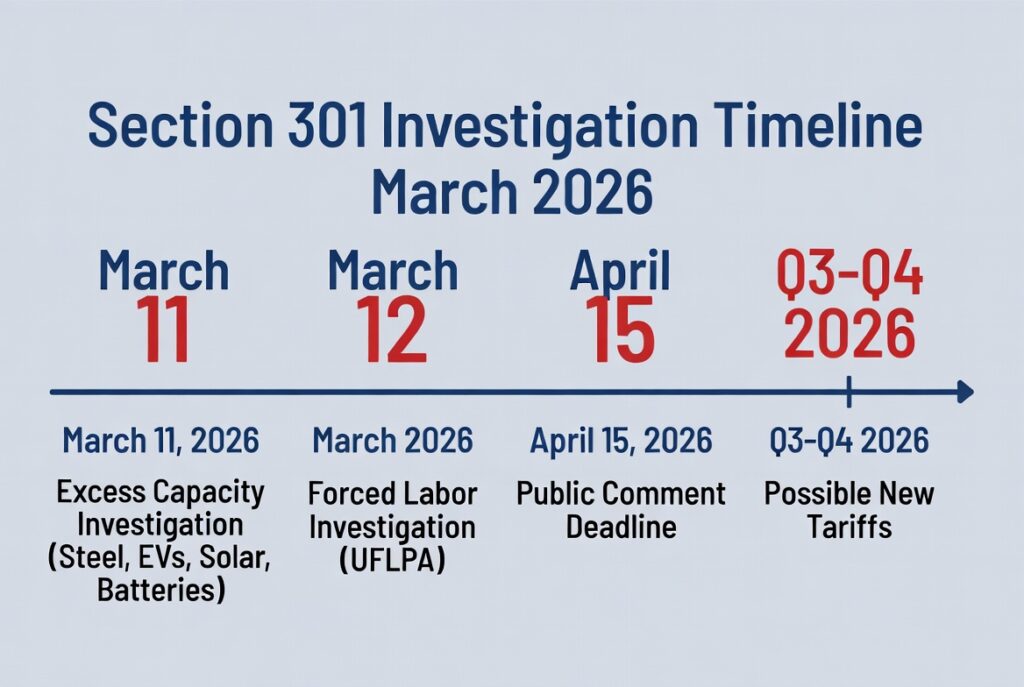
- March 11: USTR opens investigation into “excess capacity” in steel, aluminum, semiconductors, EVs, solar, batteries, and medical devices.( source: USTR Initiates Section 301 Investigations Relating to Structural Excess Capacity and Production in Manufacturing Sectors )
- March 12: Second investigation launched on forced labor risks in supply chains (building on UFLPA). (source: USTR Initiates 60 Section 301 Investigations Relating to Failures to Take Action on Forced Labor)
- April 15: Public comment deadline — this is when industry groups and importers like you can push back or get ahead.
- Q3–Q4 2026: Possible new tariff lists or product-specific restrictions.
This is not a one-off political move. It’s the continuation of the same strategy that killed the $800 De Minimis loophole. The goal is clear: make it more expensive and more complicated to rely heavily on certain Chinese supply chains.
The “Hit List”: Two Investigations, Zero Safe Havens
Unlike the previous trade war, which was almost exclusively focused on China, the March 2026 investigations are a dragnet for the entire global supply chain.
Track A: Structural Excess Capacity (The “16-Economy” Trap)
Launched on March 11, this investigation targets 16 economies—including China, Vietnam, Mexico, India, and even the EU. The US argues that these regions have built manufacturing capacity that far exceeds global demand, leading to “dumping.”
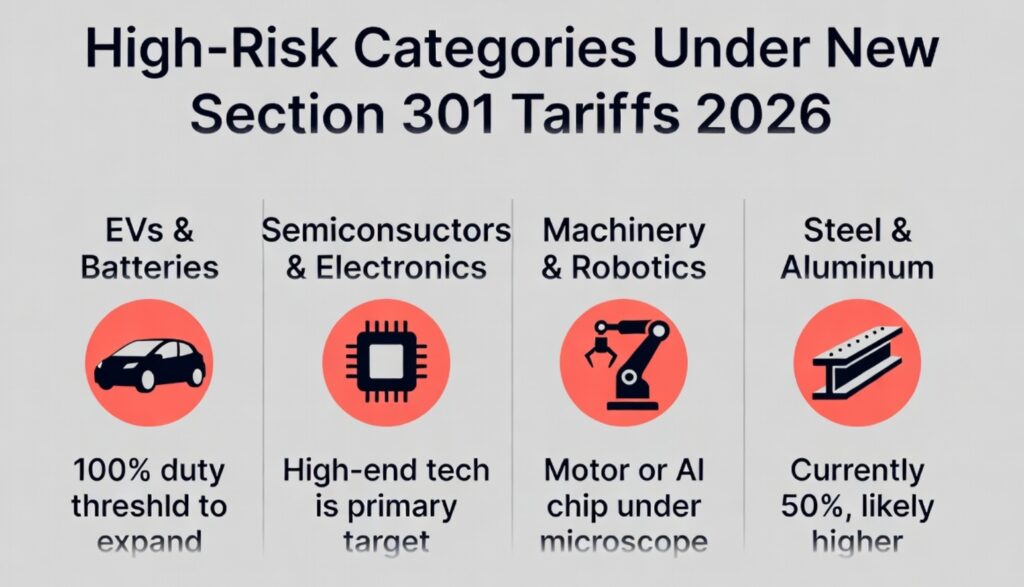
The Affected Sectors:
- EVs & Batteries: Expect the 100% duty threshold to expand.
- Semiconductors & Electronics: High-end tech is the primary target.
- Machinery & Robotics: If it has a motor or an AI chip, it’s under the microscope.
- Steel & Aluminum: Currently at 50% for most origins; likely to go higher.
Track B: The 60-Country “Forced Labor” Net
On March 12, the USTR opened a second front, targeting 60 economies (representing 99% of all US imports). This is an unprecedented expansion of the UFLPA (Uyghur Forced Labor Prevention Act) philosophy to a global scale.
The Risk: It’s no longer just about where the goods were assembled. CBP is now tracing the “Melted and Poured” origin of steel and the “Smelted and Cast” origin of aluminum across 60 countries. If your supplier in Vietnam uses Chinese raw materials, you are now at high risk for a 5H Customs Hold.
The Death of the $800 “Backdoor” (De Minimis Update)
As we predicted in our End of De Minimis blog, the March 2026 executive actions have tightened the noose on low-value shipments.
CBP has officially began “Enhanced Screening” for any package under $800 originating from China.
- The Change: “Section 321” entries are now being cross-referenced against the new 301 “Forced Labor” list.
- The Result: Packages that used to clear in 2 hours are now sitting in bonded warehouses for 5–7 days. The “Air Express” model for e-commerce is effectively dead for high-tariff categories like textiles and consumer gadgets.
Real Impact on Your Costs and Lead Times (Numbers We’re Seeing Right Now)
From the shipments we handled in the last 10 days:
- Electronics and solar components: potential additional 10–25% duties on top of existing Section 301 rates.
- Steel/aluminum-related products: risk of new 25%+ tariffs.
- Medical devices and batteries: forced labor reviews could trigger holds similar to 5H.
One client who imports LED lighting told us last week: “We were planning to ship 40HQ in May. Now we’re looking at an extra $4,200–$6,800 in potential duties if the new list hits.” Another Amazon seller moving phone accessories is already shifting 30% of volume to Vietnam to hedge.
The scary part? Most of these new tariffs won’t show up on your commercial invoice until the final rule is published — which means surprise bills at the port.
Survival Tactics: The “Kisun Strategy” for Q2 2026
You can’t control the USTR, but you can control your routing and HTS classification. Here is how our most successful clients are navigating the March 2026 reset:
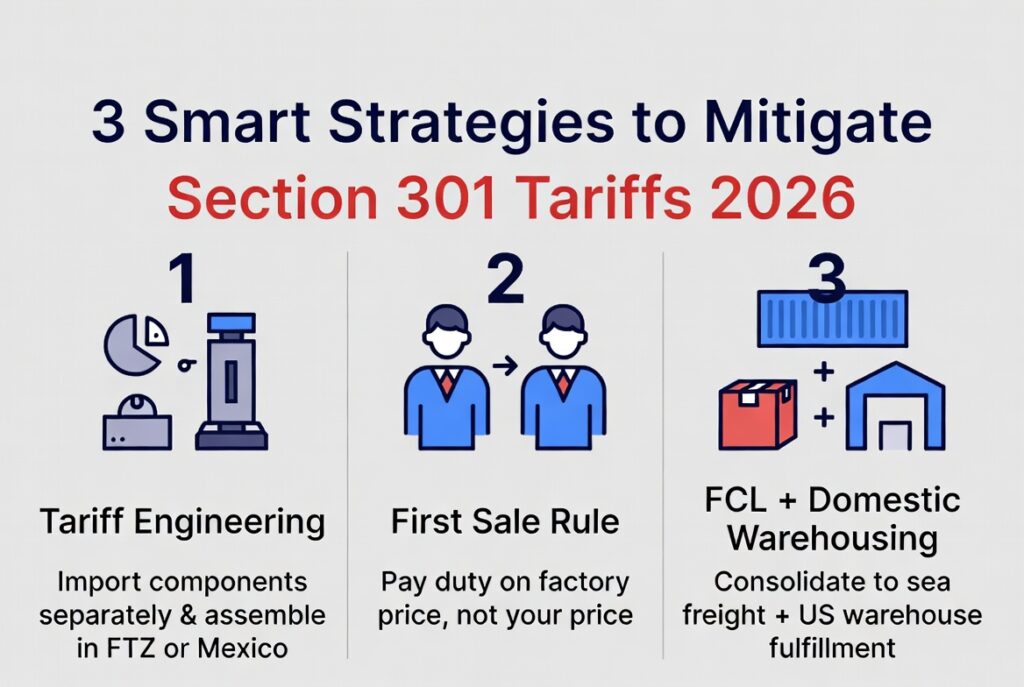
A. Tariff Engineering (The Professional Way)
This isn’t about “cheating”; it’s about legal optimization. By importing components separately and doing final assembly in a US Foreign Trade Zone (FTZ) or a USMCA-compliant facility in Mexico, you can often shift the HTS classification to a lower-duty bracket.
B. Port Shifting & “First Sale” Rule
With the major China ports facing increased scrutiny, we are helping clients implement the “First Sale” rule. This allows you to pay duties based on the price the factory sold to the middleman, rather than the price you paid, potentially saving 10–15% on the dutiable value.
C. Moving to FCL + Domestic Warehousing
If you are still shipping small parcels, the administrative fees for formal entry under the new 301 rules will eat you alive. Consolidation is your only hope. We are moving clients from Air-Express to DDP Sea Freight + US Warehouse Fulfillment.
Conclusion: The Wall is High, But the Gates are Open
The March 2026 Section 301 investigations are a clear signal that the US is moving toward a “Fortress Economy.” The cost of doing business has gone up, but so has the value of professional logistics.
At Kisun Shipping, we don’t just book ships. We audit supply chains for tariff exposure. We don’t just clear customs; we navigate the 5H minefields and the IEEPA refund maze.
Frequently Asked Questions (FAQ) – March 2026 Tariffs
Q1: Will the new Section 301 investigations lead to immediate tariff hikes?

A: No, there is a comment period until April 15, 2026, followed by hearings in May. However, the market is already "front-loading" shipments to beat the expected late-Q2 increases, which is causing port congestion in Shanghai and Ningbo.
Q2: How do the new forced labor investigations affect non-China imports?
A: The USTR is now investigating 60 countries, including Canada, Mexico, and Vietnam. This means even if your goods are made in Mexico, you may be required to provide a "Certificate of Origin" for all raw materials (steel, fabric, chemicals) to prove they don't violate the new 301 enforcement standards.Q3: Can I still use the $800 De Minimis exemption?
A: Technically yes, but for China-origin goods in the "Excess Capacity" sectors (electronics, tech, parts), CBP is now requiring Informal Entry even for low-value goods. This adds $25–$50 in processing fees per package, effectively ending the "Duty-Free" benefit.Q4: What should I do if my goods are held under a 5H inspection?
A: 5H inspections are the "High-Intensity" tier of CBP checks. You will need to provide a complete "Supply Chain Map" within 30 days. Read our Full 5H Survival Guide for a checklist of required documents.
China Logistics Expert
About the Author
Katherine Kang is a China-based logistics consultant with over 11 years of experience in international trade and freight forwarding. Specializing in helping SMEs import from China to the USA, Canada, and Europe, she focuses on compliant, cost-effective solutions to avoid delays, tariffs, and hidden fees. From anti-dumping guidance to CNY planning, Katherine has managed hundreds of shipments, saving clients 15-30% on average.
Connect with Katherine on LinkedIn or contact Kisun Shipping for a free import consultation.