
Importing products from China to the UK has become a standard business practice for thousands of wholesalers, retailers, Amazon FBA sellers, and e-commerce brands. China remains one of the UK’s largest trading partners, supplying everything from furniture and lighting to consumer electronics, machinery, textiles, and home improvement products.
However, one of the biggest challenges UK importers face is not finding suppliers—it’s choosing the right shipping solution.
Questions like these are asked every day:
- How much does shipping from China to the UK cost?
- How long does sea freight take?
- Should I choose air freight or sea freight?
- Is DDP shipping suitable for my business?
- How much Import VAT will I pay?
- Which shipping method is best for Amazon FBA?
The answers are not always straightforward because shipping costs, transit times, customs requirements, and logistics solutions vary depending on your cargo, destination, and business needs.
This guide brings together practical shipping knowledge based on real international freight operations. Whether you are importing your first shipment or managing regular container loads, you’ll find clear explanations that can help you make better logistics decisions.
By the end of this guide, you’ll understand:
- Shipping methods available from China to the UK
- Typical shipping costs and what affects them
- Average transit times
- UK customs clearance and Import VAT
- DDP shipping explained
- Amazon FBA shipping options
- Common shipping mistakes to avoid
- Frequently asked questions from UK importers
Instead of simply comparing freight prices, we’ll explain how experienced importers evaluate shipping solutions based on cost, reliability, customs compliance, and delivery time. For more detailed guide, please check Shipping from China to UK 2026: The Ultimate Logistics Guide
Services We Offer| Shipping from China to uk
- Packing, and repacking your goods in our China warehouses
- Pick up, help you pick-up services from Chinese suppliers
- air freight shipping from China to uK
- sea freight shipping from China to uK
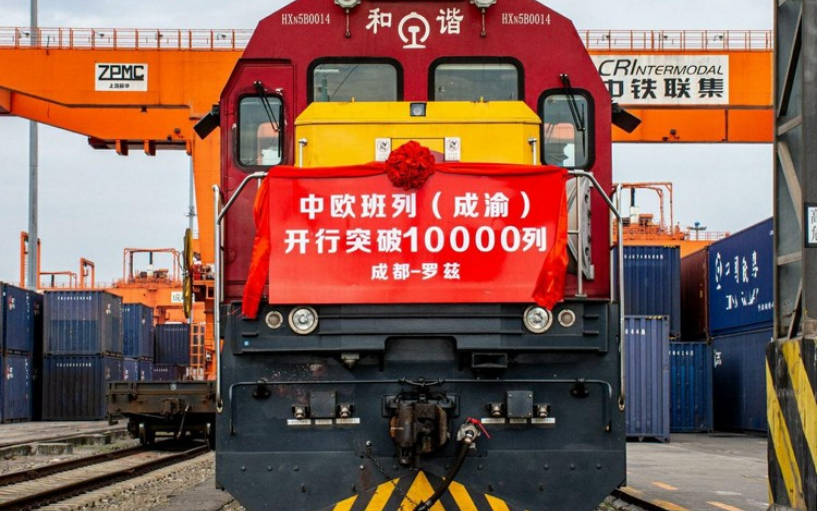
- train shipping from China to uK
- FBA service shipping from china to UK
- Cargo Inspection, offer inspection video and pictures
- Cargo Insurance, we offer insurance for your shipment
- End-to-End Customs Clearance: We handle HMRC compliance, duties, and paperwork to eliminate delays.

Shipping from China to the UK: Which Shipping Method Is Best?
There is no single “best” shipping method.
Each option offers different advantages depending on your shipment size, delivery deadline, and budget.
Below is a quick comparison.
| Shipping Method | Estimated Transit Time* | Cost | Best For |
|---|---|---|---|
| Sea Freight (FCL) | 30–45 days | ★ | Full containers, heavy cargo |
| Sea Freight (LCL) | 35–50 days | ★★ | Smaller commercial shipments |
| Air Freight | 5–10 days | ★★★★★ | Urgent, high-value cargo |
| Express Courier | 3–7 days | ★★★★★★ | Samples and small parcels |
| Rail Freight** | Limited availability | ★★★ | Selected cargo depending on current routes |
*Transit times are estimates and may vary depending on origin port, destination, carrier schedules, customs procedures, and seasonal demand.
**Rail freight availability between China and the UK may vary due to geopolitical conditions and route availability.
Selecting the right shipping method should always balance three factors:
- Cost
- Delivery speed
- Cargo characteristics
The cheapest solution is not always the most economical if delays affect your inventory or customer commitments.
Types of Freights for Shipping from China to UK
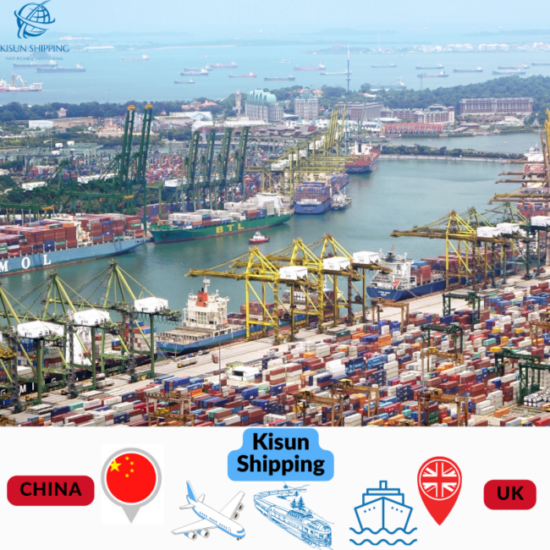
Sea shipping From China to UK
Sea shipment from China to the United Kingdom is a lower but cheaper shipping option than air and express, Kisun Shipping offers the best sea shipping costs and the shortest ocean shipping time from China to UK, contact us today to get a free quote in seconds.
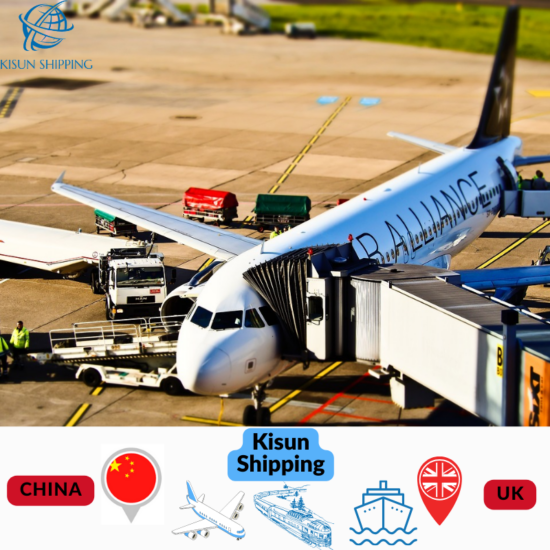
Air shipping From China to UK
Air Freight Shipping to the United Kingdom is the fastest, but air freight rates from China to UK shipping are higher than the sea, China by air is more suitable for urgent shipping needs. Contact Kisun Shipping for air cargo rates per kg.
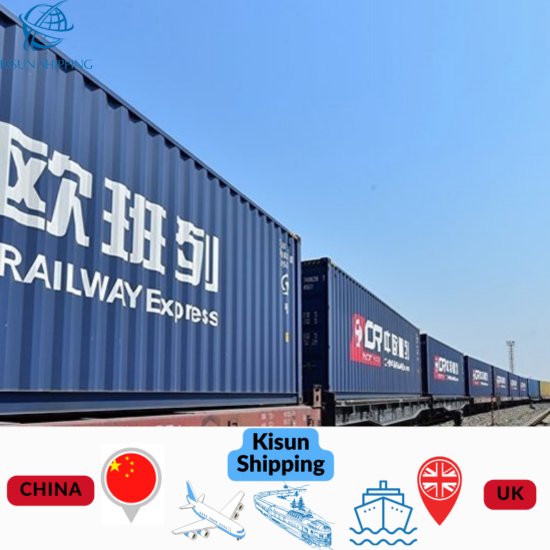
door to door Shipping From China to UK
Kisun Shipping offers Sea and Air shipping from China to the United Kingdom door to door, the average shipping cost from China to UK, by sea is only 0.8~2USD/KG, and by Air only 3.9-7.5USD/KG, feel free contact us!
Why Do So Many UK Businesses Import from China?
China continues to be one of the UK’s most important sourcing destinations because it offers a combination of manufacturing capacity, competitive pricing, and product variety that is difficult to match elsewhere.
Many UK companies regularly import products such as:
- Furniture
- Home decoration
- Lighting products
- Building materials
- Electrical equipment
- Consumer electronics
- Industrial machinery
- Kitchenware
- Garden products
- Auto parts
- Fashion accessories
- Toys
- Packaging materials
For many businesses, importing directly from China allows them to improve profit margins while offering competitive prices in the UK market.
However, purchasing products is only one part of the supply chain.
Choosing the wrong shipping method can increase logistics costs, delay deliveries, or even create customs issues that affect your business.
Understanding how international shipping works is therefore just as important as choosing the right supplier.
How much is shipping from China to uK?
Sea freight from China to UK is the most common shipping way that over 90% of global traders will choose, why it takes such a large share in global shipping? The most important reason is the cheap shipping rates among all the shipping ways. So when it’s the best time to choose sea shipping? See below:
- Shipment is bigger than 2 cubic meters (CBM), how to calculate the shipment CBM? here are the answers CBM calculator
- Your supplier is near a Chinese port or a location well connected to a port
- Not urgent need for this shipment, at least prepare over 30~35 waiting days.
| China Main Seaports | UK Main Seaports | FCL-20GP | FCL-40HQ | LCL-CBM |
|---|---|---|---|---|
| Shanghai | Southampton | $1,500–3,500 | $2,500–5,500 | $80–150 |
| Ningbo | Southampton | $1,700–3,700 | $2,700–5,700 | $80–150 |
| Qingdao | Felixstowe | $1,500–3,500 | $2,700–5,700 | $80–150 |
| Xiamen | Felixstowe | $1,500–3,500 | $2,700–5,700 | $80–150 |
| Shenzhen | Felixstowe | $1,500–3,500 | $2,700–5,700 | $80–150 |
Air Freight from China to the UK
Air freight is the fastest international shipping method available for commercial cargo.
Although significantly more expensive than sea freight, it is often chosen when delivery time is critical.
Typical situations include:
- Urgent inventory replenishment
- Product launches
- High-value electronics
- Medical equipment
- Time-sensitive commercial orders
Most commercial air freight shipments arrive within approximately 5–10 days, including export and import handling, although exact transit time depends on flight schedules, customs clearance, and final delivery arrangements.
For many businesses, the additional transportation cost may be justified if avoiding stock shortages or delayed customer deliveries.
| Main Airports in China | Main Airports in UK | Air Rates Per KG |
|---|---|---|
| Shanghai Airport | London (LHR) | $5~8 |
| Shanghai Airport | Manchester (MAN) | $5~8 |
| Shanghai Airport | Birmingham (BHX) | $5~8 |
| Shenzhen Airport | London (LHR) | $5~8 |
| Shenzhen Airport | Manchester (MAN) | $5~8 |
| Shenzhen Airport | Birmingham (BHX) | $5~8 |
Express Courier Services
Courier companies such as DHL, UPS and FedEx are commonly used for small packages, product samples and urgent documents.
Express delivery generally provides:
- Door-to-door service
- Customs clearance support
- Online shipment tracking
- Fast transit times
However, courier services become increasingly expensive as shipment size grows.
For commercial cargo above several hundred kilograms, sea freight or standard air freight is often a more cost-effective solution.
Ready to ship the goods?
Click “Start Shipping” below to connect with our experts!
Sea Freight from China to the UK
Sea freight remains the most popular shipping option for commercial imports because it offers the lowest transportation cost for medium and large shipments.
Businesses importing furniture, construction materials, machinery, consumer goods, or large quantities of products generally choose sea freight.
Sea freight is divided into two categories.
Full Container Load (FCL)
FCL means one shipper uses an entire container.
Common container sizes include:
- 20GP
- 40GP
- 40HQ
Advantages include:
- Lower cost per cubic meter
- Faster handling
- Reduced cargo handling
- Lower risk of cargo damage
- Better for large-volume shipments
FCL is usually recommended when your shipment occupies a significant portion of a container or when cargo safety is particularly important.
Less than Container Load (LCL)
If your shipment is too small to fill an entire container, LCL allows multiple importers to share container space.
This solution helps reduce shipping costs for smaller orders.
However, because cargo from different suppliers must be consolidated and later separated at destination, LCL generally requires additional handling and may take longer than FCL shipments.
LCL is suitable for:
- Small businesses
- Trial orders
- Product testing
- New importers
- Businesses purchasing from multiple suppliers
SEA LCL OR FCL shipping method?
LCL shipping is the best way when your shipment is less than one container, normally one 20GP can contain 26CBM, if your shipment is less than 26CBM, LCL shipping will be suitable. The below table will help you to understand and choose the right container when shipping cause the sea freight rates for different size of container is different. If you are not sure which shipment fits which size of the container, please feel free to contact us, and we will help you to solve the problem!
- Different sizes of containers
| Container Size | Container Volume(CBM) | Container Load(Ton) |
| 20GP | Max 33CBM | Max 26 Tons |
| 40GP | Max 66CBM | Max 26 Tons |
| 40HQ | Max 76CBM | Max 26 Tons |
| 45HQ | Max 86CBM | Max 29 Tons |
FBA shipping service from China to UK
The FBA shipping service of KISUN has been recognized by lots of Amazon sellers around the world, we arrange shipment from China to the Amazon warehouse as you assigned, including pick up from your supplier in China, pasting the Amazon shipping labels, shipping to Amazon warehouse, the import country customs tax and customs clearance, we will handle it, you have nothing to worry about, only need to focus on the increasing your product sales.
A freight forwarder, like Kisun Shipping, arranges your shipments on your behalf. Whether you rely on air or ocean carriers, we provide tracks with the movement of your goods and coordinate any required documents.
At Kisun Shipping, we have experience coordinating delivery to Amazon warehouses within the company’s unique requirements. With our freight forwarding service, we aim to provide transparent, smooth service to all of our clients.
Shipping to Amazon UK requires strict adherence to CARP (Carrier Appointment Request Portal) scheduling and pallet standards. We offer direct sea, air, and rail freight solutions to all major Amazon Fulfillment Centers (FC) across the UK.
Whether your inventory is routed to the Midlands logistics triangle or Southern ports, here are the primary UK Amazon destinations we service weekly:
| FC Code | Region / City | Exact Delivery Address for Shipping Labels |
|---|---|---|
| BHX4 | Coventry | Plot 1, Lyons Park, Coundon Wedge Drive, Coventry, West Midlands, CV5 9FA |
| EMA1 | Derby | Unit 1, Wilders Way, Kegworth, Derby, East Midlands, DE74 2BB |
| MAN1 | Manchester | 6 Sunbank Lane, Airport City, Altrincham, Manchester, M90 5DL |
| LCY2 | Tilbury | Amazon Distribution Depot, Unit 2, London Distribution Park, Tilbury, RM18 7AN |
| LBA2 | Doncaster | Amazon Fulfillment Center, Unit 1, Iport Avenue, New Rossington, Doncaster, DN11 0BG |
| BRS1 | Bristol | Goldcrest Way, Central Park, Severn Beach, Bristol, South West, BS35 4DJ |
| LTN2 | Hemel Hempstead | Boundary Way, Hemel Hempstead, Hertfordshire, HP2 7LF |
| CWL1 | Swansea | Ffordd Amazon, Crymlyn Burrows, Swansea, Wales, SA1 8QX |
Why Amazon Sellers Trust KISUN:
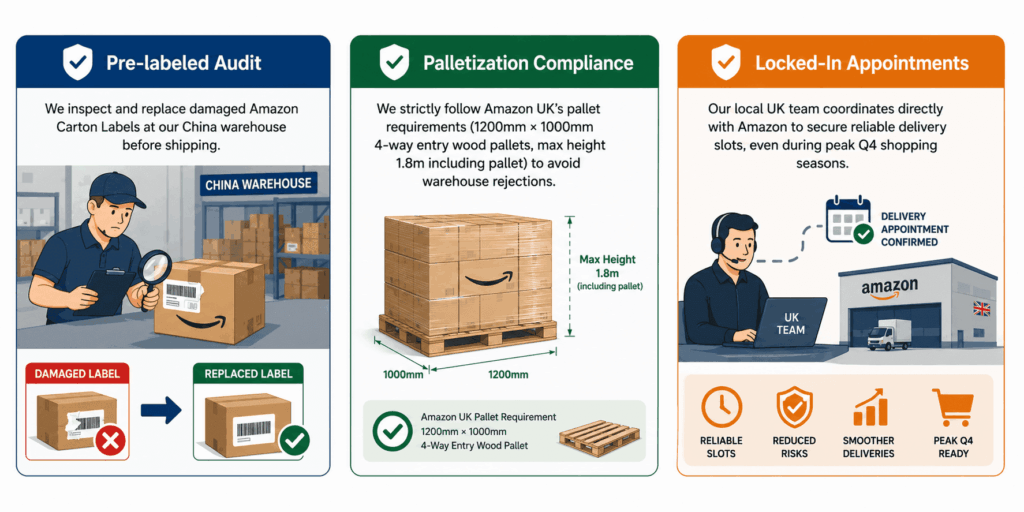
- Pre-labeled Audit: We inspect and replace damaged Amazon Carton Labels at our China warehouse before shipping.
- Palletization Compliance: We strictly follow Amazon UK’s pallet requirements (1200mm × 1000mm 4-way entry wood pallets, max height 1.8m including pallet) to avoid warehouse rejections.
- Locked-In Appointments: Our local UK team coordinates directly with Amazon to secure reliable delivery slots, even during peak Q4 shopping seasons.
Need a Custom Quote to a Specific Zip Code? > Don’t let customs paperwork slow you down. Contact Our UK Route Expert Today and get a comprehensive freight + customs quote within 2 hours.
How Should You Choose the Right Shipping Method?
Rather than asking:
“Which shipping method is the cheapest?”
A more useful question is:
“Which shipping method creates the best value for my business?”
As a general guide:
✅ Choose Sea Freight if:
- Cost is your primary concern.
- Your shipment is large or heavy.
- Delivery deadlines are flexible.
✅ Consider Rail Freight if:
- Sea freight takes too long.
- Air freight exceeds your budget.
- You need a practical balance between transit time and transportation cost.
✅ Choose Air Freight if:
- Delivery is urgent.
- Product value is high.
- Inventory shortages would cost more than the freight itself.
✅ Choose Express Courier if:
- Shipping samples.
- Sending documents.
- Delivering small parcels quickly.
No single transportation method is suitable for every shipment.
The best logistics solution depends on your cargo, budget, delivery schedule and overall business objectives.
Shipping Costs from China to the UK: What Determines Your Total Import Cost?
One of the most common questions we receive from UK importers is:
“How much does shipping from China to the UK cost?”
The honest answer is:
It depends.
Unlike buying a fixed-price product, international shipping costs are influenced by many different factors. Two shipments moving along the same route can have significantly different freight costs because of cargo size, shipping method, seasonal demand, customs requirements, and delivery destination.
Understanding these factors helps importers compare quotations more effectively and avoid unexpected logistics expenses.
What Makes Up the Total Shipping Cost?
Many first-time importers believe that the ocean freight quoted by a freight forwarder represents the total shipping cost.
In reality, international shipping consists of several cost components.
A typical shipment from China to the UK may include:
| Cost Component | Description |
|---|---|
| Freight Charges | Ocean freight, air freight or express transportation. |
| Origin Charges | Pickup, warehouse handling, export customs declaration and port operations in China. |
| Documentation Fees | Shipping documents and administrative processing. |
| Destination Charges | Terminal handling, local delivery arrangements and destination services. |
| Customs Duties & Import VAT | Taxes payable when importing goods into the UK (depending on product classification and customs value). |
| Final Delivery | Transportation from the UK port or airport to your warehouse, Amazon FBA fulfilment centre or business address. |
Looking only at the freight rate without understanding the complete logistics cost often leads to inaccurate budgeting.
How Much Does Shipping from China to the UK Cost?
One of the most common questions UK importers ask is:
“How much does shipping from China to the UK cost?”
The honest answer is:
There is no single shipping price.
International freight costs change constantly and depend on multiple factors rather than a fixed rate.
Instead of focusing only on the freight quote, experienced importers usually evaluate the total landed logistics cost, including transportation, customs-related charges, destination handling, and final delivery.
Understanding what affects shipping costs will help you compare quotations more accurately and avoid unexpected expenses.
What Factors Affect Shipping Costs?
Several variables influence the final transportation cost.
1. Shipping Method
The biggest factor is the transportation method you choose.
Generally speaking:
- Sea Freight is the most economical option for large shipments.
- Rail Freight offers a balance between cost and transit time.
- Air Freight provides much faster delivery but at a significantly higher cost.
- Express Courier is suitable for small packages and urgent samples.
The right choice depends on your shipment rather than simply choosing the cheapest quotation.
2. Cargo Volume and Weight
Ocean freight is usually charged according to:
- Container size (FCL)
- Cubic meters (LCL)
Air freight and express shipments normally consider:
- Actual weight
- Volumetric weight
Large but lightweight cargo may occupy significant space and therefore be charged according to its volumetric dimensions.
Proper packaging can often reduce unnecessary shipping expenses, for detailed guide, check our Gross Weight vs Volume Weight 2026 Guide
3. Departure and Destination
Transportation costs also vary depending on:
- Origin city in China
- Departure port
- Destination port in the UK
- Final delivery address
Deliveries to inland cities generally involve additional trucking costs compared with deliveries near major ports.
4. Seasonal Demand
Freight rates are rarely constant throughout the year.
During peak shipping seasons, such as before Christmas or major retail events, increased demand and limited vessel space often lead to higher transportation costs.
Planning shipments in advance can help reduce both transportation costs and booking pressure.
5. Additional Logistics Services
Some shipments require additional services, such as:
- Cargo inspection
- Export customs declaration
- Warehouse storage
- Palletizing
- Relabeling
- Cargo insurance
- Final delivery
These services may influence the overall logistics budget but can also reduce operational risks.
Shipping Time from China to the UK
For many importers, shipping cost is only half of the equation.
The other half is delivery time.
Whether you’re replenishing Amazon inventory, preparing for a seasonal sales campaign, or supplying products to retail customers, choosing the right shipping method can have a significant impact on your business.
One of the most common questions we receive is:
How long does shipping from China to the UK actually take?
The answer depends on several factors, including the transportation method, origin city, destination, customs clearance, and seasonal shipping conditions.
Below is a general comparison.
| Shipping Method | Estimated Transit Time* | Best For |
|---|---|---|
| 🚢 Sea Freight (FCL) | 30–45 days | Large commercial shipments |
| 🚢 Sea Freight (LCL) | 35–50 days | Smaller shipments requiring consolidation |
| 🚆 Rail Freight | 18–28 days | Businesses balancing cost and delivery speed |
| ✈️ Air Freight | 5–10 days | Urgent commercial cargo |
| 📦 Express Courier | 3–7 days | Samples, documents and small parcels |
*Transit times are estimates. Actual delivery may vary depending on vessel schedules, airline capacity, customs clearance, weather conditions, and peak shipping seasons.
As you can see, every shipping method involves a different balance between cost and transit time.
The fastest option is not always the best solution, and the cheapest option is not always the most economical if delayed inventory affects your business.
How Does the Shipping Process Work?
Many new importers assume that transit time only refers to the time spent on a ship or aircraft.
In reality, international shipping involves several stages before your goods arrive at your warehouse.
A typical shipment follows this process:

Every stage requires coordination.
Even if the ocean voyage itself takes around one month, delays at any stage may affect the overall delivery schedule.
Sea Freight Transit Time
Sea freight remains the most widely used transportation method for UK importers.
Typical transit times are:
- Shanghai → Felixstowe: approximately 30–38 days
- Shenzhen → Felixstowe: approximately 32–40 days
- Ningbo → Southampton: approximately 30–38 days
After vessel arrival, additional time is usually required for:
- Port handling
- Customs clearance
- Container release
- Inland transportation
Therefore, many businesses plan for a total logistics timeline of approximately 30–45 days under normal operating conditions.
For LCL shipments, consolidation and deconsolidation processes generally require additional handling time, making the overall transit slightly longer than FCL shipments.
Rail Freight Transit Time
Rail freight offers a practical alternative for businesses that require faster delivery than sea freight but want to avoid the high cost of air transportation.
Depending on the route and current operational conditions, rail freight generally requires around 18–28 days.
Rail transportation is particularly attractive for:
- Medium-sized commercial shipments
- Seasonal inventory replenishment
- Products with moderate delivery urgency
- Businesses seeking better inventory turnover
Although rail freight may not be suitable for every shipment, many importers find it an excellent compromise between transportation cost and delivery speed.
As international rail services may be influenced by operational conditions and route availability, it is advisable to confirm current schedules before arranging shipment.
Air Freight Transit Time
When delivery speed becomes the highest priority, air freight remains the preferred solution.
Commercial air freight typically arrives within:
5–10 days
including:
- Cargo collection
- Export customs procedures
- Flight arrangements
- UK customs clearance
- Local delivery
Air freight is commonly used for:
- Product launches
- Urgent replenishment
- High-value cargo
- Time-sensitive orders
Although transportation costs are considerably higher than sea or rail freight, avoiding stock shortages may justify the additional expense.
Express Courier Transit Time
International courier companies such as DHL, UPS and FedEx normally deliver within:
3–7 days
Door-to-door courier services include:
- Pickup
- Customs documentation
- International transportation
- Customs clearance
- Final delivery
For samples, prototypes and urgent documents, express delivery remains the fastest available option.
Why Do Shipping Delays Happen?
Many importers believe delays only occur because ships are slow.
In reality, international logistics is far more complex.
Several factors can influence delivery schedules.
Peak Shipping Seasons
Before Christmas, Black Friday and other major retail seasons, vessel space becomes limited.
Higher cargo volumes may result in:
- Delayed bookings
- Longer waiting times
- Port congestion
Planning shipments several weeks earlier can significantly reduce these risks.
Port Congestion
Major ports occasionally experience congestion due to:
- Increased cargo volumes
- Labour shortages
- Weather conditions
- Equipment availability
Even after a vessel arrives, containers may require additional time before release.
Customs Inspections
Both China and the UK conduct customs inspections.
If customs authorities request additional documentation or inspections, clearance may require extra time.
Providing accurate commercial invoices, packing lists and product descriptions helps minimise unnecessary delays.
Incomplete Shipping Documents
Incorrect documentation remains one of the most common causes of customs delays.
Typical issues include:
- Incorrect HS Codes
- Missing invoices
- Inconsistent cargo descriptions
- Incorrect consignee information
Preparing documentation carefully before shipment reduces the likelihood of customs problems.
Weather and Operational Factors
International transportation can occasionally be affected by:
- Severe weather
- Port strikes
- Shipping line schedule adjustments
- Airline capacity changes
While these situations cannot always be avoided, early planning helps reduce their impact on your supply chain.
How Can You Reduce Shipping Delays?
Although no freight forwarder can completely eliminate delays, there are several practical ways to improve delivery reliability.
1. Book Earlier
During peak seasons, booking one to three weeks before cargo is ready usually provides more sailing options and better space availability.
2. Prepare Documents in Advance
Ensure that commercial invoices, packing lists and shipping documents are complete before cargo reaches the port.
3. Choose the Right Shipping Method
If delivery deadlines are tight, rail freight may offer a better balance than sea freight.
For highly urgent shipments, air freight may ultimately be more cost-effective than missing important sales opportunities.
4. Work with an Experienced Freight Forwarder
International shipping requires coordination between suppliers, carriers, customs authorities and local delivery providers.
Experienced logistics planning can often prevent avoidable delays before they occur.
Which Shipping Method Is Fastest for Your Business?
The answer depends on what matters most to your business.
| Business Priority | Recommended Shipping Method |
|---|---|
| Lowest transportation cost | 🚢 Sea Freight |
| Best balance of speed and cost | 🚆 Rail Freight |
| Fastest commercial delivery | ✈️ Air Freight |
| Small urgent parcels | 📦 Express Courier |
Rather than asking:
“Which shipping method is the fastest?”
A better question is:
“Which shipping method allows my business to maintain inventory while controlling logistics costs?”
Finding that balance is often the key to building a reliable international supply chain.
UK Customs Clearance, Import VAT, DDP Shipping & Required Documents
For many first-time importers, arranging transportation is only one part of the process.
The next challenge begins when the shipment arrives in the United Kingdom.
Many businesses worry about questions such as:
- Will my shipment be delayed by UK Customs?
- What import taxes do I need to pay?
- What documents are required?
- Should I choose DDP shipping?
- What is the difference between DDP and DAP?
Understanding these procedures before your shipment leaves China can help avoid unnecessary delays, unexpected costs, and customs complications.
How Does UK Customs Clearance Work?
Every commercial shipment entering the United Kingdom must go through customs clearance.
Although the exact process may vary depending on the shipment and the selected Incoterms, a typical customs clearance process follows these steps.
Goods Arrive at UK Port
│
Import Declaration Submitted
│
HMRC Reviews Documentation
│
Import Duties & VAT Assessed
│
Customs Inspection (if selected)
│
Cargo Released
│
Final Delivery
For most shipments, customs clearance proceeds smoothly when the required documentation is accurate and complete.
Problems usually arise because of incorrect paperwork rather than customs itself.
Documents Required for Shipping from China to the UK
The exact documentation depends on the product category and shipping method.
However, most commercial shipments require the following documents.
| Document | Purpose |
|---|---|
| Commercial Invoice | Declares cargo value and transaction details |
| Packing List | Shows package quantity, dimensions and weight |
| Bill of Lading (Sea Freight) | Proof of shipment ownership |
| Air Waybill (Air Freight) | Air shipment transport document |
| Import Declaration | Required for UK customs clearance |
| Product Certificates (if applicable) | Required for certain regulated products |
Some products may require additional certificates depending on UK import regulations.
Preparing documentation carefully before shipment significantly reduces the likelihood of customs delays.
What Is Import Duty?
Import Duty is a customs charge that may apply when goods are imported into the UK.
The amount depends on several factors, including:
- Product classification (HS Code)
- Product origin
- Customs value
- Applicable trade rules
Different products may be subject to different duty rates.
For this reason, importers should always ensure that products are classified correctly before shipment.
Incorrect HS Codes can result in:
- Delayed customs clearance
- Incorrect duty assessments
- Additional customs enquiries
- Possible penalties in serious cases
Working with accurate product information from the beginning is always preferable to correcting customs declarations later.
Understanding UK Import VAT
In addition to customs duties, many imported products are also subject to Import VAT.
Import VAT is generally calculated based on the customs value of the goods together with other applicable import charges.
Businesses registered for VAT in the UK may be able to account for Import VAT according to current UK tax procedures, depending on their individual circumstances.
Because VAT regulations may change over time, importers should always confirm the latest requirements or consult their accountant when necessary.
What Is DDP Shipping?
One of the most frequently searched logistics terms is DDP Shipping.
DDP stands for Delivered Duty Paid.
Under a DDP arrangement, the seller or logistics provider generally arranges transportation, customs procedures and applicable import charges before delivering the shipment to the agreed destination.
For many UK importers, this simplifies the import process because they do not need to coordinate multiple logistics providers separately.
DDP shipping is particularly popular among:
- Small businesses
- First-time importers
- Amazon FBA sellers
- E-commerce companies
- Businesses without extensive importing experience
However, DDP may not be suitable for every shipment.
The most appropriate Incoterm depends on the importer’s business structure, customs requirements and supply chain strategy.
DDP vs DAP: What’s the Difference?
Many new importers confuse these two shipping terms.
The difference is mainly about responsibility for import charges.
| Item | DDP | DAP |
|---|---|---|
| International Transportation | ✔ | ✔ |
| UK Customs Clearance | ✔ | Usually arranged before delivery, with importer responsibilities depending on the agreement |
| Import Duties | ✔ | Importer responsible |
| Import VAT | ✔ | Importer responsible |
| Final Delivery | ✔ | ✔ |
Generally speaking:
Choose DDP if you prefer a more straightforward shipping solution with fewer logistics arrangements on your side.
Choose DAP if you already have experience handling UK imports and prefer to manage customs-related responsibilities yourself.
Before selecting any Incoterm, always confirm exactly which services are included in the quotation.
Why Do Some Shipments Get Delayed by Customs?
Most customs delays are preventable.
Common reasons include:
Incorrect Product Descriptions
Descriptions such as:
- “Accessories”
- “General Goods”
- “Samples”
are often too vague.
Providing detailed product descriptions helps customs officers process shipments more efficiently.
Incorrect HS Codes
HS Codes determine:
- Customs classification
- Duty calculation
- Regulatory requirements
Incorrect classification may require additional customs review.
Missing Documents
Incomplete invoices or packing lists frequently cause unnecessary delays.
Checking documentation before cargo departure is far easier than correcting paperwork after arrival.
Restricted or Regulated Products
Certain products may require additional documentation before entering the UK.
Examples include:
- Medical devices
- Food products
- Cosmetics
- Chemicals
- Certain batteries
- Products requiring safety certification
Importers should verify product-specific requirements before shipment.
How to Make UK Customs Clearance Smoother
Experienced importers usually follow several simple practices.
Prepare Accurate Documentation
Ensure:
- Commercial invoices are complete.
- Cargo descriptions are specific.
- HS Codes are reviewed.
- Product quantities match the packing list.
Confirm Import Requirements Before Shipment
Some products require additional documentation.
Confirming these requirements before cargo leaves China helps prevent delays after arrival.
Choose the Appropriate Shipping Terms
Not every shipment requires DDP.
Some experienced importers prefer FOB or DAP because these terms better fit their internal logistics processes.
The best choice depends on your company’s operational requirements rather than selecting the same Incoterm for every shipment.
Which Shipping Option Is Right for You?
The table below provides a simple comparison.
| Your Situation | Recommended Solution |
|---|---|
| First-time importer | DDP Shipping |
| Small business with limited import experience | DDP Shipping |
| Experienced importer with customs broker | DAP / FOB |
| Amazon FBA seller seeking simplified logistics | DDP Shipping |
| Company with established UK import procedures | FOB or DAP |
There is no universally “best” shipping term.
The right solution depends on your business experience, supply chain structure and customs management capabilities.
Post-Brexit UK Customs & VAT: How We Guarantee Hassle-Free Clearance
Ever since the UK officially left the EU, customs clearance isn’t as simple as it used to be. A single mismatch on your paperwork can leave your container stranded at Felixstowe or Southampton, racking up hundreds of pounds in daily port storage fees.
At KISUN, we don’t just move boxes; we handle the entire UK customs compliance framework so you don’t have to face unexpected delays. Here is how we protect your shipment:
1. GB EORI vs. EU EORI: Getting the Basics Right
To import goods into the UK, you must have a valid GB EORI number (Economic Operators Registration and Identification).
- The Trap: Many overseas sellers mistakenly try to use an EU EORI number (starting with FR, DE, etc.). This will result in an immediate rejection at the UK border.
- Our Solution: We audit your EORI status before your goods leave the China port. If you don’t have one, our team can guide you through the registration process to ensure seamless compliance.
2. Postponed VAT Accounting (PVA) – Keep Your Cash Flow at £0
Paying 20% Import VAT upfront can severely tie up your business cash flow.
- How We Help: We fully utilize the UK’s Postponed VAT Accounting (PVA) system via the Customs Declaration Service (CDS). Instead of paying Import VAT at the port of entry, we declare it on your periodic VAT return.
- The Result: You pay £0 upfront VAT at the border, keeping your cash right where it belongs—in your business.
3. Precision HS Code Classification
The UK Customs (HMRC) has heavily digitized its compliance tracking. Miscalculated duty rates or incorrect Commodity Codes (HS Codes) are the #1 reason for customs audits. Our in-house customs brokers review your commercial invoices and product specs in China to map out the exact UK tariff codes, eliminating the risk of underpayment penalties or border holds.
What’s Prohibited shipping from China to UK?

How It Works?
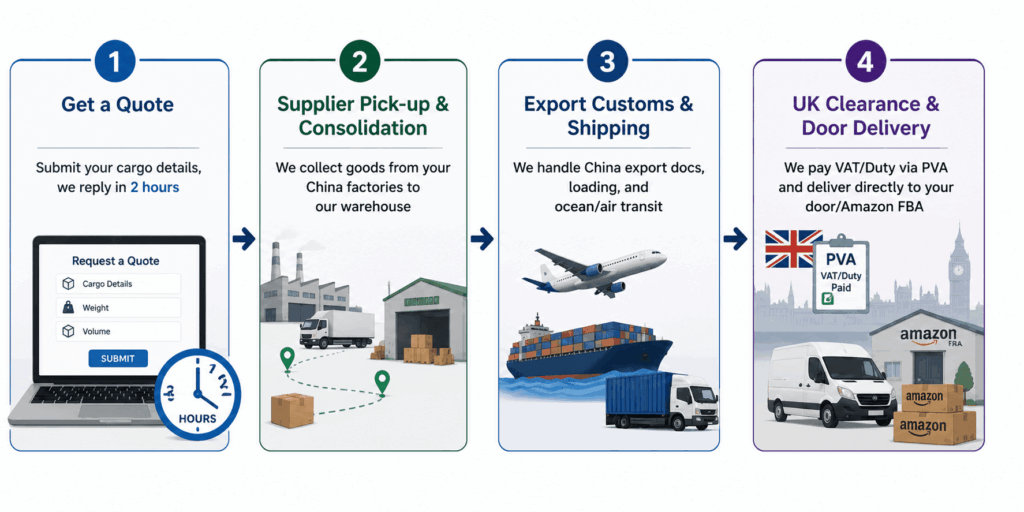
- Step 1: Get a Quote (Submit your cargo details, we reply in 2 hours)
- Step 2: Supplier Pick-up & Consolidation (We collect goods from your China factories to our warehouse)
- Step 3: Export Customs & Shipping (We handle China export docs, loading, and ocean/air transit)
- Step 4: UK Clearance & Door Delivery (We pay VAT/Duty via PVA and deliver directly to your door/Amazon FBA)
Frequently Asked Questions (FAQ)
Q1: What is the cheapest way to ship goods from China to the UK?
A: For shipments over 2 CBM or 200 kg, Sea Freight (LCL/FCL) is the most cost-effective option. If your cargo volume is small (under 100 kg), Air Express (DHL/FedEx/UPS) or specialized air cargo lines often end up being cheaper when you factor in the fixed local port fees associated with ocean shipping.
Q2: How long does shipping from China to the UK take in 2026?
A: It depends entirely on the transit mode:
- Air Express: 3–5 business days (door-to-door).
- Air Freight: 5–9 days (airport-to-airport).
- Rail Freight: 20–25 days via the Eurasian Land Bridge.
- Sea Freight: 28–40 days, depending on whether you route via Southern ports (Southampton) or Northern hubs (Felixstowe).
Q3: Do I need a UK VAT and EORI number to import from China?
A: Yes. To clear UK customs legally, you must have a valid GB EORI number. If you are registering as a UK business, you will also need a UK VAT number to leverage Postponed VAT Accounting (PVA), which allows you to defer your 20% import VAT instead of paying it upfront at the port. If you are an overseas seller without these, we can provide a DDP (Delivered Duty Paid) solution using our own clearance import entities.
Q4: Who handles the customs clearance process in the UK?
A: At KISUN, we handle the entire customs entry process through the UK’s Customs Declaration Service (CDS) system. Our in-house brokers check your commercial invoices and HS codes before departure from China to ensure full compliance with HMRC regulations, avoiding costly border delays or penalty fees.
Q5: Can you ship directly to UK Amazon FBA warehouses?
A: Yes, we specialize in Amazon UK logistics. We manage the entire supply chain: picking up from your China factory, auditing Amazon FNSKU labels, booking delivery slots via the CARP system, and palletizing cargo according to strict Amazon UK guidelines (1200mm × 1000mm standards) to prevent warehouse rejections at hubs like BHX4, EMA1, or LCY2.

LOOKING FOR THE BEST FREIGHT FORWARDER FROM CHINA?
WE CAN BE YOUR FIRST CHOICE.

Happy Customers

Get Started shipping to UK with Kisun Shipping
To Get A Quick Quote