
DDP Shipping from China to the UK: What’s Included and How It Works
For many UK importers, the most difficult part of buying from China is not finding a supplier. It is dealing with everything that happens after the goods are ready to ship.
International transportation is only one part of the process. Import customs, duties, VAT, documentation and final delivery can all require additional coordination.
This is where DDP shipping from China to the UK can be useful.
DDP stands for Delivered Duty Paid. Under Incoterms® 2020, the seller is responsible for bringing the goods to the agreed destination, completing the export and import formalities, and paying the applicable import duty and taxes. DDP can be used for any mode of transport, including multimodal transportation.
But there is an important point that many DDP articles do not explain clearly:
DDP does not simply mean “the freight forwarder pays everything.” The actual customs and tax arrangement behind the service matters.
At Kisun Shipping, our DDP solution is designed for UK importers who want us to handle the China-to-UK transportation, import clearance, applicable duties and taxes, and final delivery as one coordinated service.
Quick Answer
DDP (Delivered Duty Paid) is a shipping arrangement where the seller is responsible for delivery to the agreed destination, import clearance, and applicable import duties and taxes under the agreed Incoterms® 2020 arrangement.
At Kisun Shipping, our China-to-UK DDP service can include supplier pickup, warehouse/consolidation, export handling, international transportation, UK import customs clearance, Duty/VAT handling and final delivery.
We currently offer Sea DDP, Rail DDP, Truck DDP and Air DDP.
What Does DDP Mean for a UK Importer?
For a UK customer using our DDP service, you do not need to provide your own EORI or VAT number to us for the DDP arrangement.
We handle the import clearance and related tax arrangements through our established UK import and customs arrangements.
This is different from our DAP service, where the importer provides their required EORI and VAT information and authorises our customs broker to handle the import declaration on their behalf.
This distinction is important because UK commercial imports normally require customs arrangements and an appropriate EORI. GOV.UK states that businesses importing into Great Britain generally need a GB EORI, while businesses that are not eligible to obtain one may appoint someone to handle customs on their behalf.
Therefore, we would not describe DDP as:
“The importer never needs an EORI.”
A more accurate description is:
With our DDP service, the UK customer does not need to provide their own EORI or VAT details to us. We arrange the import clearance and applicable tax handling through our own established import and customs arrangements.
This is the practical difference between our DDP and DAP solutions.
How Does DDP Shipping from China to the UK Work?
The basic process is:
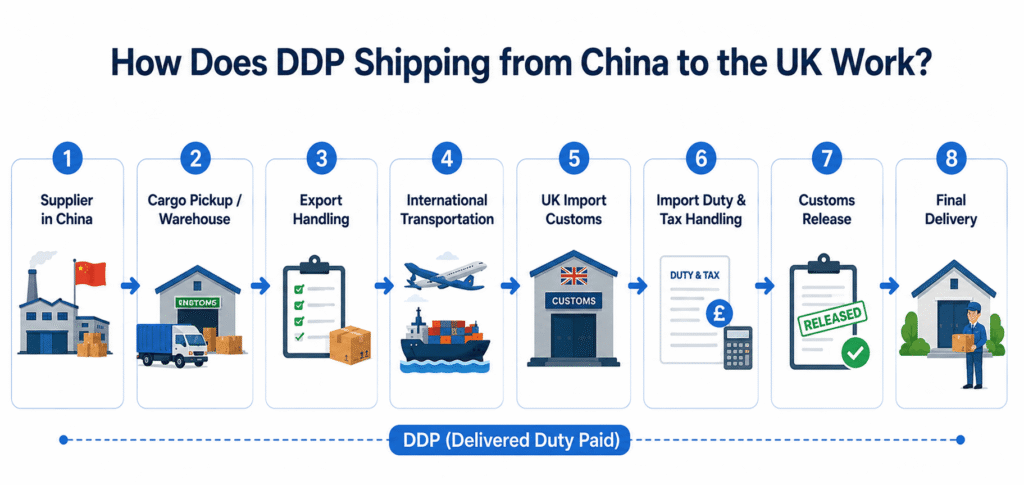
The advantage is not simply transportation.
The main advantage is that the importer does not have to coordinate each stage separately.
Instead of arranging:
China freight + UK customs broker + tax payment + UK delivery
the shipment is managed as one DDP logistics solution.
GOV.UK confirms that importers can appoint a transporter or customs agent to handle customs declarations and clearance on their behalf.
What Is Included in Our DDP Service?
The exact scope should always be confirmed in the quotation, but our DDP solutions can be arranged to cover the main stages of the China-to-UK shipment:
- Pickup from the supplier in China
- Export handling
- International transportation
- UK import customs clearance
- Applicable import duty and tax handling
- Final delivery to the agreed UK destination
The final quotation should clearly state what is included and how exceptional situations are handled.
For example, storage, inspection, demurrage, special handling, redelivery or other unusual charges may require separate arrangements depending on the shipment.
This is why a very low “DDP price” should not automatically be considered the best quotation.
Always compare the service scope, not just the final number.
DDP Shipping by Sea, Rail, Truck or Air
One important advantage of our UK service is that DDP is not limited to one transportation method.
We can arrange DDP through:
| DDP Shipping Method | Typical Door-to-Door Time* | Best For |
|---|---|---|
| 🚢 Sea DDP | 45–55 days | Large and cost-sensitive shipments |
| 🚆 Rail DDP | 35–45 days | A balance between cost and delivery time |
| 🚛 Truck DDP | 25–30 days | Faster delivery without using air freight |
| ✈️ Air DDP | 12–15 days | Urgent or time-sensitive shipments |
*These are typical service ranges based on our current China-to-UK operations and are intended for planning purposes rather than as guaranteed delivery dates. Actual timing depends on the route, cargo readiness, carrier schedules, customs procedures and other operational conditions.
This gives importers more flexibility.
For example, if sea freight is too slow but air freight is too expensive, rail DDP or truck DDP may provide a more suitable middle ground.
The DDP arrangement remains similar; what changes is the international transportation method and resulting cost and delivery time.
Who Can Benefit from DDP Shipping?
DDP can be particularly useful for businesses that want to simplify the importing process.
This may include:
- First-time UK importers
- Small and medium-sized businesses
- E-commerce sellers
- Amazon sellers
- Businesses without an established customs operation
- Importers who prefer one logistics provider to coordinate the entire shipment
The main value is operational simplicity.
Instead of learning every step of UK import procedures before their first shipment, the importer can work with a logistics provider that coordinates the transportation and customs process.
That does not remove the importance of providing accurate product and shipment information. Correct product descriptions, values, quantities and other relevant details are still essential for compliant customs processing.
DDP Is Not Automatically the Best Choice for Everyone
DDP is convenient, but convenience is not the same as suitability.
A UK company with an established import department, its own customs broker and existing VAT processes may prefer a different arrangement such as DAP.
Under DAP, the seller handles transportation to the agreed destination, while the buyer generally handles import clearance and import duties and taxes.
Our DAP service therefore works differently:
The customer provides the required EORI and VAT information and authorises our customs broker to handle the import declaration on their behalf.
This can be more appropriate for businesses that already have their own UK import setup and want to retain responsibility for the import side.
The choice between DDP and DAP should therefore be based on your business structure, not simply which service has the lower freight quotation.
One Important Question to Ask Before Booking DDP
Before accepting a DDP quotation from any freight forwarder, ask:
“Exactly what is included in the quoted DDP price?”
At minimum, clarify:
- Is pickup in China included?
- Is export handling included?
- Which transportation method is being used?
- Is UK import customs clearance included?
- Are import duty and applicable taxes included?
- Is final delivery included?
- What happens if the shipment requires inspection, storage or special handling?
Two companies can both call their service “DDP” while offering different scopes or handling exceptional costs differently.
A clear quotation protects both sides.
Final Takeaway
DDP shipping from China to the UK is not simply about paying one price instead of several invoices.
The real benefit is having the transportation, import clearance, applicable duties and taxes, and final delivery coordinated as one logistics solution.
At Kisun Shipping, we offer Sea DDP, Rail DDP, Truck DDP and Air DDP, allowing UK importers to choose a delivery solution according to their cargo, budget and required timeframe.
For our DDP arrangement, UK customers do not need to provide their own EORI or VAT details to us. We handle the import clearance and associated tax arrangements through our established UK import and customs setup.
For customers choosing DAP, the process is different: the importer provides the required EORI and VAT information and authorises our customs broker to handle the import declaration.
If you are unsure which arrangement is appropriate for your shipment, the most useful information to provide is your product type, cargo volume or weight, supplier location in China and UK delivery postcode. From there, the available DDP options can be evaluated based on both cost and delivery requirements.
What Is Actually Included in Our DDP Shipping Service?
One of the most important questions to ask before booking DDP shipping is simple:
What exactly is included in the quoted DDP price?
The term DDP is often used by freight forwarders to describe an all-in-one shipping solution, but the actual service scope can differ between providers.
For this reason, UK importers should not compare DDP quotations based only on the final price.
With our DDP service from China to the UK, the logistics process is arranged as a complete chain:
China Pickup → Warehouse/Consolidation → Export Handling → International Transportation → UK Import Customs → Duty & VAT → Final Delivery
Here is what each stage means in practice.
1. Pickup from Your Supplier in China
The DDP process can begin with collection directly from your supplier.
This is useful when you purchase from factories or trading companies located in different parts of China and do not want to arrange domestic transportation yourself.
We coordinate the movement of the cargo from the supplier to the appropriate warehouse or shipping location.
The exact pickup arrangement depends on the supplier’s address, cargo size and shipment requirements.
2. Warehouse Receiving and Cargo Consolidation
For importers purchasing from multiple suppliers, the goods can be sent to a warehouse in China before international shipment.
The warehouse can be used to:
- Receive cargo from different suppliers
- Consolidate shipments
- Organise the cargo for export
- Prepare the shipment for the selected transportation method
This can be particularly useful for businesses that purchase from several factories but want to move the goods internationally as one coordinated shipment.
Instead of managing several individual shipments, the importer can work through one consolidated logistics arrangement.
3. Export Handling in China
Before the goods leave China, the shipment needs to be prepared for international transportation.
This stage includes the necessary export handling and coordination for the selected shipping method.
Accurate cargo information remains important at this stage, including details such as:
- Product description
- Quantity
- Weight and dimensions
- Commercial documentation
- Other information required for the shipment
Providing accurate information from the beginning helps reduce avoidable problems later in the logistics process.
4. International Transportation
Once the cargo is ready for export, we arrange the international transportation according to the agreed DDP solution.
Our China-to-UK DDP services are available through:
- Sea Freight DDP
- Rail Freight DDP
- Truck Freight DDP
- Air Freight DDP
This means the DDP solution does not force every importer into the same transportation method.
A customer focused on lower logistics costs may choose sea freight, while another importer with a tighter delivery requirement may choose rail, truck or air transportation.
The transportation method, expected delivery range and service scope should be confirmed in the quotation before shipment.
5. UK Import Customs Clearance
After the cargo arrives in the UK, import customs procedures still need to be completed before the goods can proceed to final delivery.
Under our DDP arrangement, we coordinate the UK import customs process as part of the service.
This is one of the main differences between DDP and a shipment where the importer manages the import process independently.
As explained earlier in this guide, our DDP arrangement does not require the UK customer to provide their own EORI or VAT details to us. We handle the import clearance through our established UK customs and import arrangements.
The importer still needs to provide accurate information about the goods and shipment so that the customs process can be handled correctly.
6. Import Duty and VAT
Another important part of the DDP arrangement is the handling of applicable import duty and VAT.
These costs are included in the agreed DDP service, subject to the quotation and the specific shipment.
This is important because some low freight quotations can appear attractive until the importer discovers that customs-related costs have not been included.
When comparing DDP quotations, always confirm whether the quoted amount includes:
- Import duty
- VAT
- Customs clearance
- Final delivery
A genuine comparison should be based on the total agreed service scope, not simply the headline freight rate.
7. Final Delivery in the UK
The final stage is delivery to the agreed destination.
Depending on the shipment, this may be a:
- Business address
- Warehouse
- Distribution centre
- Other agreed delivery location
The objective of the DDP service is to coordinate the shipment all the way from the supplier in China to the agreed delivery point in the UK.
This means the importer does not need to arrange separate logistics providers for international transportation, import clearance and final delivery.
What Should You Confirm Before Accepting a DDP Quote?
Even when a freight forwarder describes a shipment as DDP, it is still important to ask what the quoted price actually covers.
A clear DDP quotation should make the service scope understandable.
At a minimum, confirm whether the quotation covers:
| Service | Included in Our DDP Service |
|---|---|
| Supplier pickup in China | ✅ |
| Warehouse receiving / consolidation | ✅ |
| Export handling | ✅ |
| International transportation | ✅ |
| UK import customs clearance | ✅ |
| Import Duty / VAT handling | ✅ |
| Final delivery | ✅ |
Exceptional situations should also be clarified in advance.
For example, additional costs may arise in unusual circumstances involving storage, inspections, special handling, redelivery or other services outside the agreed scope.
This is why a reliable DDP quotation should explain not only what is included, but also how exceptional situations are handled.
Why the DDP Service Scope Matters More Than the Headline Price
Imagine two freight forwarders quote DDP for the same shipment.
One quotation is significantly cheaper.
At first, it looks like the obvious choice.
But after closer comparison, you discover that the two quotations do not include exactly the same services.
If one quotation excludes certain destination charges or handles exceptional situations differently, the initial price comparison may be misleading.
This is why we recommend comparing DDP quotations using the same checklist:
Pickup + Export + International Transport + UK Customs + Duty/VAT + Final Delivery
Only after these elements are clear does the price comparison become meaningful.
A DDP Quote Should Answer One Simple Question
Before booking, you should be able to answer:
“What will I still need to arrange or pay for after accepting this quotation?”
A well-defined DDP service should make that answer clear.
At Kisun Shipping, our DDP solutions are designed to coordinate the major logistics stages from the supplier in China through to the agreed UK delivery destination, with the specific service scope confirmed in the quotation.
In the next section, we’ll compare Sea DDP, Rail DDP, Truck DDP and Air DDP and explain how UK importers can choose between them based on delivery requirements and cargo characteristics.
Sea DDP vs Rail DDP vs Truck DDP vs Air DDP: Which One Fits Your Shipment?
DDP does not mean there is only one way to transport your goods from China to the UK.
The customs and delivery arrangement can be structured as DDP, while the international transportation method can still be chosen according to your cargo, budget and required delivery time.
At Kisun Shipping, we currently arrange four DDP options:
- Sea Freight DDP
- Rail Freight DDP
- Truck Freight DDP
- Air Freight DDP
The key difference is therefore not the DDP itself, but how quickly your goods need to reach the UK and how much you are prepared to spend to achieve that delivery time.
Sea Freight DDP: When Cost Matters Most
For larger shipments that do not require urgent delivery, sea freight DDP is generally the most cost-oriented option.
Our typical door-to-door service timeframe is approximately:
45–55 days
Sea DDP can be suitable for:
- Full container loads
- LCL shipments
- Furniture
- Building materials
- Heavy or bulky products
- Regular inventory that is planned in advance
The main advantage is that you can combine international sea transportation with a DDP solution, allowing the customs, duty/VAT handling and final delivery to be coordinated as part of the same service.
The main trade-off is time.
If your business has only a few weeks of inventory remaining, sea DDP may not provide enough flexibility.
Rail DDP: A Middle Option Between Sea and Faster Services
Rail DDP is designed for importers who need a faster solution than sea freight but do not necessarily need the speed of air transportation.
Our typical door-to-door timeframe is approximately:
35–45 days
Rail DDP can make sense for businesses that:
- Need to replenish inventory sooner
- Want to reduce the lead time compared with sea freight
- Are not willing to pay full air-freight costs
- Have medium-term delivery requirements
For example, an importer may find that waiting 45–55 days for sea freight creates too much inventory pressure, while air freight is difficult to justify for the entire shipment.
Rail can provide another option between those two extremes.
Rail availability and transit schedules should always be confirmed when the shipment is booked because routes and operating conditions can change.
Truck DDP: When Rail Is Still Too Slow
Truck DDP is one of the more interesting options for importers who need a faster solution without moving the entire shipment by air.
Our typical door-to-door timeframe is approximately:
25–30 days
This creates a useful middle ground:
Sea DDP → 45–55 days
Rail DDP → 35–45 days
Truck DDP → 25–30 days
Air DDP → 12–15 days
Truck DDP can be particularly relevant when:
- Your inventory is running lower than expected
- Sea freight is no longer fast enough
- Rail still does not meet the required delivery window
- Air freight would add too much cost to the shipment
This does not mean truck DDP is automatically the best option.
Its value is that it gives importers another time-and-cost point to consider rather than forcing a choice between slow sea freight and expensive air freight.
Air DDP: For Time-Sensitive Shipments
Air DDP is the fastest option among the four services discussed here.
Our typical door-to-door timeframe is approximately:
12–15 days
It may be suitable for:
- Urgent inventory replenishment
- Time-sensitive commercial orders
- High-value products
- Product launches
- Shipments where the cost of waiting is greater than the additional freight cost
The advantage is straightforward: significantly shorter delivery time.
The trade-off is transportation cost.
For this reason, air DDP is normally most useful when the business benefit of receiving the goods earlier can justify the higher logistics expense.
The Four DDP Options at a Glance
| DDP Service | Typical Door-to-Door Time | Main Advantage | Typical Use Case |
|---|---|---|---|
| Sea DDP | 45–55 days | Cost efficiency | Large, planned shipments |
| Rail DDP | 35–45 days | Cost/time balance | Planned replenishment |
| Truck DDP | 25–30 days | Faster without air | More time-sensitive inventory |
| Air DDP | 12–15 days | Speed | Urgent shipments |
These timeframes reflect our current China-to-UK service experience and should be treated as typical planning ranges rather than guaranteed delivery dates.
The Most Useful Question Is Not “Which DDP Is Cheapest?”
When comparing DDP options, importers often focus on the quoted price.
A better approach is to ask:
How much is it worth to receive my inventory earlier?
Consider a simple example.
Suppose you have a shipment worth £30,000 and your current stock will last another 40 days.
A lower-cost sea DDP service may appear attractive.
But if the shipment takes 45–55 days, you may face a period without enough stock.
In contrast, paying more for a faster service could reduce the risk of lost sales.
The correct decision therefore depends on the relationship between:
Shipping Cost + Inventory Risk + Required Delivery Time
Not the freight rate alone.
Can You Use Different DDP Methods for Different Shipments?
Yes.
There is no requirement for an importer to use the same DDP transportation method every time.
A business might use:
- Sea DDP for normal inventory
- Rail DDP for planned replenishment
- Truck DDP when stock becomes tighter
- Air DDP for genuinely urgent orders
This approach allows the transportation method to change according to the business situation rather than treating every shipment identically.
For regular importers, this can provide more flexibility when demand, inventory levels or delivery deadlines change.
What Should You Tell Your Freight Forwarder?
To recommend an appropriate DDP option, the freight forwarder needs enough information to understand the shipment.
Useful information includes:
- Product type
- Number of cartons
- Gross weight
- Cargo volume
- Supplier location in China
- Cargo ready date
- UK delivery postcode
- Required delivery date
The more complete the information, the easier it is to compare the available DDP options realistically.
The Right DDP Option Depends on the Shipment
There is no universal winner.
Sea DDP is usually the logical starting point when cost is the main consideration.
Rail DDP may be more attractive when you need to shorten the lead time without moving to air.
Truck DDP provides another option when you need faster delivery than rail but want to avoid full air-freight pricing.
Air DDP is the strongest option when delivery speed is critical.
The important point is that all four options can be built around the same basic DDP objective: coordinating transportation, UK import clearance, applicable duty/VAT handling and final delivery as one logistics solution.
In the final part, we will look at how to compare DDP quotations, what questions to ask before booking, common mistakes to avoid, and when DDP may not be the right choice for a UK importer.
How to Compare DDP Shipping Quotes from China to the UK
A DDP quotation can look very simple:
One price from China to your UK address.
But two freight forwarders can both offer “DDP” and still provide different service scopes, transportation routes and handling arrangements.
This is why comparing only the final price can be misleading.
Before booking, make sure you understand exactly what each quotation covers.
7 Questions to Ask Before Booking DDP
1. Is Pickup in China Included?
Some quotations may start from a warehouse or port rather than the supplier’s address.
Confirm whether the quoted price includes collection from your supplier.
If you purchase from multiple factories, also ask whether the quotation covers collection from multiple suppliers or whether consolidation charges apply separately.
2. Which Transportation Method Is Being Used?
“DDP” describes the delivery arrangement. It does not tell you how the goods will travel.
A DDP quotation should clearly identify whether the shipment will move by:
- Sea
- Rail
- Truck
- Air
This matters because the transportation method directly affects both transit time and cost.
For example, a sea DDP quotation should not be compared directly with an air DDP quotation simply because both are described as DDP.
3. Is UK Import Clearance Included?
This is one of the most important questions.
Under DDP, the seller is responsible for import clearance and applicable import duties and taxes under the Incoterms® 2020 rule.
GOV.UK also confirms that businesses can appoint a customs agent or transporter to deal with import declarations and customs clearance on their behalf.
For our DDP arrangement, UK import customs clearance is included in the service.
The exact customs arrangement should still be confirmed before shipment, particularly for products subject to specific import requirements.
4. Are Import Duty and VAT Included?
Do not assume that the word “DDP” on a quotation automatically tells you everything about the final cost.
Confirm specifically whether the quoted amount includes:
- Import Duty
- Import VAT
- Customs clearance
Under the DDP Incoterms® rule, the seller bears the responsibility for import clearance and payment of import duty and applicable taxes.
For our DDP service, Duty and VAT handling is included according to the agreed quotation.
This is one of the areas where comparing the complete quotation is much more useful than comparing the headline freight rate.
5. Is Final Delivery Included?
Ask where the quoted DDP service actually ends.
For example:
UK port
is not the same as:
Your warehouse in Manchester
or:
Your business address in Birmingham.
Our DDP service is designed as a door-to-door solution to the agreed UK destination.
The delivery address should therefore be provided when requesting a quotation so that the final delivery requirements can be assessed correctly.
6. What Happens If Something Unusual Occurs?
A professional DDP quotation should also make clear how exceptional situations are handled.
For example:
- Customs inspection
- Storage
- Demurrage
- Special handling
- Redelivery
- Unusually remote delivery locations
These situations are not necessarily part of the normal shipping process, so they should not simply be assumed to be included in every quotation.
The safest approach is to clarify them before booking rather than after the cargo has arrived.
7. What Information Does the Freight Forwarder Need?
A realistic DDP quotation cannot be prepared accurately without enough information about the shipment.
At a minimum, provide:
- Product description
- Cargo quantity
- Carton dimensions
- Gross weight
- Cargo volume
- Supplier location in China
- Cargo ready date
- UK delivery postcode
For some products, additional product or compliance information may also be required.
The more complete the information, the easier it is for the freight forwarder to recommend an appropriate route and provide a meaningful quotation.
Why the Lowest DDP Quote May Not Be the Cheapest Option
Consider two quotations:
Quote A
£X
Quote B
£X + £500
At first glance, Quote A appears better.
But after checking the service scope, you discover that Quote A handles the main transportation while some destination-related or exceptional charges are treated separately.
Quote B includes a broader service scope and provides a clearer arrangement from pickup through final delivery.
The second quotation may therefore be the better value even though its headline price is higher.
The lesson is simple:
Compare DDP quotations line by line, not just by the final number.
Common Mistakes When Booking DDP
1. Choosing the Cheapest Quote Without Checking the Route
A low price can sometimes reflect a different transportation method, routing arrangement or service scope.
Always confirm how the shipment will actually move.
2. Assuming All “DDP” Services Are Identical
The word DDP refers to an Incoterms® delivery rule. It does not mean every freight forwarder’s operational process is identical.
The actual customs, transportation and delivery arrangements still need to be clearly defined.
3. Providing Inaccurate Product Information
Customs declarations depend on accurate information.
Product descriptions, values, quantities and other shipment details should be reviewed before cargo departure.
For imports into Great Britain, customs procedures require appropriate information and businesses using customs intermediaries still have responsibilities concerning the accuracy and due diligence of declarations.
When DDP May Not Be the Best Choice
DDP is convenient, but it is not automatically the best arrangement for every UK importer.
A company may prefer DAP or another arrangement when it already has:
- Its own UK customs process
- An established customs broker
- Internal import management
- Its own approach to import VAT and duty accounting
Under DAP, the buyer is responsible for import clearance and related import costs under Incoterms® 2020.
For our DAP service, the customer provides the required EORI and VAT information and authorises our customs broker to handle the import declaration on their behalf.
GOV.UK states that businesses importing into Great Britain generally need a GB EORI and that, where appropriate, a customs intermediary can be appointed to handle declarations.
By contrast, under our DDP arrangement, the UK customer does not need to provide their own EORI or VAT details to us; we use our established UK import and customs arrangements for the shipment.
This is a description of our operational DDP arrangement, not a general statement that UK importers never need an EORI. UK EORI requirements depend on the actual importer and customs structure.
Frequently Asked Questions
Does DDP include customs clearance in the UK?
Under the DDP Incoterms® rule, the seller is responsible for import clearance. Our DDP service includes UK import customs clearance as part of the agreed arrangement.
Does DDP include import duty and VAT?
Our DDP service includes Duty and VAT handling according to the agreed quotation. Under Incoterms® 2020, DDP places responsibility for applicable import duty and taxes on the seller.
Do I need my own EORI for your DDP service?
For our DDP arrangement, the customer does not need to provide their own EORI or VAT details to us. We handle the import process through our established UK import and customs arrangements.
This should not be confused with the general UK EORI rules, under which businesses importing into Great Britain will usually need an EORI when they act as the importer or make customs declarations themselves.
Do I need an EORI for your DAP service?
Yes. Under our DAP arrangement, the importer provides the required EORI and VAT information and authorises our customs broker to handle the import declaration on their behalf.
Can DDP be used for Amazon FBA shipments?
Yes, DDP can be arranged for shipments destined for Amazon FBA, but the shipment must still meet the relevant product, labelling, packaging and delivery requirements.
Can I choose sea, rail, truck or air DDP?
Yes. We currently arrange all four options, with the appropriate route selected according to the cargo and delivery requirements.
Final Thoughts
The most important thing to understand about DDP is that the label itself is not enough.
A good DDP quotation should tell you:
What is being transported?
How is it being transported?
Who handles UK import clearance?
Who handles Duty and VAT?
Where does final delivery take place?
What happens if something unusual occurs?
Once these points are clear, comparing quotations becomes much easier.
At Kisun Shipping, we provide Sea DDP, Rail DDP, Truck DDP and Air DDP from China to the UK, with the transportation, UK import clearance, Duty/VAT handling and final delivery coordinated according to the agreed service.
If you are comparing DDP quotations, send us your product type, cargo volume/weight, supplier location in China and UK delivery postcode. We can evaluate the available DDP option based on the actual shipment rather than simply offering a generic rate.

China Logistics Expert
About the Author
Katherine Kang is a China-based logistics consultant with over 11 years of experience in international trade and freight forwarding. Specializing in helping SMEs import from China she focuses on compliant, cost-effective solutions to avoid delays, tariffs, and hidden fees. From anti-dumping guidance to CNY planning, Katherine has managed hundreds of shipments, saving clients 15-30% on average.
Connect with Katherine on LinkedIn or contact Kisun Shipping for a free import consultation.