Undeclared Goods When Shipping From China: Why Even Small Gifts Matter
What Looks Like a Small Favor Can Become a Serious Customs Problem
If you have been importing products from China for a while, you’ve probably experienced this situation—or your supplier may have suggested it.
“We’ve added a few gifts inside the cartons for you.”
Maybe it’s some local tea.
Maybe it’s a branded wallet.
Maybe it’s a few product samples.
Or perhaps it’s simply an electronic gadget as a thank-you gift.
At first glance, it sounds like a thoughtful gesture.
Unfortunately, from a customs perspective, it can create a serious compliance problem.
At Kisun Shipping, we regularly remind factories and suppliers not to place any additional items inside export shipments unless they are properly declared. Yet we still encounter cases where suppliers quietly add “small gifts” after the packing list has already been finalized.
Sometimes it’s only one carton.
Sometimes it’s a laptop.
Sometimes it’s branded leather products.
Sometimes it’s food, tea, cosmetics, or electronic accessories.
The common belief is always the same:
“It’s only a few extra items. Customs won’t notice.”
Unfortunately, customs authorities don’t see it that way.
Whether an item is worth $5 or $5,000, if it is not included in the customs declaration, it becomes an undeclared good.
That single “small gift” can delay an entire container worth hundreds of thousands of dollars.
A Real Situation We Recently Encountered
Recently, one of our customers was preparing a container shipment from China to Europe.
Before arranging export customs clearance, we reminded the supplier—as we always do:
Please do not place any additional items inside the shipment unless they appear on the packing list and commercial invoice.
The supplier agreed immediately.
However, when loading the container, they quietly added several extra gift boxes into the corner of the container without informing anyone.
Fortunately, we discovered the issue before customs declaration was completed and asked the supplier to remove the items.
Had the shipment proceeded without correction, the consequences could have been far more expensive than the value of those gifts.
This isn’t an isolated case.
Over the years, we’ve seen suppliers add:
- Tea and local specialty foods
- Branded handbags and wallets
- Clothing
- Electronic accessories
- Power banks
- Personal belongings
- Product samples
- Even a brand-new laptop
Most suppliers genuinely believe they are doing something nice for their customers.
But good intentions do not change customs regulations.
Why Factories Sometimes Add Extra Items
In our experience, suppliers usually have good intentions.
They may want to:
- Thank a long-term customer.
- Send free product samples.
- Include replacement parts.
- Give local specialties from China.
- Save international shipping costs by combining everything into one shipment.
From a business relationship perspective, these ideas sound reasonable.
However, customs authorities do not evaluate shipments based on intention.
They evaluate them based on documentation.
Every item inside an export shipment should match the information declared on documents such as:
- Commercial Invoice
- Packing List
- Export Customs Declaration
- Shipping Documents
If an item is physically inside the container but does not appear on the declaration, customs may treat it as an undeclared item.
That is where problems begin.
Why Overseas Importers Should Care
Many overseas buyers assume this is only the supplier’s responsibility.
In reality, both the exporter and the importer may be affected.
Imagine this scenario.
Your supplier decides to surprise you by placing several branded gifts inside your shipment.
They never mention it.
You never requested it.
Your freight forwarder isn’t informed.
When the shipment arrives, customs officers select the container for inspection.
They discover items that do not match the declared documents.
Now the customs officer has an obvious question:
If these items weren’t declared, what else inside this shipment might be inaccurate?
At that point, the inspection often becomes much more detailed.
Even if the undeclared items represent only a tiny percentage of the shipment, the consequences may include:
- Delayed customs clearance
- Physical cargo inspection
- Additional storage charges
- Container demurrage
- Customs inquiries
- Requests for amended documentation
- Possible fines or penalties, depending on the applicable customs regulations
The financial impact can easily exceed the value of the “gift” itself.
Customs Compliance Is Becoming More Important Every Year
Around the world, customs authorities are investing heavily in digital risk analysis, X-ray scanning technology, and data-driven inspection systems.
Modern customs inspections are no longer based solely on random checks.
Authorities compare:
- Product descriptions
- Declared values
- Shipment weights
- Container history
- Shipping routes
- Importer records
- Exporter compliance history
When inconsistencies appear, shipments are far more likely to be selected for inspection.
This is one reason why customs compliance has become increasingly important for international trade.
Trying to “save a little money” or “hide a small gift” is no longer worth the risk.
Is It Illegal to Add Extra Items to a Shipment? Understanding Customs Declaration the Right Way
One of the biggest misunderstandings we see in international shipping is this:
“It’s only a small gift. It doesn’t need to be declared.”
Or:
“It’s just a free sample. We didn’t charge the customer, so it doesn’t matter.”
Unfortunately, this way of thinking creates many of the customs problems we encounter.
Whether you are shipping a full container, a few pallets, or even a small parcel, customs authorities care about what is physically inside the shipment—not simply whether the buyer paid for it.
If the actual cargo does not match the shipping documents, you may face customs delays, additional inspections, document amendments, or other enforcement actions depending on the applicable laws and regulations.
Let’s start with the most important question.
What Are Undeclared Goods?
Simply put, undeclared goods are items that are physically inside a shipment but are missing from the customs declaration or shipping documents.
For example, your commercial invoice and packing list show:
- Wooden furniture
- 120 cartons
- Total value: USD 18,000
However, before sealing the container, the supplier quietly adds:
- Two cartons of tea
- Several branded wallets
- One laptop
- A few power banks
- Replacement accessories
- Free product samples
None of these extra items appear on the paperwork.
From Customs’ perspective, these are undeclared goods.
The issue is not whether the items are expensive.
The issue is that the documents no longer accurately describe the shipment.
Customs Doesn’t Judge Your Intentions—It Checks Your Declaration
Many factories tell us:
“We’re only trying to help our customer.”
Others say:
“They’re just gifts.”
Or:
“Nobody is paying for them.”
We understand the intention.
In fact, many Chinese suppliers include gifts because they appreciate long-term customers and want to build stronger business relationships.
But customs officers cannot determine your intentions.
They can only compare two things:
- What your documents say.
- What is actually inside the shipment.
If those two don’t match, questions immediately arise.
From the customs officer’s perspective, they don’t know whether the undeclared item is:
- A harmless gift
- A branded product that may infringe intellectual property rights
- A controlled product
- A dangerous good
- A product subject to import restrictions
That is exactly why customs authorities expect declarations to accurately reflect the shipment.
Does a Free Sample Still Need to Be Declared?
This is probably one of the most common questions we receive from factories.
“This is just a free sample. We didn’t charge the customer anything. Do we still need to declare it?”
Our answer is always:
Yes.
Whether an item is sold, provided free of charge, sent as a promotional gift, or included as a replacement, it should still be disclosed to your freight forwarder and accurately reflected in the shipping documents where required.
Many people mistakenly believe customs declarations are based only on products that have been sold.
That is not how customs declarations work.
Customs authorities are primarily concerned with what is crossing the border.
If an item is inside the shipment, it should not simply disappear from the paperwork because no payment was made.
For example:
- Free product samples
- Promotional gifts
- Replacement parts
- Warranty replacements
- Complimentary accessories
- Marketing materials
- Bonus products
These items may not generate sales revenue, but they are still physical goods moving through international customs.
“It’s Free” Doesn’t Mean “It Doesn’t Exist”
Imagine Customs opens a container and discovers five extra cartons.
None of them appear on the commercial invoice.
None of them appear on the packing list.
The exporter explains:
“Those are only free samples.”
Unfortunately, that explanation doesn’t solve the problem.
The concern isn’t whether the customer paid.
The concern is that the declared shipment no longer matches the actual shipment.
That inconsistency alone may trigger further inspection or requests for additional documentation.
Even Small Gifts Can Create Big Problems
Some suppliers believe that customs only cares about expensive products.
That’s another common misconception.
We’ve seen suppliers include:
- Local tea
- Chinese snacks
- Leather wallets
- Branded handbags
- Cosmetic products
- Mobile phone accessories
- Bluetooth speakers
- Power banks
- Personal belongings
- Even a brand-new laptop
Every time, the explanation is similar:
“It’s only a small gift.”
However, customs inspections are not based on the size of the gift.
A single undeclared carton can create questions about the accuracy of the entire shipment.
Once Customs begins to doubt the declaration, the inspection often becomes much more detailed.
Why Batteries, Liquids and Electronics Are Even More Sensitive
The risks become even greater when the undeclared item contains:
- Lithium batteries
- Power banks
- Electronic devices
- Aerosol products
- Paint
- Chemicals
- Perfume
- Alcohol-based liquids
These products may be subject to additional transport or customs requirements.
If they are hidden inside a shipment without being disclosed, the consequences can be much more serious than simply adding an undeclared gift.
At Kisun Shipping, we have seen suppliers unknowingly place power banks or electronic products inside export cartons simply because they wanted to surprise the customer.
From a shipping perspective, however, these products may require additional review before they can legally travel with the rest of the cargo.
That is why informing your freight forwarder before loading the shipment is always the safest approach.
A Declaration Is More Than Just a Packing List
Many first-time importers assume customs declaration simply means preparing a packing list.
In reality, export customs clearance relies on several pieces of information working together.
Depending on the shipment and destination, this may include:
| Document / Information | Why It Matters |
|---|---|
| Commercial Invoice | Declares the transaction and cargo value |
| Packing List | Shows quantities, cartons, weight and dimensions |
| Product Description | Identifies exactly what is being exported |
| HS Code | Helps classify products for customs purposes |
| Product Specifications | Supports accurate customs classification |
| Declared Value | Used for customs valuation where applicable |
| Battery Information (if applicable) | Determines whether additional shipping requirements apply |
| Brand Information (if applicable) | Helps identify products that may require additional compliance review |
If additional goods are added after these documents have been prepared, the paperwork may no longer accurately describe the shipment.
Key Takeaway
Customs declarations are based on what is shipped—not just what is sold.
Whether an item is a paid product, a free sample, a promotional gift, or a replacement part, it should be disclosed before shipment so the cargo documentation can accurately reflect what is inside the shipment.
A small conversation before loading the container can prevent weeks of customs delays later.
Your Freight Forwarder Cannot Declare What They Don’t Know: Why Importers Must Provide Accurate Product Information
One of the biggest misunderstandings we see among new importers is this:
“I already paid the supplier and handed the cargo to the freight forwarder. The rest is their responsibility.”
Many first-time buyers believe that once the goods leave the factory, the freight forwarder should handle everything:
- Export declaration
- Customs clearance
- Import clearance
- Taxes and duties
- Final delivery
This misunderstanding becomes especially common with DDP shipping from China, because buyers often assume:
“Since I chose DDP, I don’t need to worry about documents.”
However, this is not how international trade works.
A freight forwarder can organize transportation and assist with customs procedures, but they cannot create accurate customs information without knowing the details of the actual cargo.
Customs declarations must be based on real product information provided by the exporter or importer.
A responsible logistics provider can help you prepare documents.
They cannot legally guess what is inside your shipment.
Customs Declaration Starts Before the Cargo Leaves the Factory
Many overseas buyers don’t realize that customs compliance actually begins at the supplier level.
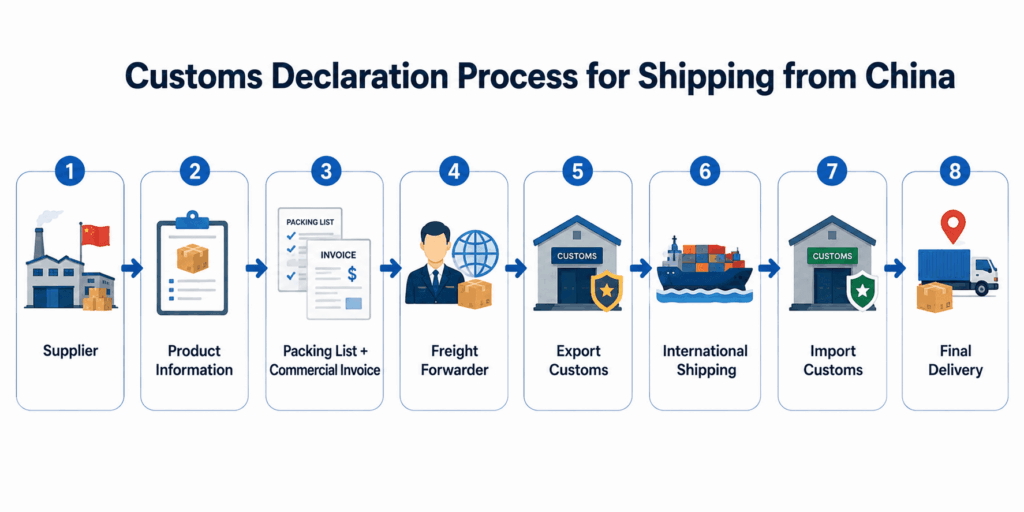
Before a shipment leaves China, someone needs to provide accurate information about the products.
This information normally comes from:
- The manufacturer
- The supplier
- The exporter
- The importer (for certain import requirements)
The freight forwarder uses this information to prepare or coordinate shipping documents.
However, the freight forwarder usually does not manufacture the products, pack the cartons, or decide what the goods actually are.
Only the supplier knows the real details:
- What materials are used?
- What components are included?
- Does it contain batteries?
- Is it branded?
- What is the actual quantity?
- What is the actual selling price?
Without this information, accurate declaration is impossible.
The Challenge of Buying From 1688, Yiwu Markets, and Small Trading Vendors
This issue is especially common among small overseas importers.
Many new buyers source products through:
- 1688 suppliers
- Yiwu wholesale markets
- Guangzhou trading markets
- Small factories
- Trading companies
These suppliers can offer competitive prices and a wide range of products.
However, many small suppliers are focused primarily on selling products—not international export compliance.
Some may provide only:
- A product photo
- A simple quotation
- A total price
- A basic product name
But when it comes to export documentation, problems appear.
For example:
The supplier says:
“This is a kitchen product.”
But Customs needs more details:
- What material is it made of?
- Is it stainless steel, plastic, or aluminum?
- Does it contain electrical components?
- What is the function?
- What is the correct HS classification?
Or:
The supplier says:
“These are accessories.”
But Customs needs to know:
- Accessories for what product?
- What material?
- What quantity?
- What value?
A vague product description may be acceptable for a casual domestic transaction.
It is not enough for international customs declaration.
What Information Does Your Freight Forwarder Actually Need?
Before arranging export clearance, importers should make sure their suppliers can provide detailed cargo information.
The exact requirements vary depending on the product and destination country, but common information includes:
| Information Needed | Why It Matters |
|---|---|
| Accurate product name | Customs needs to identify the goods |
| Product specifications | Helps determine correct classification |
| Material composition | Important for many product categories |
| Quantity | Required for declaration |
| Unit price | Used to determine shipment value |
| Total value | Required for customs documents |
| HS Code | Helps classify goods correctly |
| Package details | Needed for shipping and inspection |
| Country of origin | Required for many imports |
| Battery information | Necessary for electronic products |
| Brand information | Important for trademark-related risks |
A freight forwarder cannot simply write:
“General goods”
or
“Samples”
for every shipment.
Those descriptions do not provide enough information for proper customs compliance.
Why Some Importers Think “The Freight Forwarder Handles Everything”
We understand why this misunderstanding happens.
Many buyers are busy running their businesses.
They are focused on:
- Finding suppliers
- Negotiating prices
- Selling products
- Managing customers
Shipping seems like something that happens after purchasing.
But international logistics is not only transportation.
It involves:
- Export regulations
- Customs requirements
- Product classification
- Documentation accuracy
- Import compliance
The freight forwarder is a partner in this process, but the accuracy of the shipment information must come from the people who know the product best.
Usually, that means the supplier and importer.
DDP Shipping Does Not Mean “No Documents Needed”
DDP (Delivered Duty Paid) is one of the most misunderstood shipping terms among new importers.
Some buyers think:
“I chose DDP. I just send the goods and wait for delivery.”
However, DDP does not remove customs requirements.
DDP means the seller or their logistics provider is responsible for arranging delivery, including certain customs-related responsibilities according to the agreed terms.
It does not mean:
- The supplier can hide products.
- The freight forwarder can invent information.
- Customs documents are unnecessary.
- The importer has no compliance responsibility.
Even with DDP shipping, someone still needs to know:
- What products are being shipped.
- How many units are included.
- What the products are worth.
- Whether special regulations apply.
A professional DDP provider will still request accurate cargo information before shipping.
Be Careful When Someone Says “No Information Needed”
This is an important point for new importers.
You may sometimes hear:
“Don’t worry about documents. Just send the goods to us.”
It sounds convenient.
But importers should ask:
How can a customs declaration be accurate if nobody knows exactly what is inside the shipment?
A shipment without proper product information creates unnecessary risks.
Possible problems include:
- Incorrect customs classification
- Incorrect declared value
- Incorrect product description
- Higher inspection risk
- Delayed customs clearance
- Additional questions from customs authorities
A smooth shipment is not created by avoiding paperwork.
It is created by preparing the right information before the shipment moves.
A Professional Freight Forwarder Protects Your Business, Not Just Your Cargo
At Kisun Shipping, our role is not simply moving cargo from China to another country.
A reliable logistics partner should help importers identify potential risks before they become expensive problems.
Before shipment, we encourage customers and suppliers to confirm:
✅ What exactly is inside the shipment?
✅ Are all products listed?
✅ Are any gifts or samples included?
✅ Do any items contain batteries or special materials?
✅ Are product descriptions accurate?
✅ Are documents consistent with the actual cargo?
These questions may seem simple.
But they can prevent major customs issues later.
The Best Importers Prepare Before They Buy
For experienced importers, customs compliance is not something they think about after a shipment is delayed.
They consider it before placing orders.
Before purchasing from a new supplier in China, ask:
- Can this supplier provide export documents?
- Can they provide detailed product information?
- Do they understand international shipping requirements?
- Can they provide accurate invoices and packing lists?
The cheapest supplier is not always the lowest-cost option.
A supplier who cannot provide accurate information may create hidden costs later through:
- Customs delays
- Inspection fees
- Storage charges
- Lost sales opportunities
A smooth import business is built on accurate information from the beginning.
Key Takeaway
Your freight forwarder can manage customs procedures, but they cannot declare information that does not exist.
The supplier knows the product.
The importer knows the business purpose.
The freight forwarder connects the process and helps ensure compliance.
When all parties provide accurate information, shipments move faster, customs clearance becomes smoother, and unnecessary risks are avoided.
The Real Cost of Misdeclaration, Under-Declaration and Hidden Goods
Many importers think the biggest risk of inaccurate customs declarations is simply paying a fine.
In reality, the financial consequences can be much larger.
A customs problem can affect the entire shipment—and sometimes the cost continues long after the container has been released.
Consider what can happen when Customs discovers that the actual cargo does not match the declaration:
Inspection → Documentation Problems → Customs Delay → Storage & Demurrage → Additional Duties or Penalties → Possible Cargo Seizure
And that is before considering the potential impact on your customer relationships and future shipments.
The Most Expensive Part May Not Be the Customs Fine
Suppose a supplier secretly places several boxes of additional products inside your container.
The extra goods might only be worth a few hundred dollars.
You might think:
“Even if Customs finds them, how serious could it be?”
But the value of the undeclared goods is not necessarily the value of the problem.
A customs inspection can interrupt the movement of the entire container.
Depending on the circumstances and the destination country’s rules, you may face additional costs such as:
- Customs inspection charges
- Documentation amendment costs
- Customs clearance delays
- Port storage
- Container demurrage
- Additional transportation
- Customs duties or taxes
- Penalties or other enforcement costs
- Cargo examination or handling charges
- Possible seizure or destruction of prohibited or infringing goods
The original “gift” might be worth $50.
The resulting logistics bill could be many times higher.
That’s why experienced importers don’t evaluate customs compliance based on the value of one individual item.
They evaluate the potential cost to the entire shipment and business.
Under-Declaration Is Not the Same as an Honest Mistake
Another common problem is under-declaration.
This can happen when a supplier or importer deliberately reports:
- A lower cargo value
- Fewer units
- A lower quantity
- An inaccurate product description
- A different product category
The motivation is often simple:
“If we declare a lower value, we can pay less duty.”
Or:
“If we use a cheaper product description, Customs won’t pay attention.”
This can create serious problems.
There is an important difference between:
an honest documentation error
and
deliberately providing false information to reduce customs duties or avoid regulatory requirements.
The consequences can be very different depending on the facts and the jurisdiction.
That is why importers should never intentionally ask a supplier or freight forwarder to “make the customs value lower.”
“Can You Just Declare a Lower Value?”
This is another question freight forwarders hear frequently.
For example:
“The supplier invoice says $20,000, but can we declare $10,000?”
The answer should not be based on what saves the most tax.
Customs valuation rules vary by country, product, and transaction structure. Importers should use the applicable valuation method and provide supporting documentation when required.
A freight forwarder should not simply invent a lower value because a customer wants to reduce the duty.
If the declared value does not accurately reflect the transaction or otherwise comply with applicable customs valuation rules, the shipment can attract scrutiny.
And once Customs starts asking questions, the importer may need to provide:
- Purchase orders
- Commercial invoices
- Payment records
- Contracts
- Supplier information
- Product information
The problem can quickly become much larger than the original tax saving.
A Low Invoice Value Does Not Automatically Make a Shipment Low Risk
Some importers believe that customs officers only look at the total declared value.
Modern customs risk management is much more complicated.
Authorities can compare information across different sources, including shipment data, product descriptions, weights, quantities, previous declarations, and other available records.
For example, imagine a container contains thousands of electronic products.
The declared value appears unusually low compared with the quantity and product description.
That may raise questions.
Similarly, if the declared cargo is described as:
“Plastic household goods”
but an inspection reveals:
- Battery-powered electronics
- Aerosol products
- Branded goods
- Different quantities
- Products made from different materials
the problem is no longer simply a typo on a document.
The declaration may not accurately represent the cargo at all.
One Realistic Example: When “General Goods” Are Not General Goods
We’ve seen situations where a shipment was described very broadly, while the actual cargo contained products with completely different characteristics.
For example, imagine a declaration describes a shipment as:
Plastic household products
But during inspection, Customs discovers:
- Battery-powered electronics
- Aerosol products
- Different product categories
- Items requiring additional regulatory review
Suddenly, the shipment has multiple compliance questions.
Are the batteries properly declared?
Are the products correctly classified?
Are the aerosols permitted?
Are additional transport requirements applicable?
Are the declared values accurate?
Are the quantities correct?
This is why using a vague product description to “make the declaration easier” is a dangerous approach.
The more the declaration differs from the actual cargo, the more difficult it becomes to explain the shipment when Customs asks questions.
Hidden Dangerous Goods Can Turn a Customs Problem Into a Safety Problem
This is one of the most important reasons we repeatedly tell suppliers:
Never put undeclared batteries, liquids, chemicals or other potentially regulated products inside a shipment.
A hidden gift might not look dangerous.
But imagine a supplier places:
- Power banks
- Lithium batteries
- Electronic devices containing batteries
- Aerosol cans
- Chemical products
- Flammable liquids
inside a container without telling the freight forwarder.
Now the issue is no longer simply customs documentation.
It may also become a dangerous goods transportation and safety issue.
Certain dangerous goods require specific classification, packaging, documentation, labeling and transportation procedures.
For example, lithium battery shipments may require information such as the battery type, specifications and applicable test documentation, depending on the product and transportation method.
This is why a supplier should never assume:
“It’s only one box, so we don’t need to mention it.”
One undeclared box can change the compliance requirements of an entire shipment.
What Happens When Customs Finds the Difference?
There is no single outcome for every customs inspection.
The consequences depend on:
- The country involved
- The type of goods
- The nature of the discrepancy
- The declared and actual value
- Whether the mistake was accidental or intentional
- Whether restricted or prohibited goods are involved
- The importer’s previous compliance history
- The applicable customs regulations
Depending on the situation, Customs may request additional information or documentation.
The shipment may also be subject to further examination, amended declarations, additional duties or taxes, penalties, seizure, or other enforcement measures.
For particularly serious cases, the matter can move beyond routine customs clearance and into formal enforcement or investigation.
That’s why nobody should assume:
“Worst case, I’ll just pay the difference.”
Sometimes the consequences are much more complicated than that.
The Hidden Cost: Your Container Can Stop Moving
This is something small importers often overlook.
Imagine your container arrives at the destination port on Monday.
Your customer expects delivery on Wednesday.
But Customs selects the container for inspection because the declared cargo does not match the actual contents.
Now the delivery schedule changes.
Instead of a simple customs clearance, you may need to deal with:
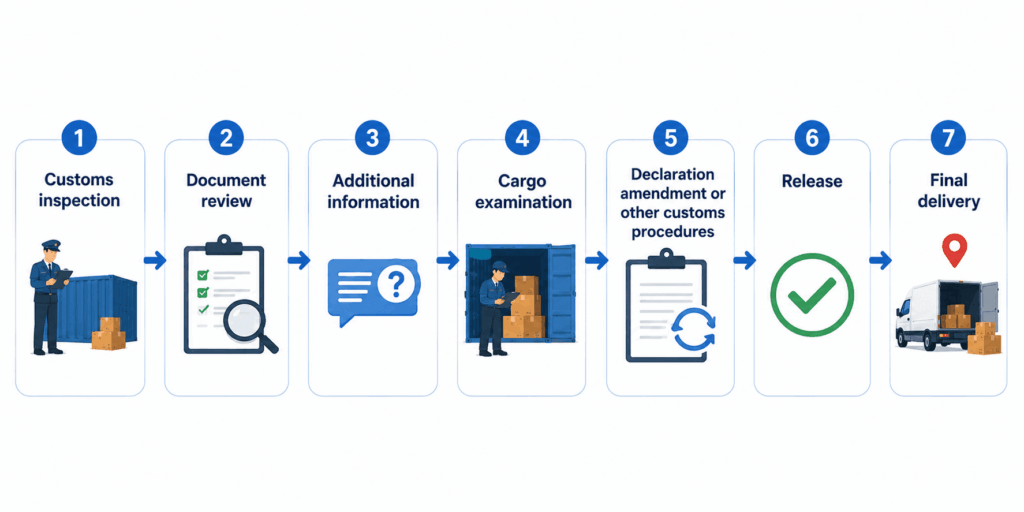
Every additional step can consume time.
Meanwhile, depending on the specific situation and local terminal rules, storage, demurrage, detention, inspection, handling, or other charges may continue to accumulate.
The “free gift” suddenly becomes very expensive.
The Business Cost Is Even Bigger
There is another cost that doesn’t appear on a customs invoice:
Lost trust.
Imagine you’re importing products for an Amazon business.
Your container is delayed because the shipment has a customs problem.
You were expecting the goods to arrive before a major sales period.
Instead:
- Inventory arrives late.
- Your warehouse runs out of stock.
- Orders are delayed.
- Customers become unhappy.
- Your sales ranking may suffer.
- Your cash is tied up in inventory that cannot move.
For a small importer, one delayed container can have a disproportionate impact on cash flow.
This is why customs compliance is not simply a “paperwork issue.”
It is part of supply chain risk management.
What About Your Future Shipments?
Another misconception is:
“If this shipment is eventually released, everything will go back to normal.”
Not necessarily.
Customs authorities maintain records and use risk-management systems to identify shipments that may require additional attention.
The specific treatment of future shipments depends on the country and circumstances, but a history of customs problems can make future clearance more complicated.
This can mean:
- More questions
- More document requests
- More inspections
- Longer clearance processes
- Greater administrative burden
For a company importing from China every month, that can become a significant operational problem.
One shipment is temporary.
A damaged compliance record can affect how your business operates going forward.
Don’t Risk a Container Full of Cargo to Save a Few Dollars
Let’s look at the economics.
Suppose a supplier wants to avoid declaring a few hundred dollars of additional goods.
The potential benefit might be relatively small.
But the potential downside could include:
Small tax saving
vs.
Inspection + delay + storage + demurrage + additional customs costs + potential penalties + lost sales
That’s not a sensible trade-off.
Experienced importers understand something that first-time buyers often learn the hard way:
The cheapest shipment is not always the shipment with the lowest freight quote.
The cheapest shipment is often the shipment that arrives without surprises.
A Simple Rule for Importers
Before your supplier seals the container, ask three questions:
1. Is everything inside the shipment listed?
If not, stop and check.
2. Does the documentation accurately describe the cargo?
If not, correct it before export.
3. Has the freight forwarder been informed about unusual items?
This is especially important for:
- Batteries
- Electronics
- Liquids
- Chemicals
- Food
- Cosmetics
- Branded products
- Samples
- Gifts
If the answer to any of these questions is “No”, don’t assume the problem will disappear after the container leaves the factory.
It usually becomes harder—and more expensive—to solve once the shipment is already in transit.
The Real Cost of Non-Compliance
Undeclared goods → Customs questions → Inspection → Delay → Additional costs → Possible enforcement
The value of the hidden item may be small.
The cost of the resulting customs problem may not be.
The Bottom Line
Customs compliance isn’t about making paperwork complicated.
It’s about making sure that the documents tell the truth about the cargo.
A free sample should not be treated as invisible.
A gift should not be treated as invisible.
A replacement part should not be treated as invisible.
And a battery should certainly never be treated as “just another box.”
If something is going into the shipment, tell your supplier and freight forwarder before the container is sealed.
That five-minute conversation can be worth far more than the value of the item being added.
How to Prevent Customs Problems Before Your Shipment Leaves China
The good news is that most of the problems discussed in this article can be prevented.
You don’t need to become a customs expert.
You don’t need to understand every customs regulation in every country.
But you do need to make sure that your supplier, your freight forwarder, and your shipping documents are working from the same information.
Before your supplier loads the container, take a few minutes to complete a simple compliance check.
A Simple Pre-Shipment Checklist for Importers
Before your goods leave China, confirm the following:
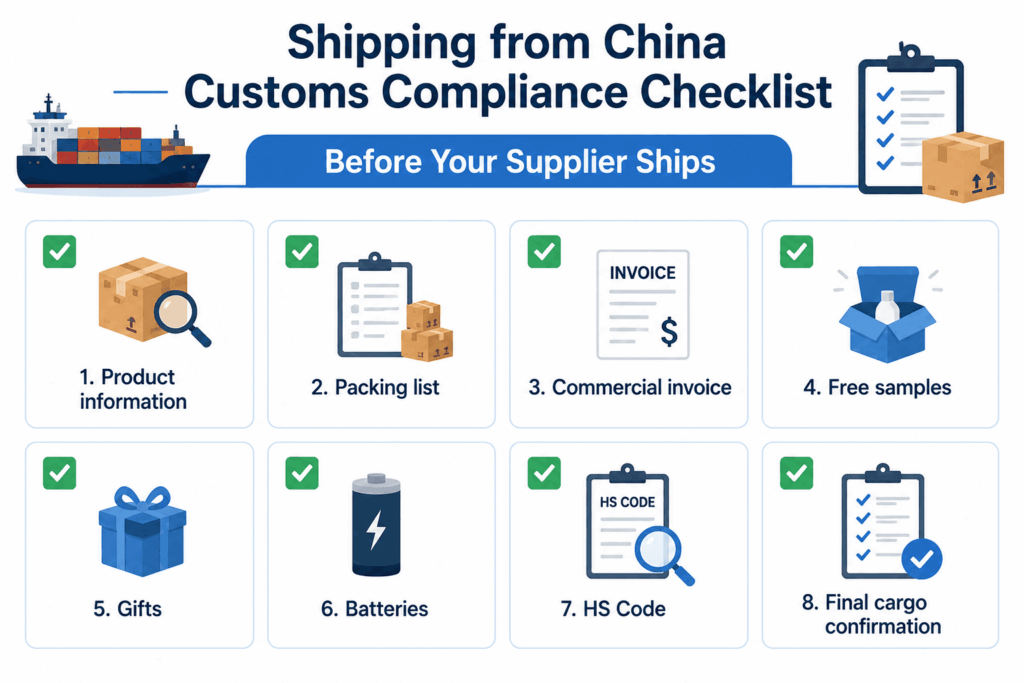
1. Ask Your Supplier: “What Exactly Is Inside the Shipment?”
Don’t rely only on the purchase order.
Ask your supplier to confirm the complete contents of the shipment.
This should include:
- Main products
- Free samples
- Gifts
- Replacement parts
- Accessories
- Promotional products
- Spare parts
- Any other items added during packing
The goal is simple:
Nothing should be inside the shipment that you don’t know about.
2. Make Sure the Packing List Matches the Actual Cargo
Before loading, ask your supplier to provide the final packing list.
Check:
- Product names
- Quantities
- Number of cartons
- Gross weight
- Net weight
- Package dimensions
- Product specifications
The packing list should represent the cargo that is actually going into the container.
If the supplier adds something after preparing the packing list, the documents may need to be updated.
Don’t wait until the container has already departed.
3. Ask About Free Samples and Gifts
This is one of the easiest questions to ask—and one of the most important.
Tell your supplier:
“Please let me know before adding any samples, gifts, replacement parts, or additional products to my shipment.”
If they want to include something, give your freight forwarder the information first.
Do not let the supplier decide:
“It’s free, so it doesn’t matter.”
It does matter.
The item should be disclosed so the appropriate documentation and customs treatment can be determined.
4. Check Whether the Products Contain Batteries
This is especially important when importing:
- Electronics
- Toys
- Lamps
- Power tools
- Consumer devices
- Bluetooth products
- Smart devices
- Power banks
Ask your supplier:
“Does this product contain a battery?”
If the answer is yes, ask for the relevant battery information before booking transportation.
Depending on the product and transportation method, additional dangerous goods or battery shipping requirements may apply.
Never allow a supplier to secretly place batteries or power banks into a shipment simply because they are “small.”
5. Make Sure Product Descriptions Are Specific
Avoid descriptions such as:
- General goods
- Accessories
- Household items
- Products
- Samples
- Plastic goods
These descriptions may be too vague to accurately identify the actual merchandise.
A better product description explains what the product actually is.
For example:
Instead of:
Plastic products
provide a description that identifies the actual product and relevant characteristics.
The exact information required depends on the product and applicable customs rules, but the basic principle is universal:
Customs needs to understand what the goods actually are.
What Information Should Your Supplier Provide?
If you are a small importer buying from China for the first time, you can send your supplier a simple request like this:
Please provide the final product list before shipment, including product name, specifications, quantity, unit price, total value, material, HS Code if available, and any battery or special-product information. Please also confirm that no additional goods, samples, gifts, or replacement parts will be placed inside the shipment without informing us first.
This simple instruction can prevent many unnecessary problems.
What If Your Supplier Cannot Provide These Details?
This is where small importers often encounter difficulties.
You may buy products from a small Yiwu vendor, Guangzhou wholesale market, 1688 seller, or small factory.
You ask for a detailed packing list.
They respond:
“We don’t have that.”
You ask for the HS Code.
They say:
“The freight forwarder knows.”
You ask for the product specifications.
They send you a product photo.
You ask about the materials.
They say:
“It’s normal material.”
This creates a problem.
The freight forwarder cannot simply invent the missing information.
Don’t Expect Your Freight Forwarder to Guess the Product
A freight forwarder may have extensive experience with customs clearance.
They may have shipped thousands of similar products.
But that doesn’t mean they know exactly what your supplier manufactured.
For example, two products may look almost identical but have different:
- Materials
- Functions
- Components
- Battery specifications
- Intended uses
- Product classifications
Those differences can affect customs treatment.
The supplier is therefore an important source of the information required to prepare accurate shipping documents.
What Should You Do If Your Supplier Says, “The Freight Forwarder Will Handle It”?
Tell the supplier:
“The freight forwarder can handle the shipping and customs process, but you still need to provide accurate product information.”
This distinction is extremely important.
The freight forwarder handles the logistics process.
The supplier provides information about the goods.
The importer provides information about the transaction and destination requirements when applicable.
Everyone has a role.
What About DDP Shipping?
DDP can make international shipping much easier for small importers.
Instead of managing every part of the logistics process yourself, you can work with a logistics provider that coordinates transportation, customs-related procedures, duties and final delivery according to the agreed service.
But DDP does not mean:
“I don’t need to know what I’m importing.”
And it certainly does not mean:
“My supplier can put anything inside the shipment.”
A professional DDP provider still needs accurate cargo information.
If your supplier sends incomplete or misleading information, the logistics provider may not be able to prepare the shipment correctly.
This is why DDP is a logistics solution—not a way to bypass customs compliance.
How Kisun Shipping Handles This Problem
At Kisun Shipping, one of the first things we want to understand is:
What exactly are you shipping?
Before arranging transportation, we may need to review information such as:
- Product description
- Quantity
- Weight
- Dimensions
- Product value
- HS Code
- Material
- Battery information
- Destination
- Shipping method
If the supplier wants to add samples or gifts, we want to know about them before the shipment is finalized.
If the cargo contains potentially sensitive products, we want to identify the issue before the goods are loaded—not after Customs finds it.
That’s an important difference between simply moving cargo and managing logistics risk.
We Would Rather Delay a Shipment for One Day Than Create a Customs Problem
Sometimes a customer may be frustrated when we ask for additional information.
They may say:
“Another forwarder didn’t ask me for this.”
We understand.
But there is a reason we ask.
If we don’t have enough information to understand the cargo, we cannot responsibly determine how the shipment should be documented and handled.
Taking an extra day to confirm the cargo is usually far better than discovering a problem after the container has reached a port.
Our philosophy is simple:
Check before shipping. Don’t investigate after Customs opens the container.
What Overseas Importers Should Tell Their Chinese Suppliers
If you regularly import from China, consider adding this requirement to your purchasing process:
No additional goods may be placed inside the shipment without prior approval.
This includes free samples, gifts, replacement parts, promotional products, accessories, electronics, batteries, food, liquids, and personal items.
All products must be disclosed to the buyer and freight forwarder before shipment, and the final shipping documents must accurately reflect the actual cargo.
This is especially important if you work with multiple factories.
A single supplier following the rules doesn’t help if another supplier secretly adds unreported products to the same consolidated shipment.
A 5-Minute Check Before Your Container Leaves China
Before the truck picks up your cargo, ask your supplier these questions:
Cargo
☐ Is every item inside the shipment known to the buyer?
☐ Does the final packing list match the actual cargo?
☐ Have all samples been disclosed?
☐ Have all gifts been disclosed?
☐ Have all replacement parts been disclosed?
Product Information
☐ Are product names accurate?
☐ Are quantities accurate?
☐ Are specifications available?
☐ Are unit prices and total values accurate?
☐ Is the HS Code available or ready for review?
Special Products
☐ Does anything contain a battery?
☐ Are there liquids or chemicals?
☐ Are there aerosols?
☐ Are there food or cosmetic products?
☐ Are there branded products?
Documents
☐ Commercial invoice prepared?
☐ Packing list finalized?
☐ Product information provided to the freight forwarder?
☐ Any changes communicated before loading?
If you can answer these questions before the container leaves the factory, you have already eliminated many avoidable problems.
Frequently Asked Questions
Do free samples need to be declared when shipping from China?
Yes, free samples should not simply be omitted because the customer did not pay for them.
The supplier should disclose the samples to the freight forwarder so they can be properly reflected in the relevant shipping and customs documentation and handled according to the applicable customs rules.
Whether a free sample qualifies for special customs valuation or tax treatment is a separate question from whether it should be disclosed.
Free does not mean invisible.
Can my Chinese supplier put gifts inside my shipment?
They should not add undisclosed items without informing you and your freight forwarder.
If the supplier wants to send a gift, sample, replacement part, or other additional product, it should be disclosed before shipment so the appropriate documentation and shipping requirements can be checked.
This is particularly important if the item contains batteries, liquids, chemicals, food, cosmetics, or branded goods.
What documents do I need to ship goods from China?
The exact requirements depend on the product, shipment type, export arrangement and destination country.
Commonly required information includes:
- Commercial invoice
- Packing list
- Product description
- Quantity
- Weight
- Product value
- Product specifications
- HS classification information
- Additional product documentation when applicable
Your freight forwarder or customs broker can tell you what additional documents are required for your specific shipment.
Do I need product information if I’m using DDP shipping?
Yes.
DDP does not eliminate the need for accurate cargo information.
Your freight forwarder needs to know what is being shipped in order to arrange transportation and customs procedures appropriately.
A DDP service can simplify the logistics process for an importer, but it does not make customs documentation unnecessary.
Can a freight forwarder create the HS Code for me?
A freight forwarder or customs professional can often help review or determine the appropriate classification based on the information available, depending on the service and jurisdiction.
However, the supplier still needs to provide accurate information about the actual product.
A freight forwarder cannot responsibly determine the correct classification from a vague description such as “accessories” or “general goods.”
For products with complicated classification issues, importers may need additional customs classification advice.
What happens if my supplier adds something after the documents are prepared?
Tell your freight forwarder immediately.
Do not assume that because the container has already been booked, the additional item can simply be ignored.
The documents may need to be reviewed or updated, and the item may have additional shipping or customs requirements.
The earlier you report the change, the easier it is to solve.
Is under-declaring the value a good way to reduce import duties?
No.
Importers should not intentionally provide false customs values simply to reduce duties or taxes.
Customs valuation rules vary by jurisdiction, and the correct approach depends on the transaction and applicable regulations.
If Customs questions the declared value, the importer may need to provide supporting evidence such as invoices, payment records, purchase orders, or other transaction information.
A small short-term saving is not worth creating a larger compliance problem.
The Rule We Want Every Importer to Remember
You don’t need to memorize every customs regulation.
Just remember this:
If it is inside the shipment, tell your freight forwarder.
Don’t assume:
“It’s only a gift.”
Don’t assume:
“It’s only a sample.”
Don’t assume:
“It’s free.”
Don’t assume:
“It’s only one box.”
And don’t assume:
“I’m using DDP, so I don’t need to worry about it.”
Tell your logistics provider what is actually being shipped.
Give them accurate product information.
Let them determine what documentation and shipping procedures are required.
That is how international shipping should work.
A Good Shipment Starts With Accurate Information
International logistics is not simply about finding the cheapest freight rate.
A successful shipment requires coordination between:
Supplier → Importer → Freight Forwarder → Customs → Carrier → Final Delivery
If one party hides information, the entire chain can be affected.
Your supplier may only be thinking about giving you a small gift.
You may only be thinking about getting your products delivered.
Your freight forwarder may be trying to arrange customs clearance.
But Customs sees one thing:
The cargo and the declaration.
When those two match, everyone benefits.
When they don’t, everyone can end up dealing with the consequences.
So before your supplier seals that container, ask one final question:
“Is there anything inside this shipment that isn’t on our documents?”
If the answer is yes, stop and clarify it before the cargo leaves China.
Because a free sample is not “nothing.”
A gift is not “nothing.”
A replacement part is not “nothing.”
And an undeclared item is never worth risking an entire shipment.
Accurate information today is almost always cheaper than a customs problem tomorrow.

China Logistics Expert
About the Author
Katherine Kang is a China-based logistics consultant with over 11 years of experience in international trade and freight forwarding. Specializing in helping SMEs import from China she focuses on compliant, cost-effective solutions to avoid delays, tariffs, and hidden fees. From anti-dumping guidance to CNY planning, Katherine has managed hundreds of shipments, saving clients 15-30% on average.
Connect with Katherine on LinkedIn or contact Kisun Shipping for a free import consultation.