
How Much Does Shipping from China to the UK Cost in 2026? A Complete Guide for Importers
If you’ve requested quotations from several freight forwarders, you’ve probably experienced something confusing.
You send exactly the same shipment details to five logistics companies.
A few hours later, you receive five completely different quotations.
Some are only slightly different.
Others may vary by hundreds or even thousands of pounds.
Naturally, the first question most importers ask is:
“Why are the prices so different if the shipment is exactly the same?”
The truth is that international shipping is far more complex than simply booking space on a vessel or an aircraft.
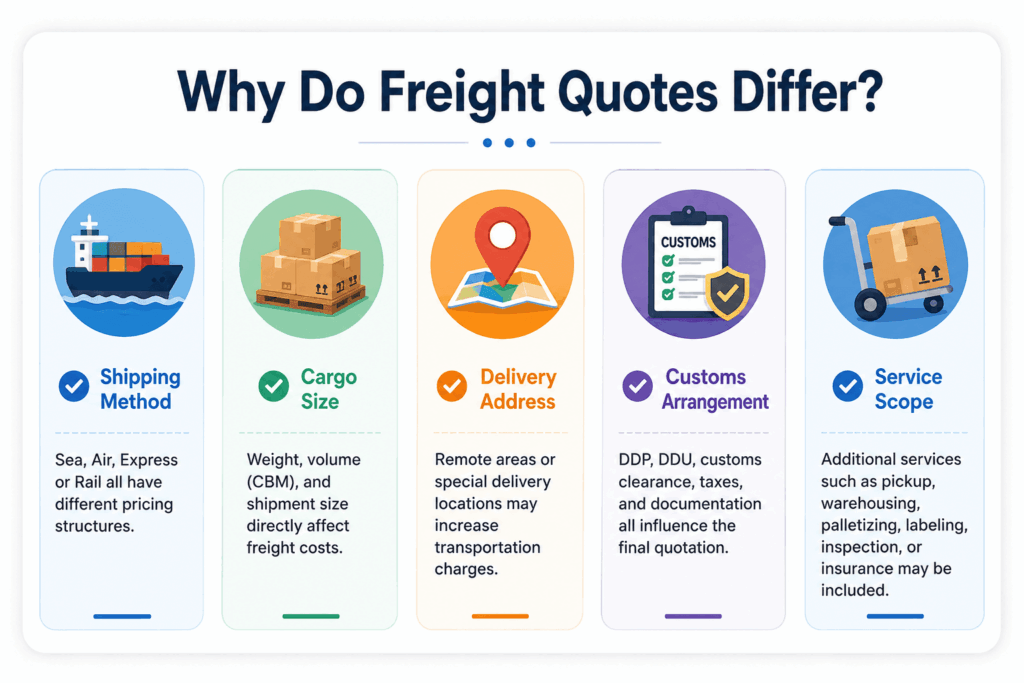
A freight quotation is influenced by many variables, including the shipping method, cargo characteristics, destination, customs arrangements, delivery requirements, and the services included in the quotation.
Understanding these factors allows you to compare quotations fairly and choose the solution that offers the best overall value—not simply the lowest price.
In this guide, we’ll explain how shipping costs from China to the UK are structured, what affects your final logistics budget, and how to choose the right shipping solution for your business.
Whether you’re importing for the first time or shipping containers every month, this guide will help you make more informed logistics decisions.
Why Is There No Fixed Shipping Price?
One of the biggest misconceptions among first-time importers is that there is a standard price for shipping from China to the UK.
In reality, there isn’t.
International freight rates change regularly because they are influenced by market conditions and shipment-specific factors.
Two companies importing similar products may receive different quotations because their logistics requirements are not identical.
For example, the following factors can all affect the final quotation:
- Shipment volume
- Cargo weight
- Product type
- Departure city in China
- Delivery location in the UK
- Shipping method
- Customs arrangement
- Delivery terms (such as DDP or DAP)
- Additional logistics services
This is why comparing freight quotations without understanding what is included can sometimes lead to unexpected costs later in the shipping process.
The First Question Shouldn’t Be “What’s the Cheapest Price?”
Many businesses start by asking:
“Who can offer the cheapest shipping?”
Experienced importers usually ask a different question:
“Which shipping solution gives my business the best balance between cost, transit time and reliability?”
For example:
A company importing heavy furniture may prioritise the lowest transportation cost and choose sea freight.
An Amazon seller preparing for a seasonal sales event may value faster delivery and choose air freight.
Another importer facing inventory shortages may decide that rail freight offers the best compromise between delivery speed and logistics cost.
The “best” shipping method depends on your business objectives—not simply the freight rate.
Different Shipping Methods Mean Different Costs
One reason quotations vary is that different transportation methods are designed for different situations.
At Kisun Shipping, we provide several transportation solutions for shipments from China to the UK, allowing importers to choose the option that best fits their timeline, budget and cargo requirements.
Sea Freight
Sea freight remains the most economical choice for large or heavy commercial shipments.
It is suitable for:
- Full Container Load (FCL)
- Less than Container Load (LCL)
- Heavy machinery
- Furniture
- Building materials
- General commercial cargo
Although sea freight generally offers the lowest transportation cost, it also requires the longest transit time.
For businesses with predictable inventory planning, it remains the preferred shipping method.
Rail Freight
Rail freight has become an increasingly attractive option for businesses looking for a balance between cost and delivery speed.
Compared with sea freight, rail transport can significantly reduce transit time.
Compared with air freight, it provides a more economical solution.
It is particularly suitable for:
- Medium-value commercial goods
- Seasonal inventory replenishment
- Retail products
- Businesses with moderate delivery deadlines
As rail services depend on current international operating conditions, route availability should always be confirmed before shipment.
Air Freight
When delivery speed is the highest priority, air freight offers the fastest commercial transportation solution.
It is commonly used for:
- High-value products
- Urgent orders
- Time-sensitive inventory
- Product launches
Although transportation costs are higher than sea or rail freight, the shorter transit time may help businesses avoid stock shortages and lost sales opportunities.
Express Courier
For small parcels, samples and documents, international courier services remain the fastest option.
Express shipping provides:
- Door-to-door delivery
- Online tracking
- Fast customs processing
- Short transit times
However, express services become increasingly expensive as shipment size and weight increase.
Service Comparison Table
| Service | Sea | Rail | Air | Express |
|---|---|---|---|---|
| Cost | ★ | ★★ | ★★★★ | ★★★★★ |
| Transit Time | Slow | Medium | Fast | Fastest |
| Large Cargo | ✓ | ✓ | △ | ✕ |
| Samples | ✕ | ✕ | △ | ✓ |
Choosing the Right Delivery Service
Transportation is only one part of the logistics process.
The delivery service you choose also affects the overall quotation.
Depending on your business requirements, shipments may be arranged for:
- Airport delivery
- Seaport delivery
- Door-to-door delivery
- Warehouse delivery
- Amazon FBA delivery
Some importers prefer to manage customs clearance and inland transportation themselves.
Others prefer a complete logistics solution with transportation, customs clearance and final delivery coordinated through a single provider.
Choosing the right service depends on your company’s importing experience, internal resources and supply chain strategy.
DDP or DAP (Often Still Called “DDU”)?
Another factor that influences shipping costs is the agreed delivery term.
Many importers are familiar with the term DDU, but under Incoterms® 2020, this term has been replaced by DAP (Delivered at Place).
Even so, many businesses continue to use “DDU” in everyday communication.
The difference between these shipping terms affects who is responsible for customs formalities and import charges.
In general:
- DDP (Delivered Duty Paid) is suitable for businesses that prefer a more complete logistics solution, with transportation and agreed customs arrangements coordinated before final delivery.
- DAP (formerly referred to by many as DDU) is suitable for importers who are responsible for import duties and taxes. Where operationally available, if the importer provides the required UK tax registration information and authorises us to act on their behalf, we can coordinate customs clearance and advance the payment of duties and taxes, with settlement according to the agreed arrangement.
Understanding which Incoterm best suits your business is just as important as comparing freight prices.
A quotation with a lower freight rate may not necessarily represent a lower total logistics cost if essential services are excluded.
What Makes Up the Total Shipping Cost?
When comparing quotations from different freight forwarders, many importers naturally focus on the final number.
However, a quotation is rarely made up of a single transportation charge.
International shipping is a combination of multiple logistics services, each of which contributes to the total cost of moving your cargo from China to the UK.
Understanding these cost components allows you to compare quotations more accurately and identify where genuine savings can be achieved.
It also helps you recognise when two quotations that appear very different are actually offering different service scopes.
Ocean Freight or Air Freight Is Only One Part of the Cost
Many first-time importers assume the freight charge represents the total shipping cost.
In reality, the international transportation itself is only one stage of the supply chain.
Depending on the shipping arrangement, your quotation may also include services before departure in China and after arrival in the UK.
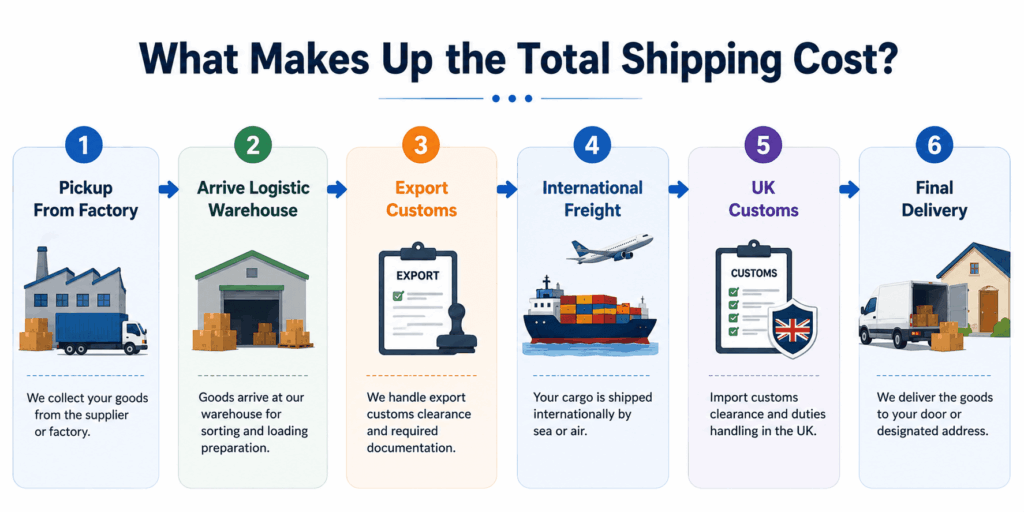
For example, a complete logistics solution may involve:
- Cargo collection from the supplier
- Warehouse receiving and cargo consolidation
- Export customs procedures in China
- International transportation
- Import customs coordination
- Inland transportation within the UK
- Final delivery to your warehouse, business address or Amazon fulfilment centre
This is one reason why quotations from different logistics providers may not be directly comparable.
One company may only quote the international transportation, while another includes several additional services in the same proposal.
The Four Cost Areas Every Importer Should Understand
Instead of looking at shipping as a single expense, it is more useful to divide it into four stages.
1. Origin Costs in China
Before your cargo even leaves China, several logistics activities may already have taken place.
Depending on your shipment, these services may include:
- Collecting goods from one or more suppliers
- Receiving cargo at a warehouse
- Consolidating shipments
- Export documentation
- Loading arrangements
- Export customs procedures
Businesses purchasing from multiple suppliers often benefit from cargo consolidation because it reduces duplicated transportation and handling.
For importers sourcing products from different factories, planning these activities efficiently can reduce both costs and administrative complexity.
2. International Transportation
This is the stage most people think about first.
However, the transportation charge itself depends on many operational factors rather than a fixed price.
For example:
- Container utilisation
- Cargo dimensions
- Actual or volumetric weight
- Available shipping capacity
- Seasonal demand
- Carrier schedules
This explains why freight rates can change even when the shipment itself has not changed.
3. Import Processing in the UK
After arriving in the UK, commercial shipments usually require import procedures before final delivery.
Depending on the agreed shipping terms, this stage may involve:
- Import customs declaration
- Duty and VAT processing
- Cargo release
- Port or airport handling
For businesses choosing a DDP solution, these procedures are generally coordinated as part of the agreed logistics service.
For businesses using DAP (formerly referred to by many importers as DDU), the importer remains responsible for applicable import duties and taxes, although customs coordination may be arranged where authorised.
Understanding these responsibilities before shipment helps avoid unnecessary delays and unexpected charges.
4. Final Delivery
The final stage is often overlooked when comparing quotations.
Delivery requirements vary considerably between businesses.
For example, shipments may need to be delivered to:
- A private warehouse
- A retail distribution centre
- A manufacturing facility
- An Amazon FBA warehouse
- A third-party logistics provider (3PL)
Different destinations involve different delivery arrangements, vehicle requirements and scheduling processes.
For this reason, final delivery should always be considered when evaluating the total logistics cost.
Why Can Two Freight Forwarders Quote Very Different Prices?
Receiving quotations that differ significantly does not necessarily mean one company is overcharging.
In many cases, the difference lies in what is included.
Before comparing prices, consider asking the following questions:
- Does the quotation include customs-related services?
- Is final delivery included?
- Are warehouse handling charges included?
- Does the quotation include cargo consolidation?
- Are destination handling charges already covered?
Two quotations may appear very different at first glance, but once the included services are compared, the price difference often becomes much easier to understand.
The Cheapest Quote Is Not Always the Lowest Total Cost
Imagine two freight forwarders provide quotations for the same shipment.
Quotation A appears less expensive.
However, after the cargo arrives in the UK, additional charges are payable for destination handling, customs coordination and final delivery.
Quotation B initially appears more expensive.
But it already includes these services, reducing the likelihood of unexpected costs later.
Without understanding what each quotation includes, comparing only the final figure can lead to incorrect decisions.
Experienced importers therefore evaluate overall logistics value, not simply the transportation rate.
Focus on Total Landed Logistics Cost
Successful businesses rarely optimise only one part of the supply chain.
Instead, they consider the total cost of moving products from the supplier’s factory to their final destination.
Sometimes paying slightly more for transportation can reduce warehouse costs, shorten inventory cycles or improve delivery reliability.
Looking at logistics as a complete process rather than an isolated freight charge often leads to better long-term decisions.
How to Reduce Shipping Costs from China to the UK Without Compromising Reliability
Every importer wants lower shipping costs.
However, reducing logistics expenses does not necessarily mean choosing the cheapest quotation.
In many cases, businesses that focus only on the lowest freight rate end up paying more through unexpected charges, shipping delays or inefficient transportation.
Experienced importers approach logistics differently.
Instead of asking:
“How can I get the cheapest shipping?”
They ask:
“How can I make my entire supply chain more efficient?”
Below are several practical strategies that can help reduce shipping costs while maintaining reliable delivery.
1. Choose the Right Shipping Method for Your Delivery Schedule
One of the most common mistakes is selecting a shipping method based only on price.
For example:
A shipment needed in three weeks is unlikely to be suitable for sea freight.
Choosing sea freight simply because it is cheaper may result in inventory shortages, delayed customer orders and lost sales.
On the other hand, shipping a full container by air simply because production finished late may dramatically increase logistics costs.
Instead, match the transportation method to your business requirements.
| Business Need | Suitable Transport Solution |
|---|---|
| Lowest transportation cost | Sea Freight |
| Faster delivery with a controlled budget | Rail Freight |
| Urgent commercial shipments | Air Freight |
| Samples and small parcels | Express Courier |
Choosing the right transportation method from the beginning is often the easiest way to optimise logistics costs.
2. Plan Shipments Earlier Instead of Shipping Faster
Many businesses spend extra money on air freight because production finishes later than expected.
In reality, earlier logistics planning often saves more money than negotiating a lower freight rate.
For example:
If production is expected to finish next month, discussing transportation arrangements in advance allows:
- More vessel choices
- Better rail schedules
- Improved space availability
- Greater flexibility if delays occur
Booking early also reduces the risk of paying premium rates during busy shipping periods.
Good planning is often one of the most effective cost-saving strategies.
3. Make Better Use of Cargo Space
Transportation costs are closely linked to how efficiently cargo is packed.
Poor packaging can result in:
- More occupied cargo space
- Higher volumetric weight
- Lower container utilisation
- Additional handling requirements
For example, unnecessarily oversized cartons may increase shipping costs even though the products themselves have not changed.
Optimising packaging dimensions and loading arrangements can often improve container utilisation and reduce transportation costs.
This is one reason why many experienced importers review packaging before arranging shipment.
4. Consolidate Cargo from Multiple Suppliers
Many UK businesses purchase products from more than one factory in China.
Without consolidation, each supplier may arrange separate transportation, increasing handling costs and creating unnecessary complexity.
A more efficient approach is to collect goods from different suppliers into one warehouse before international shipment.
Cargo consolidation can provide several benefits:
- Fewer individual shipments
- Better container utilisation
- Simpler documentation management
- Lower overall transportation costs
For businesses sourcing from multiple manufacturers, consolidation is often one of the easiest ways to improve logistics efficiency.
5. Select the Right Shipping Terms
Shipping costs are influenced not only by transportation but also by the agreed delivery terms.
Some importers prefer to manage customs clearance and final delivery themselves.
Others prefer a logistics solution where transportation, customs coordination and delivery are arranged together.
There is no universally correct choice.
The appropriate shipping term depends on:
- Your importing experience
- Internal logistics resources
- Customs knowledge
- Supply chain management capabilities
Selecting the most suitable shipping arrangement can reduce administrative work and improve overall logistics efficiency.
6. Provide Accurate Shipping Information from the Start
Freight quotations are based on the shipment information provided.
If important details change after booking, additional costs or operational adjustments may be required.
To obtain an accurate quotation, prepare information such as:
- Product type
- Number of cartons
- Dimensions
- Gross weight
- Pickup location
- Delivery destination
Providing complete information early helps avoid unnecessary revisions later in the shipping process.
7. Understand the Difference Between Price and Value
A lower quotation does not automatically represent lower logistics costs.
When evaluating freight proposals, it is helpful to compare:
- Included services
- Transit time
- Delivery arrangements
- Customs coordination
- Communication efficiency
- Operational support
Sometimes a quotation with a slightly higher transportation cost may reduce delays, simplify customs procedures and lower the total cost of managing the shipment.
Looking at the overall value rather than a single freight rate often leads to better long-term decisions.
A Practical Example
Imagine two UK importers purchasing similar products from China.
Importer A chooses the lowest freight quotation without reviewing the service scope.
After arrival, additional charges are incurred for destination handling and delivery, and customs documentation requires further clarification.
The final logistics cost exceeds the original expectation.
Importer B reviews the quotation carefully before booking.
The logistics solution includes cargo consolidation, coordinated customs procedures and final delivery.
Although the initial quotation is slightly higher, the shipment proceeds more smoothly with fewer unexpected costs.
The difference is not simply the freight rate.
It is the quality of the logistics planning.
Shipping Costs Can Be Controlled — But Not by Price Alone
Successful importing is rarely about finding the cheapest freight forwarder.
It is about making informed decisions throughout the logistics process.
By selecting the appropriate shipping method, planning shipments earlier, improving packaging, consolidating cargo where appropriate and understanding the services included in your quotation, businesses can often reduce overall logistics costs while improving supply chain reliability.
The goal is not simply to spend less.
It is to achieve better value for every shipment.
Which Shipping Solution Is Best for Your Business?
After understanding how shipping costs are calculated and learning practical ways to reduce logistics expenses, the next question becomes:
Which shipping service should you actually choose?
There is no universal answer.
The best shipping solution depends on your products, delivery schedule, budget and internal logistics capabilities.
Rather than selecting the same transportation method for every shipment, experienced importers choose different solutions for different business situations.
The following examples can help you decide which option is most suitable for your shipment.
| Goal | Best Practice |
|---|---|
| Lower Cost | Sea Freight |
| Faster Delivery | Rail |
| Urgent Cargo | Air |
| Samples | Express |
| Multiple Suppliers | Consolidation |
Scenario 1: You Want the Lowest Possible Transportation Cost
If your priority is reducing transportation costs and your production schedule allows sufficient lead time, sea freight is usually the most economical solution.
Sea freight is generally suitable for:
- Full container shipments (FCL)
- Less than container load (LCL)
- Heavy cargo
- Furniture
- Building materials
- Machinery
- General commercial goods
Sea freight requires longer transit time, but for businesses with stable inventory planning it often provides the lowest logistics cost per shipment.
Scenario 2: Sea Freight Is Too Slow, but Air Freight Is Too Expensive
This is a situation many UK importers encounter.
Waiting over a month for sea freight may delay inventory replenishment.
However, shipping the entire order by air may significantly increase transportation costs.
In these cases, rail freight can offer a practical balance.
Rail freight generally provides:
- Faster transit than sea freight
- Lower transportation cost than air freight
- Reliable service for many commercial shipments
- Better inventory turnover for businesses that cannot wait for ocean shipping
For many companies, rail freight fills the gap between cost and speed.
It is particularly suitable for businesses with seasonal products, retail inventory or moderate delivery deadlines.
As rail services depend on operational conditions and route availability, shipment schedules should always be confirmed before booking.
Scenario 3: Delivery Time Is Your Highest Priority
Sometimes transportation cost is no longer the most important consideration.
For example:
- Your customer is waiting for delivery.
- Your warehouse is almost out of stock.
- Amazon inventory needs urgent replenishment.
- A product launch has already been scheduled.
In these situations, air freight often becomes the most practical solution.
Although transportation costs are higher, avoiding stock shortages or delayed customer orders may justify the additional expense.
Many businesses evaluate air freight based on the commercial value of earlier delivery rather than transportation cost alone.
Scenario 4: You Only Need to Ship Samples or Small Parcels
For product samples, spare parts or urgent documents, international express courier services remain the fastest option.
Express delivery is often chosen for:
- Product samples
- Prototype testing
- Small replacement parts
- Business documents
Door-to-door courier services simplify the shipping process and usually provide complete online shipment tracking.
For larger commercial cargo, however, express shipping is generally less economical than other transportation methods.
Scenario 5: You Prefer a Complete Door-to-Door Logistics Solution
Many importers prefer not to coordinate multiple logistics providers.
Instead, they want one company to manage the shipment from China to the final destination in the UK.
Depending on the shipment requirements, door-to-door services may include:
- Cargo collection from suppliers
- Export customs procedures
- International transportation
- Import customs coordination
- Final delivery
This approach reduces communication between multiple service providers and simplifies shipment management.
For businesses importing regularly, a coordinated logistics solution can also improve operational efficiency.
DDP or DAP — Which Is More Suitable?
Choosing the appropriate delivery term is just as important as choosing the transportation method.
Many importers are familiar with DDU, although under Incoterms® 2020 this term has been replaced by DAP (Delivered at Place).
The terminology has changed, but many businesses still use “DDU” in everyday conversations.
Generally speaking:
DDP
DDP is often preferred by businesses that want a simplified logistics process.
Transportation, agreed customs arrangements and final delivery are coordinated as part of one service, reducing the amount of logistics management required by the importer.
It is commonly chosen by:
- First-time importers
- Small businesses
- Amazon sellers
- Companies without an in-house logistics department
DAP (Formerly Referred to by Many Importers as DDU)
DAP is often more suitable for importers who already have experience managing UK imports.
Under DAP, the importer is generally responsible for import duties and taxes.
Where operationally available, if the importer provides the necessary UK tax registration information and authorises us to act on their behalf, we can coordinate customs clearance and advance the payment of applicable duties and taxes, with settlement according to the agreed arrangement.
For experienced importers, this provides greater flexibility while allowing them to retain control over their import procedures.
Choosing the Right Service Is About More Than Price
When comparing logistics solutions, transportation cost is only one factor.
Experienced importers also consider:
- Delivery reliability
- Transit time
- Communication efficiency
- Customs coordination
- Flexibility when shipment plans change
- Support for multiple suppliers
- Final delivery arrangements
The most effective logistics solution is not always the one with the lowest quotation.
It is the one that best supports your supply chain while reducing operational risk.
A Simple Decision Guide
The following table summarises which solution is generally suitable for different business situations.
| Your Business Situation | Recommended Solution |
|---|---|
| Lowest logistics cost for large shipments | Sea Freight |
| Faster than sea freight without paying air freight prices | Rail Freight |
| Urgent commercial shipments | Air Freight |
| Samples and small parcels | Express Courier |
| Prefer a complete logistics solution | Door-to-Door DDP |
| Have experience handling UK import taxes and customs responsibilities | Door-to-Door DAP (commonly still called DDU by many businesses) |
| Delivery to a UK airport for onward handling | Airport Delivery |
| Delivery directly to your warehouse or business address | Door-to-Door Delivery |
No single shipping solution is ideal for every shipment.
The right choice depends on your business priorities, delivery deadlines and the level of logistics support you require.
Common Mistakes When Comparing Shipping Quotes
Requesting quotations from several freight forwarders is a sensible way to understand the market.
However, many importers compare quotations based only on the final price and overlook important differences in the service itself.
Below are some of the most common mistakes that can lead to unexpected costs or delays.
Mistake 1: Comparing Prices Without Comparing Services
A quotation may look cheaper simply because fewer services are included.
Before making a decision, check whether the quotation covers:
- Cargo collection in China
- Export customs procedures
- International transportation
- Customs coordination in the UK
- Final delivery
- Any additional handling charges
Comparing quotations on the same service scope provides a much clearer picture of the actual logistics cost.
Mistake 2: Requesting a Quote with Incomplete Information
Freight forwarders calculate quotations based on the information available.
If key shipment details are missing, the quotation may need to be revised later.
To receive a more accurate quotation, prepare:
- Product description
- Number of cartons
- Carton dimensions
- Gross weight
- Collection address in China
- Delivery address in the UK
- Preferred shipping method
- Required delivery time
The more accurate the information, the more accurate the quotation.
Mistake 3: Focusing Only on Freight Cost
Transportation is only one part of importing.
A slightly higher quotation may include services that reduce administrative work, simplify customs procedures or avoid unexpected destination charges.
Instead of asking:
“Which quotation is the cheapest?”
Ask:
“Which quotation gives me the best overall logistics solution?”
Mistake 4: Waiting Too Long to Arrange Shipping
Many businesses contact a freight forwarder only after production has been completed.
By then, shipping schedules may be limited, particularly during busy seasons.
Planning transportation earlier often provides:
- More route options
- Better schedule flexibility
- More competitive freight rates
- Additional time to resolve unexpected issues
Good logistics planning usually begins before the goods are ready for collection.
Before Requesting a Shipping Quote
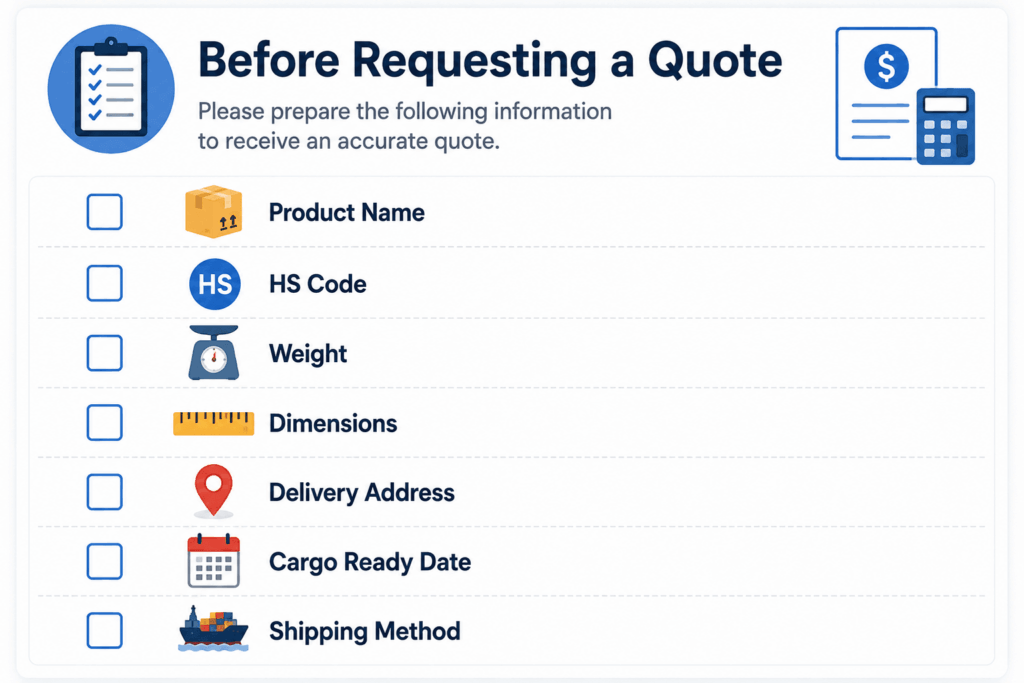
Preparing the following information in advance will help your freight forwarder recommend the most suitable shipping solution.
Cargo Information
- Product name
- HS Code (if available)
- Whether the cargo contains batteries or other regulated items
- Commercial or personal shipment
Packaging Information
- Number of cartons or pallets
- Carton dimensions
- Gross weight
- Estimated cargo volume
Pickup Information
- Supplier location in China
- Number of suppliers
- Expected cargo ready date
Delivery Information
- Delivery postcode in the UK
- Warehouse, business address or Amazon FBA warehouse
- Preferred shipping method (if known)
Providing these details at the beginning helps avoid unnecessary revisions and speeds up the quotation process.
Frequently Asked Questions
How much does shipping from China to the UK cost?
There is no fixed shipping price.
The total cost depends on factors such as the shipping method, cargo size, weight, destination, delivery terms and the services included in the quotation.
The most accurate way to determine shipping costs is to request a quotation based on your specific shipment details.
Which shipping method is usually the most economical?
For large commercial shipments, sea freight is generally the most cost-effective option.
However, the most suitable method depends on your delivery schedule, cargo type and business priorities.
Is rail freight cheaper than air freight?
In most commercial situations, rail freight offers a balance between cost and transit time.
It is typically more economical than air freight while providing faster delivery than sea freight.
Route availability and operational conditions should always be confirmed before booking.
Should I choose DDP or DAP?
The answer depends on how you manage your imports.
Businesses that prefer a simplified logistics process often choose DDP.
Businesses with experience handling UK imports may prefer DAP, where they remain responsible for applicable import duties and taxes.
Discussing your business requirements with your logistics provider will help determine which option is most appropriate.
Can I combine products from multiple suppliers into one shipment?
Yes.
Cargo from multiple suppliers can often be consolidated at a warehouse in China before international transportation.
Consolidation may improve container utilisation, simplify logistics management and reduce overall shipping costs.
Can you arrange delivery directly to my warehouse in the UK?
Yes.
Depending on the shipping arrangement, shipments can be delivered to a business address, warehouse, distribution centre or other designated delivery location.
The available delivery options should be confirmed when requesting a quotation.
Final Thoughts
Shipping costs from China to the UK are influenced by much more than the freight rate alone.
Transportation method, cargo characteristics, customs arrangements, delivery requirements and service scope all play an important role in determining the final logistics cost.
Rather than searching for the lowest quotation, successful importers focus on selecting the shipping solution that best supports their business.
Planning shipments early, providing accurate cargo information, choosing the appropriate transportation method and understanding exactly what is included in a quotation can help reduce unexpected costs while improving supply chain reliability.
International logistics is not simply about moving cargo from one country to another.
It is about creating a transportation strategy that balances cost, transit time and operational efficiency.
Need Shipping from China to the UK?
Whether you’re importing a single pallet, consolidating cargo from multiple suppliers or shipping full containers to the UK, choosing the right logistics solution starts with understanding your shipment.
At Kisun Shipping, we offer a range of transportation options, including:
- Sea Freight (FCL & LCL)
- Air Freight
- Rail Freight
- International Express
- Airport Delivery
- Door-to-Door Delivery
- DDP Shipping
- DAP Shipping (often still referred to as DDU by many importers)
Because every shipment is different, we don’t believe in one-size-fits-all solutions.
Instead, we evaluate your cargo, delivery schedule and business requirements to recommend the shipping method that offers the best balance between cost, transit time and reliability.
If you’re planning your next shipment from China to the UK, our team will be happy to provide a tailored logistics proposal based on your actual shipment details.

China Logistics Expert
About the Author
Katherine Kang is a China-based logistics consultant with over 11 years of experience in international trade and freight forwarding. Specializing in helping SMEs import from China she focuses on compliant, cost-effective solutions to avoid delays, tariffs, and hidden fees. From anti-dumping guidance to CNY planning, Katherine has managed hundreds of shipments, saving clients 15-30% on average.
Connect with Katherine on LinkedIn or contact Kisun Shipping for a free import consultation.