China to Amazon FBA 2026: Current Costs, Delays & The Best Routes to Protect Your Margins
If you’re shipping from China to Amazon FBA right now, you’ve probably noticed the same thing I hear from sellers every single week: rates didn’t drop as much as everyone hoped after Chinese New Year, and picking the wrong route can quietly eat 20-30% of your margin or leave your inventory sitting in a port for weeks.
I’ve run hundreds of China-to-FBA shipments in the last few months. The numbers I’m sharing below are what our clients are actually paying in March–April 2026 — not last year’s estimates, not “typical” quotes that magically disappear when you book. This is the real picture: current costs, real transit times, common delays, and which route actually makes sense for your volume.
We’ll cover the three main shipping methods (sea, air, rail), a clear cost-and-time comparison, the routes we handle most often, and the practical things you must watch out for so your next shipment doesn’t turn into an expensive surprise.
Quick links to related guides on our site (so you can jump straight to what matters):
The Three Main Ways to Ship from China to Amazon FBA in 2026
In 2026, the question isn’t just “Air or Sea?” It’s about “Speed to Shelf.” Every day your product sits in a container is a day your BSR (Best Seller Rank) is tanking.
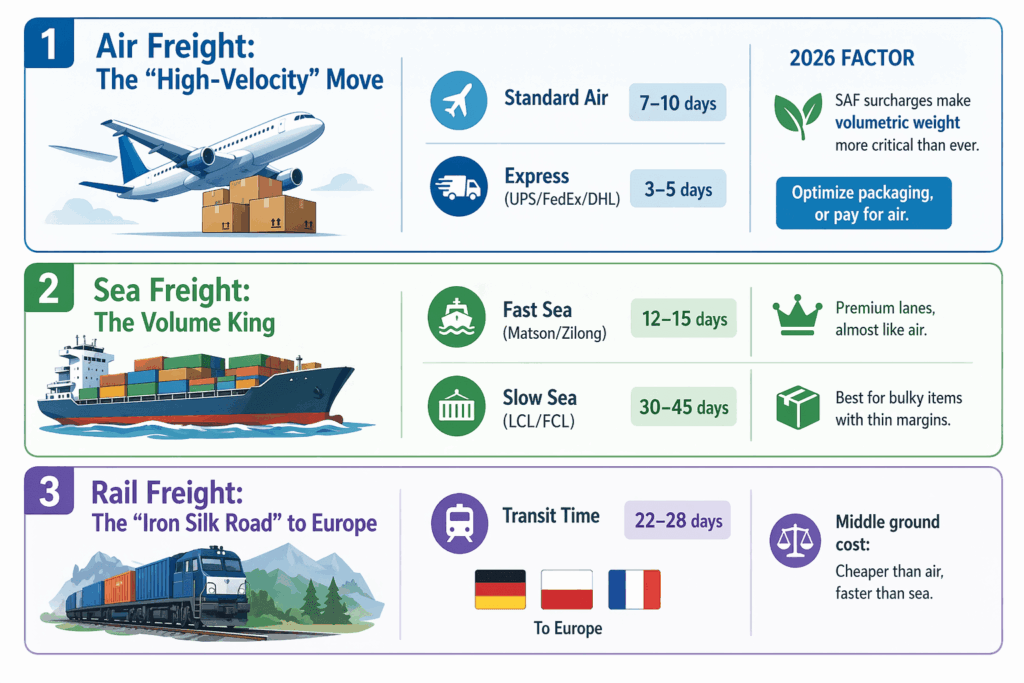
1. Air Freight: The “High-Velocity” Move
In April 2026, air freight remains the lifeline for high-value electronics and seasonal launches.
- Standard Air: 7–10 days.
- Express (UPS/FedEx/DHL): 3–5 days.
- The 2026 Factor: With the expansion of Sustainable Aviation Fuel (SAF) surcharges, air freight costs are more sensitive to “volumetric weight” than ever. If your packaging isn’t optimized, you are paying for air.
2. Sea Freight: The Volume King
Sea freight is still the most cost-effective way to ship to amazon fba from china, but the sub-categories have changed:
- Matson (Fast Sea): These “premium” lanes now function almost like air freight, hitting US West Coast ports in 12–15 days.
- Slow Sea (LCL/FCL): 25–45 days. Ideal for bulky items where the margin is thin and the inventory cycle is long.
3. Rail Freight: The “Iron Silk Road” to Europe
For our sellers targeting Amazon Germany, Poland, or France, rail freight has stabilized in 2026. It offers a “middle ground” cost—cheaper than air, faster than sea—with a transit time of roughly 22–28 days.
Simple Decision Framework: Which Route Should You Choose in 2026?
Here’s the practical rule we give most Amazon sellers:
- Choose Sea Freight (FCL or LCL) when: Your shipment is over 200–300 kg (or 5+ CBM), you have at least 4–5 weeks before you need the stock, and cost is more important than speed. This is still the most popular and economical option for planned replenishment.
- Choose Air Freight when: You’re launching a new product, running low on stock with strong current sales, or the item has high margins and needs to be in FBA within 10–12 days. Speed beats cost in these situations.
- Consider Air freight and Sea freight when: Your FBA warehouse is in the Midwest or East Coast, you want faster delivery than pure sea but don’t want to pay full air prices, and your shipment size is medium (roughly 300kg–5 CBM). It often gives the best balance for inland destinations.
The key is always matching the route to your sales velocity and inventory buffer.
2026 Price Index & Transit Times (Mid-April Update)
Let’s talk numbers. Please note: These are market averages for April 2026 and are subject to weekly fluctuations.
| Route (China to US/EU) | Method(DDP) | Transit Time | Est. Cost (USD) |
| China to US West (ONT8/LGB8) | Fast Sea (Matson) | 12-15 Days | $2.5 – $3.8 / kg |
| China to US East (ABE8) | Sea Freight (Normal) | 35-40 Days | $1.2 – $2.3 / kg |
| China to Europe (FBA) | Rail Freight | 22-28 Days | $1.8 – $2.6 / kg |
| China to Global FBA | Air Freight | 5-9 Days | $5.5 – $8.0 / kg |
Note: These are real March–April 2026 benchmarks from actual bookings. Rates can still move 10–15% in a month, so always get a fresh quote.
Kisun Shipping: Global FBA Footprint
While we ship everywhere, Kisun Shipping has built “Priority Corridors” in 2026 for the highest-performing Amazon marketplaces:
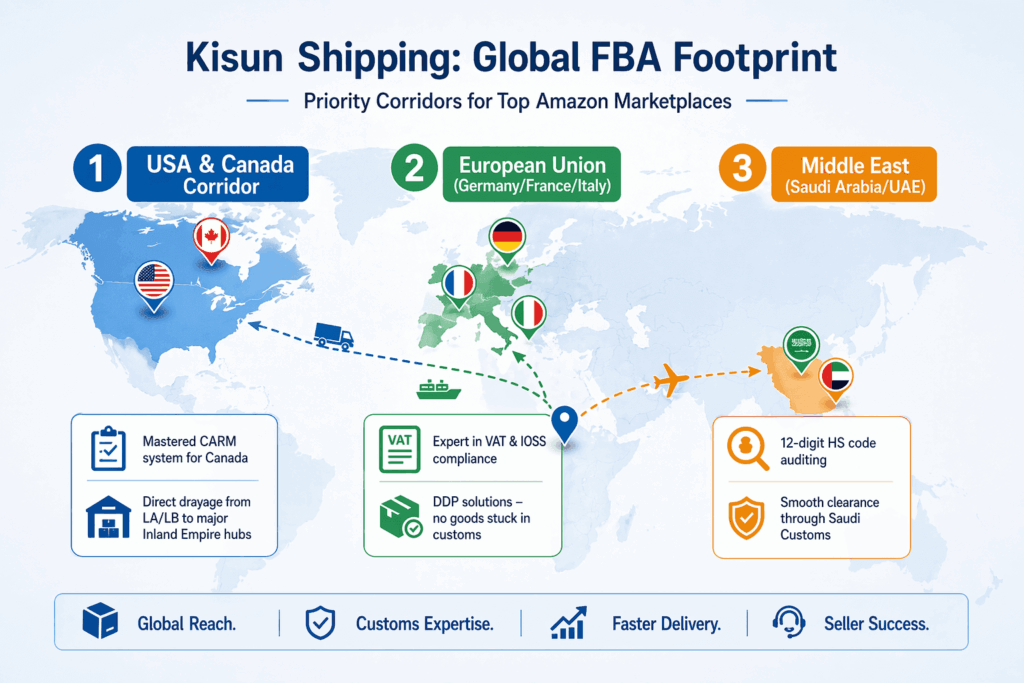
1. The USA & Canada Corridor
We have mastered the CARM system for Canada (as detailed in our Comprehensive Canada Customs Guide) and offer direct drayage from LA/LB to the major Inland Empire hubs.
2. The European Union (Germany/France/Italy)
Navigating VAT and IOSS in 2026 is a minefield. We provide DDP (Delivered Duty Paid) solutions that ensure your goods don’t get stuck in a Hamburg customs warehouse.
3. The Middle East (Saudi Arabia/UAE)
Amazon SA is the “Gold Rush” of 2026. We provide specialized 12-digit HS code auditing to ensure your electronics pass Saudi Customs without a hitch.
Shipping Precautions & Things That Still Trip Sellers Up in 2026
Even with stable rates, small mistakes still cause big headaches. Here’s what we tell every client before they ship:
- Labeling & Packaging — FNSKU rules are stricter than ever. Wrong labels or cartons that don’t meet Amazon’s weight/dimension limits get rejected at the warehouse. Always confirm packaging with your forwarder before the factory finishes production.
- Documentation — Vague descriptions or incorrect HS codes slow down customs. We review everything before the container even leaves China.
- Buffer Time — Build in at least 2–3 extra weeks. Delays from weather, port congestion, or sudden carrier changes still happen.
- Port Choice — Shipping from Shenzhen is often cheaper and smoother than Shanghai or Ningbo for many routes. Check our 5 Major Ports Guide to see why.
- DDP vs DAP — For most Amazon sellers, DDP (all-in delivered) is simpler and avoids surprise destination fees.
The sellers who do best treat shipping as part of their overall strategy, not a last-minute task.
At Kisun Shipping, we do exactly that: we review your labeling, packaging, and documentation upfront, then give you a side-by-side comparison of sea, air, and rail options with real 2026 numbers. No guesswork.
Top 5 Amazon FBA Seller FAQs (2026 Update)
Q. Is there a realistic way to avoid the new Inbound Placement Service Fee without splitting my inventory across the US?

A. If you want to ship to a single location (Minimal Splits), you have to pay the "convenience tax"—usually around $0.40 per unit. In 2026, the only way to bypass this fee is to choose "Amazon-Optimized Splits" (4+ locations). The pro move we do for our clients is "Origin Splitting." We take your cargo in our Shenzhen warehouse, split it into the four required shipments there, and handle the separate logistics legs. You avoid the per-unit placement fee, and while the freight coordination cost goes up slightly, your total landed cost usually drops by 15-20%.
Q. My factory uses high-quality inkjet printers for FNSKU labels. Will Amazon reject these in 2026?
A. Yes, and it’s a gamble you shouldn't take. Amazon’s 2026 standards strictly favor thermal or laser printing. Why? Because inkjet ink is water-soluble. During a 30-day sea voyage, humidity in the container can make inkjet barcodes smudge or "bleed." When that box hits the conveyor belt at ONT8 or SMF3, the laser scanner won't read it. Your shipment gets flagged for "Manual Processing," and you’ll get hit with a per-item relabeling fee. Stick to 300 DPI thermal labels—it’s the industry standard for a reason.Q. With the end of the "De Minimis" ($800) loophole, is Air Express still viable for FBA?
A. The days of tax-free "quick restocks" are over. In 2026, US Customs treats almost all FBA-bound air cargo as commercial entry, regardless of value. This means you’re paying duties, HTS fees, and MPF (Merchandise Processing Fees) on every kilo. Air Express is still viable for preventing an "Out of Stock" disaster, but you have to bake an extra 15-25% into your shipping budget for taxes. We recommend our DDP (Delivered Duty Paid) Air Line—we handle the formal entry and the tax bill so you don't get stuck with a surprise brokerage invoice three weeks after your goods arrive.Q. Why does my tracking show "Delivered" at the Amazon FC, but my inventory isn't "Available" for sale?
A. "Delivered" just means the truck has dropped the trailer at the Amazon yard. In 2026, especially during Q3 and Q4, the gap between "Delivered" and "Checked-in" can be 7 to 10 days. Amazon uses a queue system; your trailer is literally sitting in a parking lot waiting for a dock door. Don't panic unless it's been more than 14 days. This is why we always tell our sellers: your "Lead Time" isn't when the ship arrives; it’s when the "Active" button lights up in Seller Central. Always add a two-week buffer to your replenishment cycle.Q. I’m a reseller—can I still use the manufacturer’s UPC code to save on labeling time?
A. As of the March 2026 policy shift, Amazon is forcing almost all third-party sellers (especially resellers) toward FNSKU-only tracking. If you use a manufacturer UPC, your inventory is "commingled" with every other seller of that product. If a competitor sends in a fake or a damaged unit, it could be sent to your customer, and your account gets the 1-star review or the "Inauthentic" strike. Labeling with a unique FNSKU is the only way to "wall off" your inventory and protect your account health.Summary: Your Logistics is Your Competitive Advantage
In 2026, how to ship from china to amazon fba is a math problem, not a transportation problem. By choosing the right split-shipment strategy and a forwarder that actually understands the 2026 tariff landscape, you can keep your margins while your competitors are drowned by “Placement Fees.”
[Get a Live 2026 Quote for Your FBA Shipment] — Let Kisun Shipping navigate the 2026 delays while you focus on scaling your brand.

China Logistics Expert
About the Author
Katherine Kang is a China-based logistics consultant with over 11 years of experience in international trade and freight forwarding. Specializing in helping SMEs import from China to the USA, Canada, and Europe, she focuses on compliant, cost-effective solutions to avoid delays, tariffs, and hidden fees. From anti-dumping guidance to CNY planning, Katherine has managed hundreds of shipments, saving clients 15-30% on average.
Connect with Katherine on LinkedIn or contact Kisun Shipping for a free import consultation.