Complete Guide 2026: Shipping from China to Philippines (The Logistics Masterclass)
In 2026, the Philippines isn’t just a destination; it is a global trade powerhouse. As the rotating chair of ASEAN this year, the Philippines has transformed its logistics infrastructure to handle a record-breaking influx of goods. With China accounting for nearly 30% of all Philippine imports as of Q1 2026, the demand for a reliable freight forwarder from China to Philippines has never been higher.
If you are seeing the status “parcel in transit from china to philippines” on your tracking app and wondering why it’s taking 12 days instead of 5, or if you are trying to calculate the landed cost for a fleet of New Energy Vehicles (NEVs), you are in the right place.
The 2026 Macro View: Why China-PH Trade is Exploding
The Philippine economy is currently one of Southeast Asia’s most dynamic markets. In January 2026 alone, export values hit US$7.09 billion, marking over a year of consecutive growth.
Key Trade Drivers:
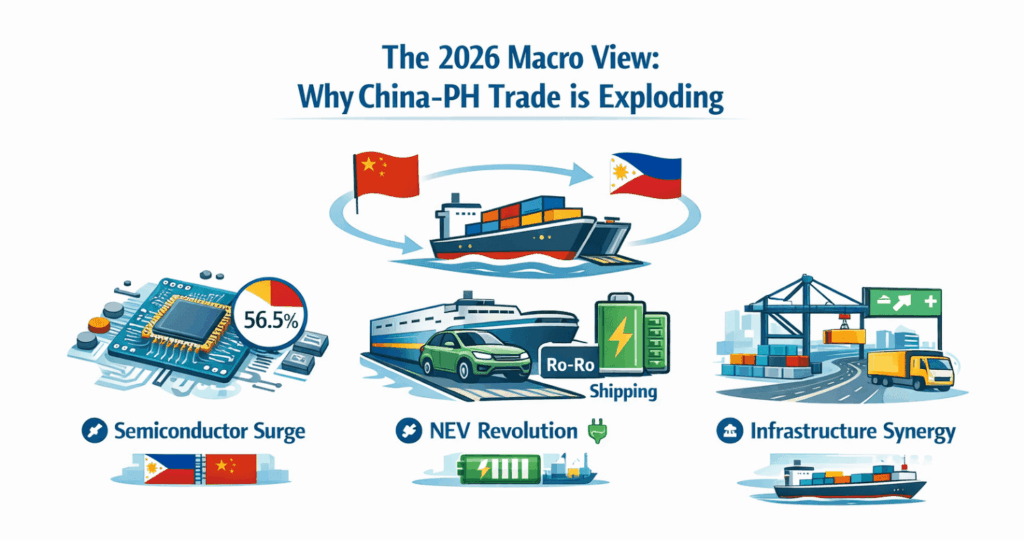
- The Semiconductor Surge: Electronic products now make up 56.5% of total exports. China remains the primary source for the raw components and semiconductors required for the Philippines’ massive IT-BPM and electronics sectors.
- The NEV Revolution: 2026 has seen a significant spike in Chinese EV brands entering the Manila market. This requires specialized Ro-Ro (Roll-on/Roll-off) shipping and lithium-battery compliant logistics.
- Infrastructure Synergy: The Philippine government’s export target of US$116 billion for 2026 is supported by the rapid modernization of ports like Batangas and Subic Bay to relieve the pressure on Manila.
Navigating the Gateways: Which Port Should You Choose?
When shipping from China to Philippines, choosing the right port of entry is the difference between a 3-day delivery and a 3-week headache.
| Port Name | Regional Focus | Best For | 2026 Advantage |
| Port of Manila | Metro Manila / Central Luzon | General retail, furniture, FBA goods | Highest frequency of sailings from China. |
| Port of Batangas | CALABARZON Industrial Zone | Manufacturing raw materials, Automotive | Bypasses Manila truck bans; faster “Last Mile”. |
| Subic Bay Freeport | Northern Luzon / Re-export | Electronics, High-tax items, Transshipment | Duty-free storage; ideal for re-exporting. |
| Port of Cebu | Visayas Region | Consumer goods for Central Philippines | Direct routes from Ningbo/Shanghai; lower costs. |
| Port of Davao | Mindanao Region | Heavy machinery, Agricultural equipment | Strategic entry for Southern PH infrastructure. |
Port of Manila (The Heart of the Beast)
Handling 70% of all national cargo, Manila (North and South Harbors) is the default choice. However, in 2026, “Manila Congestion” is a term every importer must respect.
- Best for: General consumer goods, furniture, and retail inventory destined for Metro Manila.
Port of Batangas (The CALABARZON Secret)
If your warehouse is in the southern industrial zones (CALABARZON), shipping to Batangas is significantly faster. It avoids the Manila truck ban and offers faster turnaround times for manufacturing clients.
Subic Bay Freeport (The Re-export Hub)
Subic is the go-to for tax-free transshipment and high-tech manufacturing. As a former naval base, its infrastructure is world-class, making it ideal for shipping to amazon fba from china if you are using the Philippines as a secondary prep hub.
Port of Cebu & Davao (Serving the South)
Don’t funnel everything through Luzon. If you are targeting the Visayas or Mindanao markets, shipping directly to Cebu or Davao (the primary agricultural exit point) will slash your domestic trucking costs by 40%.
Future Outlook: Casiguran New International Port
Keep an eye on the Aurora province. The Casiguran deep-water project is set to become the “Pacific Gateway,” offering a shorter route for ships coming from China’s eastern ports like Ningbo and Shanghai.
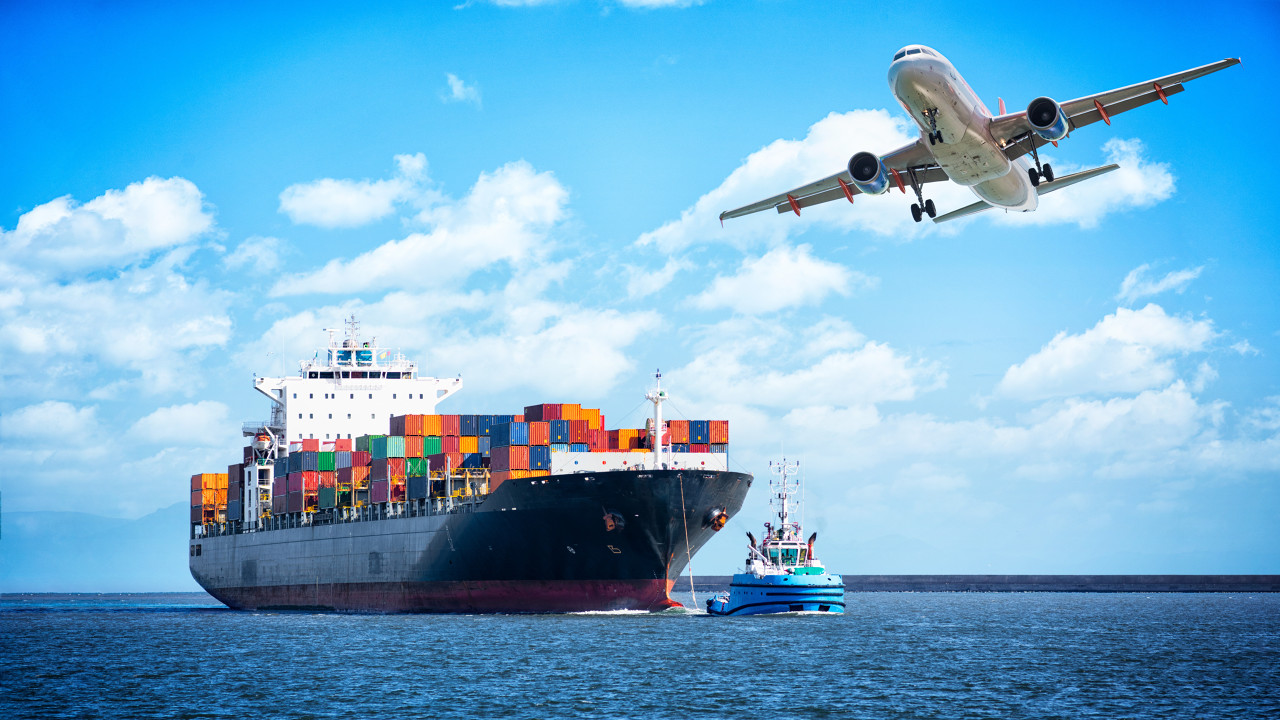
Shipping Modes: Sea Freight vs. Air Freight in 2026
| Feature | Sea Freight (FCL/LCL) | Direct Air Freight |
| Transit Time | 5 – 12 Days | 2 – 3 Days |
| Cost Level | Low (Best for ROI) | High (Premium Service) |
| Ideal Cargo | Bulky, Heavy, Steel, Furniture, Solar | Semiconductors, E-cigs, Urgent Spares |
| Customs Focus | Form E / ACFTA Compliance | Formal Entry / Battery Certifications |
| Volume Limit | No limit (Container based) | Best for < 300kg or high-value smalls |
Sea Freight: The Backbone of Bulk
For most businesses, sea freight China to Philippines is the only way to maintain margins.
- LCL (Less than Container Load): Perfect for small businesses. You share space in a container.
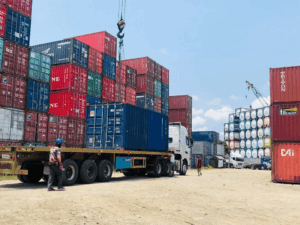
- FCL (Full Container Load): Essential for large-scale imports of steel, machinery, or solar panels.
- Transit Time: 5 to 12 days from major China ports (Shenzhen, Guangzhou, Ningbo).
Air Freight: The “Emergency” Channel
When the status says “parcel in transit from china to philippines,” every hour counts for high-value items like semiconductors, e-cigarettes, or fresh produce.
- Direct Routes: Guangzhou/Shanghai/Shenzhen to MNL (Manila) or CEB (Cebu).
- Transit Time: 2 to 3 days.
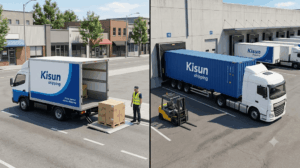
- Kisun Specialty: We handle the rigorous compliance needed for e-cigarettes and lithium batteries, which many standard couriers reject.
The “Zero Duty” Secret: Form E and ASEAN Compliance
This is where many “cheap” freight forwarders from China to Philippines fail their clients. Because of the China-ASEAN Free Trade Agreement (ACFTA), most goods can be imported with 0% to 5% import duty.
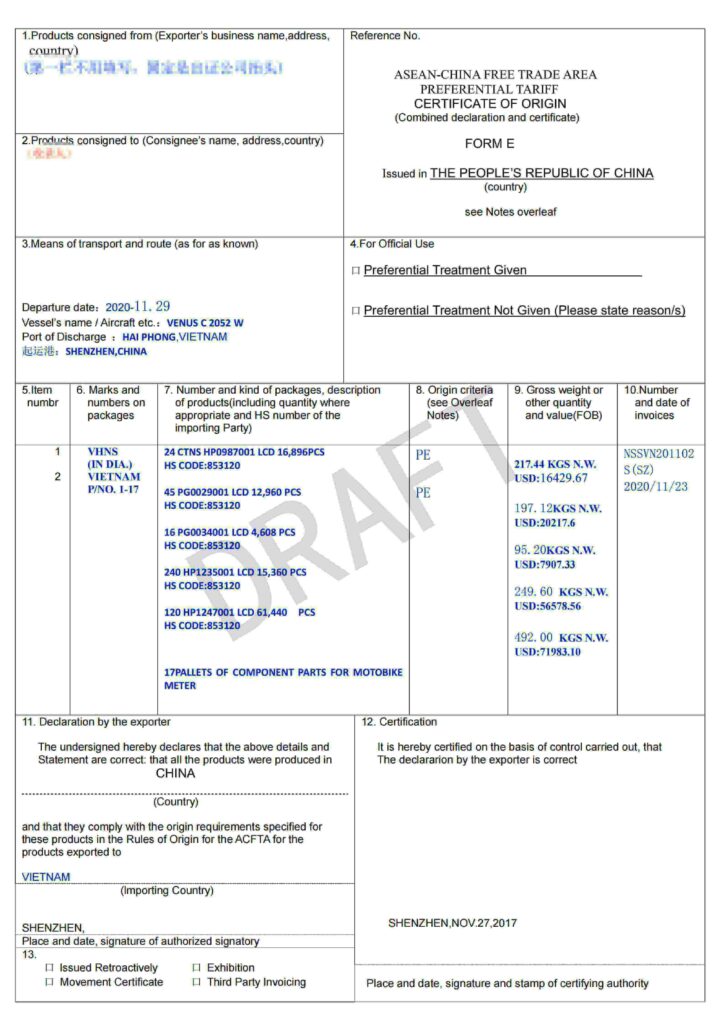
What is Form E?
The Certificate of Origin (Form E) is your golden ticket. Without this document, the Bureau of Customs (BOC) will charge you the full “Most Favored Nation” (MFN) tariff rates, which can be 10%, 20%, or even 35%.
Kisun Warning: In 2026, the BOC has increased audits on Form E authenticity. If your supplier in China provides a fake or poorly filled Form E, you will face “Supervised Release” and heavy fines. We handle the vetting of your supplier’s documentation before the ship even leaves the dock.
Door-to-Door (DDP) vs. Traditional (CIF/FOB)
As a modern freight forwarder from China to Philippines, Kisun Shipping has seen a massive shift toward DDP (Delivered Duty Paid).
Why DDP is Winning in 2026:
| Responsibility | Traditional (CIF/FOB) | Kisun DDP (Door-to-Door) |
| Shipping Cost | Variable (often hidden surcharges) | All-inclusive fixed rate |
| Customs Clearance | Handled by Buyer (High Risk) | Handled by Kisun (Zero Hassle) |
| Import Duties/VAT | Paid by Buyer at Port | Included in the price |
| Local Trucking | Buyer must arrange local fleet | Delivered to your warehouse/office |
| Documentation | Complex (Buyer needs Importer ID) | Simple (Use our Import License) |
- Price Predictability: You pay one price that includes freight, taxes, customs clearance, and local delivery. No “surprise” bills at the Manila port.
- Ease for E-commerce: If you are running a Shopify store or selling on Lazada/Shopee, DDP allows you to focus on marketing while we handle the BOC.
- The “Last Mile” Expertise: Our local fleet in Manila, Davao, and Batangas ensures that once the parcel in transit from china to philippines clears customs, it reaches your doorstep in 24-48 hours.
Common Pitfalls: Why Shipments Get Stuck
Even with the best shipping from China to Philippines plan, things can go wrong. Here is what we are seeing in 2026:
- Misdeclared HS Codes: The BOC is now using AI-assisted scanning. If your “Electronic Toys” are actually “Drones with high-res cameras,” your cargo will be seized.
- PEZA Misunderstandings: If your business is in a PEZA (Philippine Economic Zone Authority) zone, you have specific tax incentives, but the paperwork is different. We have a dedicated team for PEZA zone deliveries.
- Under-valuation: Trying to save on 12% VAT by declaring a $10,000 shipment as $1,000? Don’t. The BOC has a “valuation database” for all Chinese goods. They know what a 20ft container of steel costs.
The Kisun 4-Step “Hassle-Free” Shipping Process
We’ve simplified the most complex trade route in Southeast Asia into four steps:
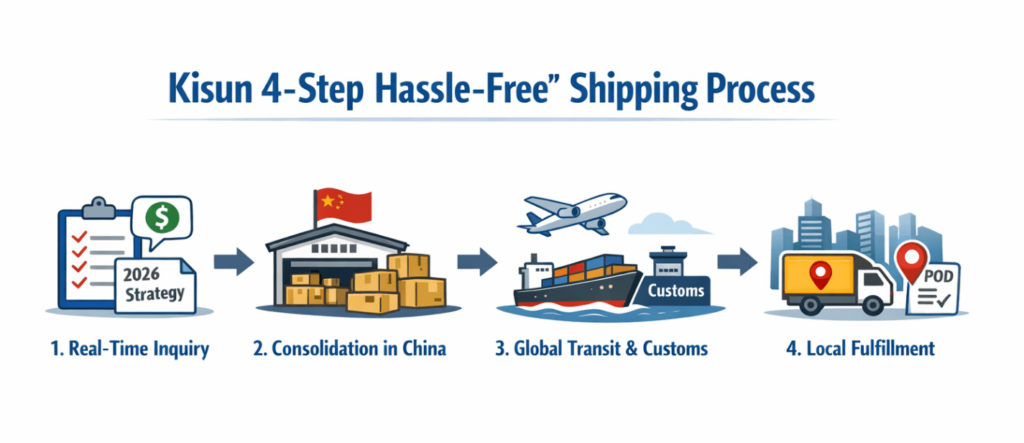
Step 1: Real-Time Inquiry
Tell us what you’re shipping(goods name, HS code, shipment weight and volume) and where it’s going. We don’t just give a quote; we give a 2026 Tariff Strategy.
Step 2: Consolidation in China
Ship your goods to our warehouses in Guangzhou, Shenzhen, or Yiwu. We offer free 7-day storage for consolidation.
Step 3: Global Transit & Customs
We handle the loading, the Form E filing, and the BOC clearance. You track your shipping from China to Philippines through our live portal.
Step 4: Local Fulfillment
From Manila ports to the streets of Makati or the industrial parks of Laguna, our local drivers ensure the POD (Proof of Delivery) is signed and your inventory is ready for sale.
To complement your Complete Guide 2026, here are the 5 most-searched questions by Philippine importers. These are written to reflect the real-world frustrations of Manila and Cebu business owners, providing the “hard truths” that build authority for Kisun Shipping.
Top 5 FAQs: Shipping from China to Philippines (2026 Edition)
Q: My tracking says "Parcel in transit from China to Philippines"—why has it been stuck for 7 days?

A: This is the most common frustration for e-commerce sellers. In 2026, a "transit" status usually means your cargo is either waiting for a feeder vessel in a transshipment hub like Kaohsiung or, more likely, it's caught in the Manila Port Congestion queue. While the actual sailing time from Shenzhen to Manila is only 3–5 days, the "berthing delay" at North Harbor can add another 4–6 days during peak seasons. If you are using a cheap courier, they often wait for a "full load" before moving your parcel. At Kisun, we use Direct Express vessels to bypass these mid-route delays.
Q: How much import duty will I pay if I don't have a "Form E" certificate?
A: Without a Form E (Certificate of Origin), you are throwing money away. Under the China-ASEAN Free Trade Agreement (ACFTA), most electronics, machinery, and furniture qualify for 0% to 5% duty. If you fail to provide a valid, BOC-compliant Form E, the Bureau of Customs will default to "MFN" (Most Favored Nation) rates, which can climb to 20% or 30% plus the 12% VAT. In 2026, the BOC has tightened its "Value Reference" checks—so even with a Form E, make sure your invoice price isn't suspiciously low, or they will "benchmark" your shipment to a higher value.Q. Can I ship e-cigarettes and lithium batteries via air freight to Manila in 2026?
A: Yes, but you cannot use standard "General Cargo" channels. In 2026, the Civil Aviation Authority of the Philippines (CAAP) and international airlines have stricter DG (Dangerous Goods) protocols. E-cigarettes and high-capacity lithium batteries (like those for power stations) require UN38.3 certification and specialized MSDS documentation. If you try to "hide" these in a regular air parcel, the shipment will be rejected at the X-ray in Guangzhou or Shenzhen, and you may face a permanent carrier ban. We operate a Specialized DG Line that is pre-cleared for these items.Q. Is "All-in" DDP shipping legal for commercial business in the Philippines?
A: This is a "gray area" that many freight forwarders won't explain honestly. DDP (Delivered Duty Paid) is extremely popular for SME importers because it provides a single, predictable price. However, for large-scale corporate tax filing, you may need an Official Receipt (OR) from the Bureau of Customs in your own company name to claim "Input VAT." If you are a small retailer, Kisun’s DDP service is perfect—it saves you from the nightmare of filing your own import permits. But if you are a massive corporation, we recommend our Formal Entry service so you can maximize your tax credits.Q. Which is better for 2026: Shipping to the Port of Manila or the Port of Batangas?
A: If your final destination is anywhere in the CALABARZON (Cavite, Laguna, Batangas, Rizal, Quezon) industrial zone, choose Batangas. Manila’s "Truck Ban" hours and city traffic can add 24–48 hours to your local delivery time and significantly increase your trucking fees. Batangas has become a world-class gateway in 2026 with much faster "Gate-out" times. However, if you are distributing to retail markets in Binondo or Quezon City, Manila South Harbor remains the most logical (though more congested) choice.Conclusion: Your Moat is Your Logistics
In 2026, the difference between a profitable importer and a bankrupt one is their freight forwarder from China to Philippines. You need more than a “mover”; you need a partner who understands the rotating chairmanship of ASEAN, the fluctuations in the Peso-Yuan exchange rate, and the specific clearance quirks of the Port of Batangas.
Are you ready to optimize your 2026 supply chain?
Whether you are looking for sea freight China to Philippines rates or need help with a complicated vacis exam at the US border (for your global operations), Kisun Shipping is the “Old Soldier” you want on your side.
Get a Free 2026 Quote Today or explore our Saudi Arabia Customs Guide if you are expanding into the Middle East.

China Logistics Expert
About the Author
Katherine Kang is a China-based logistics consultant with over 11 years of experience in international trade and freight forwarding. Specializing in helping SMEs import from China to the USA, Canada, and Europe, she focuses on compliant, cost-effective solutions to avoid delays, tariffs, and hidden fees. From anti-dumping guidance to CNY planning, Katherine has managed hundreds of shipments, saving clients 15-30% on average.
Connect with Katherine on LinkedIn or contact Kisun Shipping for a free import consultation.