
Shipping from China to Amazon FBA UK: Why FBA Shipping Is Different
Shipping products from China to a normal UK warehouse is not the same as sending inventory to Amazon FBA.
With a normal commercial delivery, the main objective is usually straightforward:
Move the cargo from China to the customer’s UK address.
For Amazon FBA, there is an additional layer:
The inventory must reach Amazon’s fulfilment network through the shipment process Amazon requires.
That difference is important.
A shipment can arrive in the UK successfully and still have a problem getting into FBA if the Amazon shipment information, preparation or delivery requirements have not been followed correctly.
Amazon’s current FBA process requires sellers to register for FBA, create or convert listings, prepare their products, and send inventory to Amazon fulfilment centres using the relevant Seller Central workflow. Once Amazon receives the inventory, it handles fulfilment activities such as storage, picking, packing and shipping orders to customers.
So when you ship from China to Amazon FBA UK, you are managing two connected processes:
China-to-UK international logistics
plus
Amazon FBA inbound requirements
Understanding both is essential.
Quick Answer
To ship inventory from China to Amazon FBA UK, you need to coordinate two processes: Amazon’s inbound shipment requirements and the UK import process. Your inventory must be prepared according to the current instructions in Seller Central, transported from China, cleared through UK customs where required, and delivered to the Amazon destination specified for the shipment.
At Kisun Shipping, we can coordinate China-side consolidation and preparation, international transportation, UK customs clearance and final delivery using sea, rail, truck or air services.
What Is the Difference Between Normal UK Delivery and Amazon FBA?
The physical transportation may look similar, but the destination and receiving process are different.
| Normal UK Commercial Delivery | Amazon FBA Shipment |
|---|---|
| Delivered to your warehouse or business address | Delivered to an Amazon fulfilment centre |
| Receiving is controlled by your business | Amazon controls the receiving process |
| Your own warehouse requirements | Amazon’s current FBA requirements apply |
| Delivery arranged according to your address | Shipment information and destination come from Amazon’s Seller Central workflow |
| Standard commercial logistics | Logistics + Amazon inbound requirements |
This means that a freight forwarder should not simply receive an instruction saying:
“Ship this to Amazon UK.”
The shipment should be planned using the specific Amazon shipment information generated in Seller Central.
How Does Shipping from China to Amazon FBA UK Work?
A typical process looks like this:
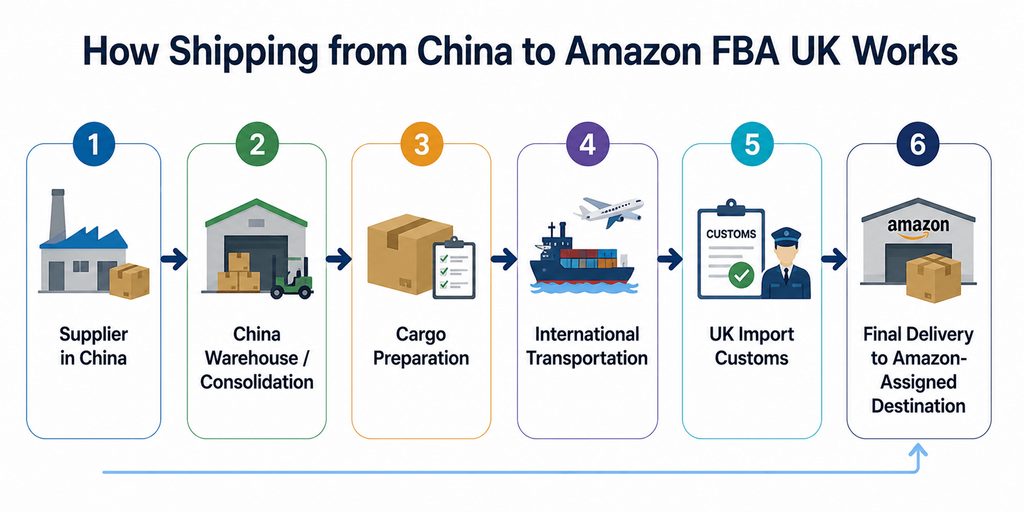
The exact process depends on your shipment and Amazon’s current requirements.
The important part is that the Amazon-side preparation should be completed before the international shipment is arranged.
Amazon’s own FBA guidance tells sellers to prepare their products and send them to its fulfilment centres through the relevant Seller Central workflow.
Why You Should Prepare the Amazon Shipment Before Shipping from China
One of the easiest mistakes is treating Amazon as if it were simply another warehouse.
For example, a seller may tell the supplier:
“Send 500 cartons to Amazon UK.”
But that is not enough information for a reliable FBA shipment.
Before your cargo leaves China, you should already know the shipment details generated through Amazon’s current workflow, including the products and quantities being sent and the relevant destination and labelling instructions.
This gives your logistics provider the information needed to prepare the shipment correctly.
It also reduces the risk of making changes after the cargo is already in transit.
Your China Warehouse Can Be an Important Part of the Process
This is where the logistics process can become much easier for sellers sourcing from multiple Chinese suppliers.
Instead of sending every supplier’s cargo separately toward the UK, your goods can first be coordinated through a China warehouse where the agreed preparation work can be completed.
Depending on the service required, this may include:
- Receiving goods from multiple suppliers
- Consolidating cargo
- Checking cartons and quantities
- Confirming shipment information
- Preparing agreed labels
- Repacking where required
For an Amazon seller buying from several factories, this can turn a complicated multi-supplier shipment into one coordinated logistics operation.
The key is to complete the necessary preparation before the international shipment leaves China.
Amazon FBA Is Not Just About Getting the Cargo to the UK
This is the most important point of this guide.
A successful FBA shipment has to satisfy three separate stages:
1. International logistics
The cargo must move from China to the UK using the selected transportation service.
2. UK import
The shipment must be handled through the appropriate UK customs and import process.
3. Amazon inbound
The inventory must reach Amazon according to the current shipment, labelling and receiving requirements provided through Seller Central.
A problem at any one of these stages can affect the overall shipment.
That is why Amazon FBA logistics should be planned as a complete process rather than treated as simply another China-to-UK delivery.
2026 Update: Amazon’s Barcode Rules Have Changed
This is particularly important for sellers who rely on older FBA guides.
Amazon announced that its commingling practices ended for inventory shipped on or after March 31, 2026, together with changes to eligibility for using manufacturer barcodes.
Under the updated policy:
- Brand owners with the Brand Representative role in Amazon Brand Registry may use manufacturer barcodes for eligible products that already have them, without applying Amazon barcode stickers to prevent commingling.
- Resellers who are not enrolled in Amazon Brand Registry as a Brand Representative are required to use Amazon barcode stickers even when products have manufacturer barcodes.
- Products without a manufacturer barcode still require Amazon barcode stickers.
The practical lesson is simple:
Do not rely on an old FBA labelling guide when preparing inventory from China.
Check the current Seller Central instructions for the specific products and shipment before your goods leave the supplier.
What This Means for a China-Based FBA Seller
Your freight forwarder does not replace Amazon Seller Central.
Amazon determines the FBA shipment requirements through its seller workflow, while the logistics provider’s role is to make sure the physical cargo is prepared and transported in line with those instructions.
A well-coordinated shipment therefore connects:
Your Supplier
→ China Warehouse
→ FBA Preparation
→ International Freight
→ UK Customs
→ Amazon Fulfilment Centre
The more accurately these stages are coordinated before departure, the less likely you are to discover a logistics problem after the cargo is already on its way.
What Should Be Ready Before Your FBA Shipment Leaves China?
Once an Amazon FBA shipment has been created in Seller Central, the next step is making sure the physical inventory matches the information Amazon expects to receive.
This is where careful preparation in China can make a real difference.
Your freight forwarder should not have to guess what is inside the shipment or how the cartons should be identified. The information used to create the Amazon shipment should be available before the cargo is collected.
1. Confirm the Amazon Shipment Information First
Before arranging international transportation, check the current shipment details in Seller Central.
Your logistics provider may need information such as:
- Products and quantities being shipped
- The Amazon-assigned destination
- Box or shipment labels generated by Amazon
- Pallet information where applicable
- Any specific preparation or labelling instructions shown for that shipment
Amazon’s Send to Amazon workflow is designed to guide sellers through these steps and generate the labels and shipment information needed for inbound inventory. (sellercentral.amazon.co.uk)
The important point is:
Prepare the physical cargo based on the shipment information in Seller Central—not on a general assumption about how Amazon FBA works.
Amazon can change operational requirements, so the current instructions for your shipment should take priority over older guides or previous shipment experience.
2. Make Sure Your Inventory Matches the Shipment
One of the simplest things to check is whether the physical goods actually match what was created in Seller Central.
Before shipment, compare:
Seller Central quantity
vs.
Actual quantity ready in China
Also check:
- SKU
- Product variant
- Carton quantity
- Packaging configuration
For example, if the shipment was created for 500 units but the supplier prepares 520 units, that difference should be resolved before the cargo leaves.
The same applies if the supplier changes the carton configuration after the shipment was created.
A small discrepancy at the China warehouse is much easier to fix than the same discrepancy after the inventory has already entered international transit.
3. Product Preparation Should Be Checked Before Shipping
Amazon has product-specific preparation requirements, and the applicable requirements depend on the product.
Depending on the inventory, preparation may involve requirements relating to:
- Packaging
- Poly bags
- Sealing
- Product protection
- Expiration dates
- Labelling
The important point is not to assume that every FBA product uses the same preparation method.
Amazon’s current Seller Central instructions for the specific product and shipment should be followed. (sellercentral.amazon.co.uk)
For a China-based seller, this is an important reason to check the goods before they leave the supplier or consolidation warehouse.
4. Check Cartons Before They Leave the Warehouse
Carton-level mistakes can create problems even when the products themselves are correct.
Before export, the warehouse can check:
- Number of cartons
- Carton condition
- Carton dimensions and weight
- Carton labels
- Shipment information
- Whether the physical cartons match the shipment record
This is especially useful when inventory from several suppliers is being consolidated.
A carton that is damaged, incorrectly labelled or recorded with the wrong information is much easier to correct while it is still in China.
5. Use Your China Warehouse as a Final Checkpoint
For sellers working with multiple suppliers, the China warehouse can do more than simply store cargo.
It can serve as a pre-shipment checkpoint.
For example:
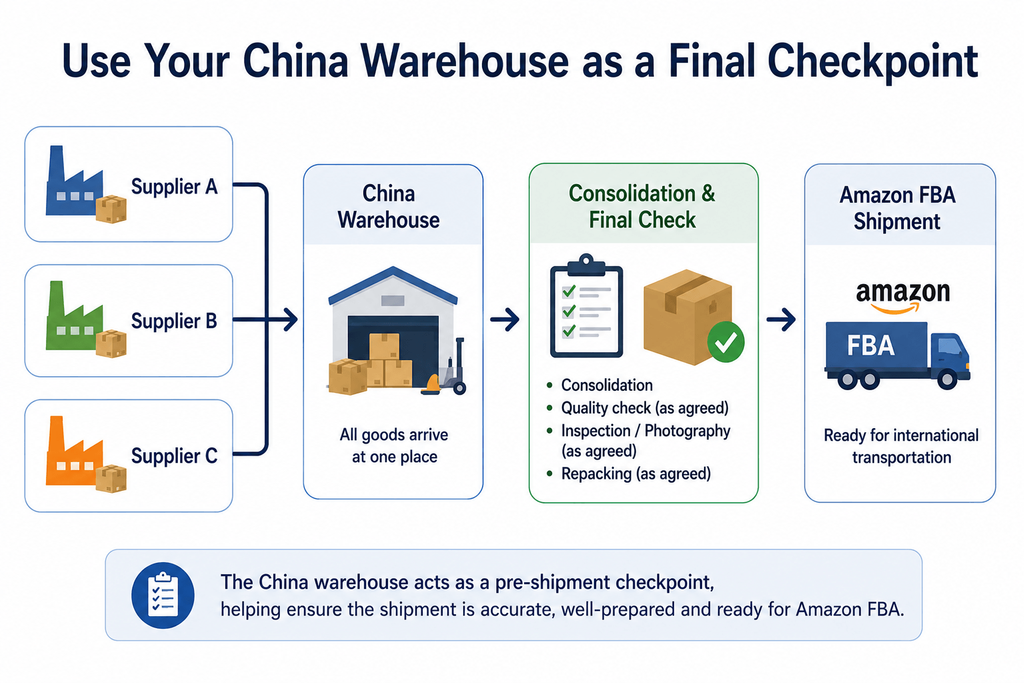
This gives the seller one place to review the shipment before international transportation begins.
Depending on the service arranged, a warehouse may also support agreed inspection, photography, repacking or consolidation work.
This can be particularly useful when different suppliers use different carton sizes or packaging standards.
6. Give Your Freight Forwarder the Right Information
Once the Amazon shipment is ready, provide the logistics team with the information needed to arrange the physical shipment.
A practical handover may include:
- Amazon shipment information
- Product/SKU information
- Carton count
- Carton dimensions
- Gross weight
- Pickup locations
- UK delivery information
- Any special preparation instructions
This reduces unnecessary back-and-forth between the seller, supplier and freight forwarder.
It also allows the logistics provider to identify potential issues while the cargo is still in China.
7. Don’t Treat Labels as a One-Time Decision
Amazon’s labelling requirements can depend on the product, seller status and current Seller Central instructions.
This is particularly important because Amazon changed its commingling policy in 2026, including changes affecting eligibility for manufacturer barcodes. Amazon states that its commingling practices ended for inventory shipped on or after March 31, 2026. (sellercentral.amazon.co.uk)
Therefore, a seller should not assume that the labelling approach used for an older shipment automatically applies to a new one.
The safest approach is:
Check the current labelling instructions generated for the specific shipment before your goods leave China.
A Simple Pre-Shipment Check
Before giving the final instruction to your freight forwarder, confirm:
Amazon side
- Shipment created in Seller Central
- Quantities confirmed
- Current labels available
- Destination information confirmed
- Preparation requirements checked
China side
- Actual quantity matches
- Cartons match the shipment
- Labels are correct
- Packaging has been checked
- Weight and dimensions are confirmed
Once these two sides match, the shipment is in a much better position to move into international transportation.
The Goal Is Simple
The purpose of pre-shipment preparation is not to make the process complicated.
It is to catch mistakes when they are still easy to correct.
A wrong carton label in a China warehouse is a small operational issue.
The same mistake discovered after the cargo has travelled halfway around the world is a very different problem.
Amazon FBA UK Labelling and Packaging: What You Need to Check
Getting the right products to the UK is only part of the job.
Before Amazon can receive your inventory, the products and shipping cartons need to meet the applicable FBA preparation and labelling requirements for the shipment.
This is one of the areas where mistakes made in China can become expensive to correct later.
Product-Level Barcodes: Don’t Rely on Old FBA Guides
One common source of confusion is the difference between a manufacturer barcode and an Amazon barcode such as an FNSKU.
Amazon changed its barcode and commingling policy for inventory shipped on or after March 31, 2026.
Under the current policy, eligible brand owners with the appropriate Brand Registry role may use an existing manufacturer barcode without applying an Amazon barcode sticker to prevent commingling. Resellers who are not enrolled in Amazon Brand Registry in the relevant role are required to use Amazon barcode stickers, while products without a manufacturer barcode still require an Amazon barcode. (sellercentral.amazon.co.uk)
The practical lesson for sellers is simple:
Do not assume that every FBA product needs the same barcode treatment.
Check the barcode option and instructions shown for your specific products in Seller Central before your inventory leaves China.
Each FBA Box Needs Its Own Shipment Label
Product barcodes and shipping-carton labels serve different purposes.
For FBA shipments, Amazon’s current packing guidance states that each box in the shipment needs its own unique FBA Box ID label generated through the shipping workflow. (sellercentral.co.uk)
This means a shipment with 100 cartons should not be treated as one large package with a single identification label.
The individual cartons need to be identifiable.
This is particularly important when inventory is prepared at a China warehouse, because carton labels can be checked before the cargo is exported.
What About Pallets?
When inventory is shipped on pallets, Amazon’s current guidance states that each pallet requires four FBA Pallet ID labels, one on each side, while the individual boxes on the pallet still require their own Box ID labels. (sellercentral.co.uk)
The exact pallet requirements should always be checked against the current instructions associated with your shipment.
The important point is that pallet labelling does not replace carton identification.
Packaging Is About More Than Appearance
Amazon’s packaging requirements are designed to help inventory arrive safely and be processed efficiently at fulfilment centres.
Amazon guidance includes requirements such as using suitable, secure packaging and ensuring products are adequately protected. Certain product types can have additional preparation requirements.
For example, depending on the product, Amazon may have specific requirements concerning:
- Poly bags
- Suffocation warnings
- Fragile-item protection
- Sets
- Sealing
- Product-specific preparation
There is therefore no single packaging method that works for every FBA product.
The preparation instructions shown for the specific product should take priority.
Reused Cartons Can Create a Simple but Avoidable Problem
If cartons are being reused, old labels and barcodes should not simply be left visible.
Amazon’s current packing guidance instructs sellers to remove old shipping labels, barcodes or markings, or make old barcodes unscannable.
This may seem like a minor detail, but an old barcode can create confusion during receiving.
For a shipment being prepared at a China warehouse, it is easy to check this before export.
Check the Physical Carton, Not Just the Label File
A PDF label being correct does not guarantee that the physical shipment is correct.
Before cargo leaves China, it is worth checking:
Does the label belong to this shipment?
Is it attached to the correct carton?
Is the barcode visible and scannable?
Does the carton count match the Amazon shipment?
Have old labels or barcodes been removed where required?
These checks are particularly useful when several suppliers are sending products into the same warehouse.
Why China-Side Preparation Matters
Once the inventory has left China, fixing a labelling or packaging problem becomes much more difficult.
At a China warehouse, a problem may be solved by:
- Reprinting a label
- Replacing a carton
- Repacking the product
- Correcting the carton information
- Rechecking the shipment before export
This is much simpler than discovering the problem after the shipment has already reached the UK.
For this reason, a freight forwarder supporting Amazon FBA shipments can add value not only through transportation, but also through pre-shipment checking and preparation where that service has been agreed.
A Practical FBA Labelling Check
Before your shipment leaves China, check three levels:
Product
- Correct barcode method for the SKU
- Required product labels applied
- Packaging meets the current product-specific requirements
Carton
- Correct FBA Box ID label
- No conflicting old barcode or shipping label
- Physical carton information matches the shipment
Pallet
- Correct pallet labels where pallets are used
- Individual cartons remain correctly identified
The exact requirements should always be verified in the current Seller Central workflow because Amazon’s requirements can change.
One Rule to Remember
Your previous FBA shipment is not necessarily a template for your next one.
Amazon’s requirements can change, and the applicable labelling or preparation method can depend on the product and seller setup.
The 2026 barcode and commingling changes are a good example: a labelling process that was correct before March 31, 2026 may not be appropriate for the same seller or product under the current rules. (sellercentral.amazon.co.uk)
So before every shipment:
Check Seller Central → Confirm the current instructions → Prepare the physical inventory accordingly.
UK Customs, DDP and Final Delivery to Amazon FBA
Preparing your inventory correctly is only half of the process.
Your products may have the correct labels and packaging, but they still need to complete the UK import process before they can reach the Amazon destination assigned to your shipment.
This is where Amazon FBA logistics connects with international customs and delivery.
Amazon FBA Does Not Replace UK Customs Clearance
Sending inventory to Amazon does not remove the normal requirements for importing goods into the UK.
When commercial inventory enters Great Britain from China, the shipment still needs an appropriate import declaration and customs arrangement.
The customs process can involve information such as:
- Product description
- Commodity Code
- Customs value
- Country of origin
- Importer information
- Supporting documents where required
The specific requirements depend on the goods and the import arrangement.
For a detailed explanation of the UK customs process, see our guide to UK Customs Clearance for Imports from China.
The Amazon Destination Is Not Simply “Amazon UK”
This is an easy mistake for new FBA sellers.
Amazon has multiple fulfilment centres and its inbound process determines the destination information associated with the shipment.
For that reason, telling your freight forwarder:
“Please deliver to Amazon UK”
is not sufficient information.
The logistics provider should work from the current shipment information generated in Seller Central, including the destination and labels associated with that shipment.
Amazon’s Send to Amazon workflow provides sellers with the shipment details and labels needed to prepare inventory for delivery.
This is particularly important when a shipment is being prepared in China because the delivery information should be confirmed before international transportation begins.
DDP and Amazon FBA
For sellers who want a simpler logistics process, DDP can combine the international shipment, UK import clearance, applicable Duty/VAT handling and final delivery into one coordinated service.
Our DDP service can be arranged by:
The transportation method is selected separately from the customs arrangement.
The important point for an Amazon seller is that DDP does not replace the Amazon inbound requirements.
You still need to create and prepare the Amazon shipment correctly in Seller Central.
The freight forwarder then uses the resulting shipment information to manage the physical logistics.
DAP and Amazon FBA
Under our DAP arrangement, the import side works differently.
The customer provides the required EORI and VAT information and authorises our customs broker to handle the import declaration on their behalf.
The customer remains responsible for the applicable import duties and taxes.
This arrangement can suit sellers who already have their own UK import structure but want a customs broker to manage the declaration.
For sellers using our DDP service, the customer does not need to provide their own EORI or VAT details to us under our established DDP arrangement.
What Happens After Customs Clearance?
Once the shipment has been released from customs, the final delivery still needs to be completed.
The logistics chain is essentially:
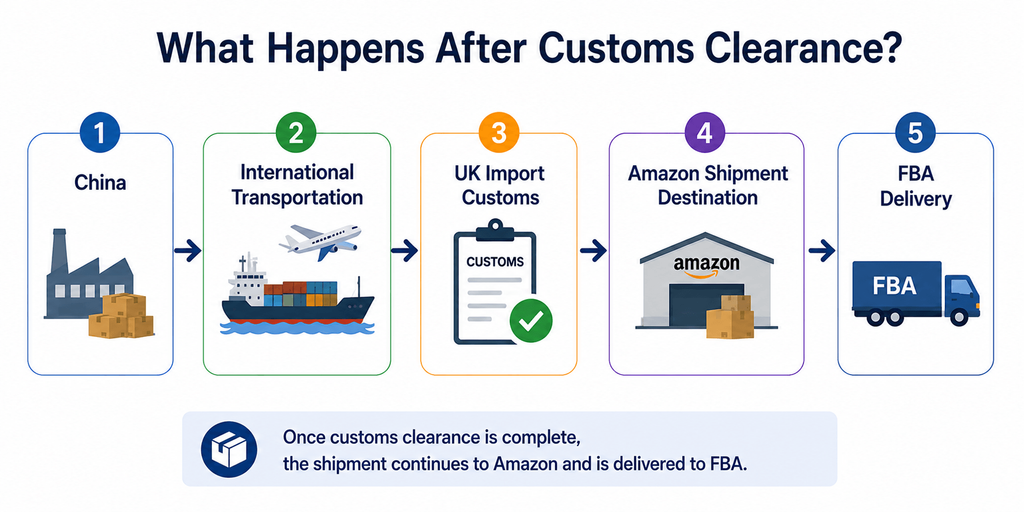
This final stage should be coordinated using the shipment information currently shown in Seller Central.
A shipment being released by customs does not automatically mean Amazon has received the inventory.
The physical delivery still needs to reach the appropriate destination and be accepted through Amazon’s inbound process.
What If Amazon Is Not Ready to Receive the Shipment?
Do not assume that customs clearance and delivery availability are the same thing.
Your freight forwarder may have completed the import process, but the shipment can still require coordination for the final delivery stage.
This is one reason it is useful to keep the Amazon shipment information up to date and communicate any changes to your logistics provider promptly.
The exact receiving and delivery arrangements depend on the current Amazon workflow for that shipment.
Why the Final Mile Matters
For a normal warehouse delivery, you control the receiving location.
For Amazon FBA, your shipment enters Amazon’s fulfilment network according to Amazon’s procedures.
That means a successful China-to-UK FBA shipment needs three things to work together:
1. Your Amazon account
The shipment must be correctly created and prepared in Seller Central.
2. UK import compliance
The goods must be imported using the appropriate customs arrangement.
3. Physical logistics
The cargo must be transported and delivered according to the shipment information provided by Amazon.
A problem in any one of these areas can affect the whole inbound process.
A Practical FBA Shipping Workflow
For sellers using a freight forwarder, a simple workflow is:
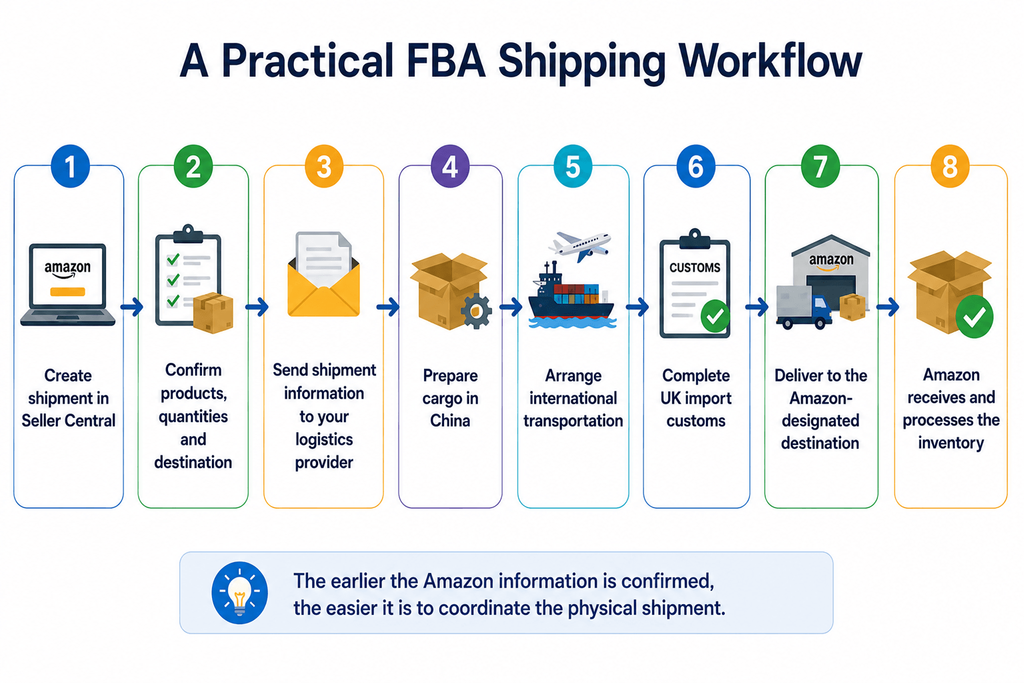
The earlier the Amazon information is confirmed, the easier it is to coordinate the physical shipment.
One Important Rule for FBA Importers
Do not treat the Amazon warehouse as just another UK delivery address.
The shipment must be planned around both sides of the process:
Amazon’s inbound requirements + UK import requirements
That is the main difference between ordinary China-to-UK delivery and shipping inventory into Amazon FBA.
At Kisun Shipping, we can coordinate the international transportation, UK customs clearance and final delivery for FBA shipments, while the Amazon shipment itself remains managed through your Seller Central account.
Which FBA Shipping Solution Should You Use?
Once your Amazon shipment has been prepared correctly, the remaining question is how to organise the logistics around it.
There is no single solution that works for every Amazon seller.
Your choice will depend on factors such as:
- How frequently you replenish inventory
- How much inventory you need to move
- How much delivery time you can tolerate
- Whether you already have a UK import setup
- How much logistics coordination you want to handle yourself
The key is to match the logistics service to your actual business situation rather than choosing the same method for every shipment.
Sea, Rail, Truck or Air: A Practical FBA Approach
We have already covered the typical transit times of the available services in this guide. For Amazon sellers, the more useful question is when each option makes commercial sense.
Stable Inventory
If your inventory is well planned and you have sufficient stock available, a lower-cost solution may make more sense.
For many larger or regularly replenished shipments, sea freight can be the logical choice.
Planned Replenishment
If your stock level is healthy but you want to shorten the replenishment cycle, rail can provide another option.
Tighter Inventory
When stock is becoming more limited and sea or rail may not fit your planning window, truck freight can be considered as a faster alternative without moving the entire shipment by air.
Urgent Replenishment
When an inventory shortage could result in lost sales, air freight may be justified by the value of receiving the goods sooner.
This is not an Amazon rule. It is a supply-chain decision.
Amazon Global Logistics vs an Independent Freight Forwarder
Amazon also offers Amazon Global Logistics (AGL), which provides international transportation services for eligible sellers. Amazon states that AGL can arrange transportation from China and Vietnam into its fulfilment network, including ocean freight services. (sell.amazon.co.uk)
This gives Amazon sellers another option to consider.
The comparison is less about which company is “better” and more about what type of logistics support your business needs.
| Amazon Global Logistics | Independent Freight Forwarder | |
|---|---|---|
| Amazon ecosystem integration | ✅ | Depends on provider |
| China-to-UK international transport | ✅ | ✅ |
| Multi-supplier consolidation | Depends on service | Can be arranged |
| China warehouse support | Depends on service | Can be arranged |
| Repacking / inspection | Depends on service | Can be arranged where offered |
| Multiple transport options | Depends on current AGL services | Can be arranged |
| DDP / DAP arrangements | Depends on service | Can be arranged |
| Non-Amazon destinations | Not the primary focus | ✅ |
AGL can be attractive to sellers who prefer to manage logistics within the Amazon ecosystem.
An independent freight forwarder can be more flexible for sellers who need services around the Amazon shipment, such as multi-supplier consolidation, warehouse preparation, different transportation options or customised DDP/DAP arrangements.
Always check the current scope and availability of each service before booking.
What If Amazon Changes the Destination?
Amazon’s inbound system may assign the destination for a particular shipment.
For this reason, do not prepare your international shipping instructions based on an old Amazon shipment or a warehouse address copied from a previous order.
Instead:
Use the current shipment information generated in Seller Central.
This is especially important when working with a freight forwarder because the logistics provider needs the current destination and shipment details to arrange final delivery correctly.
Amazon’s current FBA workflow provides shipment-specific information through Seller Central. (sellercentral.amazon.co.uk)
2026 Update: FBA Barcode and Commingling Changes
Amazon’s 2026 policy change is important for anyone using older FBA shipping guides.
Amazon announced that its previous commingling practices ended for inventory shipped on or after March 31, 2026. At the same time, the eligibility rules for manufacturer barcodes changed. (sellercentral.amazon.co.uk)
The practical lesson is simple:
Do not assume a labelling method that worked for an older shipment will automatically apply to your next FBA shipment.
Check the current instructions in Seller Central for the specific SKU and shipment before printing labels or sending inventory from China.
This is particularly important for sellers who have been using older sourcing or FBA preparation guides.
A Final Check Before You Ship
Before your inventory leaves China, make sure you can answer “yes” to these questions:
- Is the FBA shipment correctly created in Seller Central?
- Do the physical products and quantities match the shipment?
- Have the current product and carton labelling requirements been checked?
- Is the UK import arrangement clear?
- Has the correct delivery destination been provided to your freight forwarder?
- Does your chosen logistics service match your inventory requirements?
If all six are clear, the shipment is much easier to manage.
Frequently Asked Questions
How do I ship goods from China directly to Amazon FBA UK?
Create and confirm the shipment in Seller Central first, then provide the relevant shipment information to your logistics provider. The cargo can then be prepared and transported from China to the UK, followed by the appropriate import and final delivery arrangements.
Can a freight forwarder deliver directly to Amazon FBA?
Yes, a freight forwarder can arrange transportation and delivery to the Amazon destination specified for the shipment, subject to the applicable Amazon receiving requirements.
Do I need DDP to ship to Amazon FBA UK?
No. DDP is one possible import and delivery arrangement, but it is not a requirement for using FBA.
Can I ship Amazon FBA inventory from China by rail?
Yes, rail freight can be used for suitable shipments, subject to current route and service availability.
Can I use truck freight for Amazon FBA shipments?
Truck freight can be arranged for suitable China-to-UK shipments, provided the route, cargo and Amazon delivery requirements are compatible.
Can I consolidate products from several Chinese suppliers?
Yes, shipments from multiple suppliers can be consolidated at a China warehouse where the service is available and the shipment is properly prepared before international transportation.
What is Amazon Global Logistics?
Amazon Global Logistics is Amazon’s own international logistics programme. Amazon currently describes AGL as providing transportation services from China and Vietnam into Amazon fulfilment networks, including ocean freight. (sell.amazon.co.uk)
Should I use Amazon Global Logistics or an independent freight forwarder?
It depends on how much logistics flexibility and additional China-side support you need. Compare the actual service scope, routing, handling options and import arrangements rather than choosing based only on the provider’s name.
Final Thoughts
Shipping from China to Amazon FBA UK is not simply a matter of putting cartons on a truck, ship, train or aircraft.
A successful shipment connects three different processes:
Amazon FBA requirements
+
UK import compliance
+
International logistics
Most problems become easier to prevent when these three parts are coordinated before the goods leave China.
For sellers who want a more flexible logistics setup, Kisun Shipping can coordinate Sea, Rail, Truck and Air transportation, together with China-side consolidation and preparation, UK customs clearance, and final delivery to the Amazon destination.
The right solution depends on your inventory, delivery requirements and import arrangement.
Planning your next Amazon FBA shipment from China?
Send us:
- Product type
- Number of cartons
- Total weight / CBM
- Supplier location in China
- Amazon shipment information
- UK delivery details
We can then assess the available logistics solution and coordinate the shipment from China through UK customs and final delivery.

China Logistics Expert
About the Author
Katherine Kang is a China-based logistics consultant with over 11 years of experience in international trade and freight forwarding. Specializing in helping SMEs import from China she focuses on compliant, cost-effective solutions to avoid delays, tariffs, and hidden fees. Katherine has managed hundreds of shipments, saving clients 15-30% on average.
Connect with Katherine on LinkedIn or contact Kisun Shipping for a free import consultation.