

UK Import VAT from China: What Is It and How Does It Work?
If you import goods from China into Great Britain, Import VAT is one of the costs you need to understand before your shipment arrives.
It is important to distinguish Import VAT from Customs Duty. They are separate charges, and the fact that a shipment has a certain duty rate does not mean its VAT treatment is automatically the same.
For most goods, the standard UK VAT rate is 20%, but some goods can be subject to a reduced rate or zero rate. The applicable rate depends on the goods and the relevant VAT rules.
This is why simply assuming:
“Import VAT = 20% of the product price.”
can give you the wrong answer.
Quick Answer
For most imports into Great Britain, Import VAT is charged at the VAT rate applicable to the goods. For many products this is 20%, but some goods can be zero-rated or subject to a reduced rate. Import VAT is not calculated simply by multiplying the supplier’s invoice value by the VAT rate; the VAT value is determined under UK import VAT rules and can include customs duty and relevant transport, insurance and other costs.
UK VAT-registered businesses may be able to use Postponed VAT Accounting (PVA), which accounts for eligible import VAT on the VAT Return instead of normally paying it upfront at import.
Import VAT at a Glance
| Topic | What UK Importers Need to Know |
|---|---|
| Standard VAT rate | 20% for most goods |
| Calculation | Not simply goods value × VAT rate |
| Customs Duty | Separate from Import VAT |
| PVA | Available to eligible VAT-registered businesses |
| DDP | VAT handled within the agreed DDP arrangement |
| DAP | Importer responsible under the agreed arrangement |
| £135 | Mainly relevant to low-value VAT collection rules; customs treatment is changing |
Import VAT vs Customs Duty: What Is the Difference?
These two charges are often confused because they can arise during the same import process.
| Customs Duty | Import VAT | |
|---|---|---|
| What is it? | A customs charge on imported goods where applicable | VAT charged on imported goods |
| What affects the amount? | Mainly the goods’ tariff classification and customs valuation | VAT rate and the value determined under UK import VAT rules |
| Can it be recovered? | Not normally treated as input VAT | Eligible VAT-registered businesses may be able to recover it, subject to normal VAT rules |
The important point is that Import VAT is not simply another name for Customs Duty.
For a commercial shipment from China, you may have to deal with both, depending on the goods and the applicable rules.
When Is Import VAT Charged?
For imports into the UK, VAT is generally due on imported goods according to the applicable VAT rules.
For low-value commercial imports of £135 or less, the VAT system has a different collection mechanism: for many B2C sales, VAT is collected at the point of sale by the overseas seller or online marketplace rather than at the border. Since 2021, the previous VAT exemption for goods worth £15 or less has also been removed.
For higher-value commercial imports, Import VAT is normally accounted for through the import process.
This distinction is particularly relevant to e-commerce sellers because the £135 threshold does not simply mean “no VAT.”
Why Is the £135 Threshold Important?
The £135 threshold is often misunderstood.
It does not mean that goods valued at £135 or less are automatically free from UK VAT.
The current system generally treats VAT on low-value commercial consignments through the point-of-sale rules described above.
There is also an important upcoming change.
In July 2026, HMRC and HM Treasury confirmed plans to remove the existing £135 customs duty relief for low-value imports and introduce new customs arrangements. The new arrangements are scheduled to come into force by October 2028 at the latest, subject to the legislation and detailed rules required for implementation.
This means any article discussing the £135 threshold should be treated as a time-sensitive topic, rather than presenting the current arrangement as something that will remain unchanged indefinitely.
Import VAT Is Not Always a Permanent Business Cost
For a UK VAT-registered business, Import VAT may be recoverable as input tax, subject to the normal VAT recovery rules.
Eligible businesses can also use Postponed VAT Accounting (PVA), which allows import VAT to be accounted for on the VAT Return rather than paid upfront at the point of import, subject to the applicable requirements.
This distinction matters for cash flow.
For example, a business may have a significant Import VAT liability when goods enter the UK, but PVA can change when that VAT is accounted for rather than simply eliminating the VAT itself.
Import VAT and Customs Duty should therefore be considered separately when calculating the financial impact of an import.
The Key Point
When importing from China, do not look at Import VAT as simply:
Product price × 20%
The applicable VAT rate and the value used for Import VAT purposes depend on the goods and HMRC’s valuation rules. The import VAT value can include the customs value plus certain import charges and other amounts specified by HMRC.
In the next part, we will explain how HMRC determines the VAT value of imported goods, why freight and Customs Duty can affect the calculation, and why the VAT calculation is more complicated than simply multiplying your supplier’s invoice value by 20%.
How Is Import VAT Calculated in the UK?
The easiest mistake to make with UK Import VAT is to take the supplier’s invoice value and multiply it by 20%.
That is not a complete way to calculate Import VAT.
For UK imports, the VAT value is based on the customs value of the goods, with certain additional amounts added according to HMRC’s rules. These can include applicable Customs Duty and certain transport, insurance and other incidental costs.
So the calculation is more accurately understood as:
Customs value
- Applicable Customs Duty and other import charges
- Relevant transport, insurance and incidental costs
= Value used for Import VAT
The applicable VAT rate is then applied to that value.
The exact calculation depends on the circumstances of the import, so the illustration below should not be treated as a universal formula.
A Simple Example
Suppose a shipment has:
- Customs value: £10,000
- Customs Duty: £500
- Other relevant costs required to be included in the VAT value: £300
The Import VAT calculation would not simply be:
£10,000 × 20%
The relevant VAT value would instead need to include the applicable additional amounts under HMRC’s rules.
This is why a freight forwarder or customs agent needs accurate information about the shipment rather than just the supplier’s invoice.
HMRC specifically requires certain transport, insurance and incidental expenses to be added when arriving at the VAT value.
Why Does Customs Value Matter?
The starting point is normally the customs value.
For most imports subject to ad valorem Customs Duty, HMRC requires importers to try Method 1 — transaction value first. This is generally based on the price actually paid or payable for the goods when sold for export to the UK, subject to the applicable adjustments.
This does not mean that the invoice can simply be given an arbitrary value.
The customs value needs to reflect the actual transaction and the applicable valuation rules.
For example, HMRC’s rules can require certain costs such as packing, transport and insurance connected with delivery to the UK border to be included in the customs value.
What About Freight and Insurance?
This is one area that often surprises importers.
Certain transport and insurance costs can form part of the customs value or the subsequent value used to calculate Import VAT.
HMRC also states that transport and insurance costs to a destination beyond the first UK destination can need to be included in the Import VAT value if that destination is known when the goods are imported.
So the location and terms of delivery can matter.
This is another reason why an Import VAT calculation should be based on the actual shipment rather than a simple:
Product value × VAT rate
approach.
What If No Customs Duty Is Payable?
A shipment can still have Import VAT even when there is no Customs Duty to pay.
HMRC states that the VAT valuation is based on the customs value even if there is no duty payable.
This is an important distinction.
No Customs Duty ≠ No Import VAT.
The two charges need to be assessed separately.
What Information Should Your Customs Agent Have?
For a reliable Import VAT calculation, your customs representative may need information such as:
- Actual purchase price
- Currency
- Transport costs
- Insurance where applicable
- Destination
- Commodity Code
- Relevant customs charges
HMRC can require evidence supporting the customs value, including commercial invoices, purchase orders, transport documents and freight bills.
Providing complete information from the beginning makes it easier to establish the correct customs value and VAT treatment.
The Key Point
Import VAT is calculated from the relevant VAT value, not simply the supplier’s invoice amount.
The practical sequence is:
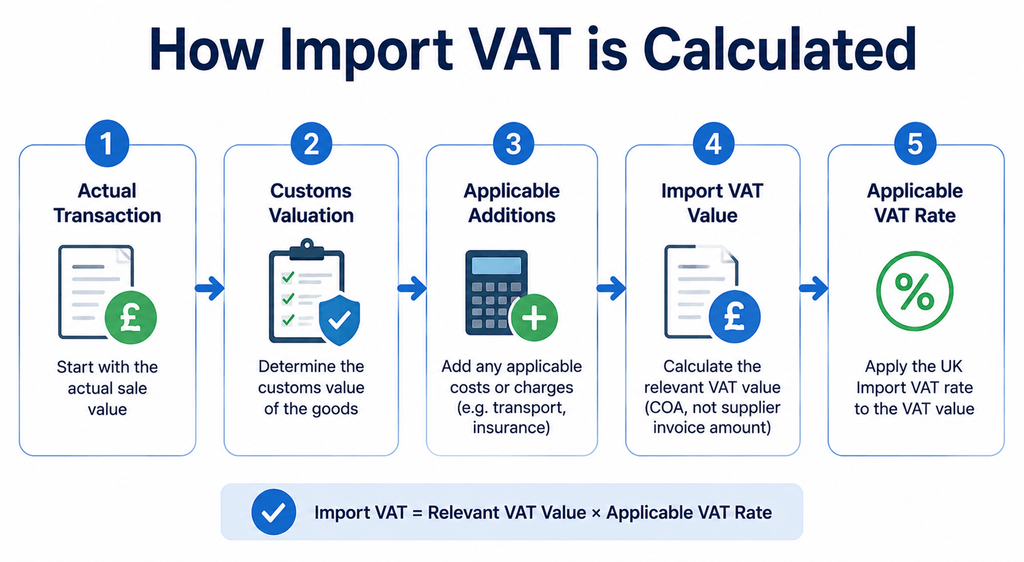
The calculation can become more complicated for unusual transactions, special valuation situations or products subject to specific rules.
For this reason, importers should avoid using a generic online formula for every shipment.
Postponed VAT Accounting (PVA): How It Works for UK Importers
For UK VAT-registered businesses importing regularly from China, Postponed VAT Accounting (PVA) can make a significant difference to import VAT cash flow.
The basic idea is simple:
Instead of paying Import VAT when the goods are imported and recovering it later, eligible businesses account for the Import VAT on their VAT Return.
HMRC confirms that a UK VAT-registered business can use PVA for eligible imports into Great Britain, without needing separate approval from HMRC. The normal rules for recovering input VAT still apply.
How Does PVA Work?
Without PVA, an importer may need to pay Import VAT at importation and later recover eligible VAT through its VAT accounting process.
With PVA, the Import VAT is instead reported on the VAT Return for the accounting period covering the import.
For an eligible business, the basic flow is:
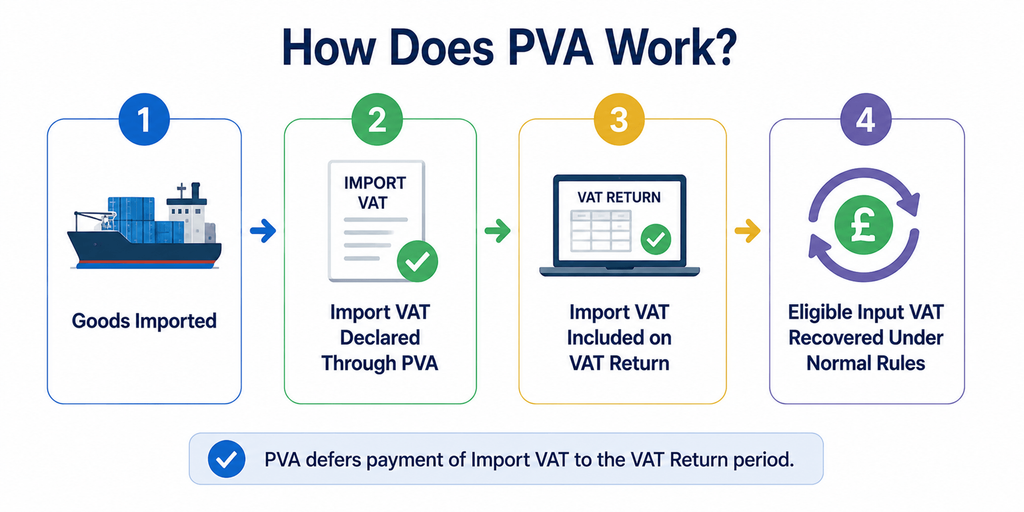
This means PVA can reduce the need to fund the Import VAT payment upfront.
It is important to understand that PVA does not remove Import VAT. It changes how and when the VAT is accounted for.
Who Can Use PVA?
The basic requirement is that the business must be registered for VAT in the UK.
For eligible imports, PVA can be used for goods imported into:
- Great Britain from outside the UK
- Northern Ireland from outside the UK and EU, subject to the applicable rules
If a freight forwarder, customs agent or other intermediary is making the import declaration on your behalf, you need to tell them in writing that you want to use PVA so the correct option can be selected on the declaration.
This is an important operational detail.
PVA is not something your freight forwarder should simply assume you want to use.
PVA and Cash Flow
The main benefit of PVA is usually cash-flow management.
Imagine your business regularly imports commercial goods and the Import VAT on a shipment is substantial.
Under a traditional payment arrangement, you may need to fund that VAT at import and recover eligible VAT later.
With PVA, the Import VAT is accounted for on the VAT Return instead.
For businesses with regular imports, avoiding that upfront cash requirement can make inventory purchasing and working-capital management easier.
However, the financial benefit depends on the business’s individual VAT position and its normal ability to recover input VAT.
What Records Do You Need?
Businesses using PVA should keep their monthly Postponed Import VAT Statements.
HMRC provides these statements online, and they contain the information needed to support the VAT accounting for imports.
If a customs agent handles your declarations, it is also worth checking that the import has been allocated to the correct EORI and that the relevant import appears on your PVA statement.
Good record keeping matters because PVA is an accounting method, not simply a freight-forwarding service.
PVA Is Not the Same as Reclaiming VAT
This distinction is worth remembering.
PVA changes when Import VAT is accounted for.
Whether you can recover that VAT as input tax depends on the normal VAT recovery rules applicable to your business.
So the correct way to think about PVA is:
PVA helps manage the timing of Import VAT accounting. It does not automatically make every Import VAT amount recoverable.
The Key Takeaway
For a VAT-registered UK importer, PVA can make importing from China more cash-flow efficient because Import VAT is accounted for on the VAT Return rather than normally being paid upfront at import.
But the process needs to be set up correctly:
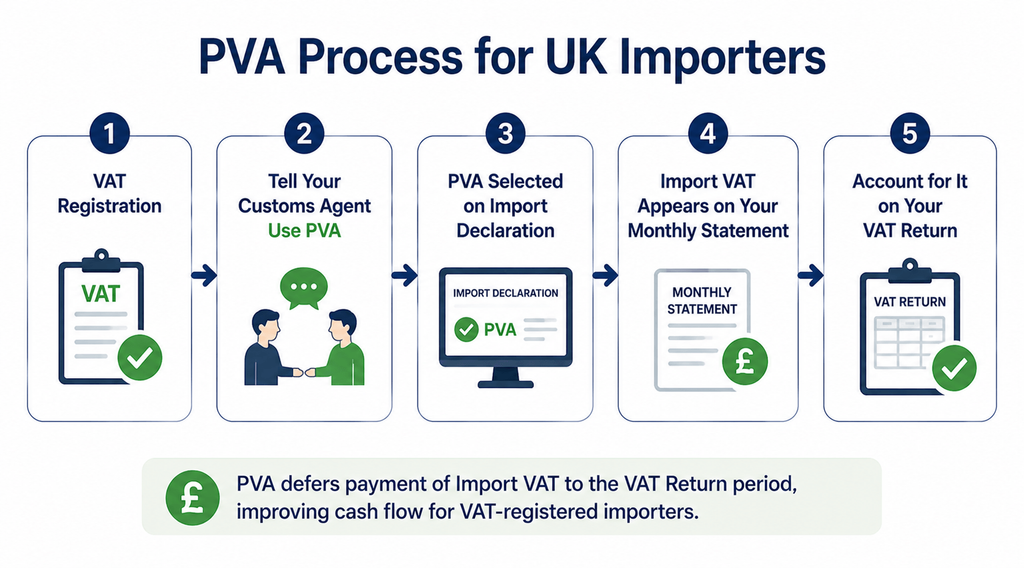
DDP, DAP and the £135 Low-Value Import Rules
Import VAT becomes much easier to understand once you separate the tax itself from who is responsible for handling it.
For China-to-UK shipments, the arrangement you choose with your freight forwarder can determine who manages the import process and how the VAT is handled operationally.
Import VAT Under DDP and DAP
The practical difference between our two services is straightforward.
| DDP with Kisun | DAP with Kisun | |
|---|---|---|
| UK import customs | Handled through our DDP arrangement | Our customs broker acts on the importer’s behalf |
| Customer provides EORI/VAT to us | No | Yes |
| Import Duty / VAT | Handled within the agreed DDP service | Customer responsible |
| Final delivery | Included in the agreed service | Included in the agreed service |
With our DDP arrangement, the UK customer does not need to provide their own EORI or VAT details to us. We arrange the import clearance and Duty/VAT handling through our established UK import arrangements.
With DAP, the importer remains responsible for the UK import side. The customer provides the required EORI and VAT information and authorises our customs broker to handle the import declaration on their behalf.
This is an important operational distinction, but it should not be confused with the general UK VAT or EORI rules that apply to businesses according to their own import structure.
For more detail, see our guide to DDP Shipping from China to the UK
What About the £135 Threshold?
The £135 threshold is frequently misunderstood.
For current UK VAT rules, goods imported in consignments valued at £135 or less are generally handled under a different VAT collection mechanism for low-value sales.
For many business-to-consumer (B2C) sales, the overseas seller or online marketplace collects UK VAT at the point of sale rather than VAT being collected at the border. For business-to-business (B2B) sales to a UK VAT-registered customer, different rules can apply. (source: gov.uk)
The £135 figure refers to the value of the total consignment, not the value of each individual item in the shipment. (source: gov.uk)
Most importantly:
£135 does not mean “no UK VAT”.
VAT has applied to low-value imports since the 2021 changes, while the customs-duty treatment has been different.
The £135 Customs Duty Rule Is Changing
This is particularly important for anyone publishing or relying on old UK import information.
As of July 2026, the UK government has confirmed plans to remove the existing £135 customs duty relief for low-value imports and introduce new customs arrangements.
The government has accelerated the implementation timetable and now intends the new arrangements to come into force by October 2028 at the latest. (source: gov.uk)
The reform concerns the customs treatment of low-value imports. It does not mean that the current VAT system has already been replaced today.
This distinction matters because many older articles still describe the £135 rule as though it were a permanent customs exemption.
It is not.
What Should UK Importers Do Now?
For ordinary commercial imports, do not make your shipping or pricing decisions based on the assumption that:
“Under £135 means no tax.”
Instead, determine:
- What are you importing?
- Is the shipment B2B or B2C?
- What is the total consignment value?
- Who is responsible for collecting and accounting for VAT?
- Does the shipment fall under the current low-value rules or standard import arrangements?
For businesses selling directly to UK consumers, the point-of-sale VAT rules can be particularly important.
For businesses importing commercial stock into their own UK operation, the normal import VAT and customs arrangements are generally more relevant.
Import VAT Should Be Viewed as Part of Your Import Structure
For a regular UK importer, the question is not simply:
“How much VAT will I pay?”
You should also ask:
Who accounts for the VAT, when is it accounted for, and can my business recover it under the normal VAT rules?
That depends on the business, the transaction and the import arrangement.
This is why the same shipment can have a very different cash-flow impact depending on whether the importer uses a standard import VAT payment arrangement, PVA, DDP or another structure.
Frequently Asked Questions
Does DDP include UK Import VAT?
Under our DDP service, Import VAT handling is included in the agreed DDP arrangement.
Does DAP include Import VAT?
Under our DAP service, the importer remains responsible for applicable Import VAT and provides the required EORI and VAT information for the customs declaration.
Does £135 mean I do not pay VAT?
No. The £135 threshold relates to the way low-value imports are treated. VAT can still apply, and B2C low-value sales generally use a point-of-sale VAT collection model.
Is the £135 customs-duty relief still available?
As of August 2026, the existing relief remains part of the current system, but the government has confirmed that it will be removed and replaced with new low-value import customs arrangements by October 2028 at the latest.
Does PVA remove Import VAT?
No. PVA changes how eligible UK VAT-registered businesses account for Import VAT; it does not remove the underlying VAT liability.
Final Takeaway
For UK businesses importing from China, Import VAT should not be viewed as a simple percentage added to the supplier’s invoice.
The outcome depends on:
The goods → Their value → The VAT rules → The import arrangement → How the VAT is accounted for
For regular importers, understanding these rules can help with both landed-cost calculations and cash-flow planning.
And because UK low-value import rules are already changing, businesses involved in e-commerce should review the latest GOV.UK guidance rather than relying on older £135 explanations.
For a China-to-UK shipment, we can also help you compare the practical differences between DDP and DAP, including who handles customs, Duty/VAT and final delivery.
Kind note: Rules can change. Always check the latest GOV.UK guidance for your specific goods and import arrangement.

China Logistics Expert
About the Author
Katherine Kang is a China-based logistics consultant with over 11 years of experience in international trade and freight forwarding. Specializing in helping SMEs import from China she focuses on compliant, cost-effective solutions to avoid delays, tariffs, and hidden fees. From anti-dumping guidance to CNY planning, Katherine has managed hundreds of shipments, saving clients 15-30% on average.
Connect with Katherine on LinkedIn or contact Kisun Shipping for a free import consultation.