
Shipping Lithium Batteries from China to the Philippines in 2026: Requirements, Costs & Common Mistakes
Many importers don’t realize their cargo is regulated until it’s too late.
Every Week, We Receive the Same Question
Almost every week, our team receives enquiries that sound surprisingly similar.
“I only have two cartons of batteries.”
“It’s just 1 CBM.”
“Can you ship it together with normal cargo?”
Most of these customers aren’t trying to ignore shipping regulations.
In fact, many of them simply don’t know that lithium batteries are often handled very differently from ordinary cargo in international logistics.
To an importer, a power bank, Bluetooth speaker, cordless drill, or electric scooter may just look like another consumer product.
To an ocean carrier or airline, however, the first question is often much simpler:
Does it contain lithium batteries?
If the answer is yes, the shipment may require additional assessment before it can be accepted for transport.
That assessment can affect everything—from carrier selection and documentation to booking availability, shipping costs, and transit time.
For businesses importing battery-powered products from China to the Philippines, understanding these requirements before placing an order can prevent costly delays and unexpected expenses.
This guide explains what importers should know, why battery shipments are different from ordinary cargo, and how to choose the right shipping solution based on your products and shipment volume.
Why Many Importers Don’t Realize Their Cargo Is Regulated
One of the biggest misconceptions in international shipping is this:
“It’s just an electronic product.”
From an importer’s perspective, that’s understandable.
You’re buying a vacuum cleaner, a laptop, or a Bluetooth speaker—not a pallet of industrial chemicals.
However, logistics companies don’t classify cargo by what it does.
They classify it by what it contains.
If a product contains lithium batteries, transport requirements may be different from those for ordinary cargo.
That’s why two products that look almost identical on a retail shelf may follow completely different shipping procedures.
For example:
| Product | May Require Additional Transport Assessment?* |
|---|---|
| Wooden Furniture | Generally no |
| Plastic Storage Boxes | Generally no |
| Kitchenware | Generally no |
| Bluetooth Speaker | Often yes, depending on battery configuration |
| Power Bank | Often yes |
| Laptop | Often yes |
| Electric Scooter | Often yes |
| Robot Vacuum Cleaner | Often yes |
| Solar Energy Storage Battery | Yes, depending on product classification |
Requirements depend on the battery type, packaging, transport mode, and applicable regulations.
This is why experienced importers usually discuss logistics before confirming production with their supplier.
Not Every Battery Product Is Handled the Same Way
Another common misunderstanding is that all battery products are shipped under exactly the same rules.
They are not.
The transport requirements for lithium batteries depend on several factors, including:
- Whether the battery is shipped by itself
- Whether it is installed inside equipment
- Whether it is packed together with equipment
- Battery chemistry
- Watt-hour or lithium content (where applicable)
- Packaging configuration
- Transport mode (sea or air)
- Carrier acceptance policies
For this reason, professional freight forwarders rarely provide a quotation based only on the product name.
Instead, they first review the cargo information to determine which transport solution may be suitable.
Products That Commonly Require Additional Shipping Review
Many importers are surprised to discover how many everyday products contain lithium batteries.
Some of the most common enquiries we receive involve:
Consumer Electronics
- Power banks
- Bluetooth speakers
- Wireless headphones
- Laptops
- Tablets
- Mobile phones
- Smart watches
- Portable projectors
Home Appliances
- Robot vacuum cleaners
- Cordless vacuum cleaners
- Smart door locks
- Electric toothbrushes
- Rechargeable kitchen appliances
Industrial Equipment
- UPS backup systems
- Energy storage systems (ESS)
- Industrial battery packs
- Portable power stations
- Solar batteries
Electric Mobility Products
- Electric bicycles
- Electric scooters
- Hoverboards
- Golf carts
- Electric wheelchairs
Professional Equipment
- Medical devices
- Survey instruments
- Drones
- Wireless power tools
- Testing equipment
Although these products serve very different purposes, they may all require additional shipping review because they contain lithium batteries.
How Lithium Battery Shipments Are Usually Assessed
One question we often hear is:
“Is my shipment considered dangerous goods?”
The honest answer is:
It depends.
Not every battery shipment follows exactly the same transport requirements.
Before accepting a booking, carriers and freight forwarders typically review factors such as:
- The type of lithium battery involved
- Whether batteries are standalone or installed in equipment
- Product specifications
- Packaging method
- Available technical documentation
- Transport route
- Applicable carrier requirements
Depending on these factors, the shipping arrangements may differ from those for general cargo.
This is why experienced freight forwarders often ask several technical questions before issuing a quotation.
They’re not trying to make the process more complicated—they’re making sure the proposed transport solution is appropriate for the cargo.
Confirm Shipping Before Production—Not After
One of the most expensive mistakes first-time importers make happens long before the shipment reaches the port.
The typical sequence looks like this:
- Find a supplier.
- Place the order.
- Production is completed.
- Contact a freight forwarder.
- Discover that additional shipping documents are required.
At this stage, changing packaging, obtaining technical reports, or preparing missing documentation can delay the shipment and increase costs.
A much better approach is:
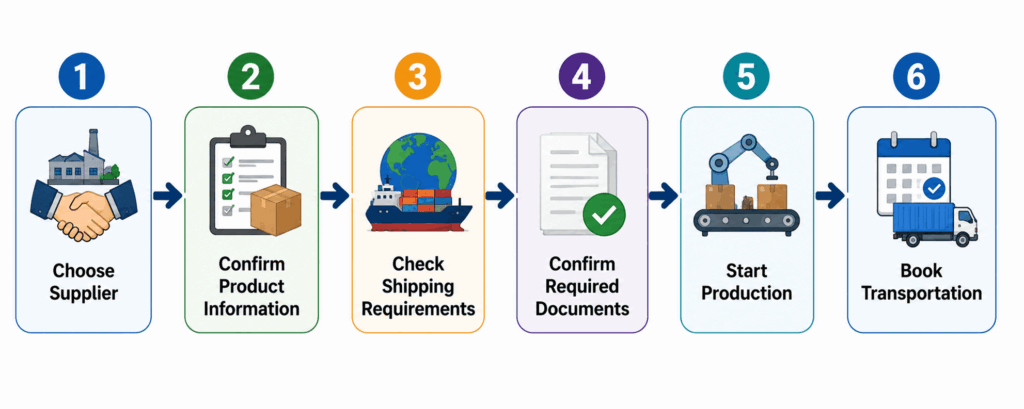
By discussing logistics before production begins, importers have more time to verify documentation, review packaging requirements, and choose the most suitable shipping method.
This simple step can help avoid unnecessary delays and reduce the risk of cargo being rejected during the booking process.
Why Small Battery Shipments Are Often More Difficult Than General Cargo
After learning that battery-powered products may require additional shipping review, many importers ask the next logical question:
“I only have two or three cartons. Why is shipping so expensive?”
or
“Why can’t you simply load my cargo together with other LCL shipments?”
It’s a reasonable question.
After all, ordinary cargo such as furniture, clothing, lighting, or household products is routinely consolidated with other shipments in the same container.
Battery-powered products can be different.
The difference isn’t because freight forwarders want to make shipping more complicated.
It’s because battery cargo may involve additional transport requirements, carrier acceptance policies, and documentation that don’t apply to ordinary cargo.
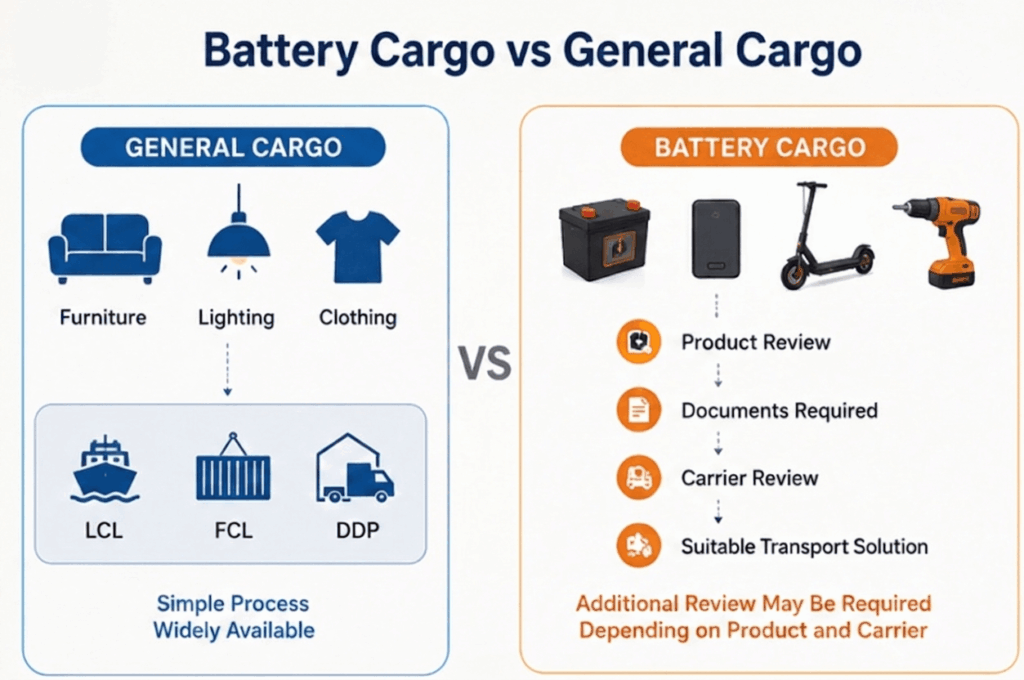
General Cargo vs Battery Cargo
The easiest way to understand the difference is to compare the typical shipping process.
| General Cargo | Battery Cargo* |
|---|---|
| Standard booking process | Additional cargo review may be required |
| LCL widely available | Availability depends on product details and carrier acceptance |
| Standard shipping documents | Additional technical documents may be requested |
| General container | Shipping arrangement depends on cargo classification |
| More carrier options | Fewer carriers may accept certain cargo |
Actual requirements vary depending on the battery type, product configuration, transport mode, and applicable regulations.
For ordinary commercial cargo, booking space is usually straightforward.
For battery-powered products, carriers often need more information before confirming whether the shipment can be accepted.
Why Dedicated DG Containers Are Common for Larger Battery Shipments
When businesses import larger quantities of battery products, the shipping solution is often different from standard LCL freight.
Dedicated Dangerous Goods (DG) container services are commonly used for commercial battery shipments because they allow the cargo to be handled according to the applicable transport requirements.
Compared with ordinary containers, DG shipments often involve:
- Additional booking procedures
- Carrier approval
- Technical document review
- Dangerous goods declarations (where required)
- Specialized loading arrangements
- Compliance with port and carrier requirements
These additional processes also explain why DG transportation generally costs more than shipping ordinary cargo.
However, for businesses importing large volumes of batteries, energy storage systems, industrial equipment, or electric vehicles, dedicated DG container shipping is usually the safest and most practical long-term solution.
Can Small Battery Shipments Be Shipped by LCL?
This is probably the question we receive most often.
The answer is:
Sometimes—but it depends on the product.
Many people assume that all battery cargo must be shipped in a dedicated DG container.
That isn’t always the case.
For certain small-capacity lithium batteries that are installed inside equipment, there may be opportunities to arrange LCL Door-to-Door (DDP) shipping, provided the shipment meets the relevant transport requirements.
Examples may include products such as:
- Bluetooth speakers
- Smart door locks
- Small consumer electronics
- Rechargeable household appliances
- Wireless devices
- Some battery-powered tools
In many cases, products with built-in lithium batteries of less than approximately 100Wh are more likely to qualify for this type of transport arrangement if complete product information and supporting documentation are available.
However, this is not an automatic rule.
Whether a shipment can be transported through an LCL DDP service depends on several factors, including:
- Whether the battery is installed inside the equipment
- Battery specifications
- Product classification
- Available documentation
- Packaging
- Carrier acceptance
- Destination requirements
Every shipment should therefore be reviewed individually before transportation is confirmed.
Pure Lithium Batteries Are Usually Much More Challenging
Another misunderstanding we frequently encounter is:
“It’s only batteries—there’s no equipment.”
Pure lithium batteries are generally subject to much stricter transport requirements than batteries already installed inside finished products.
Examples include:
- Replacement lithium batteries
- Power bank cells
- Stand-alone battery packs
- Loose rechargeable batteries
- Industrial battery modules
These shipments often require additional documentation and specialized transport arrangements.
For small commercial quantities, transportation can be significantly more expensive, and in some situations, suitable shipping options may simply not be available.
For this reason, businesses planning to import standalone batteries should discuss transportation with a freight forwarder before purchasing the goods, rather than after production has already been completed.
The Documents That Often Make the Difference
One of the biggest reasons battery shipments are delayed isn’t the battery itself.
It’s missing documentation.
When requesting a quotation, importers should prepare as much product information as possible.
Depending on the shipment, commonly requested documents may include:
- MSDS (Material Safety Data Sheet)
- UN38.3 Test Summary (where applicable)
- UN Number (if applicable)
- Product specifications
- Battery specifications
- Product photos
- Packing information
- Dangerous Goods Packaging Certificate (when required for the transport arrangement)
Having these documents available early allows the freight forwarder to evaluate the shipment more efficiently and recommend suitable transport options.
If you’re unfamiliar with these documents, we’ve explained them in detail in our guide:
➡️ China Hazardous Cargo Shipping Guide: Understanding UN38.3, MSDS & Battery Transport Documents
The Questions We Ask Before Providing a Quotation
Unlike ordinary cargo, battery shipments cannot usually be quoted based only on weight and destination.
To recommend a suitable shipping solution, we typically ask customers questions such as:
- What is the product?
- Does it contain lithium batteries?
- Are the batteries built into the equipment or shipped separately?
- Do you have the battery specifications?
- Do you have an MSDS or UN38.3 report (if applicable)?
- How many cartons, kilograms, and cubic meters?
- Which city is the cargo shipping from?
- Where will it be delivered in the Philippines?
- What is your expected shipping date?
The more complete the information, the faster we can determine whether the cargo may be suitable for standard shipping, LCL DDP, or whether a dedicated DG transport solution would be more appropriate.
A Better Shipping Plan Starts Before You Buy
One pattern we’ve noticed over the years is that experienced importers ask about logistics before placing an order.
New importers often ask after production is finished.
That small difference can determine whether a shipment moves smoothly—or requires unexpected document preparation, packaging changes, or even shipment delays.
If you’re planning to source battery-powered products from China, confirming the shipping solution with your freight forwarder before production begins is one of the simplest ways to reduce risk and avoid unnecessary costs.
Why Some Battery Cargo Cannot Be Shipped as Ordinary Cargo
One question we occasionally hear is:
“My supplier says they’ve always shipped this product in a normal container. Why is it different now?”
It’s an understandable question.
Many importers assume that if a shipment was accepted before, it will always be accepted in the future.
Unfortunately, international shipping doesn’t work that way.
Whether battery cargo can travel as general cargo or requires dangerous goods handling is not determined by the freight forwarder.
Instead, it depends on factors such as:
- The product’s classification
- Applicable dangerous goods regulations
- Carrier acceptance policies
- Port requirements
- Customs and regulatory compliance
As freight forwarders, our responsibility is to arrange transportation that complies with the requirements of the shipping line and the relevant authorities.
Why Shipping Lines Have Become Much More Strict
Over the past several years, the shipping industry has experienced a number of serious fires involving containers carrying lithium batteries or battery-powered products.
Some incidents resulted in significant cargo losses and operational disruption, prompting carriers to strengthen their review procedures for battery shipments.
As a result, many shipping lines now pay much closer attention to:
- Cargo declarations
- Battery documentation
- Product specifications
- Dangerous goods classification
- Packaging compliance
For importers, this means that shipments which may have moved through the supply chain years ago could now be subject to much closer review.
“I’ve Shipped This Product Before Without Any Documents.”
We occasionally hear comments like:
“I’ve exported this product many times.”
“My previous forwarder never asked for these documents.”
“The supplier says it can go in a normal container.”
While that may have been someone’s previous experience, it doesn’t automatically mean the shipment complies with current carrier or regulatory requirements.
Shipping requirements evolve over time.
Different shipping lines may have different acceptance standards, and enforcement practices can also change.
For that reason, we don’t recommend assuming that a previous shipment guarantees future acceptance.
Instead, it’s safer to evaluate each shipment based on its current product information, documentation, and the carrier’s latest requirements.
The Risks of Incorrect Cargo Declaration
Attempting to ship cargo under an incorrect declaration can create serious problems throughout the supply chain.
Depending on the circumstances, the consequences may include:
- Shipment delays
- Cargo inspection
- Rejection by the carrier
- Additional handling costs
- Administrative penalties imposed by the relevant authorities
- Financial liabilities under the carrier’s terms and conditions
In addition to the commercial impact, undeclared or incorrectly declared battery cargo may also create safety risks for vessels, port facilities, and other cargo if it is not transported under appropriate conditions.
For these reasons, responsible freight forwarders encourage customers to provide accurate product information before booking rather than trying to simplify the declaration process.
Our Recommendation: Don’t Rely on Luck
International shipping has become increasingly compliance-focused.
What matters today isn’t whether a similar shipment moved successfully in the past.
What matters is whether your current shipment meets the applicable transport requirements.
If you’re unsure whether your battery-powered products require additional documentation or special shipping arrangements, the safest approach is simple:
Send your product information to your freight forwarder before production begins.
A professional review usually takes far less time than dealing with shipment delays after the cargo reaches the port.
Common Mistakes Importers Make When Shipping Battery Products
Most shipping problems don’t happen at the port.
They happen much earlier—often before production even begins.
After handling battery-related enquiries from importers shipping from China to the Philippines, we’ve noticed that the same mistakes appear again and again.
Fortunately, most of them can be avoided with a little planning.
Mistake #1: Assuming Every Battery Product Is Ordinary Cargo
This is by far the most common misunderstanding.
Many first-time importers focus on the finished product:
“It’s just a speaker.”
“It’s only a robot vacuum.”
“It’s an electric scooter.”
From a logistics perspective, however, the important question isn’t what the product is—it’s whether it contains lithium batteries and how those batteries are configured for transport.
Confirming this with your supplier before production starts can save considerable time later.
Mistake #2: Waiting Until Production Is Finished Before Contacting a Freight Forwarder
Another situation we see regularly is this:
The factory finishes production.
The customer is ready to ship.
Only then do they begin looking for logistics solutions.
If additional transport documents or packaging adjustments are required, valuable time has already been lost.
A much better workflow is:
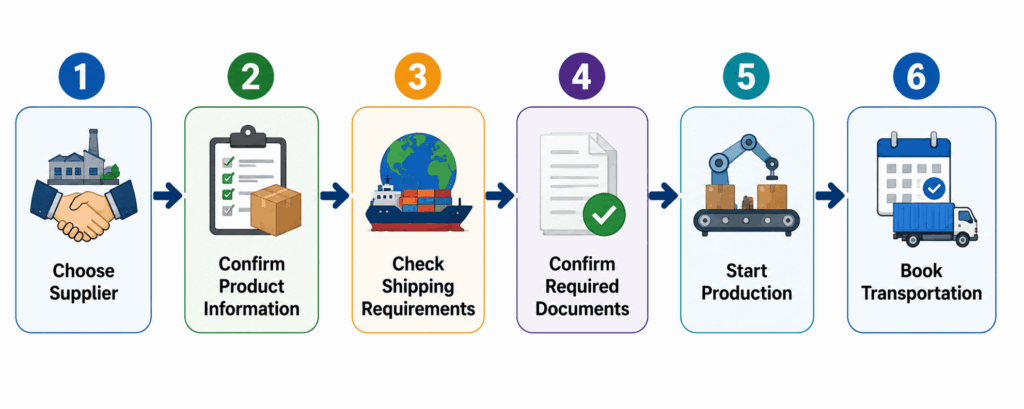
Planning logistics early gives both the supplier and the freight forwarder enough time to prepare the shipment properly.
Mistake #3: Requesting a Freight Quote Without Product Information
Unlike general cargo, battery shipments cannot usually be quoted using only weight and destination.
For example, these two enquiries may look almost identical:
- 500 kg Bluetooth speakers
- 500 kg standalone lithium batteries
The shipping arrangements could be completely different.
Providing detailed product information from the beginning helps avoid unnecessary back-and-forth communication and allows the freight forwarder to recommend a more suitable transport solution.
Mistake #4: Choosing the Cheapest Shipping Option Without Understanding the Risks
Everyone wants lower shipping costs.
That’s understandable.
However, for battery-powered products, the cheapest quotation isn’t always the most appropriate solution.
A professional freight forwarder should help you evaluate factors such as:
- Documentation requirements
- Carrier acceptance
- Transit time
- Customs procedures
- Packaging requirements
- Overall supply chain reliability
Looking only at the freight rate may lead to delays that cost far more than the initial savings.
Our Practical Advice Before You Place an Order
If you’re importing battery-powered products from China to the Philippines for the first time, we generally recommend the following approach:
✔ Confirm with your supplier whether the product contains lithium batteries.
✔ Ask whether technical documents such as an MSDS or UN38.3 Test Summary are available, if applicable.
✔ Discuss the shipment with your freight forwarder before production begins.
✔ Prepare product specifications, photos, and battery information when requesting a quotation.
✔ Avoid making shipping assumptions based on previous non-battery shipments.
These simple steps can significantly reduce the likelihood of delays during booking and transportation.
How Kisun Shipping Evaluates Battery Shipments
Unlike ordinary cargo, we don’t issue quotations for battery shipments based only on weight.
Instead, we first review the shipment to understand what transportation options may be available.
Typical information we review includes:
- Product type
- Battery configuration
- Available technical documentation
- Cargo volume
- Origin city in China
- Delivery destination in the Philippines
- Shipping schedule
Based on this information, we’ll advise whether the shipment may be suitable for:
- Standard sea freight
- LCL Door-to-Door (for eligible battery-powered products)
- Dedicated DG container shipping
- Air freight (where appropriate)
Every shipment is reviewed individually because transport requirements can vary depending on the product and the carrier.
This approach helps customers avoid unexpected issues after production has already been completed.
Frequently Asked Questions
Can I ship lithium batteries from China to the Philippines?
In many cases, yes.
However, the available shipping options depend on the battery type, how the battery is packaged, the transport mode, available documentation, and carrier acceptance.
Can batteries be shipped together with ordinary cargo?
Some battery-powered products installed inside equipment may be eligible for LCL Door-to-Door transportation after shipment review.
Standalone lithium batteries are generally subject to more restrictive transport requirements.
Is LCL shipping available for battery cargo?
It depends.
Certain battery-powered products may qualify for LCL shipping, while others may require dedicated transport arrangements.
Each shipment should be assessed individually.
Do I always need an MSDS or UN38.3 Test Summary?
Requirements vary depending on the product and transport method.
Providing available technical documentation at the quotation stage helps speed up shipment evaluation.
Why is DG container shipping more common for large battery shipments?
For larger commercial shipments, dedicated DG containers often provide a more practical transport solution because they can accommodate the documentation and operational requirements associated with certain battery cargo.
Should I confirm shipping before buying from my supplier?
Absolutely.
This is one of the simplest ways to avoid unexpected shipping issues later in the purchasing process.
Related Resources
If you’re importing from China to the Philippines regularly, you may also find these guides useful:
- Shipping Cost from China to the Philippines (2026 Guide)
- Complete Guide to Shipping from China to the Philippines
- Sea Freight from China to the Philippines
- Door-to-Door Shipping from China to the Philippines
- China Hazardous Cargo Shipping Guide: UN38.3, MSDS & Battery Documents
- How to Import from China to the Philippines
Final Thoughts
Battery-powered products have become part of almost every industry—from consumer electronics and household appliances to solar energy systems, medical equipment, and industrial machinery.
Yet many importers only discover the additional shipping requirements after their products have already been manufactured.
Understanding the transport requirements early doesn’t just help avoid delays—it also makes it easier to choose the right shipping method, prepare the correct documentation, and control overall logistics costs.
At Kisun Shipping, we assist businesses importing commercial cargo from China to the Philippines by evaluating each shipment individually rather than applying a one-size-fits-all approach.
Whether you’re shipping general cargo, battery-powered equipment, or larger DG container shipments, providing accurate product information before booking allows us to recommend the most suitable logistics solution for your business.
If you’re unsure whether your products can be shipped, simply send us the following information:
- Product name
- Product photos
- Battery specifications (if available)
- Estimated weight and volume
- Pickup city in China
- Delivery destination in the Philippines
We’ll review the shipment and advise which transport options may be suitable before production or booking begins.

China Logistics Expert
About the Author
Katherine Kang is a China-based logistics consultant with over 11 years of experience in international trade and freight forwarding. Specializing in helping SMEs import from China to the USA, Canada, and Europe, she focuses on compliant, cost-effective solutions to avoid delays, tariffs, and hidden fees. From anti-dumping guidance to CNY planning, Katherine has managed hundreds of shipments, saving clients 15-30% on average.
Connect with Katherine on LinkedIn or contact Kisun Shipping for a free import consultation.