Shipping Cost from China to Philippines in 2026: Sea Freight, Air Freight, DDP Pricing & Hidden Costs Explained
If you’re planning to import goods from China to the Philippines, one of the first questions you’ll probably ask is:
How much does shipping from China to the Philippines cost?
Unfortunately, there isn’t a single answer.
Two shipments that look almost identical can have completely different shipping costs. One importer may pay only a few hundred dollars for a small LCL shipment, while another importing similar products could spend several thousand dollars because of cargo type, shipping method, customs requirements, or final delivery location.
This is exactly why many first-time importers receive freight quotations that vary significantly from one freight forwarder to another.
As a freight forwarder specializing in shipping from China to the Philippines, we’ve handled shipments ranging from a few cubic meters of consumer products to full container loads for manufacturers and distributors. One lesson remains consistent: the cheapest quotation rarely represents the lowest total logistics cost.
In this guide, we’ll explain how shipping costs are calculated, compare sea freight, air freight, and DDP shipping, discuss the hidden costs that many importers overlook, and share practical advice to help you choose the most cost-effective shipping solution.
Whether you’re importing furniture, electronics, machinery, construction materials, e-commerce products, or sourcing through Alibaba, this guide will help you better understand China to Philippines shipping costs in 2026.
China to Philippines Shipping Methods Comparison (2026)
| Shipping Method | Transit Time | Cost Level | Best For | Recommended Cargo |
|---|---|---|---|---|
| ✈️ Air Freight | 2–5 Days | $$$$ | Urgent Shipments | Electronics, Samples, High-value Goods |
| 🚢 LCL Sea Freight | 8–18 Days | $$ | Small Shipments | 1–15 CBM General Cargo |
| 🚢 FCL Sea Freight | 8–15 Days | $ | Bulk Imports | Full Container Loads |
| 🚚 Door-to-Door DDP | Depends on Route | $$–$$$ | First-time Importers | General Commercial Cargo |
Why More Businesses Are Importing from China to the Philippines
The Philippines continues to be one of Southeast Asia’s fastest-growing consumer and manufacturing markets. Strong domestic consumption, infrastructure investment, and the rapid expansion of e-commerce have significantly increased demand for imported products.
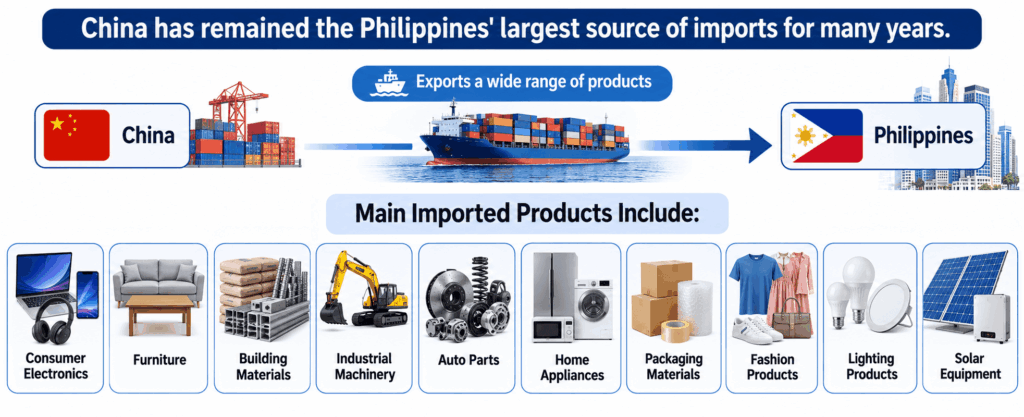
China has remained the Philippines’ largest source of imports for many years, supplying a wide range of products including:
- Consumer electronics
- Furniture
- Building materials
- Industrial machinery
- Auto parts
- Home appliances
- Packaging materials
- Fashion products
- Lighting products
- Solar equipment
For many Philippine importers, China offers an unmatched combination of manufacturing capacity, product variety, and competitive pricing. However, the savings achieved through sourcing can quickly disappear if the shipping solution is poorly planned.
A common mistake is focusing only on the freight quotation while overlooking customs procedures, delivery charges, documentation, storage fees, or the risks associated with choosing the wrong shipping method.
Understanding the total landed cost—rather than just the freight rate—is what separates experienced importers from beginners.
What Determines Shipping Costs from China to the Philippines?
Many people search Google expecting a simple price list.
In reality, freight forwarders don’t calculate shipping costs based on one factor. Instead, multiple variables affect the final quotation.
Below are the most important ones.
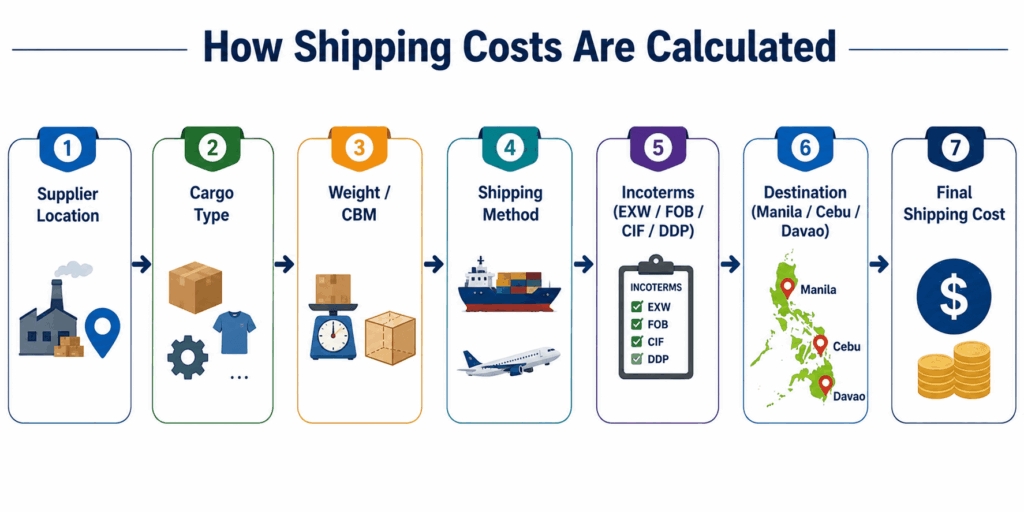
1. Shipping Method
Your choice of transportation has the biggest impact on cost.
Generally speaking:
- Lowest transportation cost
- Suitable for bulky or heavy cargo
- Best for planned inventory replenishment
- Transit time typically ranges from one to several weeks depending on the origin, destination, and vessel schedule
- Much faster
- Higher transportation cost
- Suitable for urgent replenishment
- Ideal for high-value products and time-sensitive shipments
Instead of paying each logistics provider separately, many importers choose DDP shipping from China to the Philippines, where the freight forwarder manages export procedures, international transportation, import customs clearance, duties (where included in the agreement), and final delivery.
For first-time importers, DDP often simplifies the shipping process because there is only one logistics provider coordinating the shipment from China to the final destination.
2. Cargo Volume and Weight
One of the biggest misconceptions among new importers is assuming that shipping is charged only by weight.
For international freight, carriers may charge based on:
- Gross weight
- Chargeable weight
- Cubic meters (CBM)
- Container size
For sea freight:
LCL (Less than Container Load) shipments are generally charged by cubic meter (CBM).
FCL (Full Container Load) shipments are charged by container size, such as:
- 20GP
- 40GP
- 40HQ
For air freight:
The carrier compares the shipment’s actual weight with its volumetric weight and charges whichever is higher.
This is why lightweight but bulky cargo—such as pillows, plastic products, or promotional displays—may cost more to ship than expected.
3. Departure Port in China
Shipping costs also vary depending on where your supplier is located.
The most common export ports include:
- Shanghai
- Ningbo
- Shenzhen
- Guangzhou (via Nansha)
- Xiamen
- Qingdao
If your supplier is located inland, domestic trucking to the export port may increase the overall logistics cost.
This is one reason why two suppliers offering the same product price can result in different landed costs.
4. Destination in the Philippines
Many importers assume that “shipping to the Philippines” is a single destination.
In reality, delivery costs vary depending on where the cargo is going.
Common destinations include:
- Metro Manila
- Cebu
- Davao
- Batangas
- Subic
Deliveries outside major metropolitan areas often require additional domestic transportation after customs clearance.
If your shipment is destined for an Amazon fulfillment center, retail warehouse, factory, or industrial park, delivery requirements may also differ.
5. Cargo Type
This is one factor that many online shipping calculators completely ignore.
General cargo is relatively straightforward to transport.
However, certain products require additional review before booking, including:
- Lithium batteries
- Battery-powered products
- Chemicals
- Paints
- Liquids
- Aerosols
- Magnetic products
- Certain cosmetics
These products may require additional documentation, carrier approval, specialized packaging, or compliance with international transport regulations.
We’ll discuss this topic in more detail later because it can significantly affect shipping costs.
6. Incoterms
The shipping term agreed between the buyer and supplier also changes your total logistics cost.
The most common Incoterms include:
EXW (Ex Works)
The buyer is responsible for almost the entire transportation process, including pickup from the supplier’s factory.
FOB (Free on Board)
The supplier delivers the cargo to the designated export port, while the buyer arranges international freight and import procedures.
CIF (Cost, Insurance and Freight)
The supplier arranges ocean transportation to the destination port, but import customs clearance and local charges remain the buyer’s responsibility.
DDP (Delivered Duty Paid)
The logistics provider manages the shipment from China to the final delivery address according to the agreed service scope, making it one of the most convenient options for many SMEs importing from China.
Choosing the wrong Incoterm can result in unexpected costs, duplicated services, or disputes over responsibility.
Sea Freight Cost from China to the Philippines
For most commercial shipments, sea freight remains the most economical transportation method.
If your cargo is not urgently needed, shipping by sea almost always provides the lowest cost per unit.
Sea freight is particularly suitable for:
- Furniture
- Building materials
- Machinery
- Home appliances
- Retail products
- Wholesale inventory
- Industrial equipment
- E-commerce replenishment with sufficient lead time
Depending on shipment volume, importers generally choose between LCL and FCL.
LCL Shipping (Less than Container Load)
LCL allows multiple importers to share space inside the same shipping container.
This option is ideal if your shipment doesn’t fill an entire container.
Typical applications include:
- New importers testing the market
- Small and medium-sized businesses
- Multiple suppliers consolidated into one shipment
- Seasonal inventory replenishment
Advantages
✔ Lower upfront shipping cost
✔ No need to book a full container
✔ Suitable for shipments from approximately 1–15 CBM
Considerations
Because multiple shipments share one container, LCL usually involves:
- Container consolidation
- Additional warehouse handling
- Deconsolidation at destination
As a result, LCL shipments may have slightly longer transit times and more handling compared with FCL shipments.
FCL Shipping (Full Container Load)
When shipment volume becomes large enough, booking an entire container is often the better option.
FCL is commonly used by:
- Manufacturers
- Distributors
- Construction companies
- Large wholesalers
- Retail chains
Common container sizes include:
- 20GP
- 40GP
- 40HQ
Advantages
✔ Lower cost per CBM for large shipments
✔ Reduced cargo handling
✔ Lower risk of damage
✔ Faster port operations
✔ Better scheduling flexibility
For businesses importing regularly from China, FCL often provides the best balance between cost, efficiency, and cargo security.
Which Is More Cost-Effective?
A question we hear frequently is:
Should I choose LCL or FCL?
There isn’t a universal answer.
If your shipment only occupies a few cubic meters, LCL is usually the more economical solution.
However, as cargo volume increases, there comes a point where booking an entire container becomes more cost-effective than paying LCL charges for each cubic meter.
A professional freight forwarder should compare both options before providing a recommendation, rather than automatically quoting only one service.
Air Freight Cost from China to the Philippines
While sea freight is usually the most economical option, there are situations where air freight from China to the Philippines makes far more business sense.
Many experienced importers don’t compare shipping methods based only on freight rates—they compare them based on the total cost of running their business.
For example, if you’re launching a new product, replenishing inventory during peak sales seasons, or shipping components that are needed to keep a production line running, waiting another three or four weeks for sea freight may cost far more than the additional air freight charges.
Air freight is commonly used for:
- Consumer electronics
- Mobile phone accessories
- Computer components
- Medical equipment
- Fashion products with short selling seasons
- Product samples
- Urgent replacement parts
- High-value commercial goods
For most shipments, transit time from major Chinese airports such as Guangzhou, Shenzhen, Shanghai, or Hong Kong to Manila is significantly shorter than ocean freight, although the total door-to-door timeline still depends on customs clearance and local delivery arrangements.
How Air Freight Charges Are Calculated
Unlike sea freight, air freight is rarely priced simply by weight.
Airlines calculate freight based on whichever is greater:
- Actual Gross Weight
- Chargeable (Volumetric) Weight
This is why two shipments weighing exactly 100 kg may receive completely different quotations.
For example:
A shipment of steel parts may occupy very little space.
A shipment of pillows or plastic packaging may occupy several times more volume.
Although both shipments weigh the same, the second shipment could cost considerably more because it occupies much more aircraft cargo space.
If you’re unsure which charging method applies to your shipment, your freight forwarder should explain the calculation before confirming the booking.
Transparent pricing is always better than discovering unexpected charges after the cargo has already departed.
When Is Air Freight Worth the Money?
Generally speaking, air freight becomes a good investment when one of the following applies:
✓ Your products have high profit margins.
✓ Running out of inventory would cost more than the additional freight.
✓ Your shipment is relatively small.
✓ Your customer requires urgent delivery.
✓ You’re launching a new product and need inventory available as quickly as possible.
For many Amazon sellers, it’s common to combine shipping methods—for example, sending a small quantity by air to maintain inventory while the larger replenishment order travels by sea. This approach can reduce the risk of stockouts without relying entirely on expensive air freight.
Door-to-Door (DDP) Shipping from China to the Philippines
One of the fastest-growing logistics solutions over the past few years has been DDP shipping from China to the Philippines.
Many first-time importers assume DDP simply means “delivery included.”
In reality, DDP (Delivered Duty Paid) is a comprehensive logistics service in which the freight forwarder coordinates multiple stages of the shipment under a single arrangement.
Depending on the agreed service scope, a typical DDP shipment may include:
- Cargo pickup from the supplier
- Export customs clearance in China
- International transportation
- Import customs clearance
- Payment of applicable duties and taxes (where included in the service agreement)
- Final delivery to your warehouse, office, store, or designated address
Instead of coordinating several logistics companies yourself, you work with one provider who manages the shipment from origin to destination.
For many SMEs importing from China for the first time, this significantly reduces operational complexity.
Is DDP Always the Cheapest Option?
Not necessarily.
This is one of the biggest misconceptions in international shipping.
Some buyers compare only the ocean freight rate and conclude that FOB is always cheaper than DDP.
However, once destination charges, customs brokerage, documentation fees, port handling charges, local transportation, and administrative costs are added together, the difference is sometimes much smaller than expected.
In many cases, DDP also provides greater cost certainty because most logistics expenses are agreed upon before the shipment leaves China.
For businesses without their own customs team or local import experience, predictability is often just as valuable as obtaining the lowest freight rate.
Hidden Shipping Costs That Many Importers Overlook
One reason freight quotations vary so much is that not every quotation includes the same services.
A low ocean freight rate doesn’t necessarily mean the total logistics cost will be lower.
Depending on the shipment, additional charges may include:
- Export documentation fees
- Terminal handling charges (THC)
- Customs declaration fees
- Destination handling charges
- Customs inspection fees (if selected for examination)
- Storage charges
- Port demurrage
- Container detention
- Last-mile delivery
- Warehouse unloading
- Cargo insurance
These costs don’t apply to every shipment, but they are important to understand when comparing quotations from different freight forwarders.
Instead of asking, “Who offers the cheapest freight?”, a better question is:
“What exactly is included in this quotation?”
A transparent quotation should clearly explain the scope of service so there are no surprises after the cargo arrives.
Shipping Batteries, Chemicals and Other Dangerous Goods
This is one of the most misunderstood areas of international logistics.
Every month, we receive enquiries from businesses looking to ship products such as lithium batteries, chemical products, paints, liquids, aerosols, or battery-powered equipment from China to the Philippines.
Many assume these shipments can simply be added to a regular LCL consolidation service.
In reality, transporting dangerous goods is significantly more complex than transporting ordinary cargo.
What Is Considered Dangerous Goods?
Depending on their composition and applicable transport regulations, products that may require additional assessment include:
- Standalone lithium batteries
- Battery-powered equipment
- Power banks
- E-bikes and electric scooters
- Industrial chemicals
- Paints and coatings
- Cleaning chemicals
- Adhesives
- Essential oils
- Alcohol-based liquids
- Aerosols
- Certain cosmetics
- Laboratory chemicals
Not every product within these categories is automatically classified as dangerous goods. The applicable transport requirements depend on factors such as product composition, UN classification, packaging, and supporting documentation.
Why Small Dangerous Goods Shipments Are Challenging
One of the most common enquiries we receive is something like this:
“I have around 2 CBM of lithium batteries. Can you arrange LCL DDP shipping to the Philippines?”
The answer depends on the specific product, but many importers are surprised to learn that dangerous goods cannot always be handled in the same way as general cargo.
Unlike ordinary cargo, dangerous goods often require:
- Carrier approval before booking
- Additional cargo review
- Specialized packaging
- Hazard communication labels
- Product certification
- Compliance with international transport regulations
Because ocean carriers operate under strict dangerous goods policies, availability is much more limited than for general cargo.
In many cases, dangerous goods shipments move under dedicated DG booking arrangements rather than standard LCL consolidation.
For this reason, small-volume dangerous goods shipments are often significantly more expensive per cubic meter than ordinary cargo, and depending on the product classification and available services, they may not be suitable for standard LCL or DDP solutions.
If you’re planning to import dangerous goods regularly, it’s often more practical to consolidate larger shipment volumes and discuss the available transport options before production begins.
Documents You Should Prepare Before Requesting a Quotation
Providing complete product information early allows your freight forwarder to assess feasibility and recommend the appropriate transport solution.
Depending on the product, supporting documents may include:
- Safety Data Sheet (SDS/MSDS)
- UN38.3 Test Report (for lithium batteries, where applicable)
- Product specifications
- Product photos
- Packing details
- Battery information (built-in, packed with equipment, or standalone)
- Manufacturer-issued transport certificates (if applicable)
Submitting these documents at the quotation stage helps avoid unnecessary delays later in the booking process.
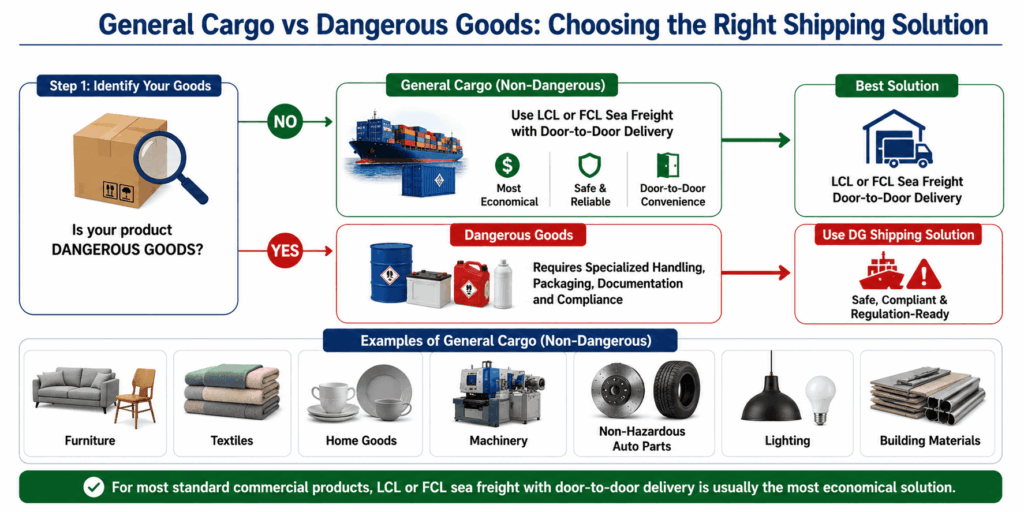
General Cargo vs Dangerous Goods: Choosing the Right Shipping Solution
For most standard commercial products—such as furniture, textiles, home goods, machinery, non-hazardous auto parts, lighting, and building materials—LCL or FCL sea freight with door-to-door delivery is usually the most economical solution.
| General Cargo ✅ | Dangerous Goods ⚠️ |
|---|---|
| Furniture | Lithium Batteries |
| Home Goods | Chemicals |
| Clothing | Paints |
| Machinery | Liquids |
| Lighting | Aerosols |
| Auto Parts (Non-DG) | Power Banks |
However, if your shipment contains regulated products such as lithium batteries or industrial chemicals, the shipping solution should be determined only after reviewing the product information and applicable documentation.
Every dangerous goods shipment should be evaluated individually rather than assuming it can move through the same logistics channel as ordinary cargo.
Making this assessment early—before placing your purchase order or finalizing packaging—can prevent costly changes later in the supply chain.
Real Shipping Scenarios: Which Shipping Method Is Right for Your Business?
One of the biggest mistakes first-time importers make is assuming that every shipment should be transported the same way.
In reality, the best shipping solution depends on your cargo volume, delivery deadline, product type, and overall business objectives—not simply the lowest freight rate.
| Cargo Type | Recommended Shipping Method | Typical Volume | Notes |
|---|---|---|---|
| Furniture | LCL / FCL Sea Freight | 3–40 CBM | Most economical |
| Electronics | Air or Sea | Depends on urgency | High-value cargo |
| Machinery | FCL Sea Freight | Large volume | Better cargo protection |
| Building Materials | FCL Sea Freight | Full container | Lower unit cost |
| Clothing | LCL / Air | Flexible | Seasonal shipments |
| Lithium Battery Products | Product Assessment Required | Case-by-case | Documentation and carrier acceptance required |
| Chemicals | Product Assessment Required | Usually larger volumes | Depends on classification |
| Liquids | Product Assessment Required | Case-by-case | Additional compliance may apply |
Here are a few typical shipping scenarios we frequently encounter.
Scenario 1: A Small Business Importing Furniture
Cargo
- 6 CBM wooden furniture
- Guangzhou → Manila
- Delivery to a retail warehouse
Recommended Solution
- LCL Sea Freight
- Door-to-Door Delivery
Why?
The shipment doesn’t justify booking an entire container, and transit time isn’t urgent. LCL sea freight provides the lowest transportation cost while allowing the importer to purchase smaller quantities without excessive inventory pressure.
Scenario 2: Urgent Electronics Replenishment
Cargo
- 500 kg consumer electronics
- Shenzhen → Manila
Recommended Solution
- Air Freight
Why?
The value of the products is significantly higher than the additional freight cost, and maintaining inventory availability is more important than minimizing transportation expenses.
Scenario 3: Full Container Building Materials
Cargo
- 1 × 40HQ
- Shanghai → Davao
Recommended Solution
- Full Container Load (FCL)
Why?
For high-volume shipments, FCL generally provides better cargo protection, lower handling risk, and a lower transportation cost per cubic meter compared with LCL.
Scenario 4: Lithium Battery Shipment
Cargo
- Battery-powered equipment
- Shenzhen
Recommended Solution
Product assessment before quotation.
Why?
Battery shipments should never be quoted based only on weight or volume.
The freight solution depends on several factors, including:
- Battery type
- UN classification
- Packaging method
- Supporting documentation
- Shipment volume
- Carrier acceptance
Providing this information before booking allows the freight forwarder to recommend an appropriate transport solution and helps avoid unnecessary delays.
How to Reduce Shipping Costs from China to the Philippines
Every importer wants lower freight costs.
However, the companies that consistently achieve lower logistics expenses don’t simply negotiate harder—they optimize their supply chain.
Here are several practical strategies.
1. Plan Your Shipments Earlier
Urgent shipments almost always cost more.
Booking space before peak shipping seasons gives you more transportation options and often better freight rates.
2. Consolidate Multiple Suppliers
If you’re purchasing products from several factories across China, consider consolidating everything into one warehouse before export.
Instead of paying for several separate international shipments, cargo consolidation can reduce handling costs and simplify customs documentation.
Kisun Shipping operates consolidation warehouses in major sourcing regions including Guangzhou, Shenzhen, and Yiwu, making it easier for importers to combine cargo from multiple suppliers into a single shipment.
3. Choose the Right Incoterm
Many importers automatically select FOB because it’s familiar.
However, depending on your business experience and local resources, DDP may provide better overall value by simplifying customs clearance and reducing administrative work.
The cheapest freight rate doesn’t always produce the lowest landed cost.
4. Optimize Packaging
Reducing unnecessary packaging can lower transportation costs, particularly for air freight where volumetric weight directly affects pricing.
Before production begins, discuss carton dimensions and pallet configurations with both your supplier and freight forwarder.
Small packaging improvements can produce meaningful savings over hundreds of shipments.
5. Work With a Freight Forwarder That Understands Your Business
International shipping isn’t simply moving cargo from one port to another.
A good freight forwarder helps you:
- Select the appropriate shipping method
- Reduce avoidable logistics costs
- Prepare compliant documentation
- Minimize customs delays
- Plan inventory replenishment
- Solve unexpected shipping problems
The cheapest quotation isn’t always the most economical decision.
Professional planning often saves far more than negotiating another few dollars off the freight rate.
How to Reduce Shipping Costs from China to the Philippines
Every importer wants lower freight costs.
However, the companies that consistently achieve lower logistics expenses don’t simply negotiate harder—they optimize their supply chain.
Here are several practical strategies.
- Plan Your Shipments Earlier
Urgent shipments almost always cost more.
Booking space before peak shipping seasons gives you more transportation options and often better freight rates.
- Consolidate Multiple Suppliers
If you’re purchasing products from several factories across China, consider consolidating everything into one warehouse before export.
Instead of paying for several separate international shipments, cargo consolidation can reduce handling costs and simplify customs documentation.
Kisun Shipping operates consolidation warehouses in major sourcing regions including Guangzhou, Shenzhen, and Yiwu, making it easier for importers to combine cargo from multiple suppliers into a single shipment.
- Choose the Right Incoterm
Many importers automatically select FOB because it’s familiar.
However, depending on your business experience and local resources, DDP may provide better overall value by simplifying customs clearance and reducing administrative work. If you choose DDP shipping way with your freight forwarder, then with your supplier, you shoudl trade with them EXW. Cause under DDP shipping term, freight forwarder will handle local work in China and exporting, your supplier just need to provide product information.
The cheapest freight rate doesn’t always produce the lowest landed cost.
- Optimize Packaging
Reducing unnecessary packaging can lower transportation costs, particularly for air freight where volumetric weight directly affects pricing.
Before production begins, discuss carton dimensions and pallet configurations with both your supplier and freight forwarder.
Small packaging improvements can produce meaningful savings over hundreds of shipments.
- Work With a Freight Forwarder That Understands Your Business
International shipping isn’t simply moving cargo from one port to another.
A good freight forwarder helps you:
Select the appropriate shipping method
Reduce avoidable logistics costs
Prepare compliant documentation
Minimize customs delays
Plan inventory replenishment
Solve unexpected shipping problems
The cheapest quotation isn’t always the most economical decision.
Professional planning often saves far more than negotiating another few dollars off the freight rate.
Why Businesses Choose Kisun Shipping
At Kisun Shipping, we believe freight forwarding should be more than simply booking cargo space.
Our goal is to help importers build a more reliable supply chain from China.
Our China–Philippines logistics solutions include:
Sea Freight
- LCL (Less than Container Load)
- FCL (Full Container Load)
- Port-to-Port
- Door-to-Door Delivery
Air Freight
Fast shipping from major Chinese airports to the Philippines for urgent commercial shipments.
Cargo Consolidation
Purchasing from multiple Chinese suppliers?
We consolidate cargo at our warehouses before arranging international transportation, helping reduce shipping costs and simplify logistics.
Customs Clearance Support
Our team assists customers in preparing shipping documents and coordinating customs clearance to reduce unnecessary delays.
Door-to-Door Delivery
From suppliers in China to warehouses, factories, retail stores, or commercial addresses throughout the Philippines.
Project Cargo & Large Commercial Shipments
Beyond standard commercial cargo, we also assist businesses with large-volume shipments and customized logistics solutions based on cargo characteristics and transportation requirements.
Frequently Asked Questions
How much does shipping from China to the Philippines cost?
There isn’t a fixed price. Shipping costs depend on factors such as cargo volume, weight, shipping method, origin, destination, cargo type, and the agreed Incoterms.
Is sea freight cheaper than air freight?
Yes. Sea freight generally offers the lowest transportation cost for bulky or heavy cargo, while air freight provides faster transit for urgent or high-value shipments.
Should I choose LCL or FCL?
If your cargo occupies only a small portion of a container, LCL is usually more economical.
For larger shipments, FCL often provides better value and lower handling risk.
What is DDP shipping?
DDP (Delivered Duty Paid) is a shipping arrangement in which the logistics provider manages transportation and, depending on the agreed scope, coordinates customs clearance and delivery to the final destination.
Can I ship directly from Alibaba to the Philippines?
Yes.
Many importers purchase products through Alibaba and arrange shipping through an independent freight forwarder rather than using the supplier’s logistics service. This often provides greater flexibility and allows you to compare shipping options before booking.
Can batteries or chemical products be shipped?
Potentially, yes—but it depends on the specific product.
Battery-powered products, lithium batteries, chemicals, liquids, and other regulated goods may require additional documentation, specialized handling, or carrier approval before shipment.
Always provide complete product information before requesting a quotation.
What documents are normally required?
Typical commercial shipments usually require:
- Commercial Invoice
- Packing List
- Product information
- Shipping labels (where applicable)
Certain regulated products may require additional documentation.
How can I reduce shipping costs?
Planning shipments earlier, consolidating cargo from multiple suppliers, optimizing packaging, selecting the appropriate shipping method, and working with an experienced freight forwarder can all help reduce overall logistics costs.
Final Thoughts
Importing from China to the Philippines isn’t simply about finding the lowest freight rate.
Successful importers focus on the total landed cost, shipment reliability, customs compliance, and choosing the right logistics solution for their business.
Whether you’re shipping a few cubic meters of consumer goods, replenishing inventory for an e-commerce business, or importing full container loads for commercial projects, understanding how shipping costs are calculated allows you to make better purchasing decisions and avoid unexpected expenses.
If you’re looking for a reliable freight forwarder from China to the Philippines, our team is happy to help you compare different shipping options and recommend the solution that best fits your cargo, timeline, and budget.

China Logistics Expert
About the Author
Katherine Kang is a China-based logistics consultant with over 11 years of experience in international trade and freight forwarding. Specializing in helping SMEs import from China to the USA, Canada, and Europe, she focuses on compliant, cost-effective solutions to avoid delays, tariffs, and hidden fees. From anti-dumping guidance to CNY planning, Katherine has managed hundreds of shipments, saving clients 15-30% on average.
Connect with Katherine on LinkedIn or contact Kisun Shipping for a free import consultation.