
New CBP IOR Rules 2027: Does Your U.S. LLC Still Qualify as an Importer of Record?
Having a U.S. LLC, an EIN, a registered business address, and a U.S. bank account does not automatically mean your company qualifies as a U.S. Importer of Record (IOR).
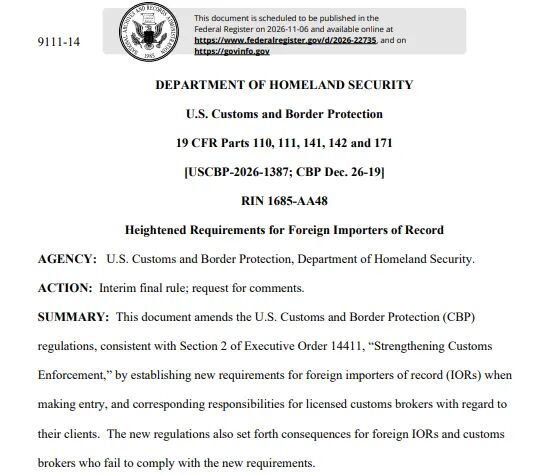
On November 6, 2026, U.S. Customs and Border Protection (CBP) published an interim final rule titled Heightened Requirements for Foreign Importers of Record (91 FR 69977).
Effective January 5, 2027, the new rule introduces stricter requirements for foreign importers and customs brokers handling their U.S. imports.
For overseas Amazon sellers, international e-commerce businesses, and foreign-owned U.S. companies, this raises an important question:
If your U.S. LLC is owned and controlled by foreign individuals, will CBP recognize it as a U.S. IOR?
The answer depends on more than where your company is registered. CBP will examine beneficial ownership, actual business presence, and U.S.-based assets.
More importantly, companies that do not qualify as U.S. IORs may still import goods into the United States, but they must follow the new requirements for foreign IORs.
Here is what international importers need to know before their next shipment.
1. What Is the New CBP IOR Rule Taking Effect on January 5, 2027?
The new regulation implements Executive Order 14411, Strengthening Customs Enforcement, signed on June 3, 2026.
Its primary objective is to strengthen CBP’s ability to identify importers, verify their business structures, collect unpaid duties, and enforce U.S. customs and trade laws.
The new rule introduces several important changes:
- A formal definition of U.S. Importer of Record and Foreign Importer of Record.
- New ownership and business-presence requirements for U.S. IORs.
- CTPAT validation requirements for foreign IORs and their customs brokers.
- New verification responsibilities for licensed customs brokers.
- A declaration of U.S. IOR status on import entry documents.
- Expanded enforcement options and potential penalties for non-compliance.
The rule takes effect on January 5, 2027.
Customs brokers may request delayed compliance with certain new verification requirements, but all brokers are expected to be fully compliant no later than May 6, 2027.
This is an important distinction: the broker compliance extension does not provide a general exemption for foreign importers.
2. Who Qualifies as a U.S. Importer of Record Under the New Rules?
Under the new regulation, CBP establishes two main categories of U.S. IORs: individuals and business entities.
Category 1: Individuals
An individual qualifies as a U.S. IOR if they are:
- A U.S. citizen.
- A lawful permanent resident (green card holder).
Category 2: Business Entities
A company must first satisfy two basic conditions:
- It must be organized under the laws of the United States.
- It must be located in the United States.
It must also meet at least one of the following ownership or property requirements:
Option A: U.S. Beneficial Ownership
At least 51% of the company’s beneficial owners must be U.S. citizens or lawful permanent residents, and these individuals must have control of the entity.
Option B: Direct Ownership of U.S. Real Estate
The company must directly own a significant amount of unencumbered real property in the United States at all times.
A property may have certain encumbrances, but its remaining unencumbered value must still be significant.
However, meeting one of these two conditions does not automatically establish U.S. IOR status.
CBP also evaluates whether the company has a genuine business presence in the United States.
Relevant factors include:
- Whether its principal place of business is in the United States.
- Whether it has a physical presence where substantial business transactions take place.
- Whether it maintains sufficient unencumbered physical domestic assets.
- Whether its business generally generates revenue exceeding its cost of goods sold.
- Whether it is structured to generate its own profit.
- Whether it is sufficiently capitalized.
CBP evaluates these factors based on the circumstances of each company.
A registered address or incorporation certificate alone is not enough.
U.S. IOR vs Foreign IOR
| Criteria | U.S. IOR | Foreign IOR |
|---|---|---|
| U.S. incorporation | Required for entities | Not required |
| U.S. business location | Required for entities | Not required |
| 51% U.S. beneficial ownership | Required under ownership pathway | Does not meet this pathway |
| Significant U.S. real estate | Alternative qualification pathway | Does not meet this pathway |
| CTPAT validation | Not generally required under this rule | Required unless using a CTPAT-validated broker |
| Non-CTPAT broker | May be used | Cannot be used to make entry on behalf of a non-CTPAT foreign IOR under the new rule |
3. Does Your Foreign-Owned U.S. LLC Still Qualify as a U.S. IOR?
This is probably the most important question for overseas Amazon sellers.
Many international entrepreneurs establish U.S. LLCs to operate their Amazon businesses, manage U.S. inventory, open business bank accounts, or simplify their commercial operations.
However, under the new CBP definition, incorporating a company in the United States does not automatically make it a U.S. IOR.
Consider the following examples.
Example 1: A U.S. LLC Wholly Owned by Foreign Individuals
An Amazon seller based in Germany establishes a U.S. LLC.
The company has:
- A U.S. registration certificate.
- An EIN.
- A U.S. registered address.
- A U.S. bank account.
However, the LLC is 100% owned and controlled by the German business owner, and the company does not directly own a significant amount of qualifying U.S. real estate.
In this situation, the LLC would generally not satisfy the new U.S. IOR ownership requirement.
It may therefore be classified as a Foreign IOR, subject to CBP’s assessment of its actual business structure and other applicable criteria.
Example 2: A U.S. LLC with Qualifying U.S. Ownership
A company is established in the United States.
At least 51% of its beneficial ownership is held by U.S. citizens or lawful permanent residents who control the business.
The company also maintains a genuine U.S. business presence and satisfies the applicable requirements.
It may qualify as a U.S. IOR, subject to CBP verification.
Example 3: A Foreign-Owned U.S. LLC with Significant U.S. Real Estate
A foreign-owned U.S. LLC does not satisfy the 51% U.S. beneficial ownership requirement.
However, it directly owns a significant amount of qualifying unencumbered real property in the United States and meets the other applicable requirements.
It may qualify under the alternative real-estate ownership pathway.
Important: A U.S. LLC owned by foreign individuals is not automatically disqualified in every circumstance. The real-estate pathway and CBP’s assessment of the company’s actual U.S. presence must also be considered.
What About a U.S. Bank Account?
CBP includes cash deposited in a U.S. bank account within its definition of physical domestic assets.
However, a bank account is only one factor in the overall verification process.
It does not independently establish U.S. IOR status.
The key message is simple:
U.S. incorporation, an EIN, and a bank account do not automatically make a foreign-owned company a U.S. IOR.
4. What Happens If Your Company Is Classified as a Foreign IOR?
Being classified as a Foreign IOR does not mean your company can no longer import goods into the United States.
However, the new regulation introduces additional requirements for customs clearance.
Under the new rules, a Foreign IOR must generally follow one of two pathways.
Option 1: Become a CTPAT-Validated Foreign IOR
The importer may qualify for the relevant CTPAT validation pathway.
However, there is an important limitation.
According to CBP’s discussion in the interim final rule, Canadian non-resident importers are currently the only foreign IOR category eligible to apply for CTPAT validation as importers.
Therefore, for Amazon sellers and businesses established in countries such as the UK, Germany, France, Australia, or other non-Canadian markets, this is generally not a practical option.
Option 2: Use a CTPAT-Validated U.S. Customs Broker
A Foreign IOR that is not CTPAT validated must designate a U.S.-licensed customs broker that is CTPAT validated.
The broker must either:
- Make the customs entry on behalf of the Foreign IOR; or
- Act as the Importer of Record for the entry, where the applicable requirements are met.
There is also an important transaction-specific requirement.
If the foreign principal on the Power of Attorney is not the owner or purchaser of the merchandise, the designated CTPAT-validated broker must act as the IOR for the entry.
The actual importer, broker, and ownership structure must therefore be reviewed before shipment.
Simply hiring any licensed customs broker will no longer be sufficient for a non-CTPAT-validated foreign IOR.
The broker must have the appropriate CTPAT validation status.
5. How Many Foreign Importers Will Be Affected?
CBP’s interim final rule provides useful statistics based on its Automated Commercial Environment (ACE) data.
The figures cover import activity between October 1, 2020, and February 6, 2026.
According to CBP:
| Category | Number / Percentage |
|---|---|
| Active Foreign IORs | 187,871 |
| Foreign IORs with CTPAT validation | 744 |
| Foreign IORs using CTPAT-validated brokers | 127,691 |
| Foreign IORs already meeting at least one of these pathways | 67.98% |
| Foreign IORs not yet meeting either pathway | Approximately 32.02% |
This means that approximately one-third of active foreign IORs may need to review or change their current customs clearance arrangements.
CBP also reported that 78% of active customs brokers were not CTPAT validated.
However, this figure refers to the overall broker population, not the proportion of foreign importers without access to compliant brokerage services.
The distinction matters.
CBP has identified a significant transition requirement, but the rule does not mean that foreign importers will have no available customs clearance options.
For importers currently working with non-CTPAT-validated brokers, the priority is to identify an eligible replacement before the effective date.
6. New Responsibilities for Customs Brokers: Five-Year Recordkeeping and IOR Verification
The new regulation also places additional responsibilities on licensed customs brokers.
Previously, brokers were already required to exercise due diligence when conducting customs business.
Under the new rule, they must also verify whether clients qualify as U.S. IORs before making the relevant declaration.
This verification requires the broker to request and review supporting records.
Depending on the company’s structure, these may include:
- Proof of U.S. citizenship or lawful permanent residence of relevant beneficial owners.
- Corporate formation documents.
- Ownership and control records.
- Financial statements.
- Business records and purchase receipts.
- Property ownership documents.
Customs brokers must retain verification records for five years from the date of verification.
If a broker determines that its client is a Foreign IOR and the broker itself is not CTPAT validated, it must stop filing entries on behalf of that client.
New Declaration Requirement
The new rule also requires U.S. IOR status to be declared when filing an entry and entry summary.
CBP has updated Form 3461 and Form 7501, together with their electronic equivalents, to accommodate the new declaration.
Importers and brokers must not incorrectly declare a foreign entity as a U.S. IOR simply because it has a U.S. incorporation certificate or EIN.
If CBP determines that an importer has inaccurately declared its U.S. IOR status, it may impose a live-entry requirement and discontinue immediate delivery privileges.
This could create additional customs processing time and costs.
Increased Penalty Exposure for Customs Brokers
The regulation also expands CBP’s enforcement options concerning customs brokers.
Historically, broker penalties under 19 U.S.C. §1641 included a monetary penalty capped at $30,000.
Under the amended enforcement framework, CBP may also pursue applicable violations under 19 U.S.C. §1592.
Depending on the facts and the level of culpability, penalties under this provision can be based on the domestic value of the merchandise.
This does not mean every broker violation automatically results in a penalty equal to the full value of the shipment.
However, the increased potential exposure gives customs brokers a stronger reason to review their clients’ importer status carefully.
7. What Should Overseas Amazon Sellers and Importers Do Before January 5, 2027?
If your business is based outside the United States but you regularly import inventory into U.S. warehouses or Amazon fulfillment centers, now is the time to review your existing customs arrangements.
Here are four practical steps.
Step 1: Review Your U.S. Company Structure
If you currently use a U.S. LLC as your Importer of Record, review:
- Who ultimately owns the company?
- Who exercises substantial control over its operations?
- Does the company meet the 51% U.S. beneficial ownership requirement?
- Does it directly own qualifying U.S. real estate?
- Does it maintain sufficient physical assets and genuine business operations in the United States?
Do not assume that having a U.S. LLC automatically means your company qualifies as a U.S. IOR.
If the ownership structure is complicated, consult a qualified U.S. customs attorney or compliance professional.
Step 2: Confirm Your Customs Broker’s CTPAT Status
If your company is classified as a Foreign IOR, contact your current customs broker.
Ask:
- Is your company currently CTPAT validated?
- Is your brokerage operation CTPAT validated?
- Can you continue handling entries for non-CTPAT-validated foreign IORs under the new rules?
- Will you act as the customs broker or as the IOR for the entry?
- What additional documents or authorization will you require?
Request written confirmation rather than relying solely on verbal assurances.
You should also independently verify the broker’s licensing and CTPAT participation status.
Step 3: Understand the Transition Deadline
The key dates are:
| Date | Event |
|---|---|
| November 6, 2026 | CBP publishes the interim final rule |
| January 5, 2027 | New IOR requirements take effect |
| January 5, 2027 | Deadline for public comments and eligible broker delayed-compliance requests |
| May 6, 2027 | Latest date for full compliance with the new broker verification requirements |
Do not assume that your current customs broker can continue operating under the previous arrangement simply because a delayed-compliance provision exists.
The extension is not an automatic exemption for foreign importers.
Step 4: Evaluate Your Long-Term Import Strategy
Depending on your business model, you may consider:
Option A: Maintain Your Own IOR
If your company qualifies as a U.S. IOR, you may continue working with an appropriately licensed customs broker under the applicable requirements.
Option B: Use a CTPAT-Validated Customs Broker
If your company is classified as a Foreign IOR, working with a CTPAT-validated broker is an important option.
Option C: Use a Compliant DDP Shipping Arrangement
If you do not want to manage U.S. importer registration and customs arrangements independently, you may consider working with a logistics provider that can coordinate a compliant DDP solution.
The important thing is to understand who will actually act as the IOR, who will handle customs clearance, and how the transaction is structured.
Changing your Incoterms from DDP to FOB does not automatically solve an IOR compliance problem. You still need a valid customs clearance arrangement for the importation.
8. Can Overseas Amazon Sellers Still Use DDP Shipping to the USA?
Yes. The new CBP regulation does not establish a blanket ban on DDP shipping.
This is an important distinction that overseas importers should understand.
DDP is an Incoterms delivery arrangement. It defines the responsibilities of the seller and buyer for transportation, import clearance, duties, and delivery.
It does not independently determine who qualifies as the Importer of Record under U.S. customs law.
For overseas Amazon sellers, wholesalers, and international businesses that do not want to establish their own U.S. IOR arrangements, a properly structured DDP service can still be a practical solution.
However, the logistics provider must have a customs clearance arrangement that meets the applicable requirements.
At Kisun Shipping, we continue to offer DDP shipping from China to the United States using U.S.-based IOR resources.
For overseas customers who do not wish to register their own IOR, we can help coordinate the transportation and customs clearance process through our U.S. IOR arrangements.
Before shipment, we review the cargo information, destination, and applicable customs clearance arrangements to determine the appropriate shipping solution.
For customers who already have their own qualifying IOR and customs broker, we can also arrange transportation under other suitable shipping terms.
Our goal is not simply to offer DDP shipping at a competitive price, but to help international importers establish a clear and workable shipping and customs clearance arrangement.
9. Final Thoughts: A U.S. LLC Is Not the Same as a U.S. Importer of Record
The new CBP regulation represents a significant change for foreign-owned U.S. companies and international businesses importing goods into the United States.
The biggest misconception is that registering a U.S. LLC automatically makes a company a U.S. IOR.
Under the new rules, CBP looks beyond the company’s registration documents and examines beneficial ownership, actual business presence, and qualifying U.S. assets.
For overseas Amazon sellers and international importers, the most important steps are to:
- Review your current IOR structure.
- Determine whether your company qualifies as a U.S. IOR.
- Verify your customs broker’s CTPAT status if you are a Foreign IOR.
- Prepare the necessary documentation before January 5, 2027.
- Evaluate alternative customs clearance arrangements if your current setup does not meet the new requirements.
You do not necessarily need to establish your own U.S. IOR to import goods into the United States.
But you do need a customs clearance arrangement that meets CBP’s requirements.
Frequently Asked Questions
Q1: Does a foreign-owned U.S. LLC qualify as a U.S. Importer of Record?
Not automatically. A foreign-owned U.S. LLC must satisfy the applicable ownership or real estate requirements, as well as CBP’s U.S. business-location and verification criteria.
Q2: Can a foreign-owned U.S. LLC import goods into the USA?
Yes. If it does not qualify as a U.S. IOR, it may generally import as a Foreign IOR by meeting the applicable CTPAT requirements, including using a CTPAT-validated customs broker.
Q3: Do foreign Amazon sellers need to obtain CTPAT certification?
Not necessarily. Most foreign IORs outside Canada will need to work with a CTPAT-validated licensed customs broker rather than obtain CTPAT validation themselves.
Q4: Can I use a regular U.S. customs broker after January 5, 2027?
A non-CTPAT-validated broker may continue handling entries for qualifying U.S. IORs. However, a non-CTPAT-validated broker cannot make entries on behalf of a non-CTPAT-validated Foreign IOR under the new rule.
Q5: Does the new CBP regulation prohibit DDP shipping?
No. The regulation does not establish a general ban on DDP shipping. However, the IOR and customs clearance arrangements must meet the applicable requirements.
Q6: Can I still use DDP shipping if I don’t have my own U.S. IOR?
Yes, potentially. A properly structured DDP arrangement may use a qualifying U.S.-based IOR or other compliant customs clearance structure. The actual importer and responsibilities should be confirmed before shipment.
Need DDP Shipping from China to the USA?
If you are an overseas Amazon seller, wholesaler, or importer looking for a reliable shipping solution from China to the United States, Kisun Shipping can help.
We offer:
- DDP sea freight from China to the USA.
- DDP air freight from China to the USA.
- Cargo consolidation from multiple Chinese suppliers.
- Shipping to Amazon FBA warehouses and commercial addresses.
- Coordination of customs clearance through U.S.-based IOR resources.
Whether you prefer to use your own IOR or need a DDP arrangement, we can help review your shipping requirements and discuss a suitable solution.
Contact Kisun Shipping for a China-to-USA shipping quote.
To receive an accurate quotation, please provide:
- Cargo pickup city in China.
- Delivery address or Amazon FBA destination.
- Product description.
- Total weight and volume.
- Preferred shipping method (air or sea).
- Estimated cargo-ready date.
Let’s make sure your next shipment is properly planned before it leaves China.
Kisun Shipping – China Freight Forwarding and DDP Shipping Solutions for International Importers.

China Logistics Expert
About the Author
Katherine Kang is a China-based logistics consultant with over 11 years of experience in international trade and freight forwarding. Specializing in helping SMEs import from China she focuses on compliant, cost-effective solutions to avoid delays, tariffs, and hidden fees. Katherine has managed hundreds of shipments, saving clients 15-30% on average.
Connect with Katherine on LinkedIn or contact Kisun Shipping for a free import consultation.