
Navigating Saudi Customs in 2026: Inspection Times, Detained Goods, and the “Fake Brands” Reality
Importing goods into Saudi Arabia can be a highly lucrative business, but for beginners, the customs clearance process often feels like a minefield. At Kisun Shipping, our operations team frequently receives questions like: “How long will my cargo be stuck at the port?” or worse, “Can you help me sneak counterfeit branded goods into Riyadh?”
Let’s set the record straight: Saudi Arabia’s ZATCA (Zakat, Tax and Customs Authority) operates one of the strictest, most technologically advanced borders in the world. In this comprehensive guide, we will break down the exact inspection times under the 2026 Fasah system, explain the catastrophic consequences of detained goods, and show you how to protect your supply chain.
(If you are completely new to this market, we highly recommend reading our foundational guide first: How to Ship from China to Saudi Arabia)
How Long Does Saudi Customs Inspection Typically Take?
Thanks to the integration of the Fasah 4.0 System, documentation review is now heavily reliant on AI. However, physical inspection times vary significantly depending on your shipping method and cargo type. Here is the pure inspection timeline (excluding the actual freight and final delivery):
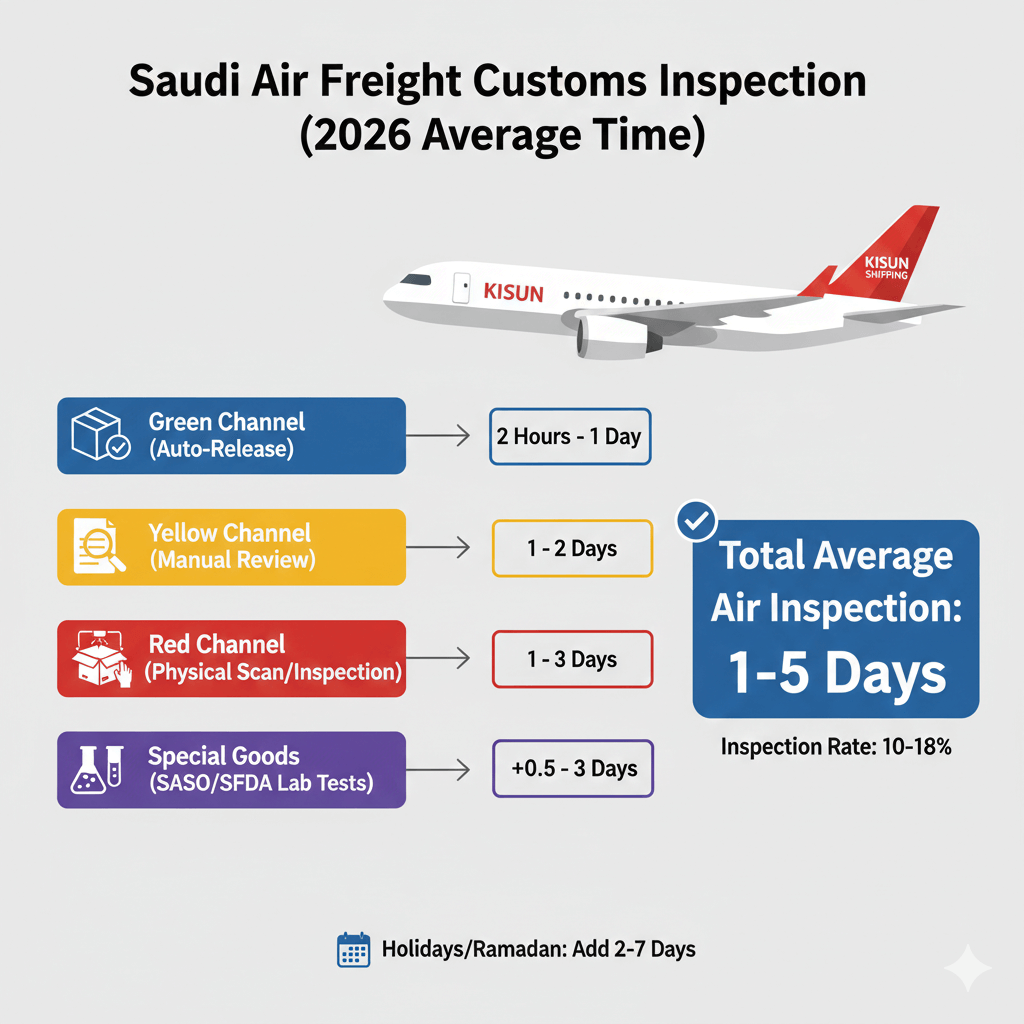
✈️ Air Freight (Riyadh / Jeddah / Dammam Airports)
Air freight benefits from a fast AI document review and a lower inspection rate (typically 10%–18%). There is no container unpacking, making it the fastest route.
- Green Channel (Automatic Release): 2 hours – 1 day
- Yellow Channel (Manual Document Review): 1 – 2 days
- Red Channel (X-ray + Physical Inspection): 1 – 3 days
- Special Goods (SASO/SFDA requiring extra checks): Add 0.5 – 3 days
- 👉 Total Average Inspection Time: 1 – 5 working days
🚢 Sea Freight (Jeddah / Dammam / King Abdullah Ports)
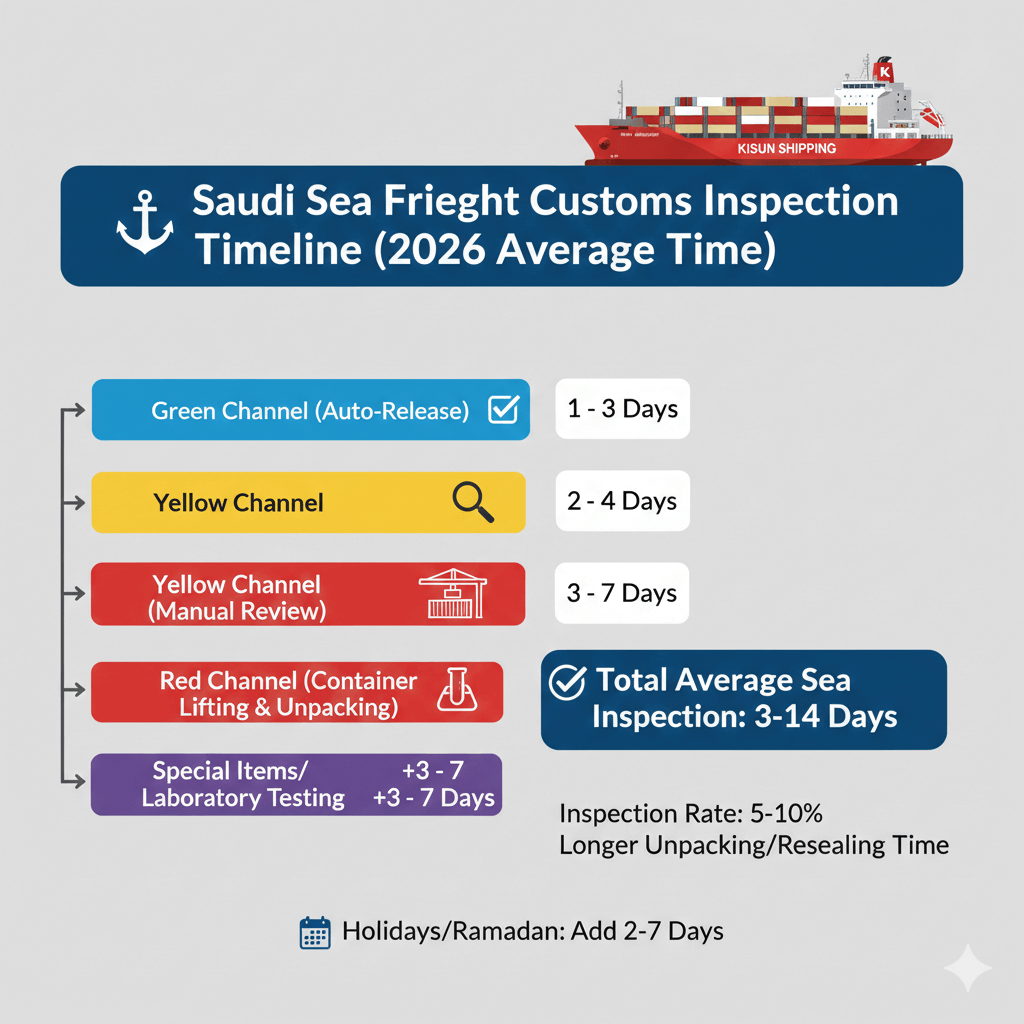
Sea freight involves heavy FCL (Full Container Load) or LCL (Less than Container Load) processing. Unpacking and resealing containers take time.
- Green Channel (Automatic Release): 1 – 3 days
- Yellow Channel (Manual Document Review): 2 – 4 days
- Red Channel (Container Lifting & Unpacking): 3 – 7 days
- Special Items / Laboratory Testing: Add 3 – 7 days
- 👉 Total Average Inspection Time: 3 – 14 working days
⚠️ Kisun Pro-Tip: During Ramadan or major national holidays, expect an additional delay of 2 to 7 days across all ports.
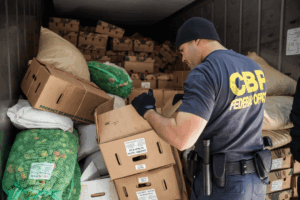
The Big Question: “Can I Ship Counterfeit (Replica) Brands to Saudi Arabia?”
The answer is an absolute, uncompromising NO.
Many novice importers ask if we can use “grey market channels” to clear counterfeit clothing, electronics, or accessories.
Under the fully networked Fasah + SABER + ZATCA digital infrastructure, grey market clearance no longer exists. Attempting to import fake brands is a 100% violation. Saudi Customs uses advanced image recognition and strict intellectual property (IP) verification. If caught, your goods will be destroyed, and you will face criminal prosecution (more on this below).
At Kisun Shipping, we only operate 100% legitimate, compliant customs clearance. We would rather lose an order than risk our clients’ entire business qualifications.
What is the Worst-Case Scenario if Goods are Detained?
If your goods are detained in Saudi Arabia due to non-compliance, the consequences go far beyond a simple “cargo loss.” Here are the worst-case outcomes, sorted from highest to lowest severity:
1. Criminal Prosecution & Permanent Blacklisting (The Ultimate Risk)
- Triggers: Smuggling, forging SABER certificates, importing counterfeit brands, or bringing in religiously prohibited items (contraband).
- Consequences: Under Article 45 of the Saudi Criminal Code, this leads to heavy fines, potential imprisonment, and a permanent ban from entering Saudi Arabia. Furthermore, the Chinese exporting company and the Saudi importing company will be permanently blacklisted, effectively ending your Middle East business.
2. Forced Destruction of Goods
- Triggers: Counterfeit goods, contraband, or failing to provide a required SABER certificate within the permitted timeframe.
- Consequences: Total loss of cargo. You recover $0. Worse, the importer is billed for the destruction costs, demurrage fees, and customs fines. Destruction usually begins within 14–21 days of non-compliance.
3. Forced Auction + Hefty Fines
- Triggers: Severe discrepancies between the commercial invoice and actual goods, abnormal under-pricing, or long-overdue clearance.
- Consequences: Customs auctions the goods to offset taxes and fines. You face penalties ranging from 10% to 30% of the goods’ value (capped at 3x the value). Demurrage fees can reach $80–$150 per day per container, easily exceeding $6,000 in a month.
4. Return Shipment (Extremely High Costs)
- Triggers: Non-prohibited goods that simply cannot complete clearance due to missing standard documents.
- Consequences: Customs orders the goods back to China. You must pay round-trip shipping costs (often 2-3 times the outbound rate), plus port storage fees. Upon returning to China, the goods are essentially devalued or useless for other markets.
Will Detained Goods Ever Be Returned? (The 3 Outcomes)
If you receive a detention notice, do not panic immediately. The outcome depends entirely on why the cargo was flagged.
- Release After Rectification: If the issue is minor—such as missing a standard document, incorrect labeling (e.g., missing “Made in China”), or a valuation dispute—you have a 14-day golden window. By rapidly submitting supplementary documents or paying the fine/tax difference, the goods will be released.
- Forced Return: If you absolutely cannot provide the required certification (but the goods are legal), customs will mandate returning the shipment to the point of origin at your expense.
- Confiscation: As mentioned, if the goods are illegal, fake, or strictly prohibited, they will never be returned. They will be seized and destroyed.
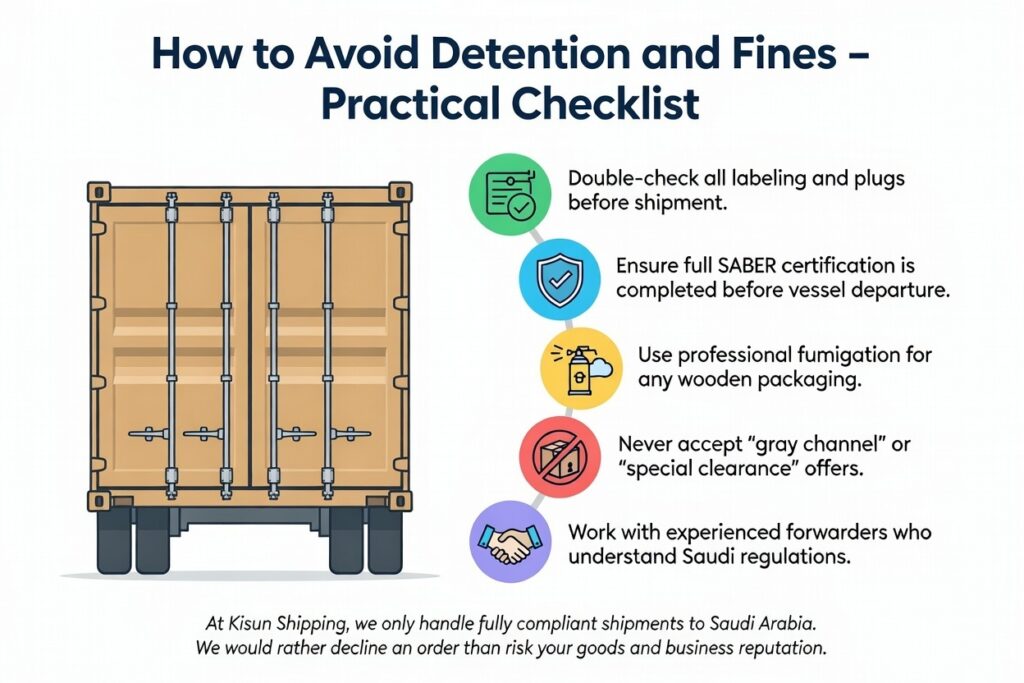
How to Avoid Detention and Fines – Practical Checklist
- Double-check all labeling and plugs before shipment.
- Ensure full SABER certification is completed before vessel departure.
- Use professional fumigation for any wooden packaging.
- Never accept “gray channel” or “special clearance” offers.
- Work with experienced forwarders who understand Saudi regulations.
At Kisun Shipping, we only handle fully compliant shipments to Saudi Arabia. We would rather decline an order than risk your goods and business reputation.
Conclusion: Compliance is Your Only Strategy
There is no room for “luck” at Saudi borders in 2026. Legitimate clearance with complete SABER documentation is the only path to profitability.
If you are shipping Full Container Loads (FCL) and want to ensure you don’t fall into these costly traps, dive into our highly detailed technical guide: Saudi Customs Clearance Guide 2026: Master SABER & FCL Process.
Need a reliable, strictly compliant forwarder? At Kisun Shipping, we pre-audit your documents before your cargo leaves China, ensuring smooth sailing through ZATCA. Contact us today to secure your supply chain.
FAQ: Saudi Customs Inspection & Detained Cargo
Q1: How long will my sea freight container be stuck in Saudi customs?

A: Under normal circumstances, pure inspection for sea freight takes between 3 to 14 working days. If your container goes through the Green Channel, it can be released in 1-3 days. However, if it is flagged for the Red Channel (requiring physical unpacking and resealing) or needs SASO laboratory testing, expect the process to take up to two weeks. (Pro Tip: Always add 2-7 extra days if your shipment arrives during Ramadan.)
Q2: Can a freight forwarder help me clear replica or counterfeit brands in Saudi Arabia using "special channels"?
A: Absolutely not. With the 2026 integration of ZATCA, SABER, and the Fasah 4.0 AI system, "grey market" clearance is entirely obsolete. Attempting to import fake brands will result in the 100% destruction of your goods, massive fines, and permanent blacklisting of both the importing and exporting companies. Kisun Shipping only handles 100% legitimate and compliant cargo.Q3: My cargo was detained because I am missing a SABER certificate. What should I do?
A: Do not panic, but act fast. You have a 14-day "golden window" to rectify documentation errors. You must immediately contact your supplier to generate the required PCoC and SCoC via the SABER system. If you fail to provide the documents within this timeframe, customs will initiate a forced auction or mandate a return shipment.Q4: If my goods are rejected and returned to China, who pays the shipping fees?
A: You (the importer/exporter) are entirely responsible. Worse, forced return shipping is incredibly expensive. It typically costs 2 to 3 times more than your original outbound freight. On top of that, you must pay any accumulated port demurrage fees (which can range from $80 to $150 per day) before the goods are allowed to leave Saudi Arabia.Q5: Why is air freight inspection so much faster than sea freight?
A: Air freight bypasses the heavy logistical bottlenecks of sea ports. It benefits from fast AI-driven document reviews and primarily handles smaller parcels. Sea freight requires heavy machinery to lift containers, physically unpack the goods for Red Channel inspections, and reseal them, which significantly slows down the process.
China Logistics Expert
About the Author
Katherine Kang is a China-based logistics consultant with over 11 years of experience in international trade and freight forwarding. Specializing in helping SMEs import from China to the USA, Canada, and Europe, she focuses on compliant, cost-effective solutions to avoid delays, tariffs, and hidden fees. From anti-dumping guidance to CNY planning, Katherine has managed hundreds of shipments, saving clients 15-30% on average.
Connect with Katherine on LinkedIn or contact Kisun Shipping for a free import consultation.