From 5H to 9H: The 2026 US Customs “Entity Purge” – Is Your Shipment (and Bond) Still Safe?
If you thought the 5H examinations at the start of 2026 were a headache, buckle up. The storm has moved from the container floor to the digital ledger.
Earlier this year, the industry was rocked by the “5H” crackdown—a brutal wave of physical inspections targeting Los Angeles and Long Beach ports. We saw a staggering 82% forced re-exportation rate for non-compliant cargo. But as of May 2026, the focus has shifted. CBP is no longer just looking at what is in the box; they are looking at who owns the box.
Enter the 9H Hold.
In the last 30 days, “9H” has become the most feared code in the ACE (Automated Commercial Environment) system. It is silent, it is digital, and it is devastating for freight forwarders and Amazon sellers who have played fast and loose with Customs Bonds and Importer of Record (IOR) identities.
At Kisun Shipping, we’ve spent the last month analyzing the fallout. Here is the guide to surviving the 2026 U.S. Customs “Entity Scrutiny” era.
The 2026 Timeline: How 5H Evolved into 9H
To understand where we are, we have to look at the “War on Compliance” timeline of 2026:
- Q1 2026 (The 5H Wave): Targeted physical exams at LA/LB and Oakland. CBP was hunting for undervaluation and de minimis (Section 321) abuse. Total impact: 3,826 containers detained.
- March 2026 (The Bond Crisis): Surety companies (the ones who back your Customs Bonds) began panic-canceling Single Entry Bonds (SEB) for high-risk commodities.
- May 2026 (The 9H Surge): CBP upgrades their algorithm. The “9H Hold” spreads beyond California to Savannah, Seattle, and New York. It’s no longer about the ports; it’s about the Bond itself.
What is a 9H Hold? The “Silent Killer” of Customs Clearance
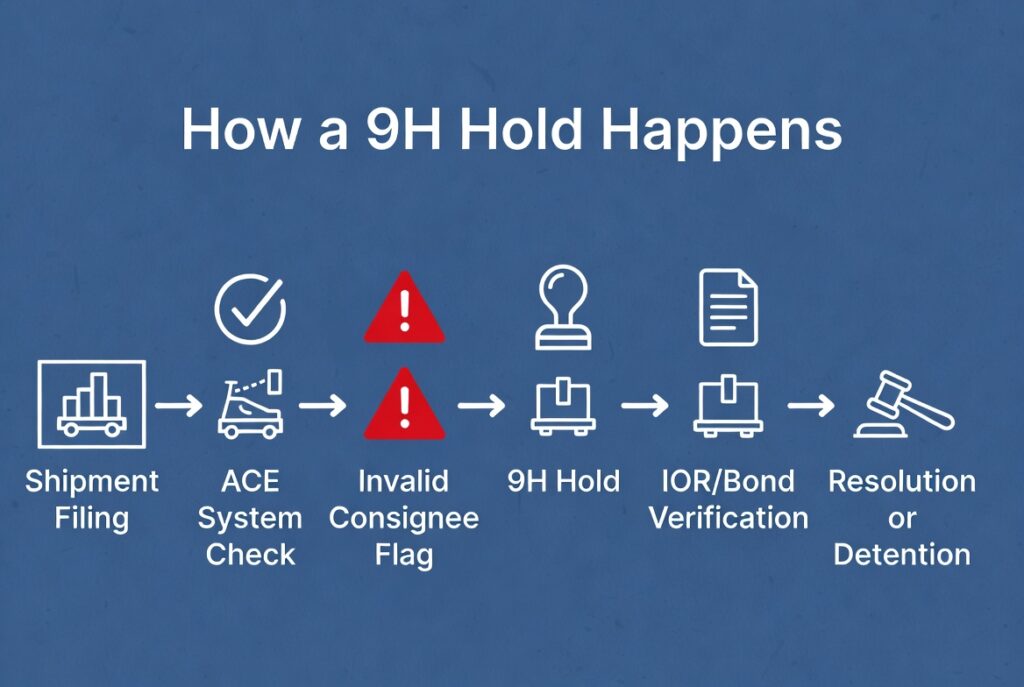
In technical terms, 9H stands for “Invalid Consignee Hold.”
Unlike a 5H or 4H exam, which involves a CET (Customs Enhancement Team) officer physically opening your container at a CES (Centralized Examination Station), a 9H hold happens at the software level.
How it works:
The CBP system flags a discrepancy in the Consignee or IOR information listed on the Bill of Lading, ISF (Importer Security Filing), or AMS. If the system detects that the entity is a shell company, has an expired address, or is using a “borrowed” identity, it triggers an immediate freeze.
The “9H” Difference Table
| Feature | 5H Examination | 9H Entity Hold |
| Focus | Physical Goods (Quantity/Value) | The Importer (Identity/Bond) |
| Location | Physical Port/CES | ACE Digital System |
| Visibility | You see the container being moved | You only see a status code in ACE |
| Resolution | Physical inspection (7-14 days) | Documentation audit (Indefinite) |
| Risk | Seizure of goods | Revocation of Bond & IOR Blacklisting |
Why is 9H Happening Now? The Core Targets
CBP’s logic is simple: If they stop the importer, they stop all their shipments at once, rather than chasing individual boxes. The 9H crackdown is targeting four specific “Industry Sins”:
- Identity Leasing (The IOR Trap): Many Amazon FBA sellers “rent” an IOR from their freight forwarder. CBP is now flagging IORs that import $100M+ in goods but have no physical office, no employees, and a $0 tax footprint.
- Customs Bond Abuse: Surety companies are discovering that thousands of bonds were obtained using fake “shell” companies. Once a surety company cancels a bond, every shipment tied to that bond triggers a 9H hold instantly.
- Undervaluation Aggression: If your Commercial Invoice shows a price that is 70% below market value, CBP doesn’t just ask for a new invoice; they flag the consignee as a “Fraudulent Entity.”
- DDP Mismanagement: Under DDP (Delivered Duty Paid) terms, the forwarder often acts as the IOR. CBP is now holding these forwarders to the same “Know Your Customer” (KYC) standards as banks.
Real Impact on China to US Shipments
Once a 9H hold hits:
- Your container may not be released even if documents look perfect on the surface.
- Demurrage and detention fees start accumulating quickly (ports have limited free days).
- Resolving it requires the importer or broker to provide proof of legitimacy — sometimes taking weeks.
- In serious cases, bonds get suspended, making future shipments extremely difficult.
We’ve seen clients lose thousands in extra fees because they didn’t realize their IOR setup had weaknesses until the hold appeared.
The “Ripple Effect”: Customs Bonds are Being Revoked
This is the part that isn’t being talked about in generic logistics blogs: The Surety Crisis.
In May 2026, we saw several major U.S. surety agencies (the companies that provide the financial guarantee for your imports) proactively terminate thousands of active Continuous Bonds. Why? Because the risk of “Liquidated Damages” (fines) has become too high. If your bond is terminated, your cargo sitting on the water is suddenly unclearable. You cannot simply “buy a new bond” overnight. You will be stuck in a loop of demurrage and storage fees that can exceed the value of the cargo in less than 10 days.
The Port Report: Seattle, Savannah, and the “Hard-Hit Zones”
While LA/LB used to be the primary battleground, the 9H hold is port-agnostic.
- Savannah: Seeing a 30% increase in 9H holds for textile and apparel importers.
- Seattle/Tacoma: High scrutiny on electronics and high-tech components.
- Small/Medium Ports: CBP is moving inspectors to smaller ports, assuming that’s where the “shady” importers are trying to hide their cargo.
How to Survive: The Kisun Compliance Roadmap
If you are shipping from China to the US in 2026, you can no longer afford to be “bold.” You have to be compliant.
1. Verify Your IOR Legitimacy
Is your U.S. importer a real company with a real FEIN (Federal Employer Identification Number)? If you are using a “shared” IOR provided by a low-cost forwarder, get out now. Use a dedicated IOR or your own U.S. entity.
2. Audit Your Customs Bond
Don’t wait for a 9H notification. Ask your broker: “Is my bond still in ‘Good Standing’ with the surety company?” If you are an Amazon seller, ensure your bond amount (usually $50k for a Continuous Bond) is sufficient for your annual duty exposure.
3. Document Consistency
In 2026, the ISF, AMS, and Commercial Invoice must be a perfect mirror. Any discrepancy in the “Sold To” or “Ship To” name can trigger the 9H algorithm.
9H & 5H Customs Enforcement: Your Burning Questions Answered (May 2026 Update)
Q1: My cargo is stuck with a "9H Hold," but the freight forwarder says they aren't even opening the container. How can Customs flag me without looking at the goods?

A: Welcome to the era of Entity-Based Scrutiny. Unlike the 5H exams you saw earlier this year (which were physical inspections), a 9H hold is a "Digital Lockdown." CBP’s AI is now auditing the Importer of Record (IOR) and the Customs Bond before the ship even docks. If the system flags your IOR as a shell company, or if your registered address doesn't match IRS records, they pull the "9H" lever. It’s not about your products—it’s about the fact that Customs doesn't trust the person or company signing the paperwork.
Q2: I’m shipping DDP, and my forwarder provided the Bond. If the shipment gets a 9H hold, is it their problem or mine?
A: Legally, it’s the IOR's problem. Financially? It’s 100% yours. If the forwarder’s "shared Bond" or "borrowed IOR" gets flagged, your container sits at the terminal accumulating demurrage and detention fees that can easily hit $300-$500 per day. In 2026, many "cheap" DDP forwarders are disappearing overnight when their Bonds get revoked, leaving sellers with abandoned cargo and massive bills. This is why Kisun Shipping insists on work on compliance, we don't have the cheapest cost, but we have reliable and low container inspection rate.Q3: Can I just cancel my shipment and "Return to Sender" (RTS) to avoid the 9H complications?
A: It’s not that simple. Once a 9H hold is triggered in the ACE system, the cargo is under Customs jurisdiction. You cannot just "pull it back" without CBP's permission. In fact, if the 9H hold escalates into a fraud investigation, the cargo could be seized permanently. Your best bet is to proactively provide the Proof of Right to Make Entry and validated FEIN/Tax ID documents through a qualified broker to "cure" the entity discrepancy.Q4: I heard Surety companies are canceling Continuous Bonds. How do I check if my Bond is still "Live" before I ship from China?
A: You shouldn't wait for your ship to hit the water to find out. In May 2026, sureties are purging thousands of risky accounts. You (or your broker) should check the ACE Portal or contact your Surety agent directly to confirm your Bond status is "Sufficient" and "Active." If your bond was issued by a shell agency or lacks a verified U.S. physical address, it’s a prime target for revocation. At Kisun, we perform a Pre-Shipment Bond Audit for all our U.S.-bound clients to avoid this exact nightmare.Q5: Is the 9H hold only happening at LA/Long Beach? Can I route through Savannah or Houston to stay safe?
A: In early 2026, you could hide in smaller ports. Not anymore. The 9H hold is a system-wide ACE alert. Whether your container lands in Seattle, Savannah, or New York, the algorithm follows the Tax ID (FEIN) of the Importer. If your IOR is blacklisted in LA, it’s blacklisted everywhere in the USA. Routing to a different port will only add extra trucking costs to your already delayed shipment. The solution isn't a different port; it's a compliant entity.Summary: A Watershed Moment for Cross-Border Trade
The era of “guessing” your way through U.S. Customs is over. The 5H and 9H crackdowns are not temporary glitches; they are the new standard for shipping to the USA from China.
In 2026, the winners in the Amazon FBA space won’t be the ones with the cheapest shipping rates. They will be the ones whose supply chains don’t get frozen by a 9H hold.
At Kisun Shipping, we pride ourselves on being a “Compliance First” carrier. We audit your documentation before it leaves Shenzhen, ensuring that when your ship hits the port, the only thing it triggers is a “Cleared” status.
Don’t wait for the ACE notification to tell you your bond is dead. Contact Kisun Shipping for a 2026 Compliance Audit & Shipping Quote

China Logistics Expert
About the Author
Katherine Kang is a China-based logistics consultant with over 11 years of experience in international trade and freight forwarding. Specializing in helping SMEs import from China to the USA, Canada, and Europe, she focuses on compliant, cost-effective solutions to avoid delays, tariffs, and hidden fees. From anti-dumping guidance to CNY planning, Katherine has managed hundreds of shipments, saving clients 15-30% on average.
Connect with Katherine on LinkedIn or contact Kisun Shipping for a free import consultation.