

Peak Season Shipping from China to the UK: How to Avoid Delays and Rising Costs
Peak season does not necessarily mean that every shipment will be delayed or that freight rates will automatically increase.
What changes is the level of pressure on the supply chain.
More businesses are trying to move inventory at roughly the same time. Available vessel space, equipment, warehouse capacity and transport schedules can become tighter, leaving importers with fewer options when something changes.
For a UK importer, that can turn a small production delay into a much bigger logistics problem.
Quick Answer
Peak season can make China-to-UK shipping less flexible because more businesses are trying to move inventory at the same time. This can affect available departures, equipment, freight rates and the time available to recover from production or logistics delays. For UK importers, the safest approach is to plan backwards from the date the inventory must be available—not wait until the cargo is ready.
Imagine this situation:
Your supplier tells you the goods will be ready in September.
You need the inventory for a November sales campaign.
You wait until the cargo is almost ready before arranging shipping.
By then, your preferred departure may have limited availability, alternative schedules may be less convenient, and there may be less room to recover if the shipment moves later than planned.
That is what makes peak-season planning important.
The biggest peak-season risk is not simply paying more. It is having less flexibility when you need it most.
What Does Peak Season Mean for China-to-UK Shipping?
Peak season is a period when demand for logistics capacity increases because businesses are preparing inventory for major sales periods, holidays or seasonal demand.
For China-to-UK trade, the pressure is particularly relevant before:
- Black Friday
- Christmas
- Year-end retail demand
- Chinese New Year
The timing is important because the products need to arrive before consumers are ready to buy them.
The UK Department for Transport has previously highlighted this point using Christmas imports as an example: September was the busiest month for containerised arrivals of Christmas decorations into UK ports.
In other words:
The Christmas logistics season starts long before Christmas.
That is why waiting until November to think about Christmas inventory can be far too late for a business importing from China.
Peak Season Is More Than Higher Freight Rates
Higher demand can affect several parts of the logistics process.
Less booking flexibility
Your preferred departure may not be available when your cargo is ready.
Tighter capacity
When available capacity becomes constrained, carriers may introduce or revise peak-season surcharges. For example, Maersk announced Peak Season Surcharge revisions for Far East Asia to North Europe in July 2026, citing tighter effective capacity and increased pressure as peak season approached.
Less room to absorb delays
If one departure is missed during a quieter period, another option may be relatively easy to find.
During a busy period, missing that departure can have a greater impact on the overall delivery plan.
More pressure on the wider supply chain
Peak demand is not limited to the vessel itself. Cargo also has to move through warehouses, ports, customs and final delivery.
This is why an importer should think about the entire lead time, rather than only the international transit stage.
When Does Peak Season Usually Start?
There is no single calendar that applies identically to every year or every type of cargo.
As a general industry pattern, ocean shipping connected to holiday inventory often becomes busier from July through October, while air freight demand can become more significant later in the year.
For China-to-UK importers, three periods deserve particular attention.
Before Chinese New Year
Factories often try to complete and ship orders before the holiday shutdown. This can concentrate export demand into a shorter period.
Summer to Early Autumn
Businesses importing products for UK autumn and winter sales begin moving inventory earlier.
This is also when the supply chain can start experiencing stronger peak-season pressure.
Before Black Friday and Christmas
Retailers need stock in the UK well before the actual shopping period.
That is why September and October can be operationally important even though the major sales events occur later.
The Key Planning Mistake: Starting From the Cargo Ready Date
One of the most common mistakes is:
“My supplier says the goods will be ready on 15 September, so I’ll contact the freight forwarder then.”
A better approach is to work backwards.
Start with:
When must the inventory be available in the UK?
Then consider:
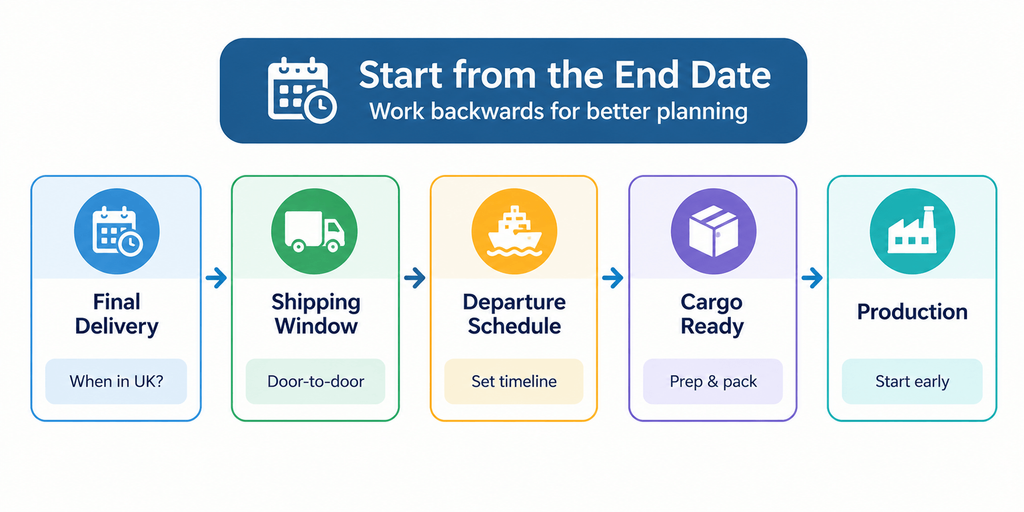
This gives you a much more realistic planning framework.
A shipment needed for a specific sales event should not be planned around the fastest possible transit time.
It should be planned around a realistic delivery window with enough room for normal operational changes.
Why Peak Season Makes Small Delays More Expensive
Consider a simple example.
Your inventory is required in the UK by early November.
Your supplier expects the goods to be ready in September.
If the cargo is delayed by three days during production, that may not sound serious.
But if those three days cause you to miss a planned departure, the effect on the overall schedule can be much larger.
This is why peak season planning is less about predicting every possible problem and more about protecting your options before problems occur.
The Practical Rule
Don’t wait for your shipment to become urgent before you start planning it.
The earlier you know your target delivery date, the more flexibility you have to choose a suitable departure and make adjustments if production or logistics conditions change.
What Actually Becomes More Difficult During Peak Season?
Peak season does not suddenly make international shipping impossible.
The bigger issue is that there is less room for mistakes.
When logistics capacity is under pressure, a small change that would normally be easy to absorb can have a much larger effect on your shipment.
Here are the areas UK importers should watch most closely.
1. Your Preferred Departure May Not Be Available
During busy periods, importers often have fewer choices than they expect.
You may have a preferred departure date, route or service, but by the time your cargo is ready, that option may no longer be available.
This does not necessarily mean there is no shipping capacity.
It means you may need to:
- Move to another departure
- Accept a different schedule
- Consider another routing option
The earlier you start planning, the more choices you are likely to have.
2. A Small Production Delay Can Become a Shipping Delay
This is one of the most common peak-season problems.
Suppose your supplier originally plans to finish production on Monday.
The goods are delayed by three days.
During a quieter period, you might still catch the next suitable departure.
During peak season, those three days could mean missing the planned cutoff and moving to a later departure.
The important lesson is:
Production time and shipping time should be planned together.
Do not treat your supplier’s cargo-ready date as guaranteed.
3. Schedule Changes Have a Bigger Impact
Shipping schedules can change for operational reasons.
When capacity is tight, there may be less flexibility to recover from a schedule change.
For an importer with a fixed sales deadline, even a relatively small adjustment can affect inventory planning.
This is why it is safer to work with a realistic delivery window rather than planning everything around the earliest possible arrival.
4. Last-Mile Capacity Matters Too
Peak season is not only about international transportation.
Your goods still need to move after arriving in the UK.
The final stages may involve:
Arrival → Customs → Local Transport → Warehouse
When demand is high, warehouse receiving schedules and local transport availability can also become more important.
For Amazon sellers, this is particularly relevant because the shipment still needs to reach the destination specified in the Amazon workflow.
You can learn more in our guide to [shipping from China to Amazon FBA UK].
5. Customs Problems Are Harder to Recover From
A customs issue can affect any shipment, regardless of season.
But during a busy period, a delay can be harder to absorb because your original schedule may already have limited flexibility.
For this reason, peak season is a particularly bad time to discover that:
- Product information is incomplete
- Customs documents need correction
- Additional import requirements have not been checked
Preparing the customs side before departure gives you more time to resolve potential issues.
See our guide to [UK customs clearance for imports from China] for a detailed explanation.
Warning Signs That Peak-Season Pressure Is Increasing
There is no single official indicator that tells you exactly when peak season has started affecting your shipment.
However, from a practical logistics perspective, you may notice signs such as:
Your preferred departure becomes harder to secure
Your usual sailing or service is no longer as flexible as it normally is.
Your freight forwarder starts suggesting alternatives
For example, another departure, route or transportation option may be recommended.
Freight quotations become more time-sensitive
A rate or booking option may have a shorter validity period because market conditions are changing.
Your supplier’s schedule becomes more important
A small production change suddenly has a larger effect on the shipping plan.
These are not guarantees that a shipment will be delayed. They are simply useful signals that your planning flexibility may be decreasing.
What Should You Do When You See These Signs?
The worst response is usually to wait and see.
Instead, confirm three things with your logistics provider:
What is the current planned departure?
What is the realistic delivery window?
What is the backup option if the original schedule changes?
Having a second option does not mean you must use it.
It simply means you are not starting from zero if the original plan changes.
Peak Season Is Really a Planning Problem
The biggest mistake is thinking:
“Peak season means freight prices will go up.”
That can happen, but price is only one part of the problem.
For an importer, the more important issue may be:
Can I still get my inventory where it needs to be, when I need it?
Once your preferred options become less flexible, late production, missed departures or customs issues become much harder to absorb.
That is why peak-season shipping should be managed before the cargo is ready—not after.
When Should You Book Your China-to-UK Shipment?
“Book early” is good advice, but it is not specific enough.
The more useful question is:
How early should you start planning if the goods are needed for a specific sales period?
There is no single number of days that works for every shipment. Your production schedule, shipping method, cargo volume and required delivery date all affect the answer.
A better approach is to work backwards from the date when the inventory must be available in the UK.
1. Start with Your Sales Date, Not Your Shipping Date
Suppose you are preparing inventory for Black Friday.
Your planning should not begin with:
“When can my supplier ship?”
Start with:
“When do I need the inventory available for sale?”
Then work backwards:
Sales / Inventory Date
↓
UK Warehouse or FBA Delivery Deadline
↓
Door-to-Door Shipping Window
↓
Booking / Departure
↓
Cargo Ready Date
↓
Production
This approach gives you a much more realistic schedule.
2. Black Friday and Christmas Need Earlier Planning Than You May Expect
For seasonal products, the inventory often needs to be in the UK well before the actual shopping event.
For example, a business preparing for Christmas sales cannot treat the first week of December as its logistics deadline.
The products may still need time for:
- Warehouse receiving
- Amazon inbound processing, if applicable
- Local distribution
- Inventory preparation
That means your internal delivery deadline should be earlier than your actual sales date.
The same principle applies to Black Friday.
A seasonal shipping plan should be based on when the inventory needs to be ready—not when customers start buying.
3. Don’t Wait Until the Cargo Is Finished to Start Planning
This is especially important during peak season.
If your supplier tells you:
“The goods will be ready in four weeks.”
That is the time to confirm the logistics plan—not four weeks later.
Ideally, you should already know:
- Which service you intend to use
- The expected delivery window
- Where the cargo will be collected
- The UK delivery destination
- Whether customs arrangements are ready
- Whether Amazon requirements apply
Then, if production changes, there is still time to adjust the shipping plan.
4. Chinese New Year Requires a Different Approach
Chinese New Year creates a different planning challenge because the issue is not simply transportation demand.
Factory production and export operations can be disrupted around the holiday period, and many businesses try to complete shipments before the holiday.
For UK importers, this means you should consider both sides of the timeline:
Production before the holiday
and
Shipping before or around the holiday period
If your inventory is required soon after Chinese New Year, waiting until factories reopen to start planning may leave very little flexibility.
For regular importers, it is better to discuss the pre-holiday shipping plan with suppliers and the freight forwarder well in advance.
5. Build a Buffer for Your Required Delivery Date
A shipping estimate should not be treated as your only planning buffer.
For example, if your selected service normally has a stated delivery range, do not schedule the shipment around the earliest possible arrival simply because it looks more convenient.
Instead, consider:
What happens if the shipment arrives toward the later end of the expected range?
This is particularly important for:
- Seasonal products
- Promotional inventory
- Amazon FBA stock
- Products with limited selling windows
A realistic buffer can make the difference between a manageable schedule and an urgent last-minute shipment.
What If You Are Already Late?
Sometimes there is no perfect solution.
Production may be delayed, a sales forecast may change, or inventory may run out faster than expected.
In that situation, don’t simply ask:
“What is the fastest shipping method?”
Ask:
“How much inventory actually needs to arrive urgently?”
If only part of the shipment is needed immediately, splitting the shipment may be worth considering.
For example:
Urgent quantity → faster service
Remaining quantity → more economical service
This can reduce the cost of solving an urgent inventory problem compared with moving the entire shipment using the fastest available option.
Whether this makes financial sense depends on the product value, inventory risk and additional handling costs.
A Simple Peak-Season Planning Checklist
Before your seasonal inventory leaves China, confirm:
1. Sales deadline
When does the inventory actually need to be available?
2. Delivery deadline
When must it reach your UK warehouse, Amazon or other destination?
3. Production deadline
When will the supplier realistically have the cargo ready?
4. Shipping window
What is the realistic door-to-door transit range?
5. Buffer
What happens if the shipment arrives later than expected?
6. Backup plan
What will you do if the original departure or schedule changes?
This six-step check is often more useful than simply asking a freight forwarder for the “fastest service.”
The Goal Is Predictability, Not Perfect Timing
No freight forwarder can control every part of an international shipment.
The goal of peak-season planning is therefore not to predict the exact delivery date months in advance.
It is to make sure you have:
Enough lead time + enough flexibility + a workable backup plan.
That gives your business more room to absorb normal changes without immediately resorting to expensive emergency shipping.
How to Protect Your Shipment During Peak Season
Peak season is not something an importer can control.
What you can control is how prepared your shipment is before it enters the busy period.
A few simple practices can make your logistics plan more resilient.
Confirm Your Cargo Information Early
Before requesting or confirming a booking, make sure your freight forwarder has accurate information about the shipment:
- Product description
- Number of cartons
- Weight and dimensions
- Estimated CBM
- Supplier location
- Cargo ready date
- UK delivery address
This allows the logistics team to plan the shipment using realistic information rather than making assumptions that may need to be corrected later.
Check Customs Before the Cargo Moves
Peak season is a poor time to discover a customs problem.
Make sure the necessary product and import information has been reviewed before departure, particularly for products that may require additional documentation or controls.
You can read our detailed guide to [UK customs clearance for imports from China] for more information.
The objective is simple:
Solve avoidable customs questions before the cargo reaches the UK.
Keep Your Amazon FBA Information Up to Date
For Amazon sellers, the logistics plan should be based on the current shipment information in Seller Central.
Before your inventory leaves China, confirm that:
- The shipment is correctly created
- Quantities are correct
- Current labels have been prepared
- The destination information is current
- Your logistics provider has the correct shipment details
Amazon’s inbound requirements can change, so an older FBA shipment should not automatically be used as the template for a new one.
For more detail, see our guide to [shipping from China to Amazon FBA UK].
Have a Backup Plan
A backup plan does not mean booking two shipments at the same time.
It means knowing what you will do if the original plan changes.
For example, you may decide in advance:
Primary option: planned shipment
Backup option: faster service for urgent inventory
This becomes particularly useful when the cost of a stock-out is significantly higher than the additional freight cost.
The backup does not have to be used. Its value is having a decision ready before the situation becomes urgent.
Don’t Wait for a Freight Rate to Become Urgent
During peak periods, freight rates and available services can change.
This is why requesting a quotation too early and then waiting indefinitely is not necessarily an effective strategy.
A better approach is to have your:
- Cargo information
- Required delivery date
- Preferred service
- Import arrangement
ready before you actually need to move the shipment.
This allows you to make a decision based on the available options rather than starting the entire process after your deadline is already approaching.
Protect the Part of the Supply Chain You Can Control
A freight forwarder cannot control every event affecting international transportation.
Neither can an importer.
But you can reduce avoidable problems by making sure:
Production is planned.
Cargo information is accurate.
Customs requirements are checked.
Amazon information is current, where applicable.
A backup option has been considered.
These steps will not eliminate every peak-season disruption.
They can, however, make your supply chain much easier to manage when conditions become less predictable.
Peak Season Shipping: The Practical Takeaway
The biggest mistake is waiting until your inventory becomes urgent.
By then, your choices may already be limited.
A better strategy is to work backwards from your required delivery date, understand the realistic logistics window, and prepare the customs, Amazon and shipment information before the cargo is ready.
Peak season is ultimately a test of planning.
The earlier you identify the risk, the more options you have to manage it.
Planning a China-to-UK Shipment During Peak Season?
When requesting a quotation, send your freight forwarder the basic information they need:
Product + Cartons + Weight/CBM + Supplier Location + Cargo Ready Date + UK Delivery Postcode + Required Delivery Date
With this information, your logistics provider can assess the available route and timing more realistically.
Frequently Asked Questions
When is peak season for shipping from China to the UK?
There is no single fixed peak season for every shipment. For China-to-UK trade, pressure often increases as businesses prepare inventory for Black Friday, Christmas and other year-end demand, while the period before Chinese New Year creates another major planning window.
Does peak season always mean higher freight rates?
No. Freight rates depend on market conditions, capacity and the specific service. Peak-season demand can contribute to higher rates or tighter capacity, but an increase is not automatic on every route or shipment.
Can peak season cause shipping delays?
It can make the supply chain less flexible and make existing delays harder to absorb. Production delays, missed departures, customs issues and final-delivery constraints can have a larger impact when schedules are already busy.
How early should I book shipping from China to the UK?
There is no universal number of days that applies to every shipment. The most reliable approach is to work backwards from your required UK delivery date and allow enough time for production, transportation and normal operational variation.
Does peak season affect air freight as well as sea freight?
Yes. Peak demand can affect different transportation modes at different times of the year. Air freight demand can also increase ahead of major retail periods, particularly when businesses need urgent inventory.
Does peak season affect Amazon FBA shipments?
It can. Amazon inventory has an additional inbound receiving process, so sellers should plan not only international transportation but also FBA shipment preparation and the final delivery stage.
How can I reduce the risk of peak-season delays?
Start planning before your cargo becomes urgent, provide accurate shipment information, check customs requirements early, keep Amazon shipment information current where applicable, and have a backup option available.
Final Thoughts
Peak season shipping is not simply a question of paying more for freight.
The bigger challenge is maintaining time and operational flexibility when many businesses are moving inventory at the same time.
For UK importers, the most effective approach is to plan backwards from the date when the goods are actually needed, rather than waiting until the supplier says, “The cargo is ready.”
Good preparation cannot prevent every disruption.
But it can give you more options when something changes.
Plan early. Check the details. Keep a backup option.
That is usually a better peak-season strategy than trying to solve an urgent shipment at the last minute.

China Logistics Expert
About the Author
Katherine Kang is a China-based logistics consultant with over 11 years of experience in international trade and freight forwarding. Specializing in helping SMEs import from China she focuses on compliant, cost-effective solutions to avoid delays, tariffs, and hidden fees. Katherine has managed hundreds of shipments, saving clients 15-30% on average.
Connect with Katherine on LinkedIn or contact Kisun Shipping for a free import consultation.