
US Customs Inspection Levels 2026: Decoding 5H, VACIS, and Every Hold You Need to Know
The landscape of US imports is undergoing a seismic shift. If you’re shipping goods to the United States in 2026, understanding the intricate world of US Customs and Border Protection (CBP) inspections is no longer optional—it’s paramount for survival. The recent surge in “5H” holds has underscored a new era of enforcement, moving beyond random checks to a meticulously orchestrated digital and physical audit.
At Kisun Shipping, we’ve seen an unprecedented surge in inquiries regarding detained cargo. Our previous analysis on the 2026 US Customs 5H Crisis garnered significant attention, confirming the industry’s urgent need for clarity. This updated, in-depth guide will be your definitive resource, dissecting every inspection type, handling code, and the severe market shifts impacting importers from China.
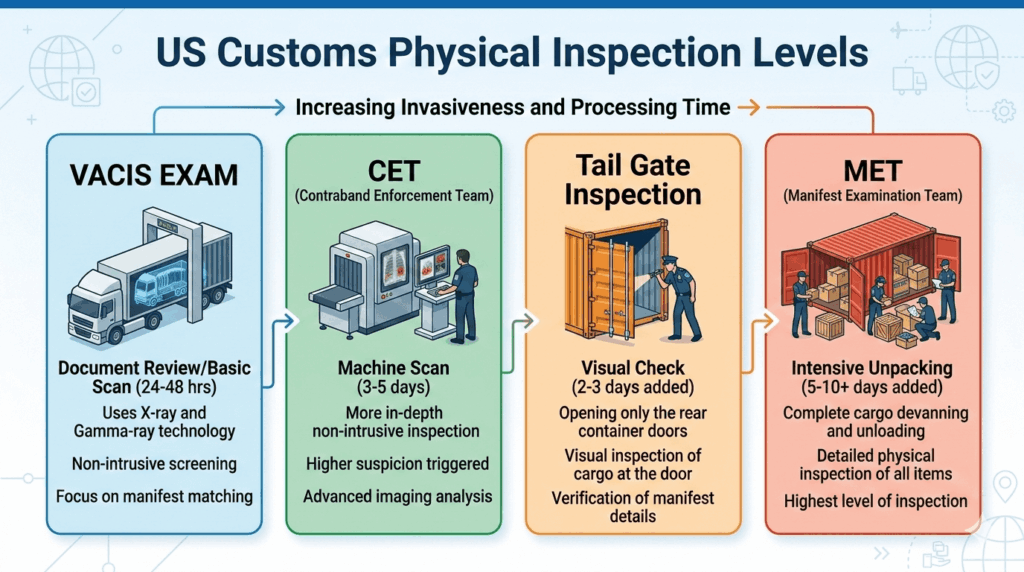
The Four Pillars of US Customs Physical Inspections
Before diving into the complex codes, let’s understand the fundamental types of physical scrutiny your cargo might face from CBP. These inspections are conducted to verify compliance with import laws, safeguard national security, and protect intellectual property rights.
1. VACIS EXAM (Vehicle and Cargo Inspection System – The Basic Scan)
- What it is: Often referred to as a “document inspection” or “paperwork inspection” in some contexts, but more accurately, a non-intrusive imaging scan that relies heavily on digital review. Containers are scanned by a specialized X-ray machine, similar to airport luggage scanners but on a massive scale.
- Process: Customs officers review high-resolution images of the container’s contents without physically opening it.
- Timeline: Generally quick, completed within 24-48 hours after the vessel berths. This is one of the most basic and frequently performed methods.
- Outcome: If images match documents, goods are released. If suspicious anomalies are detected, it escalates to a more intrusive inspection.
2. CET (Container Examination Team – The Targeted Scan)
- What it is: Also known as Non-Intrusive Inspection (NII). This is a routine, continuous inspection method. Containers are sent through large X-ray or gamma-ray scanners upon arrival at the port.
- Process: Customs officers review the scanned images for contraband, undeclared items, or discrepancies with the manifest. No physical unpacking is involved at this stage.
- Timeline: Typically completed within 3-5 business days after the container is available at the terminal.
- Outcome: If clear, a release order is issued. If suspicions persist, it leads to a “Tail Gate” or “MET” inspection. This type of inspection usually does not impact normal transit times significantly.
3. Tail Gate Inspection (The “Quick Look” Physical Check)
- What it is: As the name implies, this is a physical inspection conducted at the rear (tail gate) of the container. It’s a slightly more intrusive step following an X-ray scan that raised questions.
- Process: Customs officers remove the seal, open the container doors, and perform a preliminary visual inspection of the accessible cargo. They might check the first few rows of boxes for obvious irregularities, labels, or odors. The container is generally not completely unloaded.
- Timeline: Can add 2-3 business days to the clearance process.
- Outcome: If no abnormalities are found, the container is resealed and released. If suspicious items or major discrepancies are noted, it escalates to a full Manual Exam (MET).
4. MET (Manual Exam / Intensive Inspection – The Deep Dive)
- What it is: This is the most stringent and time-consuming inspection method in US maritime transport. It involves a full or partial unpacking of the container.
- Process: The entire container of goods is transported by CBP to a designated Container Freight Station (CFS) or inspection facility. The goods are then physically unloaded (partially or fully), and officers meticulously inspect details such as:
- Number of boxes vs. manifest
- Product names and descriptions
- Product quantity and value
- Country of Origin (COO) marking
- Intellectual Property Rights (IPR) violations (counterfeits)
- Compliance with specific agency requirements (FDA, CPSC, EPA, USDA).
- Levels of Unpacking: METs can be 1/3 unpacking, 1/2 unpacking, or a full strip-out (100% inspection).
- Timeline: Inspection results typically take 5-10 business days after the start of the inspection. During peak seasons or for complex cases (e.g., requiring laboratory testing), this can extend to two weeks or even longer. Factors like cargo type (e.g., food, electronics), sensitive names, or required certifications significantly influence the duration.
- Cost: This is the most expensive inspection, with costs for drayage, unloading, loading, and storage at the CFS all borne by the importer.
(For detailed information on protecting your cargo, refer to our guide on ).
Decoding US Customs Handling Codes (The Alphabet Soup of Detentions)
Beyond the general inspection types, CBP uses specific “hold” codes in the Automated Manifest System (AMS) to communicate the reason for detention and required actions. Understanding these is crucial for proactive management.
The “No Container Opening” Codes (X-Ray Based)
- 7H – X-Ray Inspection Hold:
- Meaning: This is a pure X-ray inspection. The container does not need to be moved to a specific inspection area or physically opened. It simply passes through a high-energy X-ray machine.
- Process: Fast. Once the scan is complete, the X-ray fee is paid.
- Release Code: 7I (indicates release after X-ray inspection).
The “Document Review First” Codes (Potential for Physical Inspection)
These holds are typically initiated by CBP’s Fast Doc Review department, often triggered by discrepancies identified by the ACE (Automated Commercial Environment) system.
- 4A – Document Review & Potential Physical Inspection:
- Meaning: CBP is initially reviewing your documents (manifest, invoice, packing list) before deciding on a physical inspection.
- Process: If documents are consistent and compliant, goods are released. If discrepancies are found, it’s a high probability of escalation to a physical inspection (often a 1H).
- Release Code: 4C (indicates release after document review).
- 1A – Document Review (Specific to Entry Types):
- Meaning: Similar to 4A, but often specific to certain entry types or compliance programs. It’s a pre-physical inspection document review.
- Process: If the document review results in clearance.
- Release Code: 1B (indicates clearance after 1A).
The “Physical Inspection” & “Undetermined” Codes
- 1H – Standard Physical Inspection Hold:
- Meaning: This is a direct order for a physical inspection. CBP will primarily check unit price, document accuracy, and verify against prohibited items or counterfeit goods.
- Process: Cargo is moved to a CFS for physical examination.
- Release Code: 1I (indicates release after 1H inspection).
- 5H – Undetermined Inspection Type Hold (The Current Hotspot!)
- Meaning: This indicates that the specific inspection type has not yet been determined by CBP. It’s a dynamic hold where customs will first review documents (often by the Fast Doc Review team) before deciding on physical examination.
- Process: This is currently the most problematic hold. Customs may release after document review, OR they may move the container to a CFS for a physical inspection (which can be a Tail Gate or MET). Importers MUST wait for specific CBP notification.
- Why it’s severe: As analyzed in our previous blog, 5H holds are often triggered by sophisticated AI algorithms detecting inconsistencies in importer bonds, declared values, or vague product descriptions. There is significantly less room for explanation or supplementary documents.
- Release Code: 5I (indicates release after 5H inspection).
- 2H – Agriculture Department Hold (USDA/APHIS)
- Meaning: This inspection is specifically conducted by the US Department of Agriculture (USDA), primarily inspecting for pests, diseases, or compliance with wood packaging regulations (ISPM 15).
- Process: Often triggered by wood products, packaging materials, or specific agricultural commodities. Even if no wood products are declared, wooden pallets used for packaging can trigger this.
- Release Code: 2I (indicates release after 2H inspection).
The Silent Crisis – Beyond CBP: Other Agency Interventions
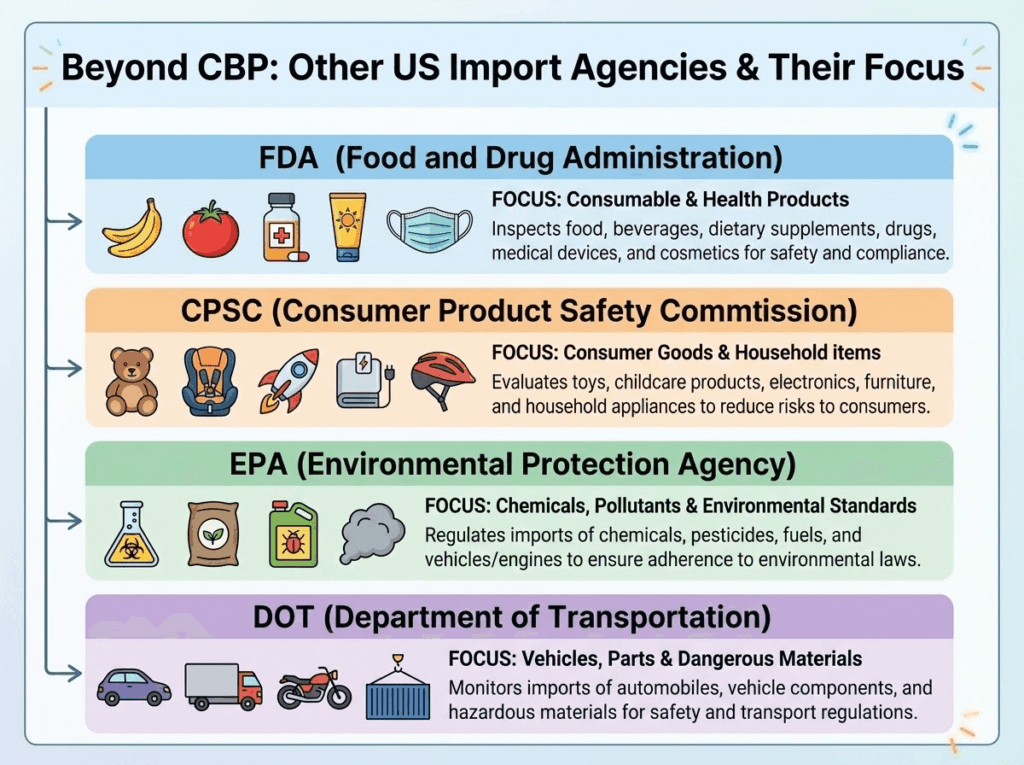
It’s crucial to understand that CBP isn’t the only gatekeeper. After CBP clears your cargo, other US federal agencies have the right to conduct further inspections or detain goods based on their specific mandates:
- FDA (Food and Drug Administration): For food, beverages, supplements, cosmetics, and medical devices.
- CPSC (Consumer Product Safety Commission): For consumer products, especially those for children (e.g., toys, cribs) or electronics, ensuring safety standards.
- EPA (Environmental Protection Agency): For chemicals, pesticides, or vehicles.
- DOT (Department of Transportation): For vehicles, parts, and hazardous materials.
A “CBP Release” does not always mean immediate freedom. These agencies can issue their own “holds,” further delaying your shipment and adding costs.
The Alarming Costs of Detention & the Market Reshaping
The current wave of inspections, particularly the 5H crackdown, has exposed the fragilities of the logistics ecosystem, leading to significant financial repercussions.
1. Skyrocketing Costs & Deposits
When a container is detained, the importer faces:
- Drayage Fees: Moving the container from the terminal to the CFS.
- Demurrage/Detention: Charges for holding the container/chassis beyond free time.
- Exam Fees: CBP charges for the inspection itself.
- Unloading/Loading Fees: Labor costs at the CFS.
- Storage Fees: Daily charges for goods stored at the CFS.
Industry insiders report that some freight forwarders have seen hundreds of containers returned. The costs associated with forced returns—including original freight, detention, storage, return freight, and potential destruction fees—are astronomical. This has unfortunately led to some freight forwarding companies (especially those operating in “gray areas”) going bankrupt, a scenario commonly known as “running away.”
2. Reshaping the China-to-US Shipping Market
This stringent enforcement by US Customs is fundamentally changing the China-to-US shipping landscape.
- Elimination of Gray Areas: Freight forwarders relying on “special channels” or questionable documentation are being weeded out.
- Shift to Compliance: The industry is moving towards healthier competition where compliance and expertise, rather than simply low prices, are the primary differentiators.
- Increased Due Diligence: Shippers are now more cautious, prioritizing partners with proven compliance records.
3. Global Ripple Effects: Other Countries Follow Suit
The US, by taking the first shot in strict inspections and canceling duty-free policies for small parcels under $800, is setting a precedent. We are observing similar trends globally:
- EU Customs: Has also canceled its preferential policy for duty-free small parcels (e.g., IOSS changes).
- Saudi Arabia: Implemented stringent SABER system and Fast Doc Review protocols, leading to similar detention patterns (see our guide on ).
This indicates a global shift towards higher accountability in international trade.
Kisun Shipping’s Future-Proofing Advice for Importers
In this new era of hyper-vigilant customs enforcement, the mantra is clear: Compliance is Paramount. Any mentality of “gambling on probability” is a recipe for disaster. What seems like saving a little on tariffs or documentation could cost you your entire shipment and business reputation.
1. Declare with Utmost Accuracy
- Actual Value: Never under-declare. CBP uses big data analytics to compare market values.
- Precise Descriptions: Avoid vague terms like “parts,” “accessories,” or “daily necessities.” Provide specific material, function, and model numbers.
- HS Codes: Ensure your Harmonized System (HS) codes are 100% accurate and don’t misclassify goods to reduce duties.
2. Validate Importer & Bond Information
- Authenticity: Ensure your importer of record’s EIN (Employer Identification Number) and Customs Bond are authentic, valid, and properly linked. CBP’s Fast Doc Review is rigorously verifying this.
- Legal Residency: For non-US citizens acting as importers, proof of legal US residency and work authorization is now heavily scrutinized.
3. Document Consistency is Non-Negotiable
- “Three-Document Match”: Your Commercial Invoice, Packing List, and Manifest must be perfectly identical in terms of value, quantity, product description, and HS codes. The ACE system automatically flags even minor discrepancies.
4. Pre-Compliance & Due Diligence is Key
- Certifications: For regulated products (electronics, toys, food), ensure all necessary certifications (FCC, CPSC, FDA) are valid and readily available.
- Fumigation (ISPM 15): All wooden packaging must be properly treated and stamped.
5. Partner with a Compliant Freight Forwarder
In 2026, your freight forwarder is more than just a transporter; they are your frontline compliance officer. Choose a partner like Kisun Shipping who:
- Has professional document pre-review capabilities.
- Possesses a deep understanding of US Customs regulations.
- Offers full transparency and real-time status updates throughout the process.
At Kisun Shipping, we would rather decline an order that is non-compliant than risk your goods, business reputation, and face the catastrophic costs of detention or forced return.
Conclusion: The Future of US Imports is Clear
The 2026 CBP enforcement shift marks the definitive end of lax customs clearance. This isn’t a temporary measure; it’s a permanent upgrade to the US import system. For shippers and freight forwarders alike, prioritizing compliance is no longer a competitive advantage—it’s the fundamental cost of doing business.
We hope this updated guide helps you navigate the complexities of US Customs inspections with greater confidence.
Are you currently facing a 5H hold or need a pre-compliance audit for your next US shipment? 👉 Contact Kisun Shipping’s US Compliance Experts Today to secure your cargo’s smooth journey.
Wishing all shippers safe passage and seamless customs clearance.

China Logistics Expert
About the Author
Katherine Kang is a China-based logistics consultant with over 11 years of experience in international trade and freight forwarding. Specializing in helping SMEs import from China to the USA, Canada, and Europe, she focuses on compliant, cost-effective solutions to avoid delays, tariffs, and hidden fees. From anti-dumping guidance to CNY planning, Katherine has managed hundreds of shipments, saving clients 15-30% on average.
Connect with Katherine on LinkedIn or contact Kisun Shipping for a free import consultation.