
Jeddah Port Gridlock 2026: The Strategic Survival Guide for Importers Shipping from China to Saudi Arabia
The Middle East logistics corridor is facing an unprecedented logistical storm. If your business is actively importing from China to Saudi Arabia, the container execution maps you relied on early this year are no longer valid.
A severe logistical gridlock has completely paralyzed Jeddah Islamic Port, creating a massive domino effect that impacts vessel berthing, customs clearance timelines, inland terminal drayage, and China to Saudi Arabia freight rates.
JEDDAH PORT CONGESTION MATRIX (JUNE/JULY 2026)
| Operational Bottleneck | On-Ground Reality | Direct Impact on Importers |
| Vessel Berth Queues | Median delays stretching to 8 days at key container terminals | Spikes China to Saudi Arabia freight rates across all alliances |
| Off-Dock Yard Saturation | Al-Khumrah yards (25km away) at 100% capacity; rejecting intake | Truck turnarounds drop by 66%; massive local haulage deficits |
| FASAH / Customs Latency | 3-to-7 day data sync lag between shipping lines and Saudi customs | Erases standard free-time windows; triggers automated demurrage traps |
For international brands evaluating China to Saudi Arabia shipping configurations, understanding the macro-dynamics driving this crisis is no longer just academic—it is an economic necessity. Unpredictable China to Saudi Arabia freight rates, compounding demurrage fees, and rolled containers are actively eroding profit margins.
Below is an exhaustive, unvarnished operational intelligence report from the logistics frontline at Kisun Shipping, mapping out why the Red Sea corridors are frozen and how you can safeguard your cargo velocity.
Current Status: The Six Stages of Paralysis at Jeddah Islamic Port
Operational efficiency at Jeddah Islamic Port has dropped significantly. The congestion has moved beyond a container yard bottleneck into a systemic infrastructure slowdown that delays every touchpoint of the importing lifecycle.
On-site operational logs reveal a circular bottleneck operating across six clear phases:
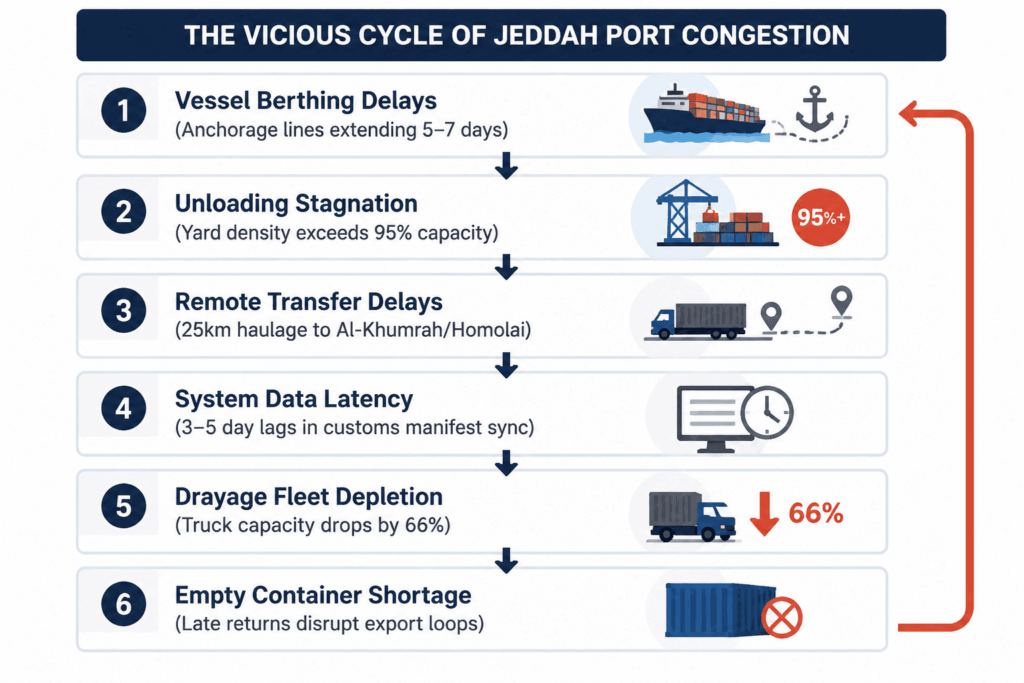
Inside the terminal boundaries, vessels sit at anchorage for days waiting for open berths. Discharged containers are stacked to maximum thresholds because yard storage is full. Outside the gates, nearby auxiliary yards are turning away new cargo, while miles of container trucks queue on access roads, slowing ground transport to a crawl.
For businesses relying on ocean freight from China to restock retail distributions in Riyadh or Western Province hubs, transit time predictability has dropped significantly.
The Macro Catalyst: How the Strait of Hormuz Closure Weaponized the Red Sea Landbridge
To understand why ocean freight from China heading into Saudi Arabia has become so volatile, you must look at the structural reallocation of Middle Eastern vessel traffic that occurred earlier this year.
Following intense regional military escalations in the spring of 2026, the Strait of Hormuz was effectively closed to commercial maritime traffic. This single geopolitical shock instantly paralyzed access to the Arabian Gulf, taking major import gateways like Dammam, Jubail, and even Dubai’s Jebel Ali out of standard container line rotations for direct Far East loops.
This blockade fundamentally redefined the baseline function of Saudi Arabia’s Red Sea ports. Jeddah Islamic Port was built to absorb domestic cargo destined for the Western Province and Western Saudi markets. Overnight, it was transformed into an involuntary transshipment super-hub for the entire Arabian Peninsula.
Millions of tons of containerized cargo originally routed for the Gulf Cooperation Council (GCC) countries are now being dumped at Jeddah and King Abdullah Port (KAP). From there, logistics providers are attempting to utilize Saudi Arabia’s domestic road networks as an overland landbridge to haul goods via truck to Riyadh, Dammam, the UAE, Oman, Qatar, and Kuwait.
This 300% surge in localized volume far exceeds the physical and digital capacity thresholds of the port infrastructure. The systemic overload has forced tier-1 carrier alliances to take unprecedented evasive actions. In early June 2026, Gemini partners Maersk and Hapag-Lloyd officially suspended all bookings to the UAE, Bahrain, Qatar, and Kuwait routed via Jeddah and KAP, citing an unsustainable breakdown in container haulage and gate-out efficiency.
The Bottom Line: Jeddah Port is not just handling Saudi Arabia’s imports anymore—it is absorbing the deflected cargo of the entire Middle East. This structural capacity deficit means any standard booking for shipping from China to Saudi Arabia is entering an extreme operational bottleneck.
Infrastructure & Hajj: The Micro-Bottlenecks Strangling Local Logistics
Even if geopolitical diversions eased tomorrow, Jeddah Port’s localized physical layout creates inherent vulnerabilities that complicate high-volume container clearing.
The 25-Kilometer Yard Disconnect
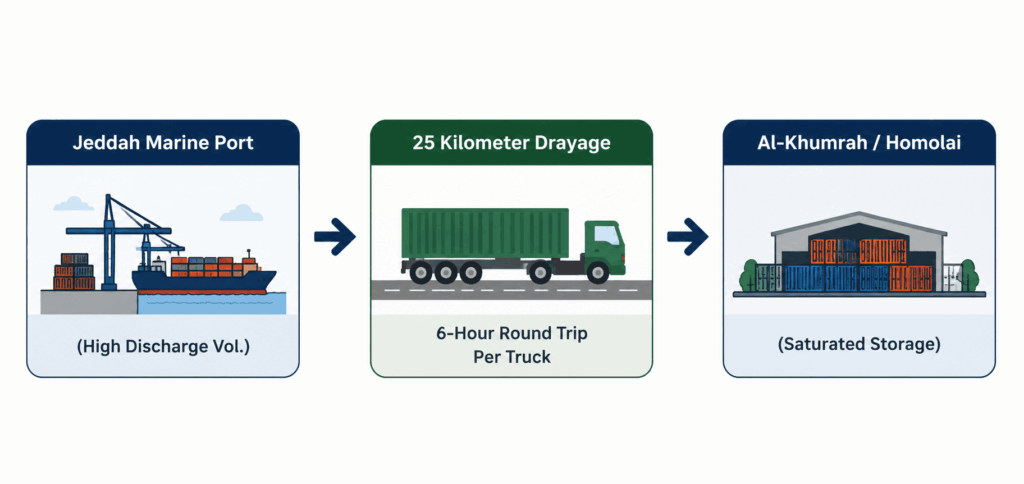
Unlike highly integrated container terminals like Dammam, Jeddah faces strict physical constraints. Space for expanding on-dock container yards is non-existent. To manage overflowing volumes, the port relies heavily on off-dock storage hubs concentrated in the Al-Khumrah industrial zone, situated more than 25 kilometers away.
This creates a mandatory, highly inefficient double-handling process. When a vessel unloads a container, it cannot stay on the dock; it must be loaded onto an internal short-haul truck and moved 25km out of the port to Al-Khumrah.
The Trucking Capacity Meltdown
As Al-Khumrah and auxiliary yards hit 100% saturation, they have begun frequently pausing intake. This forces container trucks to line up for miles on the narrow access corridors adjacent to Jeddah’s historic district.
The data from our local dispatch offices reveals a catastrophic plunge in vehicle operational efficiency:
- Pre-Crisis Baseline: A single drayage truck could comfortably complete three short-haul port-to-yard rounds per day.
- Current Operational Status: Due to gate gridlock and road traffic paralysis, a single truck now takes an average of six to eight hours to complete a single loop.
This represents a two-thirds drop in active transport capacity on the ground. Shippers are finding that even when their cargo is cleared by customs, finding an available chassis and a driver willing to wait in the Jeddah terminal queues is nearly impossible without paying massive premium spot surcharges.
The Hajj Seasonal Squeeze
Compounding this infrastructure deficit is the seasonal influx associated with the June/July 2026 Hajj pilgrimage. The surge in essential food, consumer goods, and hospitality logistics entering the Western Province has collided directly with diminished administrative capacities. During festival and holiday cycles, customs processing hours, municipal labor availability, and ministry review timelines naturally compress, creating an “administrative congestion” overlay that slows down physical gate-outs even further.
The Digital Demurrage Trap: System Failures Costing Importers Thousands
While the physical delays are obvious to anyone watching the gridlock outside the port gates, the most destructive element for businesses importing from China to Saudi Arabia is happening behind computer screens.
The sheer volume of unexpected transit cargo has overwhelmed the digital bridges linking ocean liners, the port operating matrix, and Saudi Customs systems (such as the FASAH platform).
The manifest synchronization gap
Under standard operating criteria, once an importer settles delivery order fees with a shipping line, the manifest data should instantly synchronize with customs portals for immediate processing. Currently, we are tracking a three-to-seven-day data latency gap within Jeddah’s operating systems. The software frequently freezes under the data load, leaving thousands of containers sitting in an un-cleared “pending release” matrix.
The Demurrage Time Bomb
This software latency is highly problematic for your landing costs. Ocean liners operating ocean freight from China usually grant a standard 5 to 7 days of combined Free Time (Demurrage and Detention) at Saudi ports.
- Crucially, the carrier’s billing clock starts ticking the exact second the vessel berths at the pier.
- The clock does not pause for port congestion, system crashes, or data synchronization delays inside FASAH.
Because the data processing lag regularly exceeds the carrier’s free-time window, containers are entering automated demurrage states before the importer even has the legal authorization to assign a truck for pickup. Importers are waking up to surprise bills totaling thousands of dollars in storage and detention penalties per container, completely derailing their projected margins on China to Saudi Arabia shipping contracts.
The Warning: Do not assume your standard 7-day free-time agreement will protect you. System crashes mean you will likely face unexpected port storage and carrier demurrage assessments before your customs broker can generate a valid customs declaration.
Contract vs. Spot Rate Friction: Why Cheap Quotes are Disappearing
This structural imbalance between supply and demand has sent shockwaves through the China to Saudi Arabia freight rates matrix. Spot prices are resetting on a daily basis, heavily penalizing importers who rely on transactional, low-cost forwarders.
Many logistics companies who secured low-rate, long-term annual contracts with direct shippers are now finding themselves unable to execute. Because open-market trucking costs in Jeddah have spiked to premium levels due to the 6-hour gate wait times, forwarders bound to low contractual rates cannot secure equipment. Independent truck owner-operators naturally reject low-paying contract work in favor of high-paying spot market runs.
Consequently, freight forwarders lacking asset-backed fleets or deep regional capital reserves are experiencing massive shipment delays, leaving their clients’ containers stranded at Chinese origin ports or abandoned at the Jeddah transshipment terminals.
The Survival Playbook: Strategic Advice for Saudi Importers
Navigating the 2026 Middle East shipping crisis requires a complete departure from passive logistics planning. If you continue to ship high-volume inventory from China into Jeddah via standard spot market channels, your supply chain velocity will collapse.
To maintain operational consistency, the supply chain consulting team at Kisun Shipping recommends executing these four strategic pivots immediately:
A. Execute Tactical Rerouting to Yanbu Commercial Port
If your final delivery destination is Medina, Tabuk, or even the northern districts of Riyadh, look beyond Jeddah. Yanbu Commercial Port, located further north on the Red Sea coast, has significantly bypassed the brunt of the geopolitical transshipment gridlock. Rerouting your ocean freight from China to Yanbu allows you to bypass the vessel queues and truck shortages paralyzing Jeddah entirely. While overland trucking from Yanbu to central Saudi markets may add localized domestic mileage, the savings realized by avoiding a 14-day port delay and automated demurrage traps make it highly cost-effective.
| Average Vessel Berth Wait | 6 – 9 Days | 1 – 2 Days |
| Customs Data Sync (FASAH) | 3 – 7 Days Delay | Near Real-Time |
| Yard Saturation Level | 100% (Gridlock at Al-Khumrah) | 45% (Fluid Operations) |
| Best Suited For | Western Province / Heavy Cargo | Riyadh, Medina & Northern Regions |
B. Secure Extended Free-Time Structures at Origin (Request 14-21 Days)
Never allow your freight agent to book your cargo under standard 7-day destination free-time terms during this crisis. When executing your booking templates in China, mandate a minimum allocation of 14 to 21 days of combined destination free time directly within the carrier contract. Securing this buffer at the origin port provides the crucial operational cushion needed to absorb digital system latencies and container location delays at the Jeddah terminals without triggering automated financial penalties.
C. Implement Pre-Clearance Protocols via Early Document Submission
Do not wait for the vessel to enter the Red Sea before initiating your customs compliance workflows. Ensure your factory documents, commercial invoices, certificates of origin, and SABER compliance certificates are completely uploaded and verified inside the FASAH ecosystem at least 7 days before the vessel’s estimated time of arrival (ETA). Pre-clearing your data profiles helps insulate your cargo from the worst impacts of the shipping line system sync lags.
D. Partner with Logistics Providers Backed by Private Yard Agreements
In the current market, a freight forwarder who simply acts as a digital broker cannot protect your cargo. You need a logistics partner with tangible, on-ground infrastructure in the Kingdom. Prioritize asset-backed providers who maintain direct, contractually secured chassis fleets and private, dedicated off-dock storage yards outside of the saturated Al-Khumrah public sectors. This ensures that the moment your container hits the dirt, a dedicated truck is authorized to execute an immediate gate-out, insulating your business from systemic port-side failures.
Insulate Your Middle Eastern Supply Chain with Kisun Shipping
The maritime realities of 2026 demand an experienced, agile logistics partner who understands the micro-operations of Middle Eastern ports. At Kisun Shipping, we don’t just provide standard shipping quotes; we manage risk in real time.
Through our direct carrier contracts, dedicated space allocations across major alliances, and an on-the-ground network of customs specialists and transport assets throughout Saudi Arabia, we ensure your goods bypass the chaos. Whether you need to pivot your supply chain from Jeddah to Yanbu, secure guaranteed 21-day free-time profiles at Chinese origin hubs, or navigate complex SABER compliance hurdles under pressure, Kisun Shipping delivers predictability when you need it most.
Don’t let port gridlock and unexpected demurrage fees tank your Q3 margins. If you are currently managing active shipments from China or planning your next peak-season inventory cycle, Connect with a Kisun Shipping Middle East Trade Specialist Today for an unvarnished routing and compliance audit.

China Logistics Expert
About the Author
Katherine Kang is a China-based logistics consultant with over 11 years of experience in international trade and freight forwarding. Specializing in helping SMEs import from China to the USA, Canada, and Europe, she focuses on compliant, cost-effective solutions to avoid delays, tariffs, and hidden fees. From anti-dumping guidance to CNY planning, Katherine has managed hundreds of shipments, saving clients 15-30% on average.
Connect with Katherine on LinkedIn or contact Kisun Shipping for a free import consultation.