
The Ultimate China-to-UK Freight Optimization Playbook: FCL vs. LCL & Multi-Supplier Consolidation
For UK importers, e-commerce brands, and B2B distributors sourcing products from China, shipping is rarely just a transactional cost—it is a core driver of gross profit margins and supply chain resilience. As global trade dynamics fluctuate, relying on haphazard freight arrangements, unvetted supplier-arranged shipping, or misaligned transport modes can silently destroy your bottom line.
Whether you are scaling an Amazon UK brand, supplying brick-and-mortar retail chains across Great Britain, or importing industrial components, structuring your China-to-UK logistics requires strategic decision-making across five pivotal stages:
- Selecting between FCL and LCL shipping based on volume, weight, and financial tipping points.
- Consolidating cargo from multiple Chinese manufacturers into a single managed shipment.
- Leveraging origin warehousing in China for cost-effective storage, processing, and quality control.
- Choosing the right service scope—from Port-to-Port to full Door-to-Door execution under proper Incoterms.
- Constructing a bulletproof Request for Quotation (RFQ) that eliminates hidden destination charges in the UK.
This comprehensive playbook breaks down each step with exact mathematical thresholds, operational workflows, decision matrices, and practical guidelines tailored specifically to the UK import market.
FCL vs. LCL — The Technical Breakdown & Financial Tipping Points
Understanding the structural and financial mechanics of Full Container Load (FCL) versus Less than Container Load (LCL) is the foundational step in optimizing your freight strategy.
1. Technical Container Specifications
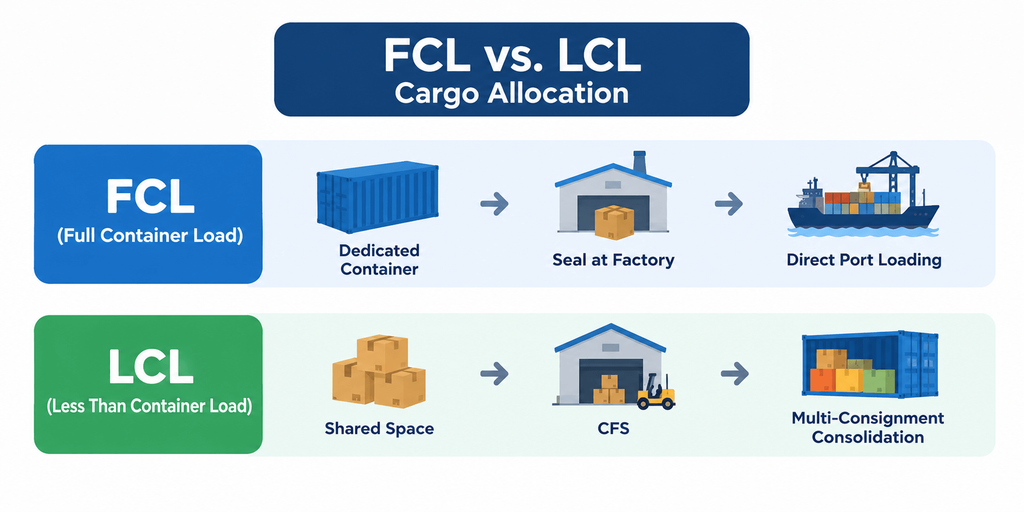
When shipping FCL, you rent the exclusive use of a steel intermodal container. When shipping LCL, your goods share space with cargo belonging to other importers inside a shared container managed by a freight consolidator (co-loader).
| Container Type | External Dimensions (L × W × H) | Internal Volume Capacity | Practical Usable Volume | Max Payload Weight |
| 20-Foot General (20GP) | 20 ft × 8 ft × 8.5 ft | ~33.2 CBM | 28 – 29 CBM | ~21,700 kg |
| 40-Foot General (40GP) | 40 ft × 8 ft × 8.5 ft | ~67.7 CBM | 56 – 58 CBM | ~26,500 kg |
| 40-Foot High Cube (40HQ) | 40 ft × 8 ft × 9.5 ft | ~76.3 CBM | 65 – 68 CBM | ~26,300 kg |
Note: Practical usable volume is always 10% to 15% lower than theoretical internal capacity due to carton stacking geometry, pallet footprints, and airflow requirements.
2. The Weight/Measurement (W/M) Rule in LCL
LCL ocean freight is billed on a Weight/Measurement (W/M) basis. The carrier charges based on whichever metric yields the higher billable figure, using the standard ocean conversion ratio:

- Volumetric Example: A shipment measuring 4.5 CBM and weighing 600 kg will be billed as 4.5 CBM because volume exceeds weight.
- Heavy Freight Example: A shipment measuring 2.0 CBM and weighing 3,200 kg will be billed as 3.2 CBM/Tons because weight exceeds volume.
3. The Financial CBM Tipping Point: When to Switch
Importers frequently assume LCL is always cheaper for smaller volumes. However, LCL carries heavy fixed handling charges at both origin and destination Container Freight Stations (CFS).
At origin, CFS fees cover unloading, handling, sorting, and master container packing. At UK destination ports (e.g., Felixstowe or London Gateway), destination CFS fees (Unpacking, Port Handling, De-consolidation, Administration) average £35 to £65 per CBM.
Because FCL avoids per-CBM destination de-consolidation fees, the financial tipping point where a dedicated 20GP container becomes cheaper than an LCL booking typically occurs at 13 to 15 CBM (depending on current ocean spot rates).
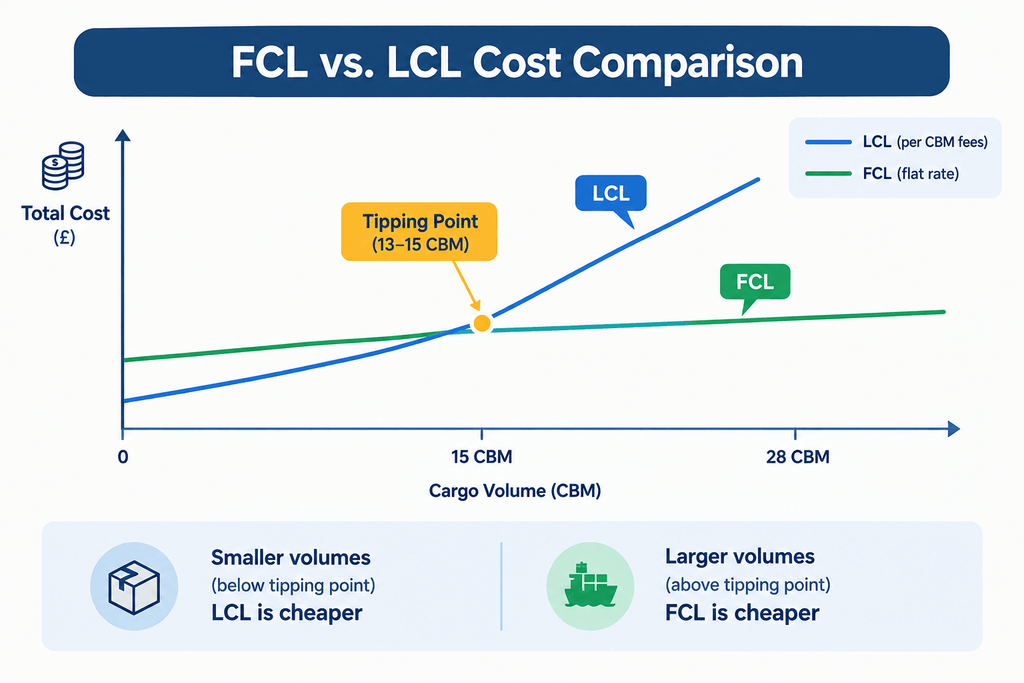
- Under 13 CBM: LCL is structurally more cost-effective.
- 13 to 15 CBM: The “Grey Zone.” While LCL ocean freight may appear cheaper on paper, total landed costs (including UK destination CFS charges) align closely with a 20GP FCL flat rate. FCL is highly recommended here due to faster transit speeds and zero co-loader risk.
- Over 15 CBM: 20GP FCL is almost always cheaper on a total landed cost basis, offering 100% dedicated container capacity.
- Over 50 CBM: 40HQ FCL provides the lowest cost per CBM across all ocean shipping modes.
4. Operational Risk & Transit Speed Profile
Beyond financial considerations, FCL and LCL offer fundamentally different risk profiles:
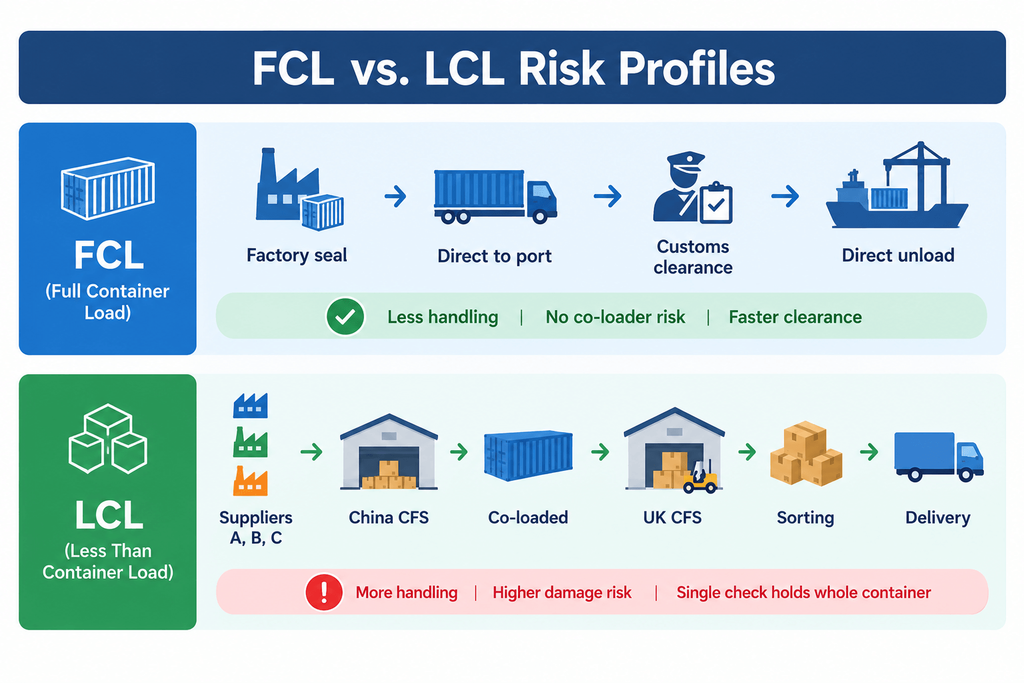
- Customs Hold Propagation (LCL Vulnerability): If one importer’s cargo inside a shared LCL container contains inaccurate documentation, non-compliant goods, or trademark issues, HMRC (HM Revenue & Customs) or UK Border Force will place a physical hold on the entire master container. Your compliant shipment will be delayed at the UK port terminal through no fault of your own.
- Transit Lead Time: LCL typically adds 5 to 8 days to total transit times compared to FCL due to origin consolidation cut-offs and UK destination CFS unpacking/sorting operations.
Multi-Supplier Buyer’s Consolidation (The China Origin Masterclass)
As UK businesses scale, they rarely source all SKUs from a single factory. A common operational setup involves sourcing different components or products from multiple specialized manufacturers—for example, hardware from Ningbo, packaging from Dongguan, and electronics from Shenzhen.
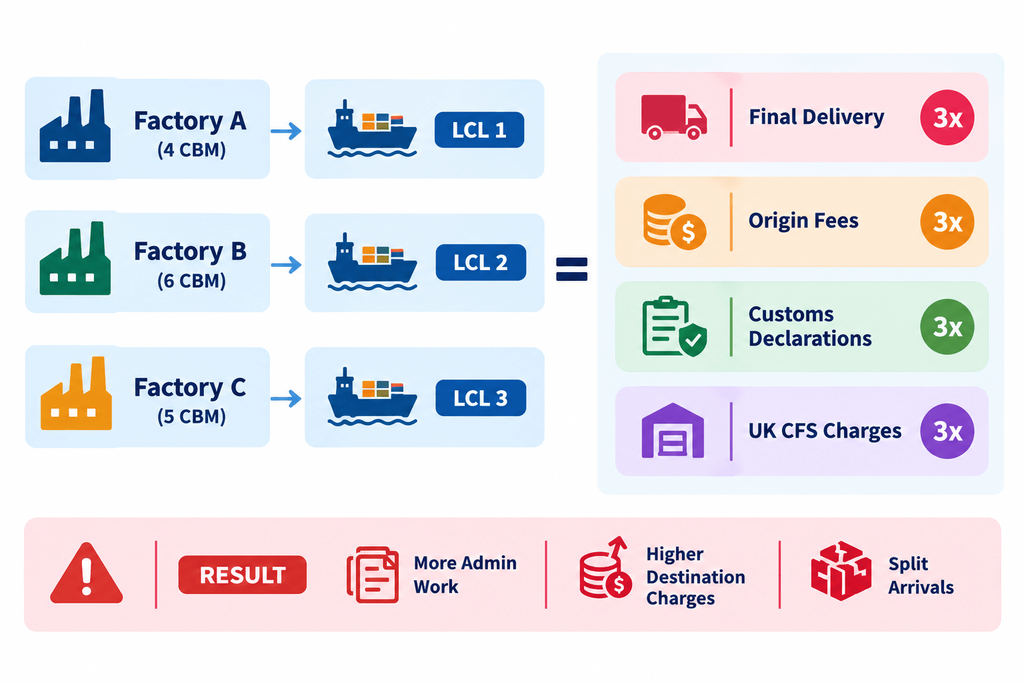
The Cost Mechanics of Fragmented Shipping
Shipping separate LCL consignments from multiple suppliers generates massive administrative and operational friction. Every individual LCL shipment incurs standalone baseline fees:
- Standalone China Export Customs Declarations ($75 – $120 per shipment).
- Origin Terminal & Documentation Fees.
- UK Destination Clearance Fees (£75 – £120 per entry via HMRC CDS).
- Minimum UK Destination CFS Handing Surcharges.
- Fragmented, multi-stop inland UK road haulage fees.
The Solution: Buyer’s Consolidation (Consolidated FCL/LCL)
Buyer’s Consolidation transforms fragmented logistics into a streamlined, cost-effective workflow. Rather than allowing suppliers to dispatch separate LCL bookings, your freight forwarder operates a central export warehouse in China (e.g., Yantian, Shenzhen, Ningbo, or Shanghai).
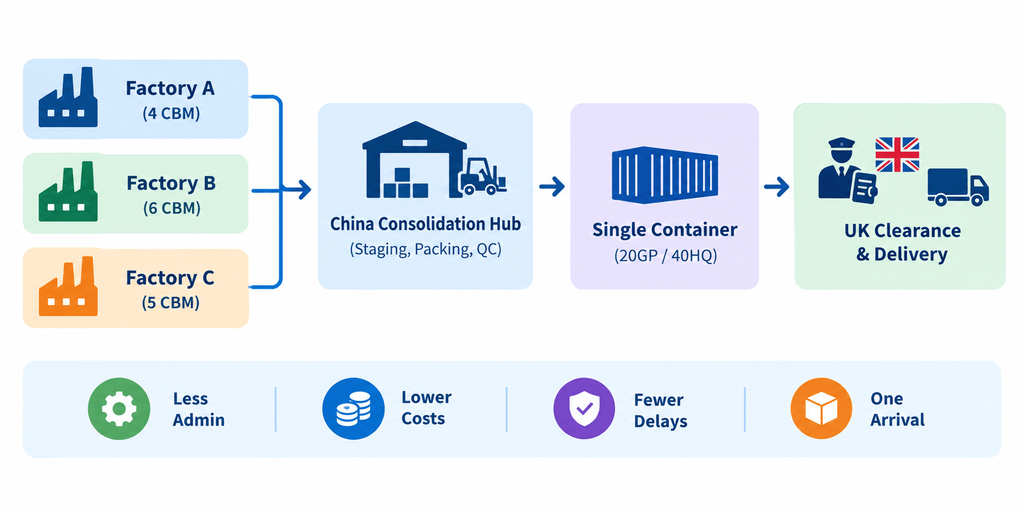
Step-by-Step Operational Workflow:
- Domestic In-Transit (China): Factory A, Factory B, and Factory C ship their goods domestically via local trucking to your forwarder’s central warehouse.
- Receiving & Cargo Audit: The warehouse receives cargo, verifies carton counts, audits gross weights/dimensions, checks for box damage, and issues a Dock Receipt.
- Container Stuffing Optimization: Warehouse staff consolidate all cargo into a single dedicated 20GP or 40HQ container, optimizing spatial geometry to eliminate wasted air space.
- Single Master Export Declaration: The forwarder prepares a unified Master Bill of Lading (MBL) covering the combined consignment.
- Streamlined UK Import: Upon arrival at Felixstowe or London Gateway, the container clears UK customs under a single import declaration on the Customs Declaration Service (CDS), radically reducing clearance administration and UK haulage fees.
Cost Savings Analysis: Fragmented LCL vs. Buyer’s Consolidation
The following financial comparison illustrates a real-world scenario of an importer sourcing 15 CBM (4,500 kg total) across 3 suppliers:
| Fee Category | Option A: 3 Separate LCL Shipments | Option B: Buyer’s Consolidation into 1x 20GP FCL | Net Financial Savings |
| China Export Customs Clearance | 3 Entries = $300 | 1 Consolidated Entry = $100 | Save $200 |
| Origin Handling & Doc Fees | 3x Standalone Charges = $450 | 1x Consolidated FCL Doc = $220 | Save $230 |
| Ocean Freight Charges | 15 CBM @ LCL Spot Rates = $1,350 | 1x 20GP FCL Flat Rate = $1,800 | +$450 (FCL Ocean Baseline) |
| UK Destination CFS Unpacking/Handling | 15 CBM @ £45/CBM = £675 ($850) | £0 (No CFS Unpacking Needed) | Save $850 |
| UK Customs Clearance Administration | 3 CDS Entries @ £85 = £255 ($320) | 1 CDS Entry @ £85 = £85 ($107) | Save $213 |
| UK Inland Final Delivery | 3 Separate LCL Trucking Drops = £450 | 1 Single Container/Haulage Drop = £280 | Save £170 ($215) |
| ESTIMATED TOTAL COST | ~$3,670 | ~$2,507 | NET SAVINGS: ~$1,163 (31.7%) |
The Strategic Value of Origin Warehousing in China
Many importers treat warehousing as a destination activity that takes place only after cargo arrives in the UK. However, establishing an origin warehousing strategy in China provides immense cost leverage and operational flexibility.
CHINA ORIGIN WAREHOUSING VS UK DESTINATION WAREHOUSING
| CHINA ORIGIN WAREHOUSE COST DYNAMICS | UK DESTINATION WAREHOUSE COST DYNAMICS |
| • Storage Cost: £2.50 – £5.00 per pallet/month | • Storage Cost: £18.00 – £30.00 per pallet/month |
| • Labor & VAS: £8.00 – £12.00 per hour | • Labor & VAS: £25.00 – £40.00 per hour |
| • Pre-Shipment Quality Control: Defects caught BEFORE ocean transit (Zero Return Freight Cost) | • Post-Arrival Defect Discovery: High Return Shipping Costs & HMRC Duty/VAT Clearance Complications |
1. Financial Leverage: Cost Comparison
Storage rates and labor fees in major Chinese logistics hubs (Shenzhen, Ningbo, Yantian, Shanghai) are a fraction of the cost of UK 3PL facilities located in the Midlands or London gateway corridors.
By shifting labor-intensive value-added services (VAS) back to the point of origin, importers reduce landed unit costs significantly.
2. Origin Value-Added Services (VAS)
A strategic origin warehouse in China acts as a quality control and pre-fulfillment filter before cargo enters international waters:
- Pre-Shipment Quality Control (QC) & Labelling Audit: Inspecting goods at the factory gate is essential, but auditing packed cartons inside an export warehouse provides absolute certainty. Defective goods can be returned to domestic Chinese factories within 24 to 48 hours for replacement at minimal cost. Catching defects after cargo arrives in the UK makes factory returns financially unviable.
- Amazon UK FBA & Retail Compliance Processing:
- Applying FNSKU barcodes and transparency labels to individual product units.
- Applying Suffolk/UK address compliance labels and country-of-origin markings required by UK Trading Standards.
- UK Palletization Compliance: Palletizing goods to UK retail and FBA specifications. While factories often use non-compliant or oversized pallets, origin warehouses ensure pallet builds use standard UK Wood/Euro Pallets (1200 mm × 1000 mm or 1200 mm × 800 mm) with strict height caps (1.8m limit for FBA) and clear stretch wrapping.
- Kitting, Bundling & Custom Packaging: Combining individual SKUs from different manufacturers into multi-packs or promotional box sets before container loading.
3. The “Drip-Feed” Inventory Distribution Strategy
Holding massive inventory reserves inside UK warehouses during Q3 and Q4 exposes businesses to high storage surcharges and ties up operating capital.
Under the Drip-Feed Strategy, importers maintain bulk stock reserves inside a secure China origin warehouse. Based on real-time UK sales velocity, inventory is dispatched in regular, high-frequency 20GP containers or consolidated LCL shipments.
This model keeps stock levels lean in the UK, avoids Amazon FBA long-term storage fees, and provides the agility to re-route origin inventory to other global sales channels (e.g., US or European hubs) if UK demand shifts unexpectedly.
Port-to-Port vs. Door-to-Door — Choosing Your Service Scope & Incoterms
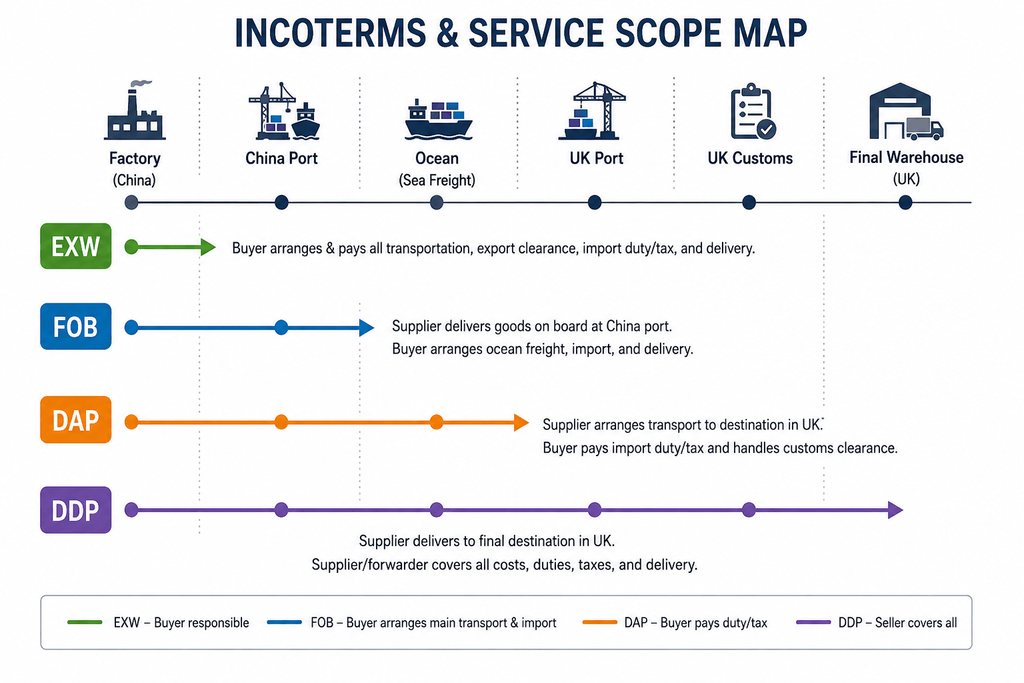
Selecting the appropriate service scope—and framing it under the correct Incoterms® 2020 rules—defines who holds financial risk, controls customs compliance, and manages transport logistics between China and Great Britain.
1. Deep Dive into Core Incoterms
EXW (Ex Works)
- Scope: The seller makes the goods available at their factory or mill premises.
- Buyer Responsibility: The buyer handles all domestic Chinese transport, export customs clearance, ocean transit, UK customs clearance, and UK final mile delivery.
- Best Use Case: Recommended only if you operate a dedicated China logistics hub and wish to maintain complete control over domestic Chinese haulage and export filings.
FOB (Free on Board) — The Industry Standard for B2B Importers
- Scope: The Chinese supplier pays all domestic costs, export documentation, and terminal handling fees required to load the cargo onto your nominated vessel at the Chinese port (e.g., FOB Yantian or FOB Ningbo).
- Buyer Responsibility: Risk and cost transfer to the buyer once cargo is safely loaded aboard the vessel. The buyer controls ocean freight routing, UK import clearance, and UK inland transport.
- Strategic Advantage: Prevents suppliers from inflating inland domestic shipping fees while granting you total control over ocean freight selection, transit speed, and choice of UK freight forwarder.
DAP (Delivered at Place)
- Scope: The freight forwarder manages the entire transport pipeline from the origin factory or port directly to your UK warehouse door.
- Crucial Distinction: Under DAP, the UK importer remains the official Importer of Record. You pay UK Customs Duty and Import VAT directly to HMRC (or via your broker’s deferment account/PVA mechanism).
- Strategic Advantage: Provides hands-off transport convenience while ensuring you retain full legal oversight and transparency over UK customs entries and tax recovery.
DDP (Delivered Duty Paid)
- Scope: The seller or forwarder manages the entire shipment end-to-end and covers all costs, including UK Customs Duty and Import VAT.
- Regulatory Warning for UK Importers: Many cheap “DDP Alibaba” shipping arrangements utilize improper co-loading schemes or illicit UK import entries to bypass VAT. HMRC actively audits importers who utilize unverified DDP brokers. If duty or VAT is under-declared by a third-party DDP agent, HMRC holds the ultimate UK recipient legally liable for unpaid back-taxes and compliance penalties.
2. The UK “Final Mile” Reality: Port Gateways & Inland Logistics
When cargo arrives at Great Britain’s deep-sea container ports—primarily Felixstowe (GBFXT), London Gateway (GBLGP), or Southampton (GBSOU)—the final mile journey begins.
Key UK Inland Logistics Factors:
- Vehicle Booking System (VBS) & Port Dwell: UK ports enforce strict VBS slot allocations for HGV (Heavy Goods Vehicle) trucks. Port delays or weather disruptions can cause hauliers to miss VBS windows, resulting in re-booking fees and demurrage charges.
- Direct Container Haulage vs. Port De-vanning:
- Direct Haulage: A specialized HGV delivers the ocean container directly to your warehouse on a skeletal chassis. Requires a loading dock or a ground team capable of manual container devanning within a 2-hour free unloading window.
- Port De-vanning to Pallet Trucking: The forwarder unloads the container at a port-adjacent warehouse, loads the goods onto UK standard pallets, and delivers them via a curtainsider truck or tail-lift vehicle. Ideal for facilities without loading docks or Amazon FBA center deliveries requiring fixed CARP booking slots.
- DVSA Driver Hour Rules: UK road transport is strictly governed by Driver and Vehicle Standards Agency (DVSA) driving hour rules. Long-distance inland trips from southern ports to northern hubs require hauliers to account for mandatory driver rest breaks, making advance scheduling essential.
The Decision Matrix — Which Strategy Fits Your Business Model?
To help you align your operational requirements with the correct logistics framework, reference this integrated decision matrix:
| Operational Metric | Strategy 1: Standard LCL (Door-to-Door / DAP) | Strategy 2: Buyer’s Consolidation (China Warehouse to FCL) | Strategy 3: Dedicated Bulk FCL (Port-to-Port / FOB) |
| Shipment Volume Target | 1 to 12 CBM | 13 to 65 CBM (Multi-Supplier) | 25 to 68+ CBM (Single Supplier) |
| Supplier Sourcing Profile | Single or few isolated suppliers | Multiple regional factories across China | Single large-capacity factory |
| Cargo Readiness Timing | Immediate dispatch required per SKU | Staggered production ready dates | Synchronized batch production |
| Primary Cost Driver | Low absolute upfront freight spend | Lowest cost per CBM for multi-supplier goods | Lowest overall cost per unit |
| Target Transit Speed | Standard (Includes CFS unpacking delay) | Optimized (Direct container packing) | Fastest (Direct port-to-port routing) |
| UK Customs Setup | Handled by Forwarder via PVA | Consolidated CDS Clearance via Broker | Direct Deferment / PVA Accounting |
| Ideal Importer Profile | Early-stage e-commerce / Niche B2B | Scaling brands / Multi-SKU Amazon UK sellers | Established wholesalers & large retailers |
How to Request an Accurate Freight Quote (The Forwarder RFQ Master Checklist)
One of the most frustrating experiences for UK importers is accepting an attractive ocean freight quote, only to receive a final invoice inflated by hundreds of pounds in unexpected “destination handling fees,” “port security surcharges,” or “customs administration extras.”
In global logistics, vague input data yields inaccurate, misleading quotes. To receive a binding, fully itemized, and transparent freight quote from a professional freight forwarder, you must submit a structured Request for Quotation (RFQ).
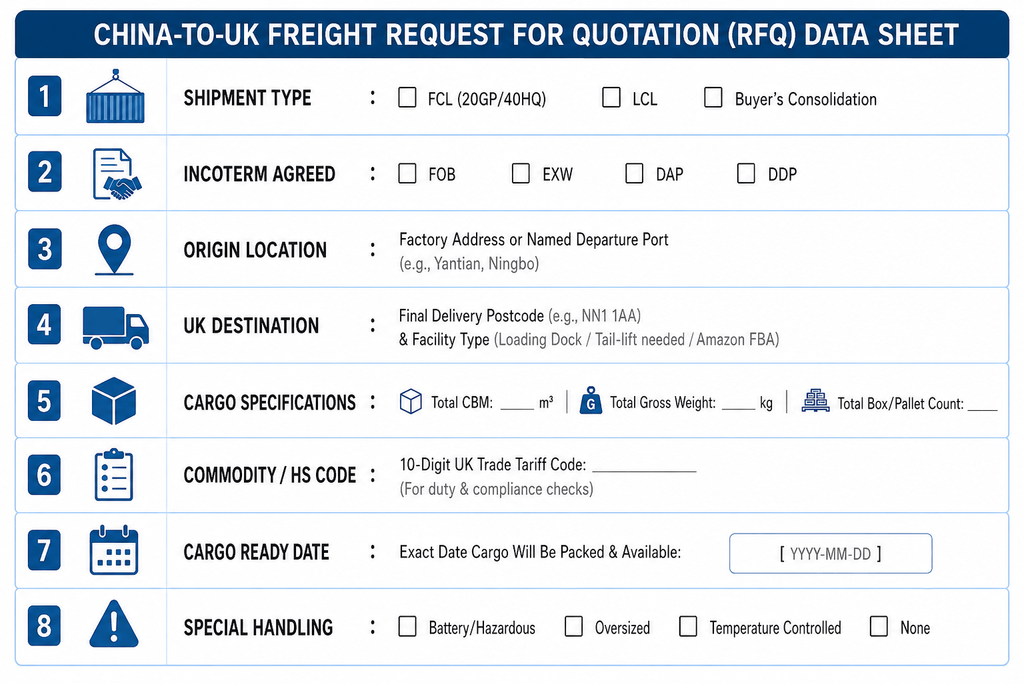
1. The Essential RFQ Data Package Checklist
When contacting freight forwarders, provide a clean data sheet containing the following eight metrics:
2. How to Spot and Eliminate Hidden Charges
When reviewing forwarder proposals, scrutinize the breakdown to ensure the following commonly obscured fees are explicitly detailed:
COMMON HIDDEN FREIGHT QUOTE SURCHARGES
| Charge Item | Details |
| ORIGIN SURCHARGES | Terminal Handling Charges (OTHC), Bill of Lading Fee, Telex Release |
| OCEAN SURCHARGES | Bunker Adjustment Factor (BAF), Peak Season Surcharge (PSS) |
| UK PORT SURCHARGES | Destination Terminal Handling (DTHC), Port Security (ISPS), Customs Clearance Admin, De-consolidation/Unpacking Fees |
| INLAND SURCHARGES | VBS Booking Fees, Tail-lift Surcharges, Waiting Time Surcharges |
- Itemized vs. Lump-Sum Quotes: Reject single line-item quotes (e.g., “All-inclusive $2,000”). Insist on an itemized breakdown separated into Origin Charges, Ocean Freight, UK Destination Charges, and UK Inland Haulage.
- Demurrage & Detention Free-Time Inclusion: Always ask: “How many days of combined demurrage and detention free time are included at the UK port?” Standard carrier terms offer only 3 to 5 days. A superior quote includes 10 to 14 days of combined free time pre-negotiated into the ocean contract.
- HMRC VAT Handling Protocol: Confirm that the forwarder supports Postponed VAT Accounting (PVA) on CDS import declarations using Method of Payment Code “G”, ensuring you are not hit with surprise broker administration fees for using a deferment account.
Streamline Your China-to-UK Supply Chain with Kisun Shipping
Navigating ocean freight modes, coordinating multi-factory consolidations, and managing UK port clearances requires precision, transparency, and deep operational expertise.
At Kisun Shipping, we specialize in providing end-to-end China-to-UK logistics solutions tailored to growing businesses, e-commerce brands, and industrial importers. Our services include:
- Direct Ocean Contracts: Priority FCL allocations and competitive LCL rates across top carrier alliances operating out of Shenzhen, Ningbo, Shanghai, and Qingdao.
- China Warehousing & Buyer’s Consolidation: Strategic origin hubs offering free consolidation, quality control audits, FBA re-labelling, and custom palletization.
- Seamless UK Import Execution: In-house UK customs brokerage supporting HMRC CDS clearance, PVA tax accounting, and direct carrier connections into Felixstowe, London Gateway, and Liverpool.
- Flexible Final Mile Delivery: Dedicated container haulage, port de-vanning, and fixed-appointment Amazon UK FBA delivery services.
Stop overpaying for fragmented freight and hidden destination fees. Contact the Kisun Shipping Team Today for a comprehensive, transparent freight quote and operational routing analysis.

China Logistics Expert
About the Author
Katherine Kang is a China-based logistics consultant with over 11 years of experience in international trade and freight forwarding. Specializing in helping SMEs import from China she focuses on compliant, cost-effective solutions to avoid delays, tariffs, and hidden fees. Katherine has managed hundreds of shipments, saving clients 15-30% on average.
Connect with Katherine on LinkedIn or contact Kisun Shipping for a free import consultation.