An In-Depth Analysis of US Ocean Freight: How to Choose Between Matson, ZIM, and Standard Carriers?
For anyone running a multi-million dollar e-commerce brand or managing procurement for supply chains reliant on shipping from China to the US, few things cause more sleepless nights than a stagnant tracking link. It’s June 2026, the summer shipping peak season is ramping up, and Amazon FBA sellers are staring down critical inventory deadlines for Prime Day follow-ups and Q4 preparation.
Then comes the pitch from your logistics providers. Your inbox is flooded with automated quote sheets touting terms like “Matson Regular Express,” “Matson CLX+ Overflow,” “ZIM eCommerce Quick Ship,” and “Standard OA Eco-Saver.” The prices fluctuate wildly—sometimes by 30% to 50% per kilogram or cubic meter.
If you try to pinch pennies on your China to US ocean freight to save a sliver of margin, you risk watching your container drift outside the Port of Los Angeles for two weeks. Your Amazon listing goes out of stock, your organic search rankings tank, and you end up burning tens of thousands of dollars on aggressive PPC campaigns just to resurrect a dead listing. On the flip side, blindly booking the most expensive fast-boat channel for non-urgent, bulky goods is an easy way to bleed your bottom line dry.
Let’s strip away the polished corporate definitions and look at the actual operational mechanics of the three major shipping pathways: Matson, ZIM, and Standard Alliances (COSCO, MSC, CMA CGM). By the end of this guide, you will know exactly how to audit your freight forwarder’s quotes, match your cargo to the right vessel, and protect your margins.
The Core Difference: It’s Won on the Docks, Not the Ocean
The single biggest misconception among brands importing from China to the US is that a “fast ship” simply has a larger engine that cuts through the Pacific waves faster than a standard container vessel.
That is structurally incorrect. On the open sea, a Matson ship and a COSCO vessel travel at relatively comparable speeds. The true bottleneck—and where the “fast ships” earn their premium—is destination port priority and terminal control.
THE PACIFIC GATEWAY TERMINAL MATRIX
| Carrier / Service | US Discharge Terminal | Average Container Retrieval Time |
| Matson CLX (Regular) | Terminal C60 (Long Beach) | 24 – 48 Hours (No Appointment) |
| Matson CLX+ / MAX | Pier A / Public Terminals | 2 – 4 Days |
| ZIM ZEX (eCommerce) | WBCT Terminal (Los Angeles) | 1 – 3 Days (Dedicated Gate Lane) |
| Standard Alliances | General Public Terminals | 5 – 12 Days (Subject to Queues) |
When a standard mega-vessel carrying 20,000 TEUs (Twenty-foot Equivalent Units) arrives at a public terminal in Los Angeles, it joins a massive queue. Unloading takes days. Then, your local drayage trucker has to battle the congested public gates, secure an available chassis, and navigate rigid port appointment windows.
Fast-transit services bypass this entire operational nightmare through private or heavily prioritized terminal agreements. Let’s break down how each player operates under the current 2026 market dynamics.
1. Matson Shipping: The “First Class” of Ocean Freight
Matson is the undisputed heavyweight champion of premium ocean freight from China. When air freight is cost-prohibitive but standard sea shipping is too slow, Matson sits in the mathematical sweet spot.
The Engine Behind the Speed: Terminal C60
Matson’s legendary status relies on its private asset: Terminal C60 at the Port of Long Beach. Because Matson owns and operates this terminal, their vessels do not wait at the outer anchorage area to queue for a public berth. They pull directly into the slip like a car pulling into a private garage.
Furthermore, Matson runs a “wheel-mounted” operation for its core regular service. Instead of stacking containers five-high on the ground—which forces terminal cranes to play a slow game of Tetris to find your box—Matson discharges containers directly onto pre-staged chassis. Your trucker drives in, hooks up the chassis, and drives out.
- Port-to-Port Speed: Shanghai/Ningbo to Long Beach in exactly 11 days with a near-perfect schedule reliability record.
- Door-to-Door Transit Time: Typically 15 to 18 days to West Coast FBA warehouses, and 20 to 25 days to East Coast destinations using expedited team trucking.
The Trap: CLX (Regular) vs. CLX+ (Extra Loaders)
This is where inexperienced importers get burned by untrustworthy logistics providers. Matson operates multiple distinct services, and they are not created equal:
- CLX (China-Long Beach Express): The flagship regular service. Departs Shanghai every Wednesday. It unloads at Terminal C60, guarantees next-day cargo availability, and does not require port appointments.
- CLX+ / MAX (Overflow Sailings): These are extra loaders introduced to handle excess e-commerce volume. While they still benefit from Matson’s efficient management, they often discharge at public terminals (like Pier A) rather than the private C60 facility. During peak volumes, container retrieval can take 2 to 3 days longer than the core CLX service.
Insider Red Flag: If a forwarder offers you a “Matson regular space” price that seems suspiciously lower than the spot market average, check the booking profile. They are likely booking your Amazon FBA shipping volume on a CLX+ or MAX vessel while charging you standard CLX regular premiums.
When to Pay the Matson Premium:
- The “Out-of-Stock” Emergency: Your inventory levels are tanking, your Amazon listing is about to go dark, and you need a lifeline that is 70% cheaper than air freight.
- High Capital-Occupancy Cargo: Electronics, high-end consumer tech, or fast-fashion apparel where capital is tied up in manufacturing costs. Getting the inventory active 15 days earlier yields a faster cash-flow cycle.
- Flawless Supply Chain Predictability: When launch deadlines or retail contract penalties leave zero margin for port delays.
2. ZIM: The “Business Class” Workhorse for South China Sellers
If Matson is the exclusive first-class cabin, Israel-based ZIM Integrated Shipping Services operates the ultimate business-class alternative—specifically tailored for the e-commerce ecosystems of South China.
The King of Yantian: ZIM eCommerce Xpress (ZEX)
For years, South China sellers in Shenzhen and Guangzhou had to pay exorbitant domestic trucking fees to haul their high-value cargo up to East China ports (Shanghai or Ningbo) to access Matson’s premium CLX sailings. ZIM filled this massive geographic gap by deploying its dedicated ZEX (ZIM eCommerce Xpress) loop directly out of Yantian and Xiamen.
- Port-to-Port Speed: Yantian to Los Angeles in roughly 12.5 days, making it the fastest direct ocean connection from Pearl River Delta factories to the US West Coast.
- Door-to-Door Transit Time: 17 to 23 days directly to major West Coast FBA hubs.
The Port Priority Setup
ZIM does not own a private terminal in Los Angeles; its vessels dock at the public WBCT (West Basin Container Terminal). However, ZIM has negotiated a highly effective premium operational package for its ZEX clients:
- Dedicated In-Gate Lanes: Truckers dropping off or picking up ZEX containers bypass the standard, slow-moving public queues via a dedicated, appointment-free lane.
- Monday Cargo Availability: Containers are systematically structured on the vessel to ensure they are the first off-loaded on Monday morning, maximizing early-week linehaul trucking capacity.
When to Choose ZIM ZEX:
- Routine, High-Velocity Replenishment: You want to maintain a lean inventory profile without paying the steep pricing tier commanded by Matson CLX.
- South China Procurement Origins: If your factory base is clustered in Dongguan, Shenzhen, or Huizhou, the massive savings on domestic trucking to Yantian port makes ZIM an unassailable value proposition compared to cross-provincial hauling to Shanghai.
3. Standard Carriers: The Economical “Bulk Rail” Alliances
Standard ocean freight refers to the massive global carrier alliances: Ocean Alliance (COSCO, OOCL, CMA CGM), 2M / Gemini Cooperation (Maersk, MSC), and THE Alliance. They operate massive mega-containerships designed for maximum volume efficiency and lowest possible per-container slot costs.
THE SERVICE PROFILE COMPARISON
| Carrier Category | Primary Value Proposition | Major Operational Risk Factor |
| Matson CLX | Speed & No-Queue Terminal | High Spot Rate Surcharges |
| ZIM ZEX | South China Cost-to-Speed | Schedule Lower Than Matson in Peak |
| Standard Carriers | Lowest Unit Transport Cost | High Risk of Port Congestion/Rolling |
The Operational Reality: Waiting and Pier Pressure
Standard carriers do not offer premium terminal handling or dedicated container staging for e-commerce. They pull into massive public terminals. If the terminal is handling multiple 20,000 TEU vessels simultaneously, the entire local drayage ecosystem chokes.
- Port-to-Port Speed: 18 to 25 days depending on the specific loop rotation and intermediate port calls.
- Door-to-Door Transit Time: 30 to 45 days. During Q4 holiday shipping surges, port terminal labor disputes, or geopolitical diversions, this timeline can easily extend past 50 days.
The Risk of “Cargo Rolling”
Because standard vessels prioritize high-volume B2B contract clients (like Walmart, Home Depot, and Target), smaller LCL (Less than Container Load) co-loaders and FBA freight forwarders are vulnerable to cargo rolling. If a ship fills up its physical weight or volume slots, your container gets bumped (“rolled”) to the next week’s sailing, throwing a wrench into your inventory projections.
When to Choose Standard Ocean Freight:
- Low-Value, Heavy, or Bulky Cargo: Items like oversized furniture, fitness weights, mass-market plastics, or cheap packaging materials where the product’s retail margin cannot absorb premium logistics fees.
- Off-Season Safety Stocking: If you are planning inventory positions 3 to 4 months in advance of a major sales event, you can deliberately utilize the slow transit time as an extension of your warehouse storage strategy.
- Predictable, Mature SKUs: High-volume legacy products with flat, highly predictable demand curves where speed is no longer an active variable.
The 2026 Shipping Landscape: Avoid These Common Industry Pitfalls
Navigating the shipping market in June 2026 requires understanding how freight forwarding quotation games have evolved. To ensure your cargo clears smoothly and escapes unexpected delay vectors, keep these three operational rules top of mind:
Pitfall 1: The “Departure Date” Illusion
Many novice brands evaluate freight quotes purely based on the sailing date: “Forwarder A leaves on Wednesday, Forwarder B leaves on Thursday.”
The date the ship leaves the dock is a vanity metric. What truly matters is the CY Cut-off (Container Yard Cut-off) and the Customs Clearance Window. If your forwarder manages their warehouse poorly and misses the strict customs filing cut-off, your cargo will sit on the pier for an entire week waiting for the next ship—even if you paid for a premium Matson slot. Always demand to see the guaranteed booking confirmation sheet detailing the exact vessel name and container allocation.
Pitfall 2: Blindly Routing to the U.S. East Coast
If your target Amazon warehouse delivery hubs are located in the Midwest (Chicago, Dallas, Memphis) or the East Coast (New York, New Jersey), Matson’s ocean speed advantage changes shape. Matson discharges exclusively on the West Coast. To get your cargo inland, it must transition onto an intermodal rail network or an expedited long-haul truck team.
For East Coast locations, ZIM’s direct all-water routes to New York or standard carrier loops traversing the Panama Canal can occasionally offer a more stable cost-per-CBM ratio than a hyper-expensive West Coast discharge paired with expensive cross-country domestic trucking.
Pitfall 3: Falling for Gray-Market “General Cargo” Declarations
As port scanning infrastructure becomes increasingly automated in 2026, custom authorities are running aggressive text-parsing and electronic auditing programs. If you are shipping battery-powered electronics or specialized chemical products, you cannot afford to hide them on standard vessels to escape documentation oversight.
Attempting to run dangerous or regulated cargo through unauthorized channels without proper compliance verification is an immediate catalyst for a full cargo seizure. For a deep structural breakdown on how to properly clear regulated electronics and battery products, read our definitive operational guide on [The 2026 Dangerous Goods Document Blueprint: Demystifying UN38.3, MSDS, and Customs Clearance].
Pitfall 4: The Last-Mile Blind Spot—Ocean+Truck vs. Ocean+Express
Most importers obsess over the departure and arrival dates (ETD/ETA), completely ignoring the massive bottleneck awaiting their cargo beyond the port gate. The geographic distance between the U.S. West Coast (USWC) and U.S. East Coast (USEC) is immense, and your choice of final-leg delivery can completely erase any speed you paid for on the water.
- Small Parcel Delivery (SPD – UPS/FedEx): Ideal for standard, fast-moving cartons hitting nearby West Coast fulfillment hubs. However, when routed across the country to the East Coast during peak season, SPD is highly vulnerable to systemic courier backlogs, missed scans, and sudden holiday appointment cancellations.
- Trucking Delivery (LTL/FTL): For oversized, heavy, or bulky freight, express networks like UPS or FedEx will outright refuse to carry them. You are forced to use trucks. While regional Less-Than-Truckload (LTL) is highly efficient near the port, relying on cheap, fragmented long-haul LTL networks to move oversized items to the Midwest or East Coast can stall your inventory for an extra 7 to 10 days.
Crucial Rule: Securing space on a fast vessel isn’t enough; you must also confirm with Kisun experts whether the final leg uses matched direct trucking or small parcel delivery (SPD)—otherwise, the port-side speed advantage of Matson will be diluted.
The Diversification Formula: How 7-Figure Brands Mix Their Logistics Channels
Experienced supply chain directors never put 100% of their cargo into a single shipping channel. They treat their logistics network like an investment portfolio, dynamically balancing speed, risk, and cash flow across three distinct operational scenarios:
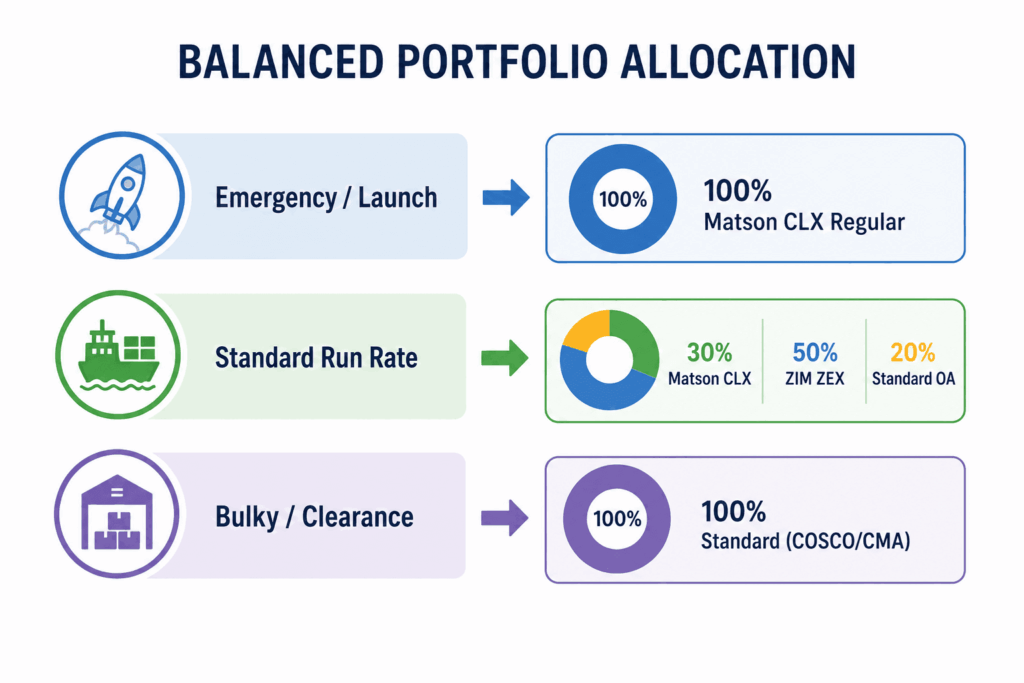
Scenario A: The New Product Launch / Critical Stock Recovery
- Allocation: 100% Matson CLX (Regular Service)
- The Strategy: At this stage, time is your most expensive asset. Do not risk a stock-out that breaks the Amazon A9 ranking algorithm. Pay the premium, get the listing active, secure the organic ranking, and stabilize your account health before trying to optimize your freight margins.
Scenario B: The Mature, Rolling Inventory Mix (The Sweet Spot)
- Allocation: 30% Matson CLX + 50% ZIM ZEX + 20% Standard Alliances
- The Strategy: This is how you optimize long-term profitability while completely neutralizing the risk of a total supply chain blackout:
- The 30% Matson allocation serves as your rolling safety buffer, ensuring a steady, hyper-predictable injection of inventory into Amazon’s network every single month to sustain baseline indexation.
- The 50% ZIM allocation serves as your primary workhorse, moving the core of your volume at a highly competitive speed-to-cost ratio.
- The 20% Standard Carrier allocation handles your baseline buffer inventory. It moves slowly, but drastically pulls down your overall average shipping cost per unit across the fiscal year.
Scenario C: Seasonal Peak Pre-Stocking & Clearance Runs
- Allocation: 100% Standard Ocean Freight
- The Strategy: If you are moving slow-moving SKUs, low-margin accessories, or executing a massive inventory push in June for holiday sales that won’t start until Black Friday, time is on your side. Leverage the lowest cost-per-CBM slot rates offered by the major alliances to maximize your net product margins.
Secure Your Logistics Infrastructure with Kisun Shipping
The shipping market doesn’t award points for guesswork. Choosing between Matson, ZIM, or a standard alliance isn’t about finding the “best” absolute route—it’s about matching the financial lifecycle of your individual SKUs to the terminal mechanics of the destination port.
At Kisun Shipping, we bypass automated, copy-paste quotes. We run deep operational evaluations on your cargo dimensions, analyze your target Amazon warehouse distribution paths, and secure direct, guaranteed space allocations with carriers that match your true target timelines.
Are you ready to optimize your shipping framework for the Q3/Q4 peak season? Connect with a Kisun Shipping Optimization Expert Today to run an analysis on your current supply chain routes, or review our comprehensive operational manual on How to Pack and Ship Amazon FBA Inventory from China to eliminate costly inbound packaging errors before your containers leave the yard.

China Logistics Expert
About the Author
Katherine Kang is a China-based logistics consultant with over 11 years of experience in international trade and freight forwarding. Specializing in helping SMEs import from China to the USA, Canada, and Europe, she focuses on compliant, cost-effective solutions to avoid delays, tariffs, and hidden fees. From anti-dumping guidance to CNY planning, Katherine has managed hundreds of shipments, saving clients 15-30% on average.
Connect with Katherine on LinkedIn or contact Kisun Shipping for a free import consultation.