Does DDP Shipping Include Unloading? A First-Time Importer’s Guide to Receiving a Full Container
International shipping doesn’t end when your container arrives at your warehouse.
In fact, one of the most overlooked—and expensive—parts of the import process happens during the final delivery.
Many first-time importers believe that choosing DDP (Delivered Duty Paid) means the freight forwarder will take care of absolutely everything, including unloading the cargo from the truck.
Unfortunately, that’s one of the most common misunderstandings we see.
Over the years, we’ve helped importers ship thousands of containers from China to the USA, Canada, the UK, and other countries. While customs clearance and transportation are often carefully planned, unloading is frequently forgotten—until the truck arrives outside the warehouse.
At that point, the questions begin:
“Where’s the forklift?”
“Who will unload the cargo?”
“Does the warehouse have a loading dock?”
If the answers aren’t ready, the truck waits.
And every extra hour may mean additional waiting charges.
In this guide, we’ll explain exactly what DDP shipping includes, who is responsible for unloading a full container, how FCL deliveries differ from LCL shipments, and what every importer should prepare before delivery day.
Whether you’re importing your first full container or expanding from LCL to FCL shipments, this guide can help you avoid costly surprises.
Quick Answer: Does DDP Shipping Include Unloading?
The Short Answer
Usually, no.
Under most DDP (Delivered Duty Paid) shipping arrangements, the freight forwarder is responsible for transporting your goods from China to the agreed delivery address. This typically includes export customs procedures, international transportation, import customs clearance, import duties (if included in the quotation), and arranging the final truck delivery.
However, unloading the cargo from the truck is normally the consignee’s responsibility unless both parties have agreed otherwise in writing.
That means when the truck arrives at your warehouse, you should already have the necessary unloading equipment and personnel ready.
Here’s a simple breakdown.
| Usually Included in DDP Shipping | Usually NOT Included |
|---|---|
| Ocean or air freight | Unloading cargo from the truck |
| Export customs clearance | Forklift or unloading equipment |
| Import customs clearance | Warehouse staff |
| Import duties & taxes (if quoted as DDP) | Loading dock |
| Final truck delivery | Internal warehouse handling |
| Delivery appointment (where applicable) | Product placement inside your warehouse |
Important: Some logistics providers may offer additional unloading services as a separate value-added service. Always confirm the quotation and service scope before booking your shipment.
A Real Customer Story: When LCL Became FCL
Recently, we worked with a customer whose business was growing rapidly.
For months, they had been importing smaller LCL (Less than Container Load) shipments from China using our DDP service.
Because the shipments were relatively small, every delivery was completed using a truck equipped with a tail lift, allowing the cargo to be unloaded safely without requiring warehouse equipment.
Everything went smoothly.
As the business expanded, the customer decided to import a full 40HQ container instead of several LCL shipments.
Naturally, they expected the delivery process to remain exactly the same.
When our Canadian operations team scheduled the delivery, the customer requested another truck with a tail lift.
Unfortunately, that wasn’t possible.
The customer believed we should simply “arrange the same type of truck as before.”
From their perspective, it sounded reasonable.
But in reality, FCL (Full Container Load) delivery works very differently from LCL delivery.
Unlike LCL shipments, a full container is transported directly on a container chassis from the container terminal to the consignee’s warehouse.
These chassis are specifically designed to carry shipping containers and cannot be fitted with tail lifts like smaller delivery trucks.
At that moment, the customer realized something they had never considered before:
Their warehouse had no loading dock, no forklift, and no plan for unloading an entire container.
Instead of discussing customs clearance or freight costs, we suddenly found ourselves helping them understand warehouse requirements, unloading equipment, and even how to rent a forklift.
Fortunately, we worked together to find a solution, and the shipment was delivered successfully.
But the experience reminded us of something important:
As your business grows from LCL shipments to full container imports, your warehouse operation must grow as well.
Transportation is only one part of international logistics.
Receiving the cargo efficiently is equally important.
Why We Decided to Share This Story
This customer wasn’t careless.
They were simply experiencing something that many growing importers eventually face.
When you’ve only received parcel deliveries or LCL shipments before, it’s easy to assume that receiving a full container works exactly the same way.
It doesn’t.
This misunderstanding is surprisingly common among first-time FCL importers, especially small businesses that are scaling up quickly.
As freight forwarders, we always try to help our customers beyond transportation whenever possible. If we notice potential issues before shipment, we’ll gladly share our experience and suggest practical solutions.
At the same time, successful international shipping is a shared responsibility.
A freight forwarder can arrange transportation, customs clearance, documentation, and delivery.
But preparing the warehouse to receive a full container is something only the consignee can truly control.
The earlier you understand these responsibilities, the smoother—and more cost-effective—your shipment will be.
Coming Up Next
Now that we’ve explained why this misunderstanding happens, let’s look at how FCL deliveries actually work and why they’re fundamentally different from LCL shipments.
Once you understand the delivery process, it becomes much easier to prepare your warehouse correctly and avoid unnecessary delays or detention charges.
Why FCL Delivery Is Completely Different From LCL
One of the biggest reasons first-time importers get confused is that LCL (Less than Container Load) and FCL (Full Container Load) deliveries look similar from the customer’s perspective—but behind the scenes, they follow completely different logistics processes.
Understanding this difference is the key to avoiding delivery delays, unnecessary trucking charges, and warehouse problems.
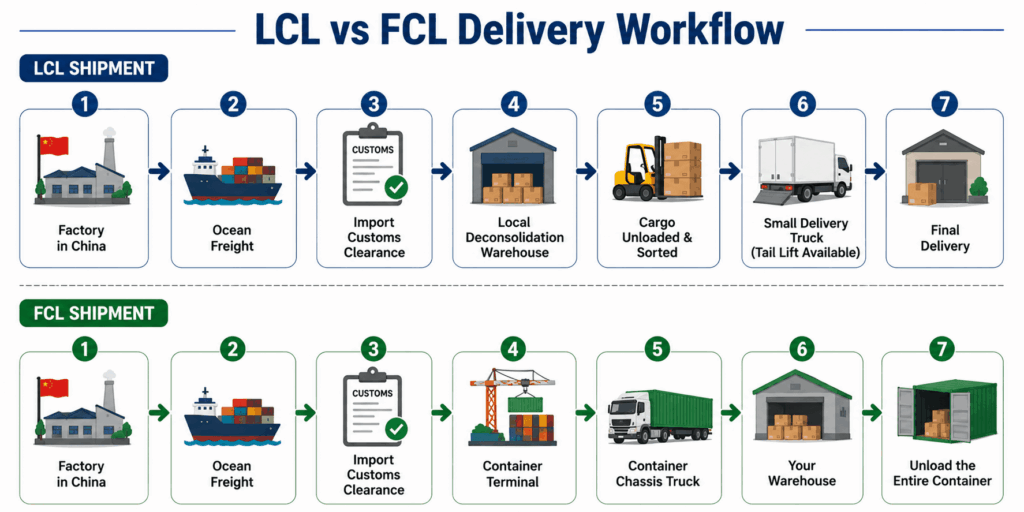
How LCL Delivery Works
With an LCL shipment, your cargo shares one container with shipments belonging to multiple importers.
After customs clearance, the entire container is transported to a local deconsolidation warehouse.
There, warehouse staff unload the container, separate each customer’s cargo, and reload individual shipments onto smaller delivery trucks.
Because these trucks usually carry loose cartons or palletized cargo rather than an entire shipping container, they can often be equipped with:
- Tail lift (liftgate)
- Pallet jack
- Smaller delivery body
- Easier residential or commercial access
This is why many LCL deliveries can be completed even if the warehouse doesn’t have its own forklift.
For many small businesses importing their first products from China, this becomes the “normal” delivery experience.
How FCL Delivery Works
A Full Container Load (FCL) shipment is completely different.
After customs clearance, the container does not stop at a local warehouse.
Instead, the shipping line releases the container to the trucking company, and a container chassis truck picks it up directly from the port or container terminal.
The truck then transports the entire sealed container straight to the consignee’s warehouse.
No warehouse staff unload the cargo beforehand.
No cargo sorting takes place.
No smaller truck is used.
Everything inside the container remains exactly as it left the factory in China until the consignee opens the doors at the final delivery location.
This is one of the biggest advantages of FCL shipping:
- Faster delivery
- Less cargo handling
- Lower risk of damage
- Better security
- More efficient transportation for large shipments
However, it also means that the warehouse receiving the container must be prepared to unload it.
LCL vs FCL Delivery Workflow
Why Container Chassis Trucks Don’t Have Tail Lifts
This is another misunderstanding we often hear from first-time importers.
Many customers ask:
“Can’t you just arrange a truck with a tail lift like last time?”
Unfortunately, the answer is no.
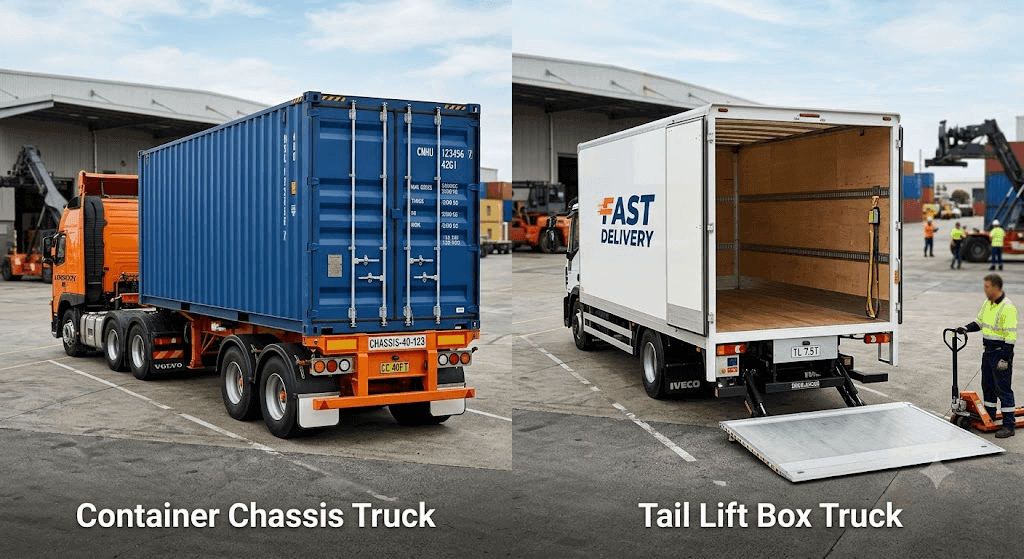
A container chassis is not the same as a standard delivery truck.
Its only purpose is to transport a full shipping container safely between the port and the delivery address.
Unlike a box truck, it doesn’t have:
- An enclosed cargo area
- A hydraulic tail lift
- Storage space for unloading equipment
Instead, the shipping container itself sits directly on the chassis.
When the truck arrives at your warehouse, the container doors are opened, and the cargo is unloaded directly from the container.
For this reason, the consignee must provide the equipment needed to remove the cargo from inside the container.
It’s not that your freight forwarder is unwilling to arrange a tail lift—it simply isn’t compatible with the equipment used for FCL transportation.
Understanding this difference before your shipment arrives can prevent a great deal of confusion on delivery day.
What Equipment Do You Need Before a Full Container Arrives?
One of the best questions an importer can ask before booking a full container is:
“Is my warehouse actually ready to receive it?”
Many people focus on ocean freight rates, customs duties, or transit times.
But the last 30 minutes of the shipment—the unloading process—can determine whether the delivery is completed smoothly or becomes unexpectedly expensive.
Below are the most important things to prepare.
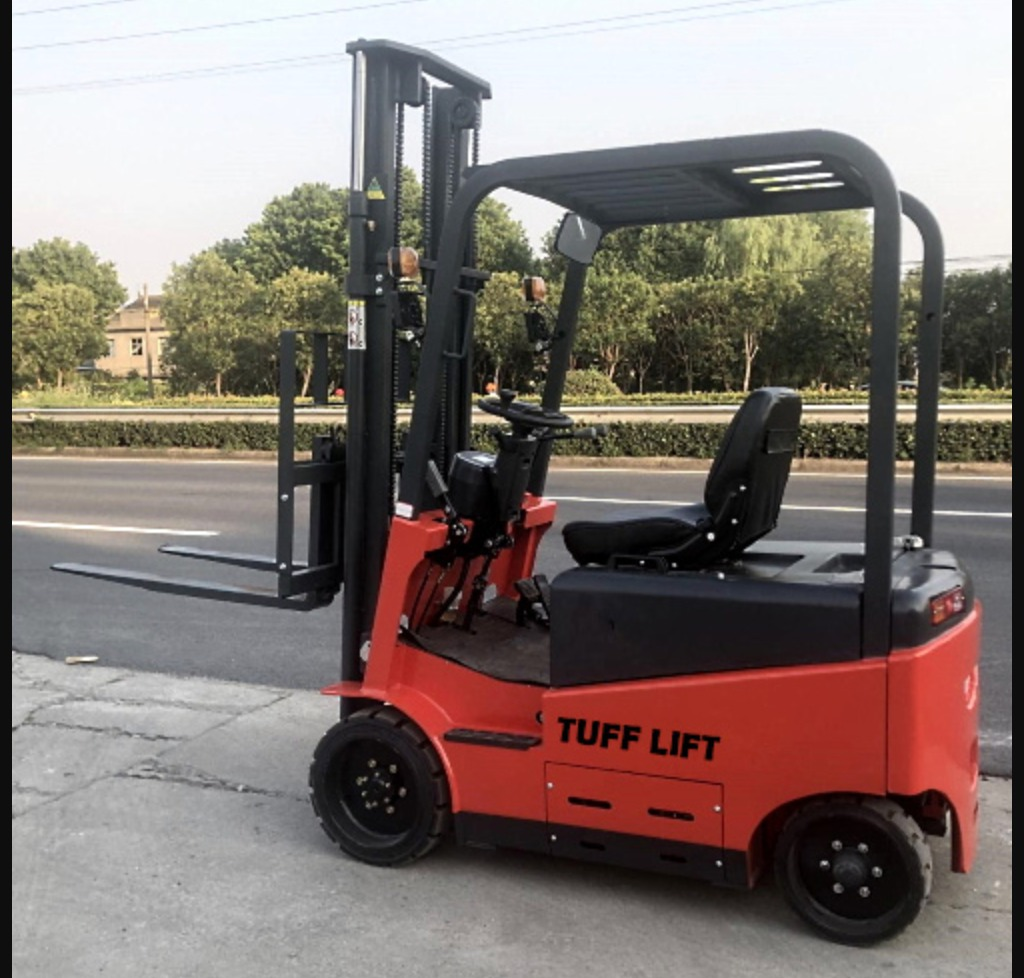
1. A Forklift (Recommended)
For most palletized shipments, a forklift is the fastest and safest unloading solution.
If your warehouse doesn’t own one, consider renting an electric forklift for the delivery day.
Compared with truck waiting charges, renting a forklift is often the more economical option.
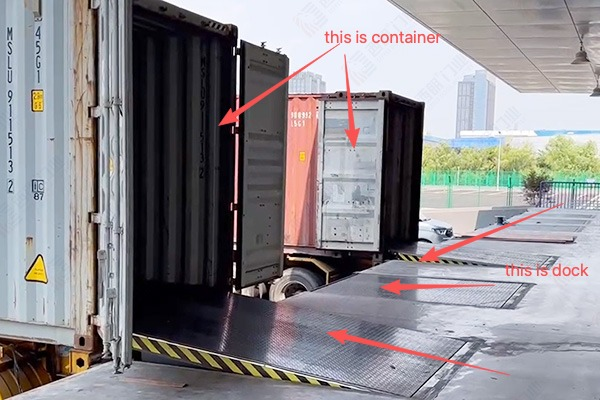
2. A Loading Dock
Many commercial warehouses are designed specifically for receiving shipping containers.
A loading dock allows the container floor and warehouse floor to sit at a similar height, making unloading much faster.
If your warehouse has a loading dock, unloading usually becomes much easier.
3. Enough Workers
Not every shipment can be unloaded entirely by forklift.
Loose cartons, irregular cargo, or products that require manual handling may need additional warehouse staff.
Before the truck arrives, make sure enough people are available to complete the unloading within the driver’s free waiting time.
4. A Scheduled Receiving Appointment
Some commercial warehouses only accept deliveries during specific receiving hours.
Others require appointments several days in advance.
Confirm these requirements before the container leaves the port.
Otherwise, the truck may arrive only to discover that the warehouse cannot receive the shipment that day.
5. Adequate Space for a 40HQ Container
This point is often overlooked.
A fully loaded 40HQ container requires enough space for the truck to:
- Enter the property safely
- Reverse into the unloading area
- Open both container doors completely
- Allow forklifts to move freely
If the access road is too narrow or the yard is too small, delivery may become difficult—or even impossible.
If you’re using a newly rented warehouse, it’s worth confirming these details with the warehouse manager before your shipment departs China.
Pro Tip from Our Logistics Team
One simple phone call before booking your shipment can save hundreds of dollars later.
Whenever you’re unsure whether your warehouse can receive a full container, ask your freight forwarder first.
An experienced logistics team can often identify potential delivery issues before the shipment even leaves China.
In many cases, a five-minute discussion is enough to prevent detention charges, failed deliveries, or last-minute warehouse changes.
How to Choose a Warehouse That Can Receive a Full Container
Many first-time importers spend weeks comparing freight rates but only a few minutes choosing a warehouse.
In reality, your warehouse plays just as important a role as your freight forwarder.
A warehouse that cannot efficiently receive a full container may result in:
- Delivery delays
- Additional trucking charges
- Longer unloading times
- Storage problems
- Last-minute delivery changes
The cheapest warehouse isn’t always the best choice.
Instead, ask yourself one question:
Can this warehouse actually handle my shipment?
If You’re Using Your Own Warehouse
If you’re receiving containers at your own facility, confirm that you have the basic infrastructure needed for container deliveries.
At a minimum, your warehouse should have either:
- A loading dock, or
- A forklift capable of unloading your cargo.
Having both is ideal, but having at least one is usually essential.
You should also consider:
- Is there enough space for a 40HQ truck to enter and turn?
- Can the container doors be fully opened?
- Do you have staff available on the scheduled delivery date?
- Do your receiving hours match the trucking appointment?
These questions may seem simple, but overlooking them can easily lead to expensive delays.
If You’re Renting a Public Warehouse
Many importers, especially new businesses, use third-party warehouses instead of operating their own facilities.
That’s perfectly normal.
However, never assume every warehouse can receive a full container.
Before signing a lease—or before shipping your cargo—contact the warehouse and explain exactly what you’re importing.
The more information you provide, the more accurately the warehouse can determine whether they can handle your shipment.
Information You Should Tell the Warehouse
Whenever possible, provide the following details.
1. What Type of Cargo Are You Importing?
Is it:
- General cargo?
- Food products?
- Cosmetics?
- Furniture?
- Electronics?
- Goods containing batteries?
- Liquid or powder products?
Certain cargo types require special handling procedures or storage conditions.
2. How Will the Cargo Be Packed?
Will the shipment arrive as:
- Loose cartons?
- Wooden crates?
- Pallets?
- Oversized cargo?
This affects both unloading equipment and warehouse labor requirements.
3. How Large Is the Shipment?
Share your:
- Total CBM
- Total weight
- Number of pallets
- Number of cartons
If available, simply send the warehouse your packing list.
This allows them to evaluate whether their equipment is suitable.
4. Will It Arrive as LCL or FCL?
This is one of the most important questions.
Many warehouse operators can easily receive small LCL deliveries.
Receiving an entire 40HQ container is a completely different situation.
Always tell them whether the shipment will arrive as:
- LCL Delivery
- 20GP Container
- 40GP Container
- 40HQ Container
5. Do You Need Additional Warehouse Services?
Besides storage, ask whether they provide:
- Forklift unloading
- Pallet wrapping
- Pallet exchange
- Inventory counting
- Cross docking
- Short-term storage
- Long-term warehousing
Choosing a warehouse that offers these services can make future shipments much easier as your business grows.
A Good Warehouse Should Never Be Chosen on Price Alone
It’s understandable that every importer wants to reduce logistics costs.
However, selecting a warehouse based only on the lowest monthly storage fee often becomes more expensive in the long run.
We’ve seen situations where businesses saved a small amount on warehouse rent, only to spend much more on:
- Truck waiting charges
- Extra labor
- Equipment rental
- Redelivery fees
- Delivery delays
A slightly higher warehouse fee may include professional unloading equipment, experienced warehouse staff, flexible receiving hours, and faster turnaround times.
In many cases, that represents much better overall value.
Another Expensive Mistake: Changing the Delivery Address at the Last Minute
Unloading isn’t the only issue we’ve encountered.
Another surprisingly common mistake is changing the warehouse address after the shipment has already left China.
Many first-time importers think:
“The container hasn’t even arrived yet. Surely changing the delivery address won’t be a problem.”
Unfortunately, international logistics doesn’t work that way.
Once the vessel departs China, your freight forwarder often begins arranging the final delivery.
Depending on the destination country, this may include:
- Booking trucking companies
- Scheduling delivery appointments
- Preparing customs documents
- Confirming warehouse receiving times
- Coordinating container pickup from the terminal
Changing the delivery address after these arrangements have been made usually requires additional work—and often results in additional charges.
Why Does Changing the Address Cost Money?
Changing a delivery address isn’t simply updating one line on a document.
It may require:
- Cancelling the original trucking order
- Booking a different trucking company
- Recalculating delivery distance
- Rescheduling appointments
- Updating customs or delivery instructions
- Paying additional dispatch fees
Even if the container hasn’t arrived at the destination port yet, much of the delivery planning has already been completed behind the scenes.
That’s why most freight forwarders charge an address change fee once transportation arrangements have begun.
Confirm Your Warehouse Before the Container Leaves China
One of the simplest ways to avoid unnecessary costs is to make sure your warehouse information is finalized before your shipment departs.
Before the vessel sails, confirm:
- The complete delivery address
- Warehouse contact person
- Receiving phone number
- Receiving hours
- Delivery appointment requirements
- Whether the warehouse accepts full containers
Spending five minutes confirming these details can prevent days of delays later.
Full Container Receiving Checklist
Before your container arrives, take a few minutes to review this checklist.
Shipping Arrangement
✅ Shipping terms confirmed (EXW, FOB, CIF, DDP, etc.)
✅ You understand which responsibilities belong to your freight forwarder and which belong to you.
Warehouse Preparation
✅ Delivery address confirmed
✅ Warehouse notified
✅ Receiving appointment booked (if required)
✅ Warehouse accepts 20GP / 40GP / 40HQ containers
Unloading Equipment
✅ Forklift available
✅ Loading dock available
✅ Pallet jack (if required)
✅ Enough warehouse staff scheduled
Delivery Day
✅ Truck driver has warehouse contact information
✅ Access road is clear for container trucks
✅ Receiving area is available
✅ Warehouse operating hours confirmed
Emergency Planning
Ask yourself these questions before delivery day:
- What happens if the truck arrives earlier than expected?
- What if the forklift isn’t available?
- Who should the driver contact?
- Is there a backup unloading plan?
Thinking about these scenarios in advance can save significant time, money, and stress.
A Small Preparation Can Prevent a Big Problem
Looking back at the customer story we shared earlier, the issue wasn’t caused by customs, shipping delays, or freight costs.
It happened because no one had discussed the final step of the journey:
Receiving the container.
Fortunately, the problem was solved.
But it serves as an important reminder that successful importing isn’t just about getting goods from China to your country.
It’s also about making sure your warehouse is ready when those goods arrive.
Every container shipment involves many moving parts—from production and ocean freight to customs clearance and final delivery.
The businesses that experience the smoothest deliveries are usually the ones that prepare for every step, including the last one.
Frequently Asked Questions (FAQ)
Does DDP shipping include unloading?
In most cases, no.
DDP (Delivered Duty Paid) usually means your freight forwarder is responsible for arranging transportation from China to the agreed destination, handling customs clearance, and paying import duties if included in the quotation.
However, unloading the cargo from the truck is normally the consignee’s responsibility, unless unloading services have been specifically agreed upon in advance.
If you’re unsure what’s included in your quotation, always ask your freight forwarder before booking the shipment.
Who is responsible for unloading a shipping container?
For most commercial container deliveries, the consignee (receiver) is responsible for unloading the cargo.
The trucking company delivers the container to the agreed address, but the warehouse is generally expected to provide:
- A forklift (if required)
- Warehouse staff
- A loading dock or other suitable unloading facilities
- Sufficient space for unloading
Responsibilities may vary depending on your shipping agreement, so it’s always worth confirming the details before shipment.
Can a shipping container be unloaded without a forklift?
Yes—but it depends on how your cargo is packed.
If your shipment consists of a small number of loose cartons, manual unloading may be possible.
However, for heavy pallets, machinery, furniture, or a fully loaded 40HQ container, a forklift is usually the safest and most efficient solution.
Without proper equipment, unloading can take significantly longer and may result in truck waiting charges.
What happens if my warehouse cannot unload the container?
If the warehouse cannot unload the container when the truck arrives, several things may happen:
- The truck may have to wait, resulting in detention or waiting charges.
- A second delivery appointment may be required.
- The container may need to be returned to a storage yard.
- Additional trucking and handling fees may apply.
These situations are usually avoidable with proper planning before the shipment departs China.
Can I change the delivery address after my shipment leaves China?
Sometimes yes—but it often comes with additional costs.
Once the container has departed, trucking arrangements, delivery appointments, and operational planning may already be underway.
Changing the delivery address at that stage can require extra coordination and may result in additional trucking or dispatch fees.
If you think your delivery address might change, discuss it with your freight forwarder as early as possible.
How long does it take to unload a full container?
The answer depends on:
- The type of cargo
- Whether the cargo is palletized or loose-loaded
- The unloading equipment available
- The number of warehouse workers
- The warehouse layout
A well-prepared warehouse with a loading dock and forklift can unload a container much faster than a warehouse relying solely on manual labor.
Because trucking companies usually include only a limited amount of free waiting time, efficient unloading can also help reduce logistics costs.
What We’ve Learned After Handling Thousands of Shipments
Every shipment teaches us something.
Over the years, we’ve learned that the biggest logistics challenges are not always caused by customs inspections, port congestion, or rising ocean freight rates.
More often, they’re caused by small details that are easy to overlook.
A warehouse without a forklift.
A delivery appointment that wasn’t booked.
A warehouse address that changed at the last minute.
Or simply assuming that DDP shipping includes services that were never part of the agreement.
Fortunately, these are also the easiest problems to prevent.
Clear communication, careful planning, and understanding each party’s responsibilities can make the difference between a smooth delivery and an expensive delay.
Three Tips for First-Time Importers
If you’re preparing to import your first full container from China, remember these three principles.
1. Understand Your Shipping Terms
Before your shipment leaves the factory, make sure you understand exactly what your chosen Incoterm includes.
Whether you’re shipping under EXW, FOB, CIF, DAP, or DDP, every shipping term divides responsibilities differently.
Never assume a service is included—ask your freight forwarder to explain the scope of service in plain language.
2. Prepare Your Warehouse Before the Container Arrives
A successful shipment doesn’t end at customs clearance.
Before delivery day, make sure your warehouse is ready with:
- A confirmed receiving appointment
- The necessary unloading equipment
- Sufficient warehouse staff
- Enough space for a container truck to access the site
A few simple preparations can prevent unnecessary delays and additional costs.
3. Treat Your Freight Forwarder as a Logistics Partner
A good freight forwarder does much more than book ocean freight.
They can help you:
- Choose the right shipping method
- Understand import procedures
- Identify potential delivery issues
- Plan warehouse receiving
- Reduce avoidable logistics costs
The earlier you involve your logistics partner in your planning, the smoother your shipment is likely to be.
Final Thoughts
International shipping is a team effort.
Your supplier manufactures the products.
Your freight forwarder manages transportation.
Customs authorities handle clearance.
The trucking company delivers the container.
And finally, your warehouse receives the cargo.
Every step matters.
From our experience, the businesses that enjoy the smoothest supply chains aren’t necessarily the biggest importers—they’re the ones who prepare well, communicate clearly, and understand how the process works before problems arise.
Whether you’re importing your very first shipment or scaling from LCL to full container loads, taking the time to prepare your warehouse can save far more than it costs.
Need Help Planning Your Next Shipment from China?
At Kisun Shipping, we help importers move cargo from China to destinations worldwide, including the United States, Canada, the United Kingdom, Australia, Europe, and many other international markets.
Whether you’re shipping:
- LCL or FCL
- Amazon FBA inventory
- Commercial cargo
- Time-sensitive shipments
- Door-to-door DDP shipments
our team will help you understand every step of the process—not just transportation, but also customs clearance, warehouse preparation, and final delivery planning.
If you’re unsure whether your warehouse is ready to receive a 20GP, 40GP, or 40HQ container, we’re happy to review your delivery plan before your shipment leaves China.
A short conversation today could help you avoid unnecessary delays, detention charges, and unexpected delivery costs tomorrow.
Recommended Reading
If you found this guide helpful, you may also be interested in:
- Shipping from China to Canada: Complete 2026 Guide
- China Freight Rates 2026: Latest Market Updates
- The Packaging Mistake That Doubled a UK Importer’s Shipping Cost
- How to Ship to Amazon FBA from China
- Matson vs ZIM vs Standard: China to US Ocean Freight

China Logistics Expert
About the Author
Katherine Kang is a China-based logistics consultant with over 11 years of experience in international trade and freight forwarding. Specializing in helping SMEs import from China to the USA, Canada, and Europe, she focuses on compliant, cost-effective solutions to avoid delays, tariffs, and hidden fees. From anti-dumping guidance to CNY planning, Katherine has managed hundreds of shipments, saving clients 15-30% on average.
Connect with Katherine on LinkedIn or contact Kisun Shipping for a free import consultation.