

The Packaging Mistake That Doubled Our UK Customer’s Shipping Cost (And How to Avoid It Before Production Starts)
When importers compare shipping from China to UK options, most focus on freight rates, transit times, customs clearance, or import duties.
Those are all important—but one factor is often overlooked until it’s too late:
Packaging.
Not the product itself.
Not the shipping company.
Not even the shipping route.
The carton size you confirm with your supplier before production can have a greater impact on your total logistics cost than many importers realize.
We recently experienced a case that perfectly illustrates this.
A UK customer had already completed production. Quality inspection had passed, and the shipment was ready to leave the factory. Everything appeared to be on schedule until we reviewed the final packing list.
The cartons were much smaller than expected.
At first glance, that didn’t seem like a problem. Smaller cartons are usually easier to handle, right?
Unfortunately, the packaging had been designed without considering the final transportation plan.
The cartons were too small for efficient pallet building, making truck delivery in the UK unnecessarily expensive. At the same time, each carton was too light to meet the most economical billing range for our DDP courier solution, meaning every parcel would be charged at a higher minimum billable weight.
Instead of saving money, the packaging increased the total logistics cost.
To solve the problem, the factory had to purchase new export cartons, combine two original cartons into one larger master carton, and repack the entire shipment. The factory charged additional labor and packaging fees, and the shipment was delayed while the work was completed.
Even after paying for the new cartons and repacking, the customer still reduced the overall transportation cost by nearly 20% compared with shipping the original packaging.
The lesson was simple:
The cheapest shipping solution is often decided before production even begins.
This is one of the most common issues we see when arranging China to UK shipping. Buyers spend weeks negotiating product prices with suppliers but only think about packaging after production has finished. By then, changing carton dimensions becomes expensive, time-consuming, and sometimes impossible.
If you’re importing products from China regularly, packaging should be part of your purchasing strategy—not just your logistics checklist.
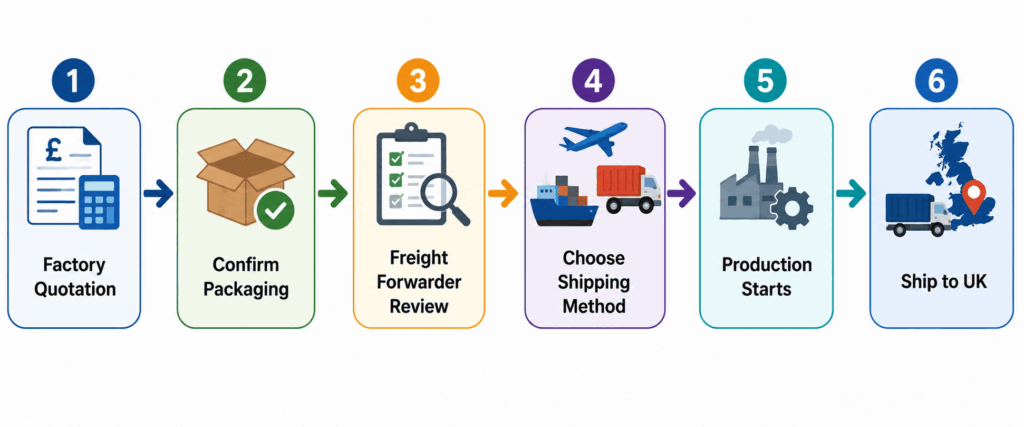
Why Packaging Determines Your Shipping Method
One question we often receive from first-time importers is:
“Can you tell me the shipping cost from China to UK?”
Of course we can—but before providing an accurate quotation, we usually ask for one document first:
The packing list.
Many customers are surprised by this. They expect us to ask about the products first, but experienced freight forwarders know that packaging tells us almost everything we need to design the transportation plan.
A detailed packing list typically includes:
- Carton dimensions (Length × Width × Height)
- Gross weight
- Net weight
- Number of cartons
- Total volume (CBM)
- Packaging type
- Pallet information (if available)
These details help us determine whether your shipment is better suited for courier delivery, air freight, LCL sea freight, FCL shipping, or a palletized truck delivery solution.
For example, in many UK door-to-door shipments, the final delivery method has strict packaging requirements.
A standard pallet delivery generally works within dimensions of approximately:
- 120 × 100 × 180 cm (including pallet height)
- Maximum gross weight around 990 kg per pallet
By comparison, many courier services used for UK deliveries apply parcel limits such as:
- Maximum billable weight per parcel: 30 kg
- Typical maximum dimensions: 100 × 70 × 60 cm
If your packaging falls between these two transportation methods, your shipment may become inefficient for both.
That is exactly what happened in our customer’s case.
The cartons were too small to build cost-effective pallets, yet not suitable for the most economical courier pricing structure.
One packaging decision affected every stage of the shipment—from warehouse handling in China to final delivery in the UK.
How Freight Forwarders Actually Choose the Best Shipping Method
Many people assume freight forwarders simply compare shipping prices and choose the cheapest carrier.
In reality, that’s only a small part of the process.
When our team evaluates a shipment, we look at several factors together:
- Product characteristics
- Carton dimensions
- Gross weight
- Total shipment volume (CBM)
- Delivery postcode in the UK
- Delivery time requirements
- Warehouse receiving requirements
- Whether palletization is recommended
Only after reviewing this information can we determine the most suitable transportation solution.
This is why there is no universal answer to questions like:
- “What is the shipping cost from China to UK?”
- “What are the current shipping rates from China to UK?”
- “How much are shipping charges from China to UK?”
The answer depends not only on the freight market but also on how your products are packaged.
In many cases, changing the carton dimensions before production can lower the total shipping cost without changing the product itself.
That’s why we always encourage customers to involve their freight forwarder early. A five-minute discussion before production starts can prevent costly changes after the goods are finished.
In the next section, we’ll look at the three packaging mistakes we encounter most often—and how each one can quietly increase your shipping costs from China to the UK.
The Three Most Common Packaging Mistakes We See
After arranging thousands of shipments from China to the UK, we’ve noticed an interesting pattern.
Most expensive shipping mistakes aren’t caused by freight rate increases or customs inspections.
They’re caused by packaging decisions made weeks—or even months—before the goods leave the factory.
Below are the three packaging mistakes we encounter most often, along with practical ways to avoid them.
Mistake #1: Oversized Cartons Increase Volumetric Weight
This is probably the most expensive mistake for shipments delivered by courier.
Many importers assume shipping costs are based only on the actual weight of the goods.
Unfortunately, that’s not how international courier companies calculate their charges.
For parcel deliveries, carriers such as DPD, DHL, UPS, and FedEx generally compare two figures:
- Actual Weight
- Volumetric (Dimensional) Weight
The higher number becomes the chargeable weight.
For example:
| Carton Size | Actual Weight | Volumetric Weight | Chargeable Weight |
|---|---|---|---|
| 60 × 50 × 50 cm | 8 kg | 25 kg | 25 kg |
Using the common courier formula:
60 × 50 × 50 ÷ 6000 = 25 kg
Although the products inside weigh only 8 kg, you’ll pay as if they weigh 25 kg.
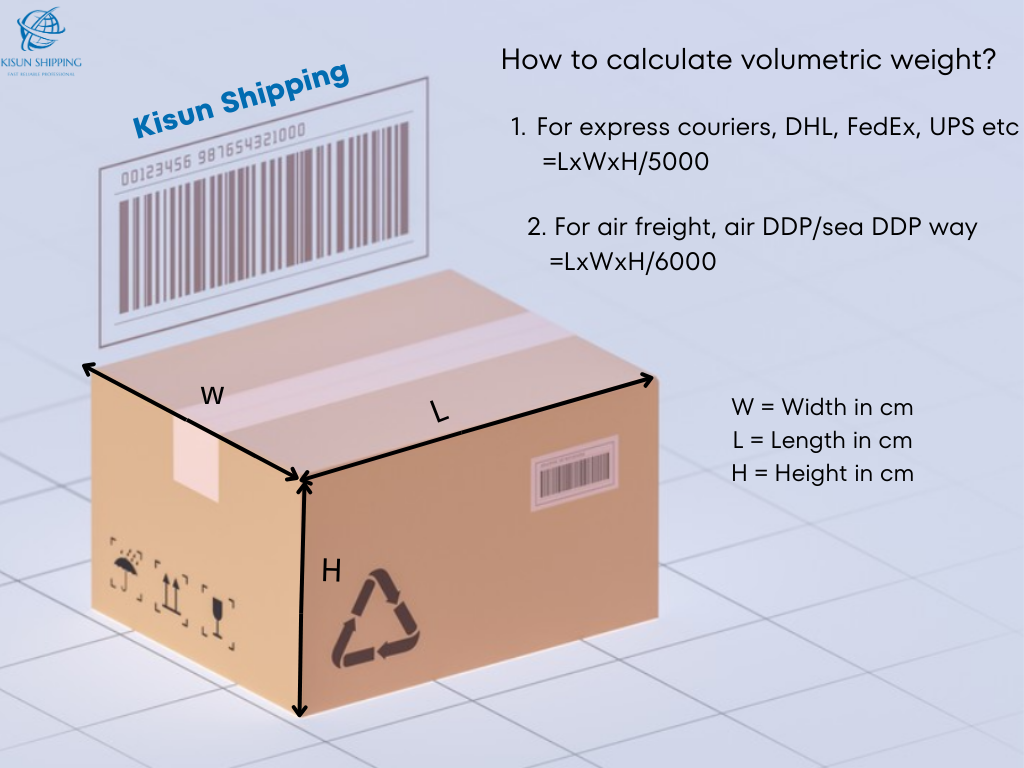
We’ve seen customers surprised when their final invoice was nearly three times higher than expected—not because freight rates changed, but because the carton dimensions weren’t considered during packaging design.
If you’re comparing the shipping cost from China to UK per kg, remember that the “per kg” rate often applies to the chargeable weight, not the physical weight of your products.
A slightly smaller carton can sometimes reduce freight costs far more effectively than negotiating a lower shipping rate.
see more informaton from: https://www.rajapack.co.uk/blog-uk/guide-volumetric-weight-reduce-packaging-costs
Mistake #2: Cartons That Are Too Small Can Be Just as Expensive
After learning about volumetric weight, some buyers immediately think:
“Then I’ll just make every carton as small as possible.”
Unfortunately, that’s another common mistake.
Smaller cartons don’t always mean lower shipping costs.
For many UK DDP shipping solutions, courier services apply a minimum billable weight for each parcel.
Although the exact rules vary depending on the carrier and shipping service, lightweight cartons may still be billed at a higher minimum charge than their actual weight.
Let’s use a simplified example.
Imagine your factory packs each carton at 7 kg.
Your selected shipping service has an economical billing structure based on parcels around 13 kg.
Even though each carton weighs only 7 kg, you’ll still pay close to the minimum billing threshold.
Now imagine shipping two 7 kg cartons separately.
Instead of paying for one efficient parcel, you’re paying the minimum charge twice.
This is exactly why we sometimes recommend combining two smaller cartons into one master carton before shipment.
In many cases, this simple adjustment reduces both handling costs and last-mile delivery charges.
Another issue with very small cartons is palletization.
Small cartons create more gaps on a pallet, require additional handling, and make it harder to build stable loads.
As a result, UK truck delivery can become more expensive because the shipment occupies pallet space less efficiently.
The goal isn’t to use the smallest carton.
The goal is to use the right carton.
Mistake #3: Mixed Carton Sizes Reduce Shipping Efficiency
This issue is especially common when sourcing from multiple suppliers.
Each factory has its own preferred carton size.
When all products arrive at the consolidation warehouse, you might end up with dozens of cartons that vary in height, width, and weight.
While this may not seem like a major problem, it creates several challenges during transportation.
Mixed carton sizes often lead to:
- Unstable pallet stacking
- Increased risk of cartons collapsing during transport
- More empty space inside containers
- Longer warehouse handling time
- Higher pallet rebuilding costs
- Reduced container loading efficiency
From our experience, standardizing carton dimensions across suppliers can significantly improve loading efficiency and reduce unnecessary warehouse operations.
If you’re purchasing from several factories, it’s worth asking them to follow a consistent packaging specification whenever possible.
That small coordination effort can save time, improve cargo safety, and reduce overall shipping charges from China to UK.
How Carton Size Affects Last-Mile Delivery
One of the biggest misconceptions among new importers is that packaging only affects the international freight rate.
In reality, carton size and carton weight often have the greatest impact on the last-mile delivery method in the UK.
For many shipments, the main question is not whether the goods travel by sea or air.
The real question is:
How will the cargo be delivered after it arrives in the UK?
Depending on the size, weight, and packing format of the goods, the final delivery method may be very different.
Here’s a simplified comparison:
| Packaging Situation | Typical Last-Mile Delivery Method | Why |
|---|---|---|
| Small cartons with low total weight | Courier delivery to warehouse | Easy to handle, fast to unload, and suitable for light shipments. |
| Larger cartons with higher total weight | Truck delivery | The shipment is too heavy or bulky for parcel networks. |
| Palletized cargo | Truck delivery | Pallets require vehicle space and forklift handling. |
| Few cartons but oversized dimensions | Truck delivery | Even if the quantity is small, the oversized cartons take up more vehicle space and increase delivery cost. |
This is why packaging decisions matter so much.
If the goods are light and the total shipment is small, courier delivery to the warehouse is often the most practical option for the final leg.
But if the shipment is heavy, bulky, or already palletized, then truck delivery becomes the only realistic choice.
In that case, the carton dimensions matter just as much as the weight.
For example, a shipment with only a few cartons may still cost more to deliver if each carton is unusually large.
Why?
Because oversized cartons reduce vehicle efficiency.
A truck can carry fewer units, takes up more space, and may require more handling time.
So even when the shipment quantity is small, the last-mile delivery charge can still increase significantly if the cartons are too large.
This is why asking “Should I use courier or truck?” is often the wrong question.
A better question is:
“How will my carton size and shipment weight affect the final delivery method in the UK?”
We’ve seen customers reduce delivery costs simply by adjusting carton dimensions before production.
Others discovered that a shipment originally planned as parcel delivery had to be switched to truck delivery because the cartons were too large for the courier network.
The products didn’t change.
Only the packaging did.
Yet the last-mile delivery cost changed significantly.
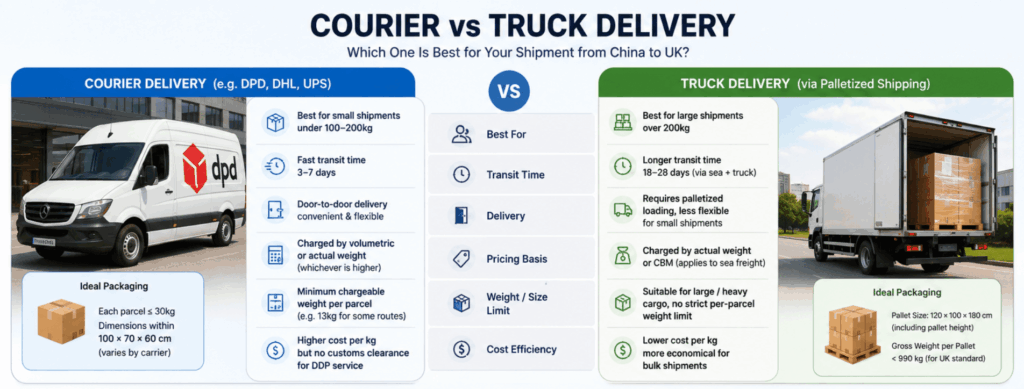
How Packaging Directly Affects Shipping Costs
Many buyers spend days comparing Shipping rates from China to UK from Different freight forwarders
Those comparisons are important.
However, they only tell part of the story.
Imagine receiving quotations from three freight forwarders.
One offers a slightly lower freight rate.
Another offers faster transit.
The third recommends adjusting your carton size before production.
At first glance, the third quotation may not appear to be the cheapest.
But if changing the packaging reduces your chargeable weight, improves pallet utilization, and lowers UK delivery costs, it could easily become the most economical solution overall.
That’s why experienced importers don’t compare freight rates alone.
They compare the total landed logistics cost.
In many cases, the most valuable advice a freight forwarder can provide isn’t a cheaper quotation—it’s identifying unnecessary costs before they happen.
At Kisun Shipping, reviewing packaging before production is one of the simplest ways we’ve helped customers reduce logistics expenses without changing suppliers, products, or shipping schedules.
The Conversation You Should Have With Your Supplier Before Production Starts
When sourcing products from China, most buyers focus on three things:
- Product quality
- Unit price
- Production lead time
Those are all important, but there’s one topic that is often overlooked until the goods are ready to ship:
Packaging specifications.
By the time production is complete, changing carton dimensions usually means ordering new cartons, paying additional labor costs, delaying the shipment, and sometimes even missing the planned vessel or delivery schedule.
That’s why we always recommend discussing packaging with your supplier before mass production begins.
A few simple questions at this stage can prevent hundreds—or even thousands—of pounds in unnecessary logistics costs later.
Ask Your Supplier These Questions
Before confirming production, ask your supplier for the following information:
- What are the final carton dimensions (L × W × H)?
- What is the gross weight of each carton?
- What is the net weight?
- How many units are packed in each carton?
- Can the cartons be safely stacked?
- Are export-standard cartons being used?
- Is there unnecessary empty space inside the carton?
- Can all suppliers follow the same carton specifications for consolidation?
Don’t hesitate to ask your supplier for a draft packing list before production starts.
Even estimated carton dimensions are often enough for an experienced freight forwarder to identify potential issues and recommend improvements.
A five-minute review today can prevent days of delays after production is finished.
Involve Your Freight Forwarder Earlier Than You Think
Many importers contact a freight forwarder only after their supplier says:
“Your goods are ready.”
From a logistics perspective, that’s already quite late.
At that point, the products are manufactured, the cartons have been printed, and the packing method has already been decided.
Your freight forwarder has very little room to optimize the shipment.
Instead, we recommend involving your logistics partner before production begins.
Once we know the estimated carton size, weight, quantity, and destination, we can often identify opportunities to reduce the overall shipping cost without changing the product itself.
Here are some of the questions worth asking your freight forwarder before placing the order:
- Is this carton size suitable for sea freight from China to UK?
- Will the shipment travel more efficiently on pallets?
- Will the courier calculate volumetric weight?
- Would a different carton size reduce chargeable weight?
- Is the current packaging suitable for warehouse handling in the UK?
- What is the estimated CBM?
- How many cartons fit on one standard pallet?
- Is there a more economical shipping solution if the packaging is adjusted now?
These discussions don’t take long, but they often make a significant difference to the final logistics cost.
In our experience, customers who involve their freight forwarder early usually have more shipping options, fewer unexpected charges, and smoother deliveries.
Real Case: A Simple Packaging Change Saved Nearly 20%
Let’s return to the shipment we mentioned at the beginning of this article.
The customer had purchased a batch of products from China and planned to use our DDP shipping service to the UK.
When we reviewed the packing list, we noticed that each carton weighed only 7 kg.
On paper, that seemed reasonable.
However, after reviewing the complete transportation plan, we realised the packaging wasn’t suitable for the most economical delivery method.
If we shipped the cartons exactly as they were, each parcel would fall below the most efficient billing range for our delivery solution.
The customer would end up paying more for transportation while also increasing warehouse handling costs.
Rather than accepting those unnecessary costs, we suggested another option.
Instead of shipping two individual cartons, we recommended combining them into one larger master carton before export.
The factory informed the customer that this would involve:
- Purchasing new export cartons
- Repacking the products
- Additional labour charges
Naturally, the customer was concerned about paying extra before the shipment had even left the factory.
So we compared both scenarios.
Although repacking required an additional factory fee, the savings in international transportation and UK last-mile delivery were even greater.
After reviewing the numbers, the customer decided to proceed.
The result?
The shipment’s overall logistics cost was reduced by approximately 20%, even after including the repacking expense.
This is exactly why we believe packaging should be treated as part of your logistics strategy—not simply as a factory decision.
Sometimes spending a little more before shipment can save significantly more throughout the entire supply chain.
A Practical Packaging Checklist for UK Importers
Before you approve production, take a few minutes to review the following checklist with both your supplier and your freight forwarder.
✔ Carton dimensions have been confirmed.
✔ Gross for each box, a least rough weight.
✔ Export cartons are strong enough for international transportation.
✔ Cartons can be stacked safely without collapsing.
✔ The packaging is suitable for pallet building if required.
✔ Empty space inside the cartons has been minimized.
✔ Multiple suppliers are using compatible carton sizes.
✔ The estimated CBM has been calculated.
✔ The packaging has been reviewed by your freight forwarder.
✔ The most suitable shipping method has been confirmed before production begins.
Completing this checklist doesn’t require much time, but it can prevent costly surprises later.
Recommended Packaging Sizes for Different Shipment Types
| Shipment Type | Recommended Carton |
|---|---|
| Courier | ≤30kg / carton |
| Air Freight | 15–30kg |
| LCL | 15–25kg |
| FCL | 20–30kg |
| Amazon FBA | According to warehouse requirements |
How to Reduce Shipping Costs Before Production Starts
Many buyers spend considerable time negotiating product prices with suppliers.
While negotiating a lower unit cost is important, reducing logistics costs often delivers the same financial benefit—sometimes with much less effort.
Based on our experience handling China to UK shipping, here are a few practical ways to reduce your overall shipping costs before production begins:
- Confirm carton dimensions before the factory orders packaging materials.
- Avoid oversized cartons that increase volumetric weight.
- Avoid unnecessarily small cartons that reduce pallet efficiency.
- Standardise carton sizes when sourcing from multiple suppliers.
- Share your preliminary packing list with your freight forwarder before mass production.
- Compare the total landed cost, not just the freight quotation.
- Consider how the goods will be delivered after arriving in the UK, not just how they will travel from China.
These simple steps can reduce unnecessary handling charges, improve container utilisation, and help you choose the most cost-effective transportation solution.
The lowest shipping price from China to UK isn’t always achieved by finding the cheapest freight rate.
More often, it’s achieved by making smarter packaging decisions before production even starts.
A Packaging Decision Can Affect Every Shipping Cost
When people search online for:
- Shipping from China to UK
- China to UK shipping
- Shipping rates from China to UK
- Shipping cost from China to UK
- Shipping prices from China to UK
they’re usually looking for one simple answer:
“How much will it cost?”
Unfortunately, there isn’t a universal answer.
The total logistics cost depends on far more than freight rates alone.
The same product can have completely different shipping costs simply because of:
- Different carton dimensions
- Different carton weights
- Different pallet configurations
- Different last-mile delivery methods
- Different warehouse handling requirements
That’s why two importers purchasing exactly the same products from the same factory can end up paying completely different shipping costs.
The difference isn’t always the freight forwarder.
Often, it’s the packaging.
At Kisun Shipping, we’ve helped many UK importers reduce logistics costs simply by reviewing their packaging before production started.
Sometimes the solution is changing the carton size.
Sometimes it’s combining smaller cartons.
Sometimes it’s redesigning the pallet layout.
These small adjustments often save far more than negotiating a slightly lower freight rate.
If you’re planning your next shipment, don’t wait until production is finished.
Talk to your supplier and your freight forwarder early.
A few conversations before production can prevent expensive surprises after your goods are ready to ship.
Frequently Asked Questions
Does packaging affect shipping from China to UK?
Yes. Packaging is one of the biggest factors affecting international shipping costs.
The carton dimensions, gross weight, and packing method determine whether your shipment is suitable for courier delivery, palletized truck delivery, LCL, or FCL sea freight.
Packaging also affects volumetric weight, warehouse handling, pallet utilization, and final delivery costs in the UK.
Reviewing your packaging before production begins is one of the easiest ways to reduce your overall shipping cost.
Why is my shipping cost from China to UK higher than expected?
Unexpected shipping costs are often caused by packaging rather than freight rates.
Common reasons include:
- Oversized cartons creating higher volumetric weight
- Cartons that are unsuitable for palletization
- Multiple suppliers using different carton sizes
- Additional warehouse handling
- Repacking after production
- Higher last-mile delivery costs
Before comparing different freight quotations, it’s worth reviewing whether your packaging can be optimized.
How is shipping cost from China to UK calculated?
There isn’t a fixed price for shipping from China to the UK.
A freight forwarder usually considers:
- Shipping method
- Total CBM
- Actual weight
- Chargeable weight
- Number of cartons
- Pallet quantity
- Collection location in China
- Delivery postcode in the UK
- Customs clearance requirements
- Final delivery method
That’s why providing a detailed packing list usually results in a much more accurate quotation.
What is volumetric weight?
Volumetric weight (also called dimensional weight) is a pricing method used by most international courier companies.
Instead of charging only by actual weight, the carrier compares:
- Actual weight
- Volumetric weight
The higher value becomes the chargeable weight.
For example:
Carton size:
60 × 50 × 50 cm
Actual weight:
8 kg
Volumetric weight:
60 × 50 × 50 ÷ 6000 = 25 kg
Even though the products weigh only 8 kg, the shipment will be charged as 25 kg.
This is one of the most common reasons importers underestimate their shipping costs.
What carton size is best for sea freight from China to UK?
There isn’t one standard carton size that works for every shipment.
The ideal carton depends on:
- Product type
- Product weight
- Pallet requirements
- Warehouse receiving requirements
- Delivery method in the UK
Instead of asking for the “best” carton size, ask your freight forwarder which packaging dimensions are most suitable for your shipping plan.
Can changing the carton reduce shipping cost?
Absolutely.
In many cases, adjusting carton dimensions before production can reduce:
- Volumetric weight
- Courier charges
- Truck delivery costs
- Warehouse handling fees
- Repacking costs
- Container loading inefficiencies
We’ve seen customers reduce their total logistics costs simply by redesigning the export cartons before production started.
Should I confirm packaging before production?
Yes.
Once production is complete, changing the packaging usually requires:
- Purchasing new cartons
- Additional labor
- Repacking fees
- Production delays
- Warehouse handling charges
Confirming packaging specifications before production begins is significantly easier and less expensive.
Should I ask my freight forwarder before placing an order?
Definitely.
Many buyers only contact their freight forwarder after production has finished.
By then, the packaging has already been finalized.
Sharing your supplier’s preliminary packing information before production allows your freight forwarder to:
- Recommend the most suitable shipping method
- Estimate shipping costs more accurately
- Check whether palletization is recommended
- Identify opportunities to reduce logistics costs
This simple step can save both time and money throughout the shipping process.
Final Thoughts
Finding the lowest shipping rates from China to UK isn’t just about comparing freight forwarders.
It’s about making better logistics decisions before your products are manufactured.
Packaging isn’t simply a factory responsibility.
It’s an important part of your overall supply chain strategy.
The right carton size can reduce chargeable weight.
The right pallet configuration can lower last-mile delivery costs.
The right packaging plan can eliminate unnecessary handling fees and improve transportation efficiency from the factory in China all the way to your warehouse in the UK.
If you’re planning your next shipment and aren’t sure whether your packaging is suitable, we’d be happy to help.
Simply send us your preliminary packing list—even if production hasn’t started yet.
Our logistics specialists will review your carton dimensions, estimate the most suitable shipping method, and suggest practical ways to reduce unnecessary shipping costs before your goods leave the factory.
Sometimes, the most valuable logistics advice doesn’t come after production.
It comes before production even begins.

China Logistics Expert
About the Author
Katherine Kang is a China-based logistics consultant with over 11 years of experience in international trade and freight forwarding. Specializing in helping SMEs import from China to the USA, Canada, and Europe, she focuses on compliant, cost-effective solutions to avoid delays, tariffs, and hidden fees. From anti-dumping guidance to CNY planning, Katherine has managed hundreds of shipments, saving clients 15-30% on average.
Connect with Katherine on LinkedIn or contact Kisun Shipping for a free import consultation.