

The July 8 Cliff: Decoding the Mandatory US CPSC eFiling Rule and How to Protect Your China-to-USA Supply Chain
If your business relies on importing from China to usa, the regulatory ground beneath your feet is about to undergo a radical transformation.
Effective July 8, 2026, the US Consumer Product Safety Commission (CPSC), in strict coordination with US Customs and Border Protection (CBP), will officially enforce its final rule amending 16 CFR Part 1110. This updates regulations for Certificates of Compliance (CoC) and mandates electronic filing (eFiling) via the Automated Commercial Environment (ACE) system at the exact time of entry.
This is not just another standard paperwork update. This is a structural migration from a reactive, “post-importation record-keeping” protocol to a proactive, “pre-importation automated gatekeeper.”
If you are shipping toys, children’s products, maternity goods, furniture, electronics, or specialized appliances, failing to synchronize your compliance data before your vessel berths will result in immediate cargo seizures, canceled customs bonds, and crushing terminal expenses.
THE MANDATORY CPSC eFILING WORKFLOW COMPLIANCE LANDSCAPE
| Regulatory Category | Old Protocol (Pre-July 8, 2026) | New Mandatory Protocol |
| Submission Timing | Produced retroactively upon random CBP/CPSC port requests | Submitted via PGA Message Set in ACE at the time of entry. |
| Data Verification | Manual review by port officers during a physical cargo exam | Algorithmic automated matching between IOR data and CPSC registry |
| De Minimis (Sec. 321) Direct-to-Consumer | Historically bypassed under the $800 informal entry threshold | Full compliance required; no valuation exemptions granted |
| Foreign-Trade Zone (FTZ) Admissions | Standard entry documentation frameworks | Graced with a extended mandatory enforcement date of Jan 8, 2027 |
For international brands evaluating China to usa shipping options during this high-volume peak season, navigating the intersection of rising China to usa freight rates and tightening customs frameworks requires an asset-backed, compliant approach.
Below is an exhaustive operational intelligence report from the customs brokerage frontline at Kisun Shipping, detailing what is changing, which products are vulnerable, and how to insulate your business from border disruptions.
The Operational Reality: What Happens in the ACE System on July 8?
Under the current framework for ocean freight from China, importers are legally required to issue and maintain compliance certificates, but they typically only need to present them if their container is flagged for a random physical inspection.
On July 8, 2026, that passive approach disappears. The updated rule integrates CPSC compliance directly into the CBP’s Automated Commercial Environment (ACE) through the Partner Government Agency (PGA) message set.
When your customs broker files your entry documentation, the ACE system will run an automated algorithmic check. If your tariff classification triggers a CPSC flag, the system will prevent customs clearance from moving forward until the specific data elements derived from your Children’s Product Certificate (CPC) or General Certificate of Conformity (GCC) are provided electronically.
The Automated Reject Loop
If the electronic certificate data is missing, incomplete, or fails to exactly match the Importer of Record (IOR) profile on your customs entry, the ACE system will generate an automated rejection. This isn’t just an administrative delay—an automated rejection prevents your cargo from being legally entered into the commerce of the United States.
Your container will remain stranded on the terminal floor, accruing significant storage fees while your team scrambles to fix upstream data errors at the manufacturing facility in China.
The Crucial Warning: Do not treat eFiling as an afterthought that your customs broker can simply fix with a quick email. The compliance data must be fully compiled, verified, and linked to your specific shipping bill before the vessel arrives at a US port of entry.
The De Minimis & FTZ Blind Spots: Who Is Most at Risk?
Two major operational misconceptions are circulating through the e-commerce and retail import sectors regarding the scope of the July 8 mandate. Bypassing these blind spots is critical for protecting your business margins.
The De Minimis (Section 321) Trap
Many direct-to-consumer (DTC) brands utilizing cross-border air freight networks or express courier services believe that because their individual shipments fall below the $800 threshold for informal entry (Section 321), they are exempt from CPSC oversight.
This is entirely incorrect. The CPSC has explicitly stated that the mandatory eFiling framework covers all regulated consumer products, specifically including de minimis shipments.
If you are shipping high volumes of toys or consumer electronics directly from factories in Shenzhen to US consumers via air express channels, your logistics provider must submit the required PGA message sets. Informal entries that lack this data will face immediate interception and destruction at express hub facilities.
The Foreign-Trade Zone (FTZ) Extended Window
For multi-channel brands managing complex supply chains via US Foreign-Trade Zones, the implementation timeline has a specific structural grace period.
- For standard consumer goods entering via direct consumption entries, the mandatory enforcement date remains fixed at July 8, 2026.
- For goods admitted into an authorized FTZ that are later transferred into US commerce for consumption or warehousing, the mandatory eFiling requirement takes effect on January 8, 2027.
This extended window allows high-volume enterprises to strategically utilize FTZ spaces to re-engineer their database systems, run pilot tests with their customs brokers, and update their certificate profiles without risking immediate peak-season inventory holds at the ports.
The Toy Importer’s Playbook: Navigating the Core Certificates
If you are involved in importing from China to usa within the toy, children’s apparel, or baby gear sectors, you operate in the highest-risk compliance category. The CPSC categorizes these goods strictly, and any data misalignment will instantly pull your shipments into an intensive physical exam queue.
Importers must distinguish between the two primary certificate types governed by 16 CFR Part 1110:
A. Children’s Product Certificate (CPC)
Applies universally to any consumer product designed or intended primarily for children aged 12 and under. This covers traditional toys, children’s furniture, infant outerwear, strollers, and games.
- The Strict Mandatory Requirement: Your CPC data cannot be based on simple factory self-declarations. The certificate must be backed by physical testing completed at a CPSC-accepted, independent third-party laboratory.
- The lab report numbers, testing dates, and specific statutory safety citations (such as ASTM F963-17 for toy safety or lead-in-substrate thresholds) must be explicitly detailed within your electronic filing.
B. General Certificate of Conformity (GCC)
Applies to general-use consumer products that fall under specific CPSC safety standards, bans, or rules, but are not intended exclusively for children. This category includes household furniture, mattresses, architectural glazing materials, clothing textiles, lighters, and specific consumer electronics.
- The Operational Distinction: While a GCC must prove compliance with applicable federal safety rules, the underlying data does not legally require testing from a CPSC-accredited third-party lab. Importers can utilize a factory’s internal testing matrices or a standard commercial lab report, provided the data points are accurate and verified.
The HTS Code Fallacy
A common error made by transactional freight forwarders is relying solely on the Harmonized Tariff Schedule (HTS) guidance list published by the CPSC to determine filing requirements.
The reference list of flagged HTS codes is merely an operational screening tool used by customs algorithms; it is not the final legal authority. Your legal obligation to file is driven entirely by the physical nature and intended use of the product itself.
If your item falls under a non-flagged tariff code but meets the statutory definition of a regulated consumer product, you are still legally required to eFile. Failing to do so constitutes a direct compliance violation, exposing your company to significant civil penalties and increased risk targeting scores across future shipments.
The 7 Mandatory Data Elements Your Chinese Factory Must Provide
To successfully execute an entry through the ACE system after July 8, your customs broker must populate the CPSC PGA message set with seven highly specific data points.
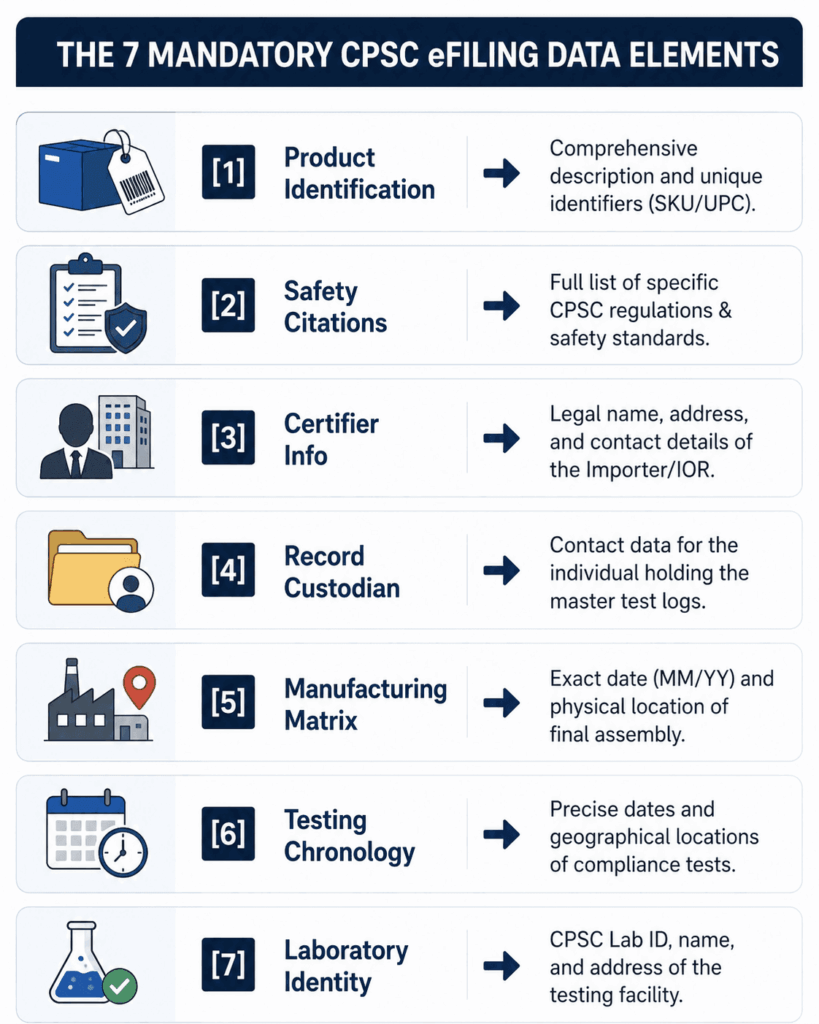
Every importer must work proactively with their manufacturing partners in regions like Guangdong, Zhejiang, and Jiangsu to extract and catalog these seven data elements into an accessible database long before booking ocean freight from China:
- Product Identification & Description: Brand name, model numbers, unique SKU identifiers, and a detailed breakdown of the finished product’s physical composition.
- Applicable Safety Citations: A complete list of every individual CPSC safety regulation, ban, and consumer standard to which the product must conform.
- Certifier Contact Information: The legal identity, business address, telephone number, and corporate email of the importer of record or domestic manufacturer certifying the item’s compliance.
- Compliance Record Custodian: The name, physical mail address, and digital contact information of the specific individual responsible for maintaining the master lab test reports supporting the certificate.
- Manufacturing Date and Location: The exact month and year when final product assembly was completed, alongside the physical street address of the manufacturing facility in China.
- Product Testing Chronology and Location: The precise calendar date and geographical location where the product was most recently tested for compliance with the cited safety standards.
- Accredited Laboratory Identity: The official CPSC laboratory identification number, full corporate name, and street address of the third-party testing facility that executed the underlying safety evaluations (mandatory for all CPC filings).
Strategic Execution: Full Declaration vs. The CPSC Product Registry
To manage this incoming data influx, the CPSC provides importers with two distinct electronic filing mechanisms through the ACE platform. Selecting the right configuration depends entirely on your product portfolio complexity and shipment frequencies.
Option A: The Full PGA Message Set (Transaction-by-Transaction)
Under this method, your customs broker manually inputs all seven mandatory data elements directly into the entry transmission for every individual shipment.
- Who it’s for: This approach is ideal for boutique retailers, brands with low SKU counts, or companies managing highly irregular, one-off seasonal import campaigns.
- The Operational Risk: If you run high SKU counts or dynamic assortments (such as varied toy collections), manual entry increases the risk of typographical errors, mismatch alerts, and processing delays at the port.
Option B: The Reference PGA Message Set (CPSC Product Registry)
This represents the most highly efficient approach for high-volume enterprise brands and established e-commerce sellers. Importers register for a secure account directly within the official CPSC Product Registry.
Inside this dashboard, you pre-upload your master CPC/GCC information and link it to your product catalog, generating a unique, system-issued reference ID for each SKU.
When it comes time to execute your China to usa shipping filings, your customs broker only needs to input the short product reference ID into the ACE message set. The customs system automatically pulls the verified compliance details from the CPSC database.
Leveraging the Regulatory Robot
If you are uncertain about the specific safety rules that apply to a new product line, utilize the CPSC’s interactive Regulatory Robot tool available via the official eFiling portal. This multilingual platform walks users through a structured series of questions regarding product composition, target consumer age, and intended function to generate a baseline compliance report.
While the Regulatory Robot serves as an excellent operational starting point, it cannot replace a formal legal audit of your manufacturing certificates.
The Perfect Storm: Peak Season Volatility and the Foreign IOR Crackdown
The enforcement of mandatory eFiling on July 8, 2026, is colliding with a highly volatile Transpacific logistics environment. Understanding this broader operational context is critical for preventing catastrophic supply chain bottlenecks.
The Peak Season Space Squeeze
Driven by early inventory front-loading, China to usa freight rates are experiencing severe upward pressure, with spot prices hitting levels not seen since the global supply chain adjustments of previous peak cycles.
Space allocations on standard carrier loops are tight, and container rolling is common at major Asian export hubs. In this environment, you cannot afford a customs delay.
If your shipment arrives at the Port of Los Angeles or Long Beach and faces a CPSC hold due to an eFiling mismatch, your cargo will be directed to an off-dock Centralized Examination Station (CES).
While your container sits in the exam queue, the carrier’s free-time clock runs continuously, exposing your business to thousands of dollars in terminal demurrage fees and equipment detention fines that will quickly erase your product’s landed profitability.
The Foreign IOR Crackdown
This issue is further amplified by US Customs’ intense focus on foreign-registered Importers of Record. If your business relies on an indirect third-party IOR framework or an unverified foreign entity setup, you face heightened vulnerability.
The automated validation checks inside the ACE system will instantly cross-reference the name on your customs bond with the corporate identity listed on your CPSC electronic certificate. Any structural discrepancy between the certificate holder and the actual financial importer of record will trigger an immediate system block.
To explore the legal realities governing import liability and customs enforcement, read our comprehensive operational analysis on The Death of Gray-Market DDP: Decoding Trump’s June 3 Executive Order on US Customs Enforcement and the New Foreign IOR Restrictions
Choosing the Right Logistics Channel
When time-sensitive retail orders or high-value toy inventories must hit store shelves without delay, moving away from low-cost, slow-moving carrier alliances is highly strategic.
Allocating your volume to premium expedited ocean channels—such as Matson’s CLX/CLX+ loops or ZIM’s ZEX express networks—provides dedicated terminal discharge privileges and priority chassis access that keep your cargo moving smoothly through port infrastructure.
To evaluate the operational transit times and structural advantages of these specialized express services, review our strategic logistics matrix on An In-Depth Analysis of US Ocean Freight: How to Choose Between Matson, ZIM, and Standard Carriers.
Secure Your July Space Allocations and Compliance Pathways with Kisun Shipping
The modern US customs environment demands an agile, asset-backed logistics partner who can manage both physical cargo movement and complex digital data compliance simultaneously. At Kisun Shipping, we don’t just move boxes; we protect your business from regulatory risks.
Through our direct contracts with Tier-1 ocean liners, premium express fast-boat networks, and an experienced team of in-house Licensed Customs Brokers, we provide stable space allocations and highly compliant customs clearance workflows across every major US gateway.
We can help you audit your existing CPC/GCC certificate databases, set up your profile within the CPSC Product Registry, and ensure your PGA message sets match your ACE entries perfectly before your vessel leaves port.
Don’t let the July 8 eFiling cliff disrupt your peak-season momentum. If you want to audit your current toy inventory compliance, secure stable space allocations, or evaluate optimized routing strategies, connect with a Kisun Shipping Compliance and Allocation Specialist Today.

China Logistics Expert
About the Author
Katherine Kang is a China-based logistics consultant with over 11 years of experience in international trade and freight forwarding. Specializing in helping SMEs import from China to the USA, Canada, and Europe, she focuses on compliant, cost-effective solutions to avoid delays, tariffs, and hidden fees. From anti-dumping guidance to CNY planning, Katherine has managed hundreds of shipments, saving clients 15-30% on average.
Connect with Katherine on LinkedIn or contact Kisun Shipping for a free import consultation.