

September 2026 Ocean Freight Rates: What Importers Should Expect
September is approaching, and many importers are asking the same question:
Will ocean freight rates from China rise again in September 2026?
Based on the latest market data, the answer is probably yes for several major trades — but not because September is simply “peak season.”
The more important story is the combination of carrier capacity cuts, Panama Canal restrictions, blank sailings, port disruption and ongoing geopolitical risks. These factors are tightening effective capacity just as seasonal shipping demand remains relatively firm.
For businesses importing from China, this means that waiting for September rates to suddenly fall could be risky.
September 2026 Freight Rate Forecast at a Glance
| Trade | Current Market | September Outlook |
|---|---|---|
| China → US West Coast | High and rising | High, with upward pressure |
| China → US East Coast | Very high | Higher risk of further increases |
| China → US Gulf | High | Upward pressure |
| China → Middle East | Extremely volatile | High volatility, upward risk |
| China → Europe | Softer than US routes | More balanced |
The important point is that not every China export route is moving in the same direction.
The latest SCFI data illustrates this divergence clearly. On August 21, the SCFI reached 3,409.63, up 1.6% from the previous week. Shanghai–Los Angeles reached $6,765/FEU, while Shanghai–US East Coast reached $9,700/FEU.
Drewry’s latest World Container Index tells a similar story. On August 20, Shanghai–Los Angeles rose 9% week over week to $6,802/FEU, while Shanghai–New York also rose 9% to $9,507/FEU. Meanwhile, capacity from Asia to the US East Coast had fallen 9% during August.
Our September View
At Kisun Shipping, our expectation is:
US-bound ocean freight rates are more likely to remain high or increase moderately than experience a major decline in September.
However, we do not expect every announced carrier increase to be fully reflected in actual spot rates.
That distinction matters.
For example, HMM has announced a September 1 GRI of $3,000 per 40-foot/40HQ container for its Transpacific Eastbound trade. But HMM also states that the actual application of the GRI remains subject to market conditions.
In other words, a carrier can announce a $3,000 increase, but the final market rate will still depend on booking demand, vessel utilization, available space and how aggressively carriers manage capacity.
This is why we would describe the September market as:
High and volatile, with an upward bias — rather than a guaranteed straight-line increase.
And there is another important factor that many importers may not yet be watching closely enough:
The Panama Canal is about to become a much bigger part of the pricing equation.
Starting September 4, the Panama Canal Authority plans to reduce daily vessel transits to 34, followed by a further reduction to 32 from September 15. At the same time, tighter draft restrictions are limiting how much cargo certain vessels can carry.
That matters particularly for China → US East Coast and US Gulf Coast shipments, where Panama Canal capacity directly affects available vessel space.
And carriers are already putting additional costs into their September pricing.
CMA CGM, for example, has announced a $500/TEU Panama Canal Adjustment Factor for cargo moving from Asia via the Panama Canal to the US East Coast and US Gulf Coast, effective September 10. MSC has also announced a new Panama Canal surcharge effective September 12.
So the real question for September is not simply:
“Is it peak season?”
The better question is:
“How much effective vessel capacity will actually be available?”
That is what we will examine next.
Why Could Freight Rates Rise in September Even Without a Massive Demand Surge?
It is tempting to explain September freight increases with one simple phrase: “peak season.”
But that would miss the bigger picture.
The current market is increasingly a capacity story rather than a pure demand story. Carriers are actively managing available vessel space at the same time that weather disruptions, port congestion and Panama Canal restrictions are reducing effective capacity.
1. Carriers Are Removing Capacity Through Blank Sailings
One of the clearest signs is the number of cancelled sailings.
Drewry expects 49 blank sailings across the major East–West trades between late August and late September, representing about 6% of scheduled departures. Around 60% of these cancellations are concentrated on the eastbound transpacific trade, meaning Asia → North America is taking the largest share of the capacity reduction.
For importers, this is important because a cancelled sailing does not simply mean a ship disappears from the schedule.
It can mean:
Fewer sailing options → tighter allocations → cargo rolled to a later vessel → less available space → stronger pricing
This is also why a market can experience high freight rates even when overall cargo demand is not surging dramatically.
Carriers do not need to remove a huge amount of capacity to change the market. They only need to make available space tighter on the routes where demand is strongest.
2. The Panama Canal Is Becoming a Real Cost and Capacity Issue
The Panama Canal is no longer just a risk that shipping companies are monitoring. It is already affecting September planning.
The Panama Canal Authority announced that daily transit capacity will be reduced to 34 vessels from September 4, followed by 32 vessels from September 15.
At the same time, lower water levels are affecting vessel draft limits. The Authority has continued adjusting the maximum draft allowed for Neopanamax vessels as it manages Gatun Lake and changing weather conditions.
This matters particularly for China → US East Coast and US Gulf Coast services that depend on the Panama Canal.
There are two separate effects:
Less transit capacity means some vessels may have to wait or adjust schedules.
Lower draft limits can also restrict how much cargo a vessel can carry.
In other words, the issue is not simply that ships may take longer.
The bigger concern is that effective cargo-carrying capacity can fall.
And carriers are already charging for the additional operational pressure. CMA CGM, for example, has announced a Panama Canal Adjustment Factor of $500 per TEU for relevant Asia → US East Coast and Gulf Coast cargo from September 10.
3. Port Congestion Is Effectively Taking Ships Out of Circulation
Another factor that importers often overlook is the difference between fleet capacity and usable capacity.
The global container fleet may continue to grow, but that does not mean all of those containers and vessels are available exactly when and where shippers need them.
According to data reported by Sea-Intelligence, around 1.7 million TEUs of global container vessel capacity were tied up in port-related delays in June, equivalent to approximately 5% of global deep-sea capacity.
That is a significant amount of capacity effectively removed from normal circulation.
This helps explain why shipping rates can remain elevated even when new vessels are being delivered and total fleet capacity is larger than before.
A ship stuck in congestion is technically part of the global fleet.
But for an importer waiting for space from Shenzhen to Los Angeles next week, that ship is not available.
4. September Demand Is Still Important — Just Not the Whole Story
Demand should not be ignored.
September remains an important period for importers preparing inventory for the final quarter, particularly for e-commerce, consumer goods and seasonal products.
Current market commentary also suggests that transpacific import demand is expected to remain relatively strong into September rather than dropping immediately after the August peak.
But this does not necessarily mean that September will produce a demand explosion.
The more important point is the combination:
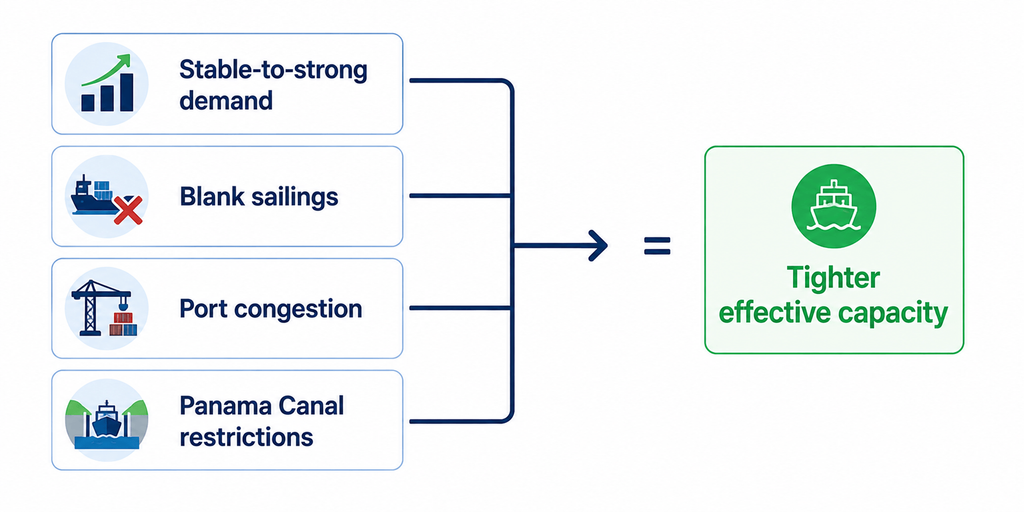
That is the environment in which freight rates can stay high.
The Key Takeaway for Importers
The September market should therefore not be viewed as:
“Peak season = rates must rise.”
A better interpretation is:
“When demand remains firm while effective capacity becomes tighter, carriers gain more pricing power.”
This is why we expect the US trades to remain under upward pressure in September, particularly the US East Coast and Gulf Coast.
However, there is an important caveat:
A carrier’s announced GRI is not necessarily the same as the final rate paid by an importer.
The actual market rate will still depend on vessel utilization, booking volumes, available allocations and how aggressively carriers enforce their announced increases.
That is why September could bring high and volatile rates rather than a simple one-way price increase.
The next question is even more important:
Which China–US routes face the greatest risk of further increases in September?
For importers, the answer is not the same for the US West Coast, US East Coast and US Gulf Coast.
Which China Shipping Routes Face the Biggest Risk in September?
Not all US-bound routes have the same outlook.
Based on current pricing and capacity conditions, we see the US East Coast and Gulf Coast as higher-risk markets, while the West Coast has a slightly better chance of stabilizing.
1. China → US West Coast: High, But a Sharp Further Spike Is Less Certain
Shanghai–Los Angeles rates have already climbed to around $6,800/FEU, with weekly increases of roughly 9%.
The West Coast remains expensive, but there is one reason not to assume another dramatic jump in September:
August’s pre-stocking surge may begin to cool.
If booking volumes moderate while additional capacity becomes available, spot rates could temporarily stabilize or pull back.
Our view:
September outlook: High and volatile, with limited room for a sharp decline but also no clear evidence that another major spike is inevitable.
For importers with flexible delivery plans, the West Coast may therefore remain the more economical US gateway.
2. China → US East Coast: Higher Risk of Further Increases
The East Coast looks more exposed.
Shanghai–New York spot rates were already around $9,500/FEU in the latest Drewry assessment, while broader Asia–US East Coast rates have been reported in the $8,000–$10,500/FEU range.
More importantly, East Coast services are directly affected by the Panama Canal situation.
CMA CGM will increase its Panama Canal Adjustment Factor to $500/TEU from September 10, while MSC will apply a Panama Canal Surcharge from September 12.
This does not mean every East Coast quote will automatically increase by the full surcharge amount.
But it does create another layer of upward pressure on an already expensive trade.
September outlook: Very high, with a stronger upward risk than the West Coast.
3. China → US Gulf: Watch This Route Closely
The US Gulf should not be overlooked.
Services using the Panama Canal are also exposed to the same capacity restrictions and additional canal-related charges. CMA CGM’s September adjustment specifically covers the US East Coast and US Gulf.
For importers whose final destination is Texas or other central US markets, it may be worth comparing:
US Gulf vs. US West Coast + inland transport
The cheapest ocean freight rate does not always produce the lowest total landed cost.
4. China → Middle East: The Most Unpredictable Market
The Middle East is a different story from the US trades.
The biggest issue is not normal seasonality. It is geopolitical and navigation risk.
Recent market reports indicate that some Asia–Middle East container rates have already moved above $10,000/FEU, with the market remaining highly sensitive to developments affecting major shipping routes.
For shippers moving cargo to Saudi Arabia, Kuwait, Iraq and other Gulf destinations, a freight quote can therefore change much faster than on a normal trade lane.
September outlook: Extremely volatile.
For these shipments, checking the validity period of the quotation is almost as important as checking the quoted ocean freight itself.
What Should Importers Do in September?
The current market does not suggest that every shipment must be booked immediately at any price.
Instead, the practical approach is to make decisions based on cargo readiness and delivery deadlines.
For cargo that is already ready to ship, waiting several weeks purely in the hope of a major rate correction could create more risk, especially on US East Coast and Gulf Coast services.
For cargo that is not yet ready, monitor the market rather than committing too early to a high long-term rate.
And always ask your forwarder one important question:
“Is this the current spot rate, or is this rate based on a carrier’s new September surcharge?”
That distinction can make a significant difference when comparing quotations.
The September market is likely to remain expensive. But the bigger opportunity for importers may not be finding a dramatically cheaper rate—it may be choosing the right route, sailing and booking window before space becomes tighter.
September 2026 Freight Rate Outlook: What Should Importers Expect?
Looking at the market as a whole, we do not expect a broad-based collapse in ocean freight rates in September.
Our base-case scenario is:
High rates + strong volatility + an upward bias on key China–US trades.
The biggest risk remains the US East Coast and Gulf Coast, where Panama Canal restrictions add another layer of pressure. The West Coast has a better chance of stabilizing if August’s strong pre-stocking demand continues to cool.
The Middle East market is harder to predict because geopolitical developments can change vessel deployment and sailing costs very quickly.
Our September Forecast
| Route | September 2026 Outlook |
|---|---|
| China → US West Coast | High / likely to stabilize or rise moderately |
| China → US East Coast | Very high / upward risk |
| China → US Gulf | Very high / upward risk |
| China → Middle East | Highly volatile / difficult to predict |
One thing we would not recommend is assuming that every September GRI will eventually become the actual market rate.
Carrier announcements are an important signal, but the final price still depends on how full vessels are and how much space is actually available.
What Importers Can Do Now
For shipments already ready to move, obtain updated September quotations early and check the rate validity, allocation and surcharge conditions rather than comparing only the headline ocean freight.
For future shipments, keep some flexibility in your routing and sailing dates. A slightly higher ocean rate can sometimes be offset by avoiding delays, rolls or expensive last-minute bookings.
Most importantly, do not plan your Q4 inventory using August freight rates alone.
September is likely to remain a market where rates are easier to push up than to push down.
At Kisun Shipping, we will continue monitoring carrier GRIs, blank sailings, Panama Canal conditions and major route disruptions as September develops. Freight rates can change quickly, so the most useful forecast is not simply a number—it is understanding what is pushing the market and which routes are most exposed.
September 2026 takeaway:
Don’t wait for a dramatic rate drop that may never come. Plan around your cargo readiness, delivery deadline and route risk—and treat every September quote as a moving market price.

China Logistics Expert
About the Author
Katherine Kang is a China-based logistics consultant with over 11 years of experience in international trade and freight forwarding. Specializing in helping SMEs import from China she focuses on compliant, cost-effective solutions to avoid delays, tariffs, and hidden fees. From anti-dumping guidance to CNY planning, Katherine has managed hundreds of shipments, saving clients 15-30% on average.
Connect with Katherine on LinkedIn or contact Kisun Shipping for a free import consultation.