
If you search online for shipping times from China to the UK, you may find very different answers.
One website says sea freight takes around 30 days.
Another freight forwarder quotes 45–55 days.
You may also receive a much faster quotation from another logistics company.
So which one is correct?
In many cases, they may all be correct.
The problem is that shipping time can be measured in different ways.
Some companies quote the time from one port to another.
Others quote airport-to-airport transit time.
But for most importers, the more important question is much simpler:
My goods are ready in China today. When will they actually arrive at my warehouse or business address in the UK?
That is a completely different calculation.
A vessel may spend a certain number of days travelling between China and the UK, but your cargo journey does not begin when the vessel leaves China—and it does not end when the vessel arrives at a UK port.
Your shipment may also need to go through pickup, warehouse handling, export procedures, loading, arrival handling, customs arrangements and final delivery.
That is why a shipment with a 30-day ocean transit can still take significantly longer from the time your cargo is ready until it reaches your final destination.
Port-to-Port Transit Time vs Door-to-Door Shipping Time
Before comparing shipping quotations, it is important to understand the difference between these two terms.
Port-to-Port Transit Time
This generally refers to the transportation time between the departure port and the arrival port.
For example:
Shanghai → Felixstowe
The quoted time usually focuses on the international transport stage itself.
It does not necessarily include:
- Cargo pickup
- Delivery to the departure port
- Export handling
- Waiting for vessel departure
- Import handling
- Customs procedures
- Delivery from the port to your final address
For this reason, port-to-port transit time should not automatically be treated as the total time required for your shipment.
Door-to-Door Shipping Time
Door-to-door time looks at the complete logistics journey.
A typical shipment may involve:
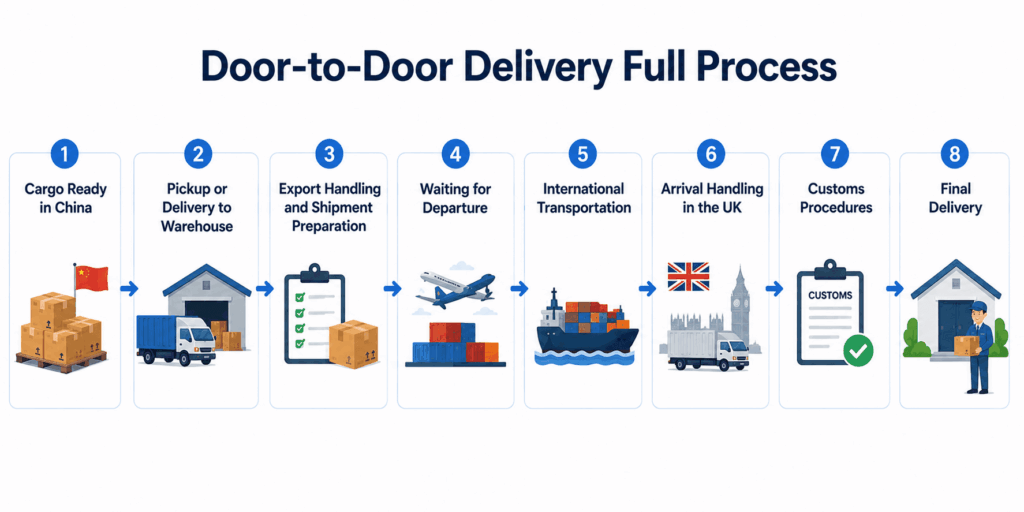
The exact process varies depending on the shipping method and service arrangement, but the key point remains the same:
The international transit time is only one part of the total shipping time.
For an importer, this distinction matters more than it may initially seem.
Imagine that your supplier tells you that the goods will be ready on 1 June.
You check an online shipping calculator and see:
Sea Freight: 30 Days
It is easy to assume that the cargo will arrive around 1 July.
But if those 30 days only represent port-to-port transit time, the actual door-to-door delivery date may be later.
This is one of the most common reasons why importers feel that their shipment has taken longer than expected—even when the international transportation itself operated close to schedule.
Shipping Time Should Be Measured from the Right Starting Point
Another issue is the starting date.
When someone says:
“This service takes 30 days.”
You should ask:
30 days from when?
Possible starting points may include:
- From cargo pickup
- From warehouse receiving
- From vessel departure
- From flight departure
- From customs release
These are not the same thing.
For planning inventory, the most useful question is usually:
How long will it take from the time my cargo is ready in China until it reaches my destination in the UK?
This gives you a more realistic basis for planning stock levels, sales campaigns and replenishment schedules.
Typical Door-to-Door Shipping Times from China to the UK
Based on the services we currently arrange, the following are typical door-to-door time ranges:
| Shipping Method | Typical Door-to-Door Time |
|---|---|
| Sea Freight | 45–55 days |
| Rail Freight | 35–45 days |
| Truck Freight | 25–30 days |
| Air Freight | 12–15 days |
These are typical service ranges rather than guaranteed delivery dates. Actual transit time can vary depending on the shipment, route, carrier schedule, operational conditions, customs procedures and final delivery arrangements.
The important thing is not simply to choose the fastest service.
For most businesses, the better question is:
Which shipping time fits my inventory and budget?
A business with enough inventory may prefer sea freight and lower transportation costs.
Another business may find that waiting 45–55 days creates too much inventory risk.
That importer may prefer rail freight or truck freight, even if the transportation cost is higher.
And when the shipment is genuinely urgent, air freight may be the only practical option.
The goal is not to find the fastest shipping method.
It is to find the right balance between delivery time, cost and supply chain risk.
Why the Same Shipping Method Can Still Have Different Transit Times
Choosing sea freight does not automatically mean every shipment will take exactly the same number of days.
The same is true for rail, truck and air freight.
Shipping time can change depending on factors such as:
- The departure location in China
- The destination in the UK
- Direct or transshipment routes
- Carrier schedules
- Cargo consolidation requirements
- FCL or LCL arrangements
- Available capacity
- Documentation accuracy
- Customs processing
- Final delivery scheduling
This is why it is important to treat quoted transit times as a planning range rather than an exact promise unless a specific guaranteed service has been agreed.
How Long Does Each Shipping Method Take from China to the UK?
Once you understand the difference between port-to-port transit time and the complete door-to-door shipping process, the next question is straightforward:
Which shipping option gives you the right delivery time for your business?
Based on the services we currently arrange, typical door-to-door transit times from China to the UK are:
| Shipping Method | Typical Door-to-Door Time | Best For |
|---|---|---|
| Sea Freight | 45–55 days | Cost-sensitive and planned shipments |
| Rail Freight | 35–45 days | A balance between cost and transit time |
| Truck Freight | 25–30 days | Faster replenishment without using air freight |
| Air Freight | 12–15 days | Urgent and time-sensitive shipments |
These time ranges should be used for planning rather than treated as guaranteed delivery dates. Actual transit times depend on the route, carrier schedule, cargo arrangement, customs processing and final delivery conditions.
The key is to understand what each option can realistically offer.
Sea Freight: Typically 45–55 Days Door to Door
Sea freight is usually the slowest option in this comparison, but for many importers, that does not make it the wrong choice.
If your inventory planning is stable and you have enough stock to cover the longer lead time, sea freight can provide a practical solution for larger or heavier shipments.
A typical 45–55 day door-to-door timeframe is very different from simply looking at the vessel’s sailing time.
Your cargo may still go through shipment preparation, export handling, waiting for departure, ocean transportation, arrival procedures and final delivery before the shipment reaches your address.
For this reason, sea freight works best when you can plan ahead.
It may be suitable if:
- Your inventory is not urgently required
- You can forecast demand in advance
- Your shipment is relatively large or heavy
- Controlling transportation costs is a higher priority than speed
However, sea freight becomes risky when your remaining inventory is already low.
If your warehouse has only 20 days of stock left, choosing a service that typically takes 45–55 days may create a supply gap, even if the freight cost is attractive.
In that situation, the cheapest shipping option may not be the cheapest business decision.
Rail Freight: Typically 35–45 Days Door to Door
Rail freight can be a useful middle option for importers who feel that sea freight is too slow but do not need the speed of air freight.
With a typical door-to-door timeframe of 35–45 days, rail freight may reduce the overall waiting time compared with sea freight while avoiding the higher cost associated with air transportation.
This can make sense for:
- Planned inventory replenishment
- Seasonal products with a clear delivery deadline
- Businesses with moderate time pressure
- Cargo that does not require air freight speed
The important point is that rail freight is not simply “faster sea freight.”
It should be viewed as a different supply chain option.
For example, if you have approximately 40 days before inventory becomes critical, sea freight may leave very little room for operational delays. Rail freight may provide a better safety margin.
Of course, the available route and service conditions should always be confirmed before booking.
Truck Freight: Typically 25–30 Days Door to Door
For us, truck freight is one of the most useful options for shipments that fall between rail and air.
This is because many importers face the same problem:
Sea freight takes too long. Rail freight is still not fast enough. But air freight is outside the budget.
In these situations, a 25–30 day door-to-door truck freight service may provide a more suitable balance.
This option can be particularly useful when:
- Inventory is running lower than expected
- A new shipment is needed sooner
- You cannot wait 35–55 days
- Air freight costs are difficult to justify for the full shipment
For example, imagine your current inventory is expected to last approximately 30–35 days.
Choosing sea freight could create a significant supply gap.
Rail freight may still leave limited flexibility.
A 25–30 day option could provide a more realistic replenishment solution.
This is where shipping decisions should be based on your actual inventory situation, not simply the lowest freight quotation.
Air Freight: Typically 12–15 Days Door to Door
Air freight is the fastest option among the services listed above.
With a typical door-to-door timeframe of 12–15 days, it is generally suitable when the cost of waiting is higher than the additional transportation cost.
Typical situations include:
- Urgent inventory replenishment
- Time-sensitive commercial orders
- High-value products
- Product launches
- Unexpected stock shortages
However, faster is not automatically better.
If your cargo does not need to arrive within two weeks, paying for air freight may not provide enough commercial benefit to justify the additional cost.
The decision should be based on the value of receiving the goods earlier.
For some businesses, paying more for air freight may help avoid lost sales or stock shortages.
For others, better planning may allow them to use rail or sea freight instead.
A Simple Way to Compare Your Options
Rather than asking which shipping method is “best,” start with one question:
When do you actually need the goods in the UK?
A simple planning guide may look like this:
| If Your Goods Are Needed… | A Possible Option to Consider |
|---|---|
| In around 12–15 days | Air Freight |
| In around 25–30 days | Truck Freight |
| In around 35–45 days | Rail Freight |
| After 45 days or more | Sea Freight |
This is not a fixed rule.
Cargo type, budget, route availability and operational conditions must also be considered.
But starting with the required delivery date can help eliminate unsuitable options immediately.
For example, if you need your cargo within 30 days, there is little value in spending time comparing sea freight services that normally require a longer overall lead time.
The Real Question: How Much Time Can Your Inventory Actually Give You?
A better shipping decision starts with your inventory rather than the freight rate.
Before choosing a service, consider:
- How much stock do you currently have?
- How many days will that stock last?
- Is demand stable or increasing?
- Is there an upcoming sales season?
- How much delay can your business realistically tolerate?
For example:
If your inventory can last another 60 days, sea freight may be perfectly suitable.
If you only have 30 days of inventory remaining, the decision becomes more complicated.
You may need a faster option—or you may consider splitting the shipment, with a smaller quantity sent faster while the remaining cargo travels using a lower-cost method.
The purpose of choosing a shipping method is not simply to move goods from China to the UK as quickly as possible.
It is to make sure your goods arrive before your business actually needs them.
Why Can Shipping Times Vary Even When You Use the Same Method?
Choosing sea freight, rail freight, truck freight or air freight does not mean every shipment will arrive in exactly the same number of days.
A quoted transit time is usually a planning range, not a fixed arrival promise.
For example, two shipments may both travel by sea from China to the UK, but one arrives in 47 days while another takes 54 days.
That difference does not necessarily mean something has gone wrong.
International shipping involves multiple stages, and the total delivery time can be affected before, during and after the main transportation stage.
The following are some of the most important factors.
1. Cargo Ready Date Does Not Always Mean Immediate Departure
One of the most common misunderstandings is assuming that once the goods are ready, international transportation begins immediately.
In reality, there may still be operational steps before departure.
Depending on the shipping arrangement, the cargo may need to be:
- Picked up from the supplier
- Delivered to a consolidation warehouse
- Checked and prepared for shipment
- Consolidated with other cargo
- Loaded into a container or prepared for departure
The next available departure schedule may also not be on the same day.
This is particularly important for importers planning inventory.
Instead of asking only:
“How many days does this shipping method take?”
It is also useful to ask:
“When is the next available departure after my cargo is ready?”
A service may have a relatively short transit time, but if the cargo waits several days before departure, the total lead time will be longer.
2. Direct Services and Transshipment Are Not the Same
The route itself can affect the final shipping time.
Some shipments may travel through a direct service, while others involve one or more transshipment points.
A transshipment can add additional handling and waiting time to the overall journey.
However, this does not mean that a direct route is always available or automatically the best option for every shipment.
Route availability depends on factors such as:
- Departure location
- Destination
- Carrier service
- Current schedules
- Cargo type
- Available capacity
When comparing quotations, it is therefore worth confirming whether the quoted time is based on a direct service or a route involving transshipment.
3. LCL Shipments Can Follow a Different Timeline from FCL
Two shipments may both move by sea freight but follow different operational processes.
FCL
With a Full Container Load, the container is generally arranged for a single shipper’s cargo.
The shipment process is relatively straightforward once the container is loaded and released for export.
LCL
With Less than Container Load, cargo from multiple shippers may need to be consolidated before departure.
After arrival, the container also needs to be handled and separated before individual shipments can continue to their final destinations.
This means that the total door-to-door timeline for LCL should not be compared directly with a simple vessel sailing schedule.
For smaller shipments, the international sea journey is only one part of the process.
4. Documentation Can Affect the Entire Shipment
Shipping delays are not always caused by transportation.
Incomplete or incorrect information can create problems before or after the cargo moves.
Depending on the shipment, logistics providers may require accurate information relating to:
- Product description
- Cargo quantity
- Weight and dimensions
- Commercial documents
- Customs information
- Consignee details
If important information needs to be corrected or clarified, this may affect the shipment schedule.
The simplest way to reduce this risk is to prepare shipment information accurately before the cargo is handed over for transportation.
5. Customs Processing Can Affect the Final Delivery Date
Arrival in the UK does not automatically mean immediate delivery.
The cargo may still need to complete the relevant import procedures before it can continue to the final destination.
The actual time required can depend on the shipment and the accuracy of the information provided.
For this reason, importers should avoid planning their inventory based only on the expected arrival date of the vessel, train, truck or aircraft.
The more useful date is:
The estimated delivery date to your final destination.
This is particularly important when goods are required for a product launch, seasonal sales period or inventory replenishment.
6. Final Delivery Also Needs to Be Scheduled
The last stage of the journey is easy to overlook.
Even after the cargo has completed the main transportation and arrival procedures, final delivery still needs to be arranged.
Factors that may affect this stage include:
- Delivery location
- Cargo size
- Vehicle requirements
- Warehouse receiving hours
- Delivery appointment requirements
For example, some warehouses or fulfilment centres may require a delivery appointment.
If the receiving location cannot accept the cargo immediately, this can affect the final delivery date.
This is why a shipment should not be considered “delivered” simply because it has arrived in the UK.
Shipping Time Is a Range, Not a Stopwatch
The biggest takeaway is simple:
A shipping time is not just the number of days spent moving between China and the UK.
It is the result of the entire logistics process.
That is why our typical service times are presented as ranges:
- Sea Freight: 45–55 days
- Rail Freight: 35–45 days
- Truck Freight: 25–30 days
- Air Freight: 12–15 days
A range gives importers a more realistic basis for planning than a single number that may only represent the best-case scenario.
For inventory planning, it is usually better to prepare for the realistic delivery window rather than assuming that every shipment will arrive on the earliest possible date.
How Should You Plan Around Possible Delays?
The best approach is not necessarily to choose the fastest shipping service.
It is to build enough flexibility into your supply chain.
Before booking a shipment, consider:
- When will the cargo actually be ready?
- When is the next available departure?
- When do you need the goods in the UK?
- How much inventory do you currently have?
- How many days of delay can your business tolerate?
If your business needs the goods by a specific date, the shipping method should be selected based on the latest realistic arrival date, not simply the fastest estimated transit time.
For example, if your inventory is expected to run out in 40 days, choosing a service with a typical delivery range of 35–45 days leaves very little room for operational changes.
In that situation, you may need to choose a faster service or adjust the shipment plan.
Seasonal Demand Requires Earlier Planning
Shipping schedules become more important when your products are connected to a specific sales period.
For example:
- Christmas sales
- Black Friday promotions
- New product launches
- Seasonal retail demand
If your goods arrive after the sales period begins, faster transportation may no longer solve the problem.
This is why seasonal shipments should generally be planned from the expected sales date rather than waiting until inventory begins to run low.
The key question is:
What happens if this shipment arrives later than planned?
If the answer is simply that the customer can wait a few extra days, you may have more flexibility.
If a late shipment means missing an entire seasonal sales period, your planning should include significantly more time.
Separate Your Shipping Deadline from Your Stock-Out Date
One of the most useful changes an importer can make is to stop treating the stock-out date as the delivery deadline.
These should be two different dates.
Stock-Out Date
The date when you expect your existing inventory to run out.
Shipping Deadline
The latest date when your new shipment should arrive to prevent disruption.
Ideally, the new shipment should arrive before your existing stock reaches zero.
The difference between these dates provides your operational buffer.
For example, if you expect to run out of inventory on 30 June, scheduling delivery for exactly 30 June leaves no room for:
- Changes in demand
- Delivery scheduling issues
- Warehouse processing
- Normal variation in shipping time
A safer approach is to establish an earlier internal delivery target.
This does not guarantee that delays will never happen, but it gives your business more flexibility when they do.
For Regular Importers, Shipping Should Become a Repeating Schedule
If you import the same or similar products regularly, each shipment should not be planned as a completely new emergency.
Over time, you can build a more predictable shipping cycle.
For example, you can track:
- Average production time
- Typical shipping time
- Seasonal demand changes
- Average daily sales
- Inventory remaining when the next shipment is dispatched
After several shipments, this information can help you identify patterns.
You may discover that:
- You regularly start shipping too late
- Your production time is less predictable than expected
- Your safety buffer is too small
- Certain periods require earlier booking
This is much more useful than simply remembering that:
“Sea freight takes around 50 days.”
The goal is to turn shipping time into part of your normal inventory planning process.
A Simple Shipping Planning Checklist
Before arranging your next shipment from China to the UK, check the following:
Your deadline
- When do the goods need to be available?
- Is there a fixed sales or business deadline?
Your inventory
- How much stock do you currently have?
- Approximately how long will it last?
Your supply timeline
- When will production be completed?
- Are there any additional preparation requirements?
Your logistics timeline
- What is the expected door-to-door delivery range?
- What is your internal safety buffer?
When these dates are visible together, it becomes much easier to identify whether you still have time to use a slower shipping option—or whether the shipment needs to move sooner.
The Main Lesson
The best time to arrange shipping is usually before the shipment becomes urgent.
Once your inventory is already close to running out, your available options become more limited and you may be forced to prioritise speed over cost.
A better approach is to plan from the date when you need the goods, work backwards through production and shipping, and leave enough flexibility for normal changes along the way.
That way, shipping becomes part of your supply chain planning rather than a last-minute problem to solve.

China Logistics Expert
About the Author
Katherine Kang is a China-based logistics consultant with over 11 years of experience in international trade and freight forwarding. Specializing in helping SMEs import from China she focuses on compliant, cost-effective solutions to avoid delays, tariffs, and hidden fees. From anti-dumping guidance to CNY planning, Katherine has managed hundreds of shipments, saving clients 15-30% on average.
Connect with Katherine on LinkedIn or contact Kisun Shipping for a free import consultation.