

UK Customs Clearance for Imports from China: How Does It Work?
Quick Answer
For imports from China into Great Britain, customs clearance involves making the required import declaration, providing accurate information about the goods, classifying them with the correct Commodity Code, determining the customs value and handling any applicable Duty, VAT, licences or other import requirements.
You can manage customs yourself or appoint a customs agent to handle the declaration on your behalf
For UK businesses importing goods from China, customs clearance is one of the most important steps between international transportation and final delivery.
A shipment arriving at a UK port does not automatically mean that the goods can be delivered to your warehouse.
Before the goods can normally move through the import process, the relevant customs declaration and border procedures need to be completed.
The good news is that importers do not necessarily have to manage the customs declaration themselves. A business can appoint a customs agent or other intermediary to handle customs procedures on its behalf.
This guide explains how UK customs clearance works for goods imported from China, what information is involved, and where importers commonly encounter problems.
Important: This guide focuses primarily on imports into Great Britain — England, Scotland and Wales. Northern Ireland can follow different customs arrangements, so importers shipping to Northern Ireland should check the specific requirements that apply to their shipment.
What Happens When Your Shipment Arrives in the UK?
A simplified China-to-UK import process looks like this:
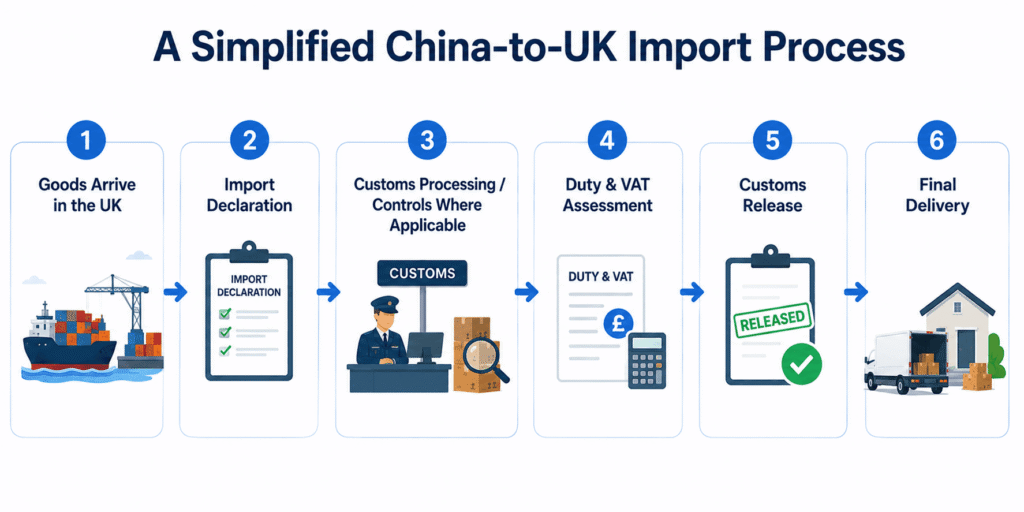
The exact process depends on the type of goods, customs procedure, declaration and other circumstances.
The important point is that arrival at the UK port is only one stage of the import process.
Your cargo still needs to be correctly declared and cleared before it can proceed to its final destination.
Who Handles UK Customs Clearance?
An importer has two broad options.
1. Handle the Customs Declaration Yourself
Businesses that manage their own imports can make their own customs declarations, provided they meet the relevant requirements.
For imports into England, Scotland and Wales, businesses generally need a GB EORI number to make import declarations. Northern Ireland has different EORI requirements in certain circumstances.
This approach can make sense for companies with an established import department and sufficient knowledge of UK customs procedures.
However, customs declarations can be complex, particularly when products have specific tariff, documentation or regulatory requirements.
2. Appoint a Customs Agent or Intermediary
A business can also appoint a customs agent, transporter or other intermediary to make customs declarations and handle customs procedures on its behalf.
GOV.UK notes that most businesses importing goods use a transporter or customs agent rather than completing every customs procedure themselves.
However, appointing an agent does not simply transfer every responsibility away from the importer.
HMRC states that businesses remain responsible for due diligence relating to their customs declarations even when someone else handles the customs process.
This is why accurate product and shipment information is so important.
What Information Does Customs Clearance Depend On?
A customs declaration contains information about the imported goods and the import transaction.
Among the key elements are:
- The goods being imported
- Commodity code
- Customs value
- Country of origin
- Quantity and other relevant shipment details
- Any applicable licences, certificates or documentary requirements
The Commodity Code is particularly important because it helps determine the applicable duty treatment and whether specific import controls or documentation requirements apply.
The value declared for customs purposes is also important because it is used when determining applicable duty and VAT.
This is why customs clearance should ideally be considered before the goods leave China, rather than only after the shipment reaches the UK.
Why Customs Clearance Is More Than “Paying Tax”
Some importers think the customs process simply means:
Goods arrive → Pay duty and VAT → Goods are released.
In reality, customs clearance involves establishing what the goods are, how they should be classified, what value should be declared and whether any additional controls or documents apply.
For example, the UK Trade Tariff can be used to check the Commodity Code, applicable duty and VAT rates, and whether licences or other tariff measures apply.
Certain Commodity Codes can also trigger specific documentary requirements.
HMRC guidance explains that the requirements associated with a Commodity Code can include documents and other customs controls, and that the applicable tariff should be checked for the relevant Great Britain or Northern Ireland process.
This is one reason why customs preparation should begin before the shipment arrives.
What Happens After Customs Clearance?
Once the relevant customs procedures have been completed and the goods are released, the shipment can proceed to the next stage of the logistics process.
For a door-to-door shipment, this normally means coordinating the final delivery from the port, airport, warehouse or other UK location to the agreed destination.
This is also why customs clearance time and total door-to-door shipping time are not the same thing.
For example, a shipment may arrive in the UK but still require customs processing and final delivery before it reaches the importer’s warehouse.
You can read more about the different China-to-UK door-to-door transit times in our guide to [shipping time from China to the UK].
The Most Important Point for New UK Importers
You do not need to become a customs specialist to import from China.
But you do need to understand who is responsible for the customs process and what information must be provided accurately.
Whether you manage the declaration yourself or appoint a customs agent, the quality of the information behind the declaration matters.
A good customs process therefore starts well before the cargo reaches the UK.
In the next part, we’ll look at the information UK importers need to prepare before customs clearance, including EORI, Commodity Codes, customs value and the information your customs agent may ask you to provide.
What Do You Need to Prepare for UK Customs Clearance?
A smooth customs clearance process usually starts before your goods leave China.
Your customs agent cannot make an accurate import declaration without accurate information about the goods, their value and the import transaction.
For most commercial shipments from China to Great Britain, four areas deserve particular attention:
- EORI and importer information
- Commodity Code
- Customs value
- Product and commercial documentation
Getting these details right before shipment can help avoid unnecessary questions or corrections later.
1. EORI: Who Is the Importer?
For businesses importing goods into England, Scotland or Wales, a GB EORI number is generally required when making import declarations. If goods move to or from Northern Ireland, different EORI requirements can apply. (source: gov.uk)
If you handle your own import declarations, this is one of the first things that needs to be in place.
If you appoint a customs agent, the agent can handle the declaration on your behalf, but the customs arrangement still needs to identify the appropriate importer and declaration structure.
This is also why DDP and DAP should not be treated as identical.
Under our DDP arrangement, the UK customer does not need to provide their own EORI or VAT details to us.
For our DAP service, the importer provides the required EORI and VAT information and authorises our customs broker to handle the declaration on their behalf.
2. Commodity Code: How Are Your Goods Classified?
The Commodity Code is one of the most important pieces of information in an import declaration.
It is used to identify the goods and determine matters such as:
- Applicable Customs Duty
- Import VAT treatment
- Certain tariff measures
- Whether licences or additional documents may be required
The UK Trade Tariff provides the official tool for checking the appropriate code and the measures associated with it. HMRC also explains that the correct code depends on information such as the type of product, what it is used for, the materials it is made from and how it is produced. (source: gov.uk)
This is why simply asking:
“What is the HS code for this product?”
may not always be enough.
Two products that look similar can potentially have different classifications depending on their characteristics and use.
For difficult classifications, importers should check the official tariff guidance or obtain appropriate professional advice rather than relying on a guessed code.
3. Customs Value: What Value Should Be Declared?
The customs value is another key part of the import declaration.
For the standard transaction value method, HMRC starts with the price actually paid or payable for the goods when sold for export to the UK, subject to the required customs valuation rules and adjustments. (gov.uk)
This means customs value should not simply be treated as:
“Whatever number appears on the invoice.”
The actual transaction and the applicable valuation rules matter.
For some imports, additional costs may need to be considered when determining the customs or import VAT value.
That is why an importer should provide accurate commercial information rather than creating a value simply to reduce the expected tax bill.
4. Product Information Must Be Specific
A customs declaration needs enough information to identify the goods accurately.
Descriptions such as:
“Accessories”
“Parts”
“General goods”
may not provide enough useful information on their own.
A better description explains what the product actually is.
For example:
Stainless steel kitchen storage rack
is considerably more useful than:
Kitchen items
The exact information required depends on the goods and the applicable customs requirements, but accurate product descriptions make classification and customs processing much easier.
This is particularly important when the goods may be subject to licensing, restrictions or other controls.
5. Commercial Documents
The exact documents required depend on the goods and the customs procedure.
However, your customs agent may need information or supporting documents such as:
- Commercial invoice
- Packing information
- Transport documents
- Purchase or transaction documents where relevant
- Licences or certificates where applicable
HMRC guidance on customs valuation also identifies commercial invoices, purchase orders, transport documents and freight-related documents among the types of evidence that may be relevant. (gov.uk)
The important point is:
There is no single document list that applies identically to every product.
6. What Your Freight Forwarder Will Usually Need From You
When requesting customs clearance, providing the following information upfront can make the process much more efficient:
Business Information
- Importer details
- GB EORI where applicable
- VAT information where relevant
Product Information
- Clear product description
- Commodity Code, if already known
- Country of origin
- Quantity
- Product materials or intended use where relevant
Commercial Information
- Commercial invoice
- Purchase price
- Currency
- Shipping and related charges where relevant
Shipment Information
- Number of cartons
- Gross weight
- Dimensions or volume
- Transport document details
Your customs agent can then assess what additional information or documentation may be required for the specific goods.
The Three Details That Deserve the Most Attention
If you are importing from China for the first time, pay particular attention to:
Commodity Code → affects duty and customs requirements.
Customs Value → affects the calculation of applicable duty and import VAT.
Product Description → supports accurate classification and declaration.
A mistake in one of these areas can affect more than the customs declaration itself.
It may also lead to additional questions, incorrect duty treatment or requests for supporting information.
The best time to resolve these issues is before the cargo leaves China, not after it arrives at a UK port.
Commodity Codes, Customs Duty and Import VAT: What Determines Your Import Costs?
Once the basic shipment information is prepared, three areas become particularly important:
Commodity Code → Customs Duty → Import VAT
These are closely connected, but they are not the same thing.
Understanding the relationship between them can help importers avoid one of the most common problems in international trade: discovering that the actual import cost is different from what they expected.
Commodity Code Comes First
The Commodity Code is not just a number required on the customs declaration.
It helps determine the customs treatment of the goods.
Using the correct code can affect:
- Customs Duty
- Import VAT
- Applicable tariff measures
- Required licences or documents
- Other import controls
The UK’s Trade Tariff allows importers to check the Commodity Code and the measures that apply to specific goods. The information needed to classify a product can include its type, use, materials and how it was manufactured. (gov.uk)
This is why a freight forwarder should not simply guess a Commodity Code from a short product name.
For example, saying:
“It’s a metal product.”
is usually not enough information to establish the correct classification.
The actual product, material, function and other characteristics may matter.
If the classification is uncertain, the appropriate tariff guidance or formal classification route should be used rather than relying on an assumption.
How Does the Commodity Code Affect Customs Duty?
Once the goods have been correctly classified, the applicable tariff measures can be checked.
Different products can have different Customs Duty treatment.
This means that two shipments with the same customs value can still have different duty liabilities if the goods are classified differently.
The Trade Tariff is therefore an essential reference point before importing.
It allows an importer to check:
- The relevant Commodity Code
- Customs Duty rates
- Import VAT information
- Certain tariff measures
- Documentary or licensing requirements
For Great Britain imports, the relevant UK tariff should be checked for the goods being declared. Northern Ireland can follow different tariff arrangements depending on the movement, so the appropriate tariff tool should be used. (source: gov.uk)
Customs Duty Is Not Simply Based on the Supplier’s Invoice Price
Another common misunderstanding is:
“I paid £20,000 for the goods, so Customs Duty is simply calculated from £20,000.”
Not necessarily.
UK customs valuation rules determine the value used for import purposes.
The first valuation method to consider is generally Method 1: transaction value. This starts with the price actually paid or payable for the goods when sold for export to the UK, subject to the applicable customs valuation rules and required adjustments. (gov.uk)
There are also other valuation methods for situations where Method 1 cannot be used.
This is why customs value should be based on the actual transaction and the applicable valuation rules, rather than simply choosing a number that produces a lower tax bill.
How Do Customs Duty and Import VAT Relate to Each Other?
Customs Duty and Import VAT are separate charges.
The exact amount depends on the goods, their classification and the applicable valuation and tax rules.
A simplified way to think about the process is:
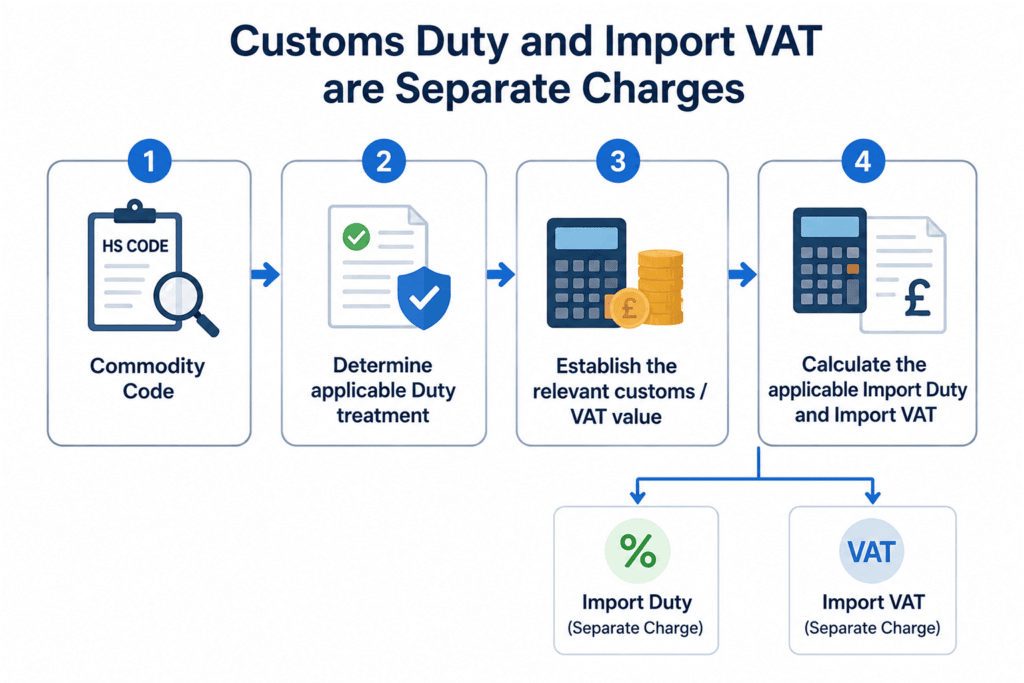
The calculation of import VAT can involve more than the customs value alone. HMRC provides specific guidance on which amounts must be included in the VAT value and which may be excluded under the applicable rules.
For this reason, simply taking:
Product value × VAT rate
is not a reliable way to calculate the final Import VAT.
What If I Do Not Know the Duty Rate?
Do not guess.
Use the official UK Trade Tariff and search for the product using its characteristics.
You may need information such as:
- What the product is
- What it is used for
- What materials it contains
- How it is manufactured
The tariff entry can then show the applicable duty and VAT information as well as other measures that may apply. (gov.uk)
If the product is difficult to classify, it is better to resolve the classification before shipment than to discover a problem after the cargo has arrived.
What About Import VAT Accounting?
Import VAT does not always have to be handled in the same way for every UK business.
For example, a UK VAT-registered business may be able to use Postponed VAT Accounting (PVA) to account for import VAT on its VAT Return rather than paying the import VAT immediately at the point of import, subject to the relevant conditions. (source: gov.uk)
PVA is different from Customs Duty.
It is an accounting mechanism for eligible VAT-registered businesses and should not be confused with a reduction or exemption from Import VAT.
Businesses using PVA must account for the import VAT correctly on their VAT Return and retain the relevant records and statements.
A Simple Example of Why Classification Matters
Imagine two businesses import products with a similar purchase value.
One product is correctly classified under a Commodity Code with one duty treatment.
The other product falls under a different Commodity Code with a different duty treatment.
Even though the purchase values may be similar, their import costs can be different.
Now add Import VAT and any applicable valuation adjustments, and the difference can become more significant.
This is why getting the classification and customs value right before shipment can be more important than negotiating a small reduction in the freight rate.
What Should You Do Before Your Goods Leave China?
Before shipment, make sure your customs agent has enough information to review:
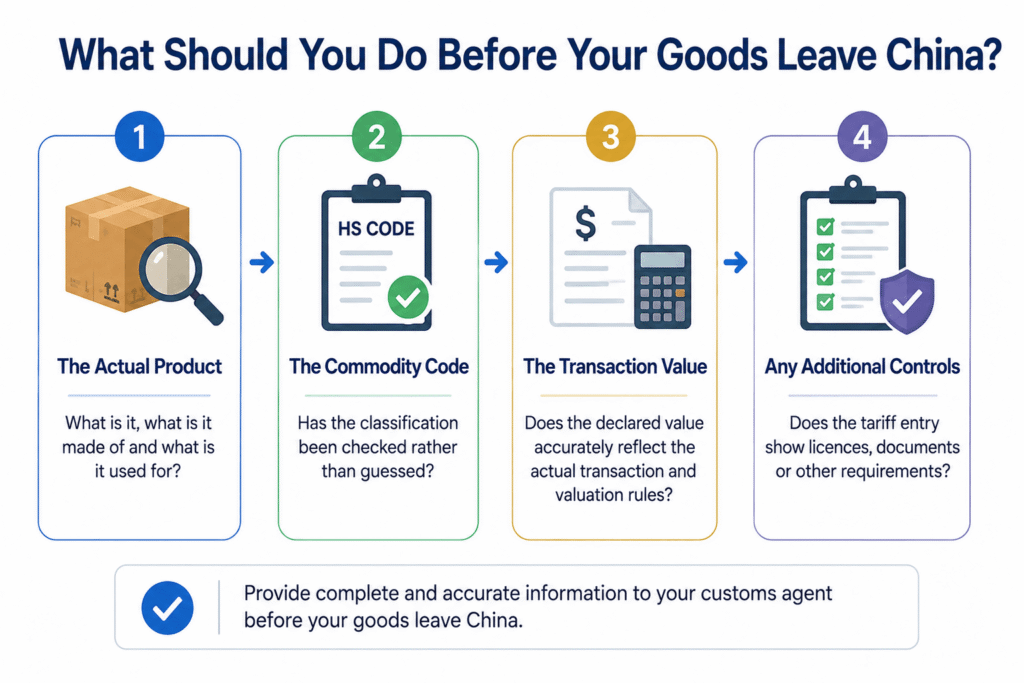
1. The actual product
What is it, what is it made of and what is it used for?
2. The Commodity Code
Has the classification been checked rather than guessed?
3. The transaction value
Does the declared value accurately reflect the actual transaction and applicable valuation rules?
4. Any additional controls
Does the relevant tariff entry show licences, documents or other requirements?
Resolving these questions before departure gives your customs representative more time to identify potential issues.
The Key Takeaway
A smooth customs clearance process does not start when the container reaches the UK.
It starts with correctly identifying the goods and understanding how the Commodity Code and customs value affect the import treatment.
Commodity Code → Duty treatment → Customs valuation → Import VAT
Getting these elements right can help prevent avoidable customs queries, incorrect tax calculations and delays.
The Main Lesson
There is no universal:
“UK customs document checklist.”
The correct requirements depend on what you are importing.
The most reliable process is:
Identify the goods → Check the Commodity Code → Check the applicable tariff measures → Prepare the required documents → Submit the declaration
That approach is much safer than collecting a generic set of documents and assuming they will be sufficient for every import.
What Documents and Import Requirements May Apply?
Once the goods have been correctly classified and the customs value has been established, the next question is:
What documents or additional requirements apply to my specific product?
There is no single document checklist that applies to every shipment entering Great Britain.
The requirements can change depending on the product, Commodity Code, customs procedure and whether the goods are subject to specific controls.
This is why a general list such as “invoice + packing list + bill of lading” should be treated as a starting point, not a complete customs checklist.
Commercial Documents
For a standard commercial shipment, your customs representative may need information supported by documents such as:
- Commercial invoice
- Packing information
- Transport documents
- Purchase or transaction records where relevant
These documents help establish what was sold, how much was paid, what was shipped and how the goods moved.
They can also be important when supporting the customs value used in the declaration.
The exact documents required depend on the shipment.
Some Products Need More Than Standard Customs Documents
Certain goods are subject to additional controls when imported into Great Britain.
Depending on the product and its Commodity Code, this may include:
- Import licences
- Health or sanitary documentation
- Safety or conformity-related documentation
- Certificates
- Other official permissions or declarations
The important point is that these requirements are product-specific.
For example, you should not assume that every electronic product, chemical product or food item requires exactly the same documents.
The correct starting point is the relevant UK tariff entry and the government guidance for the goods concerned. GOV.UK’s import guidance specifically directs businesses to check whether their goods are subject to prohibitions, restrictions, licences or other controls. (source: gov.uk)
Why Your Product Description Matters
A customs agent cannot determine the applicable requirements from a vague description.
Compare:
“Electronics”
with:
“Rechargeable LED work light with lithium-ion battery”
The second description provides significantly more information about what the product actually is.
A clear description can help your customs representative determine:
- The appropriate Commodity Code
- Whether additional controls apply
- What supporting documents may be required
The more specific the product information, the easier it is to identify potential customs requirements before the shipment arrives.
Restricted and Controlled Goods Need Extra Attention
Some imports are subject to prohibitions, restrictions or licensing requirements.
HMRC maintains specific guidance for prohibited and restricted imports into Great Britain, covering goods that may require additional authorisation or may be subject to specific controls. (gov.uk)
For these products, the safest approach is to check the requirements before booking the shipment.
Do not wait until the cargo has already arrived in the UK to discover that a licence, certificate or other permission is required.
What Can Happen If the Required Information Is Missing?
Missing or inconsistent information does not automatically mean that customs will reject a shipment.
However, it can lead to:
- Additional questions
- Requests for supporting documents
- Delays in the declaration process
- Additional checks
- Problems releasing the goods
This is particularly important when the product is subject to specific controls.
A few minutes spent checking requirements before shipment can be much more valuable than trying to resolve the issue after arrival.
Common UK Customs Clearance Problems and How to Prevent Them
Most customs problems do not begin when the shipment reaches the UK.
They often begin earlier, when product information, classification or commercial details are not prepared correctly.
A customs query may not mean that the goods have been rejected. In many cases, it simply means that customs or the customs representative needs more information before the declaration can be completed or the goods released.
The best time to prevent these problems is before the cargo leaves China.
1. The Commodity Code Is Incorrect or Unclear
An incorrect Commodity Code can affect more than the duty rate.
It may also affect whether additional documents, licences or other import controls apply.
This is why guessing a code based only on the product name is risky.
Better practice
Before shipment:
- Make sure the product description is specific.
- Check the relevant UK Trade Tariff entry.
- Provide your customs agent with enough information about the product’s materials, function and use.
- Resolve uncertainty before the goods leave China.
For complex products, it is better to investigate the classification in advance than to correct it after arrival.
2. The Customs Value Does Not Match the Transaction
Customs valuation is another area where problems can arise.
The declared customs value should reflect the actual transaction and the applicable valuation rules. HMRC’s transaction-value method starts with the price actually paid or payable, subject to the relevant rules and adjustments.
Problems can occur when:
- The declared value does not match the commercial documents.
- The importer cannot support the transaction value.
- Important valuation information is missing.
- The invoice has been prepared without considering the actual transaction.
Better practice
Keep the commercial records connected with the purchase, and make sure the customs declaration is based on the actual transaction rather than an arbitrary value.
3. The Product Description Is Too Vague
Descriptions such as:
“Accessories”
“Parts”
“General goods”
do not tell customs very much about what is actually being imported.
A more useful description identifies the product clearly enough to support classification and customs processing.
For example:
Aluminium laptop stand
is more informative than:
Computer accessories
The correct level of detail depends on the goods, but vague descriptions make classification and customs review more difficult.
4. The Goods Are Subject to Additional Controls
Some products are subject to import restrictions, licences or additional documentation requirements.
This can depend on the product and its Commodity Code.
The UK government maintains specific guidance for prohibited and restricted imports into Great Britain.
The important lesson is simple:
Do not discover a licensing requirement after the cargo has arrived.
Before shipping, check whether the product is subject to specific controls and whether any additional documents or approvals are required.
5. Shipment Information and Documents Do Not Match
A customs declaration is based on multiple pieces of information.
Problems can arise when, for example:
- The quantity on the invoice differs from the packing information.
- Product descriptions are inconsistent.
- Weight or package information changes without being updated.
- Commercial documents do not accurately reflect the actual shipment.
These inconsistencies can lead to additional questions or requests for clarification.
Better practice
Before the cargo leaves China, ask:
Do the commercial invoice, packing information and actual cargo all describe the same shipment?
That simple check can prevent many avoidable corrections.
6. Customs Questions Are Discovered Too Late
A common mistake is waiting until the goods are already on the way before checking whether the shipment has any potential customs issues.
For example, an importer may only discover during transit that:
- The product classification is uncertain.
- Additional documentation may be required.
- The customs value needs clarification.
- The product is subject to a specific control.
At that point, there may be much less time to resolve the issue.
Better practice
Carry out a basic customs review before the cargo is shipped.
This does not guarantee that customs will not ask questions, but it gives your customs representative more time to prepare.
7. What Happens If Customs Wants More Information?
A customs query does not automatically mean that the shipment is in serious trouble.
Depending on the circumstances, the customs process may simply require:
- Supporting documents
- Clarification of the goods
- Evidence supporting the customs value
- Additional information about classification
- Documentation relating to a particular import requirement
The appropriate response is to provide accurate information as quickly as possible through the importer or appointed customs representative.
Trying to guess what customs wants—or providing information that is not supported by the actual transaction—can create a much bigger problem.
The Cheapest Time to Fix a Customs Problem Is Before Shipment
This is perhaps the most practical lesson for importers.
A customs issue discovered in China can often be investigated while the cargo is still in the warehouse.
The same issue discovered after arrival in the UK may affect customs clearance and potentially delay final delivery.
That is why experienced importers treat customs preparation as part of the shipping process—not as something that starts only when the vessel reaches the UK.
Can a Freight Forwarder Handle UK Customs Clearance for You?
You do not necessarily need to manage every part of UK customs clearance yourself.
UK businesses can appoint a customs agent or other intermediary to make customs declarations and handle customs procedures on their behalf. However, the exact responsibilities depend on the type of representation and the commercial agreement. Importers also retain responsibilities around due diligence for their customs declarations.
For importers, the important question is therefore not simply:
“Can my freight forwarder clear customs?”
It is:
“Who is handling the customs declaration, under which arrangement, and what do I need to provide?”
How Our DAP Customs Clearance Works
With our DAP service, the importer remains responsible for the UK import side, including the applicable import duties and taxes.
For our operating arrangement:
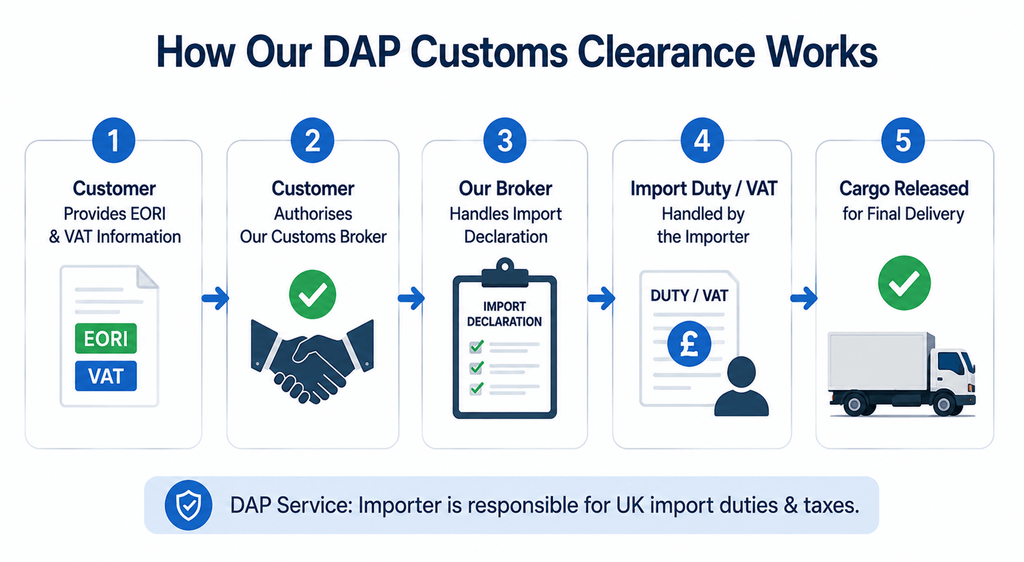
This option can suit businesses that already have their own UK import setup but prefer to have an experienced customs broker manage the declaration.
The exact customs representation arrangement should be agreed before shipment.
How Our DDP Customs Clearance Works
Our DDP service is structured differently.
For our DDP arrangement:
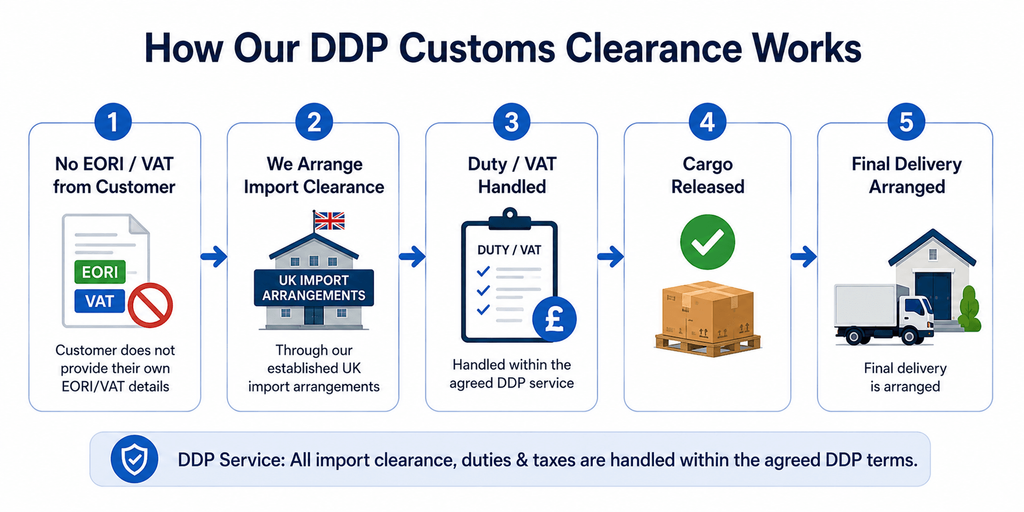
This is particularly useful for importers who do not want to build their own UK customs process for each shipment.
It is important to distinguish this practical service arrangement from the general UK EORI rules. GOV.UK states that businesses importing into Great Britain generally need an appropriate EORI when they are responsible for customs activities, while businesses that are not eligible to obtain one may appoint someone to deal with customs on their behalf.
The DDP Incoterms® rule also places responsibility for import clearance, applicable duty and customs formalities on the seller.
DDP or DAP: Which Customs Arrangement Fits Better?
| DDP | DAP | |
|---|---|---|
| UK import clearance | Arranged through our DDP setup | Handled by our customs broker on the importer’s behalf |
| Customer provides own EORI/VAT to us | No, under our DDP arrangement | Yes |
| Import Duty / VAT | Handled within agreed DDP service | Importer responsible |
| Final delivery | Included in agreed service | Included in agreed service |
| Best suited to | Importers wanting a more complete solution | Importers with an established import setup |
There is no universally better option.
A business with an established UK customs operation may prefer DAP.
A business that wants the logistics provider to coordinate the import process and related costs may find DDP more convenient.
Frequently Asked Questions
How long does UK customs clearance take?
There is no single standard clearance time for every shipment.
The time can depend on the declaration, goods, supporting information, customs procedures and whether any additional checks are required.
For this reason, customs clearance should be treated as one part of the overall delivery timeline rather than a fixed number of hours or days.
Do I need an EORI to import from China into Great Britain?
Businesses importing goods into England, Scotland or Wales generally need a GB EORI for customs activities. Northern Ireland can have different EORI requirements.
However, the practical arrangement can differ when a business appoints someone to deal with customs or when a specific DDP structure is used.
Can a freight forwarder make the customs declaration for me?
Yes. You can appoint a customs agent or other suitable intermediary to handle customs procedures on your behalf. The services and liabilities depend on the representation arrangement and agreement.
Does DDP include UK customs clearance?
Yes. Under the DDP Incoterms® rule, the seller is responsible for import clearance and the applicable import formalities. Our DDP service includes UK import customs clearance as part of the agreed arrangement.
Does DDP include Import Duty and VAT?
Our DDP service includes Duty/VAT handling according to the agreed quotation.
The exact tax treatment still depends on the goods, classification and applicable UK rules.
What is the difference between DDP and DAP?
The main difference is responsibility for the import side.
Under DDP, the seller is responsible for import clearance and applicable duty and taxes.
Under DAP, the buyer is responsible for import clearance and the associated import costs.
Can I use your customs clearance service without using DDP?
Yes.
Our DAP arrangement allows the importer to provide the required EORI and VAT information and authorise our customs broker to handle the import declaration on their behalf.
Final Takeaway
UK customs clearance does not have to be complicated, but it does need to be planned correctly.
The most important things are:
Know who is responsible for the declaration.
Provide accurate information about the goods.
Check the Commodity Code and applicable import requirements before shipping.
Understand who is responsible for Duty and VAT.
And, most importantly, make sure your freight quotation clearly explains the customs arrangement.
At Kisun Shipping, we can arrange China-to-UK logistics together with UK customs clearance through either our DDP or DAP service, depending on how you want to manage the import side.
For a DDP shipment, we can coordinate the transportation, UK import clearance, Duty/VAT handling and final delivery as one service.
For DAP, the importer provides the required EORI and VAT information and authorises our customs broker to handle the import declaration.
Need to check your next China-to-UK shipment?
Send us:
- Product description
- Quantity
- Weight / CBM
- Supplier location in China
- UK delivery postcode
- Whether you prefer DDP or DAP
We can then assess the appropriate customs and delivery arrangement before the shipment leaves China.

China Logistics Expert
About the Author
Katherine Kang is a China-based logistics consultant with over 11 years of experience in international trade and freight forwarding. Specializing in helping SMEs import from China she focuses on compliant, cost-effective solutions to avoid delays, tariffs, and hidden fees. From anti-dumping guidance to CNY planning, Katherine has managed hundreds of shipments, saving clients 15-30% on average.
Connect with Katherine on LinkedIn or contact Kisun Shipping for a free import consultation.