Shipping from China to Saudi Arabia: How the Latest Middle East Conflict Could Affect Your Cargo (July 2026 Update)
If you’re importing goods from China to Saudi Arabia, the question is no longer just:
“How much will shipping cost?”
The more important question has become:
“Will my cargo still arrive as planned if the regional situation gets worse?”
In July 2026, the security situation in the Middle East changed rapidly. After months of uncertainty surrounding the Red Sea and the Strait of Hormuz, the conflict entered a more serious phase when Houthi forces announced a maritime blockade targeting Saudi Arabia and later claimed attacks against Saudi oil tankers, raising fresh concerns across global shipping markets.
For importers, this is more than a geopolitical headline.
It directly affects shipping schedules, freight rates, insurance costs, vessel routing, customs clearance, and ultimately the total landed cost of importing products into Saudi Arabia.
Although commercial shipping services continue to operate at the time of writing, carriers, insurers, and logistics providers are closely monitoring developments. If the regional security environment deteriorates further, shipping lines could change routes, suspend selected services, or introduce additional operational surcharges with limited notice.
For businesses importing from China, understanding these risks before booking cargo has become just as important as negotiating the product price.
What Happened?
During the third week of July 2026, tensions in the Middle East escalated significantly.
According to public statements released by Houthi representatives, the group announced a maritime blockade targeting Saudi Arabia and warned commercial vessels operating in connection with Saudi ports. Within days, the Houthis also claimed missile and drone attacks against Saudi oil tankers, marking one of the most significant direct escalations involving Saudi maritime interests in recent years.
These developments came at a time when shipping through the Red Sea, the Bab el-Mandeb Strait, and the Strait of Hormuz was already facing elevated security risks.
For global shipping companies, this created a new challenge:
Instead of monitoring a single maritime chokepoint, they now had to evaluate operational risks across two of the world’s most strategically important shipping corridors at the same time.
Even when container vessels are not directly targeted, increased regional instability can influence operational decisions such as:
- Changes to vessel routing
- Temporary suspension of certain services
- Higher war-risk insurance premiums
- Additional fuel consumption caused by detours
- Longer transit times
- Reduced vessel capacity during peak shipping season
These factors affect logistics planning well before a port is officially closed.
Why Every Saudi Importer Should Pay Attention
Many importers assume that as long as vessels continue calling at Saudi ports, business can continue as usual.
Unfortunately, international shipping rarely works that way.
In today’s shipping market, uncertainty itself has a cost.
When shipping lines believe a route may become unsafe, they may adjust schedules, reduce available capacity, reroute vessels, or apply emergency surcharges long before any complete closure occurs.
For importers shipping from China to Saudi Arabia, the biggest concern is not necessarily whether cargo can leave China today.
The bigger question is what happens after the vessel has departed.
If security conditions worsen while cargo is already at sea, shipping lines may need to reroute vessels or make operational changes to protect crews and ships. Such decisions can lead to substantial additional transportation costs and longer transit times.
Depending on the carrier’s terms and conditions, some extraordinary operational expenses may ultimately be passed on to cargo owners. Standard cargo insurance also does not automatically cover every additional logistics cost associated with route deviations or war-related operational decisions. Coverage depends on the policy wording and any applicable war-risk endorsements.
This means that even if your products arrive safely, your final logistics cost may be significantly higher than the quotation you originally received.
Before You Book Your Shipment, Ask Yourself One Question
Instead of asking:
“Is freight cheaper this week?”
Ask yourself:
“If the shipping route changes after my cargo leaves China, can my business absorb the additional cost?”
This is the question every Saudi importer should be evaluating today.
If your shipment contains high-value products with strong profit margins or strict delivery deadlines, the answer may be yes.
However, if you’re importing lower-value goods with flexible delivery schedules, it may be worth carefully reassessing whether immediate shipment is the best business decision.
The objective is not to create unnecessary concern.
The objective is to understand the potential financial exposure before your cargo is already on the water.
What You’ll Learn in This Guide
This article is written specifically for importers shipping from China to Saudi Arabia.
We’ll explain:
- How the latest Middle East conflict could affect ocean freight to Saudi Arabia
- Which Saudi ports face the greatest operational pressure
- Whether freight rates are likely to continue rising
- How customs clearance and inland delivery could be affected
- What additional costs importers should prepare for
- When postponing shipment may be a smarter business decision
- Practical strategies to reduce logistics risks during periods of regional uncertainty
Whether you’re shipping a full container (FCL), LCL cargo, Amazon inventory, machinery, building materials, or commercial goods, understanding today’s logistics environment can help you make better decisions before booking your next shipment.
Why This Crisis Is Different: The Double Pressure on the Strait of Hormuz and the Red Sea Shipping Route
The Middle East has experienced shipping disruptions before.
Many importers still remember the Red Sea crisis that began in late 2023, when attacks on commercial vessels forced many international carriers to avoid the Bab el-Mandeb Strait and reroute vessels around the Cape of Good Hope.
However, the current situation creates a different level of concern for Saudi importers.
The reason is simple:
Saudi Arabia is located between two strategically critical maritime routes.
On one side is the Strait of Hormuz, the gateway connecting the Persian Gulf with global markets.
On the other side is the Red Sea and Bab el-Mandeb Strait, the route connecting Asia with Saudi Arabia’s western ports and Europe.
When one route experiences disruption, shipping companies may still have alternatives.
But when risks increase across both directions, the options become much more limited.
For companies importing from China to Saudi Arabia, this means logistics planning cannot only focus on freight rates anymore. Route reliability and contingency planning are becoming equally important.
Understanding Saudi Arabia’s Key Shipping Routes
To understand the potential impact on Chinese imports, it is important to understand how Saudi Arabia’s ports connect with global shipping networks.
1. Strait of Hormuz: The Gulf Gateway Under Pressure
The Strait of Hormuz is one of the world’s most important maritime chokepoints.
Located between Iran and Oman, it connects the Persian Gulf with the Gulf of Oman and the Arabian Sea.
A significant percentage of global energy shipments pass through this narrow waterway every year, making it highly sensitive to regional security developments.
For Saudi Arabia, the Strait of Hormuz is particularly important because several major oil-producing countries rely on this route to access international markets.
However, for container shipping from China to Saudi Arabia, the impact is more complicated.
Many Chinese goods imported into Saudi Arabia do not necessarily rely on the same route as crude oil exports. Container services may use different networks depending on:
- Port of origin in China
- Shipping line
- Final destination in Saudi Arabia
- Transshipment hub
- Vessel schedule
For example:
A shipment from Shenzhen, Ningbo, Shanghai, or Qingdao to Dammam Port may face different risks compared with cargo moving to Jeddah Islamic Port.
This is why importers should avoid assuming that all Saudi shipments are affected equally.
2. Bab el-Mandeb Strait: The Critical Route for Red Sea Shipping
The Bab el-Mandeb Strait connects the Red Sea with the Gulf of Aden and the Indian Ocean.
For Asian exporters and Saudi importers, this route is extremely important because vessels traveling between China and Saudi Arabia’s western ports typically pass through this area.
The route connects:
China ports
↓
Southeast Asia
↓
Indian Ocean
↓
Bab el-Mandeb Strait
↓
Red Sea
↓
Jeddah / Yanbu
↓
Saudi inland destinations
For many container shipments from China to western Saudi Arabia, especially those arriving at:
- Jeddah Islamic Port
- King Abdullah Port
- Yanbu Commercial Port
the security situation around the Red Sea directly affects transportation reliability.
Why Jeddah Port Matters for China-Saudi Trade
Located on the Red Sea coast, Jeddah serves not only western Saudi Arabia but also connects cargo flows to major inland cities such as:
- Riyadh
- Makkah
- Madinah
- Taif
A large amount of consumer goods, machinery, construction materials, and commercial products enter Saudi Arabia through this corridor.
When Red Sea conditions become unstable, the impact is not limited to ocean transportation.
It can create pressure throughout the entire supply chain:
Ocean vessel schedule
↓
Port operations
↓
Container availability
↓
Customs clearance
↓
Trucking capacity
↓
Final delivery
This is why Saudi importers should look beyond the ocean freight quotation.
A shipment delay at sea can eventually become a warehouse shortage, production interruption, or customer delivery problem.
Jeddah vs Dammam: Which Saudi Port Is Safer?
One common question from importers is:
“Should I switch from Jeddah Port to Dammam Port?”
The answer depends on your cargo location and business requirements.
There is no universal solution.
Jeddah Islamic Port
Advantages:
- Major gateway for Asian container services
- Strong connection with western Saudi markets
- Convenient for Riyadh trucking routes through the inland network
- Extensive logistics infrastructure
Potential Challenges:
- More exposed to Red Sea security developments
- Longer inland transportation for eastern Saudi destinations
King Abdulaziz Port, Dammam
Advantages:
- Located on the Arabian Gulf side
- Close to eastern Saudi industrial areas
- Convenient for destinations such as:
- Dammam
- Khobar
- Jubail
- Eastern Province factories
Potential Challenges:
- Operations are influenced by Gulf regional conditions
- Capacity availability depends on shipping line services
- Not always a direct replacement for western Saudi routes
The Real Question Is Not “Which Port Is Safer?”
The better question is:
“Which route creates the lowest total supply chain risk for my specific cargo?”
A cheaper ocean freight option is not always the cheapest solution if it creates:
- Longer transit time
- Higher inventory costs
- Production delays
- Customer dissatisfaction
- Unexpected logistics expenses
The Impact on Different Types of Importers Is Not the Same
One mistake many businesses make is treating every shipment the same.
The impact depends heavily on:
1. Product Value
For low-margin products:
A sudden increase in transportation cost can eliminate profit.
Examples:
- Furniture
- Household products
- Basic consumer goods
- General merchandise
For high-value products:
The priority may shift toward reliability rather than lowest cost.
Examples:
- Industrial equipment
- Electronics
- Specialized machinery
- Project cargo
2. Delivery Urgency
A retailer preparing for a sales campaign has very different requirements from an importer building inventory for six months.
A delay of 20 days may be manageable for one company but disastrous for another.
3. Inventory Strategy
Companies with sufficient safety stock have more flexibility.
Companies operating with:
- Just-in-time inventory
- Small warehouses
- Limited cash flow
may face much higher risks from unpredictable delays.
What Saudi Importers Should Understand Right Now
The current situation does not mean that all China-Saudi shipments will stop.
International shipping continues to operate.
However, the risk calculation has changed.
The most important change is:
Importers can no longer plan only based on normal shipping conditions.
A professional logistics strategy should now include:
- Alternative route evaluation
- Transit time buffer
- Insurance review
- Customs preparation
- Inventory planning
- Emergency cost assessment
In uncertain markets, the best logistics decision is not always the cheapest quotation.
It is the option that protects your business when unexpected events happen.
How the Middle East Crisis Could Affect Shipping Costs, Transit Times, and Customs Clearance for Saudi Importers
For Saudi importers buying from China, the biggest concern is not only whether vessels can continue sailing.
The bigger concern is:
“How much will my total import cost increase if the situation continues?”
Many businesses focus only on the ocean freight quotation.
However, the final landed cost of imported goods includes much more than freight:
Product cost + Ocean freight + Insurance + Surcharges + Customs clearance + Inland delivery + Storage costs
During periods of geopolitical uncertainty, some of these costs can change quickly.
A shipment that looked profitable when booked may become much more expensive after departure if unexpected operational changes occur.
This is why Saudi importers need to understand the potential cost factors before shipping from China.
1. Ocean Freight Rates: Why Shipping Costs Can Rise Quickly
When geopolitical risks increase, shipping markets usually react before actual disruptions happen.
Shipping lines and freight forwarders must consider:
- Vessel safety
- Fuel consumption
- Route adjustments
- Additional operational requirements
- Insurance exposure
- Available vessel capacity
Even if ports remain open, uncertainty itself can influence freight pricing.
For China-Saudi Arabia shipments, several scenarios are possible:
Scenario 1: Normal Operations Continue
If shipping routes remain stable:
- Vessel schedules continue normally
- Freight rates may experience only normal market fluctuations
- Importers can continue using existing shipping plans
Scenario 2: Higher Security Costs
If carriers consider the region higher risk, importers may see additional charges such as:
War Risk Surcharge
Shipping companies and insurers may apply additional fees related to operating in higher-risk areas.
The amount depends on:
- Route
- Carrier policy
- Insurance market conditions
- Security situation
Emergency Operational Surcharges
Additional costs may arise from:
- Route adjustments
- Additional fuel consumption
- Longer vessel operation time
- Emergency handling requirements
These charges are usually announced by carriers or logistics providers based on actual circumstances.
Scenario 3: Major Route Disruption
The most serious situation would be if vessels are unable to safely operate through affected areas.
In that case, carriers may consider:
- Temporary suspension
- Alternative routing
- Port changes
- Longer transit routes
For importers, this is where costs can increase significantly.
2. Why Vessel Rerouting Can Become Extremely Expensive
Many importers underestimate the financial impact of vessel rerouting.
A vessel is not like a truck that can simply take another road.
Ocean shipping involves:
- Thousands of containers
- Large amounts of fuel
- Fixed vessel schedules
- Port slot arrangements
- Crew costs
- Terminal coordination
A route change can create multiple additional expenses.
Possible impacts include:
Longer Sailing Distance
A longer route means:
- More fuel consumption
- Longer vessel operating time
- Reduced vessel efficiency
Reduced Vessel Capacity
When vessels spend more time completing one voyage, the effective global shipping capacity decreases.
For example:
A vessel that normally completes several round trips per year may complete fewer voyages if transit distances increase.
This can create:
- Less available space
- More difficult bookings
- Higher freight rates
Additional Schedule Disruptions
A delayed vessel can affect multiple future voyages.
One delay does not only affect one shipment.
It can create a chain reaction:
Delayed vessel arrival
↓
Late container return
↓
Equipment shortage
↓
Booking difficulties
↓
Longer waiting time for exporters
3. Important: Do Not Assume Insurance Will Cover Every Additional Cost
This is one of the biggest misunderstandings among importers.
Many businesses believe:
“If something happens because of war risk, insurance will pay everything.”
This is usually not how cargo insurance works.
Standard cargo insurance mainly focuses on:
- Physical loss of cargo
- Physical damage to goods
- Covered transportation risks
However, additional logistics expenses caused by operational disruption may not automatically be covered.
Examples may include:
- Extra transportation costs caused by rerouting
- Delay-related expenses
- Storage charges
- Detention and demurrage
- Losses caused by market changes
Coverage depends on:
- Insurance policy wording
- Type of coverage purchased
- War-risk clauses
- Specific circumstances of the incident
Before shipping high-value cargo, importers should review insurance terms carefully rather than assuming all unexpected costs are protected.
4. The Hidden Risk: Cargo Already on the Water
One of the most difficult situations happens when cargo has already departed China.
At that point:
- Production is completed
- Payment may already be made
- Customers may be waiting
- Inventory planning is already committed
But the shipment may still face uncertainty.
If the security situation changes during transit, possible outcomes may include:
- Longer transit time
- Schedule changes
- Port adjustments
- Additional operational costs
For importers, the key lesson is:
The risk decision should be made before the vessel leaves, not after problems appear.
5. Should Saudi Importers Delay Shipment?
This is one of the most important questions.
The answer depends on your business situation.
There is no single solution for every importer.
If Your Cargo Is Low Value and Delivery Is Flexible
Waiting may be a reasonable risk-management decision.
For example:
- Low-margin consumer goods
- Non-urgent inventory
- Products with flexible sales timing
Why?
Because the potential additional cost caused by disruption could exceed the benefit of shipping immediately.
A small saving in today’s freight rate may not justify taking a larger uncertainty risk.
If Your Cargo Is High Value or Time Sensitive
Delaying may create other problems.
Examples:
- Factory production equipment
- Project materials
- Seasonal products
- Urgent inventory replenishment
In these cases, the cost of delay may be higher than the transportation risk.
A Practical Decision Guide
| Situation | Possible Strategy |
|---|---|
| Low-value goods, flexible delivery | Consider waiting for more clarity |
| High-value cargo | Review insurance and contingency plans |
| Urgent customer orders | Consider faster transportation options |
| Cargo already produced | Evaluate total risk before booking |
| Large inventory shipment | Consider splitting shipments |
6. Customs Clearance: Why Delays Can Continue After Arrival
Many importers focus only on ocean transportation.
But the supply chain does not end when the vessel reaches Saudi Arabia.
After arrival, cargo still needs:
- Terminal handling
- Document processing
- Customs clearance
- Cargo release
- Container pickup
- Inland transportation
During periods of uncertainty, ports and logistics networks may experience additional pressure.
Possible problems include:
- More concentrated cargo arrivals
- Equipment imbalance
- Trucking shortages
- Longer container pickup times
This is especially important for importers using:
- Just-in-time inventory
- Limited warehouse space
- Retail distribution schedules
7. Why Documentation Preparation Matters More Than Ever
When logistics networks become unpredictable, avoiding preventable delays becomes critical.
Before shipping from China to Saudi Arabia, importers should confirm:
SABER Compliance
Many regulated products entering Saudi Arabia require compliance procedures through the SABER system.
Incomplete compliance preparation can result in:
- Shipment delays
- Additional inspection
- Storage costs
Correct HS Code Classification
Incorrect HS codes can create:
- Customs questions
- Clearance delays
- Unexpected duties
Complete Commercial Documents
Prepare:
- Commercial invoice
- Packing list
- Certificate of origin
- Product certificates when required
- Shipping documents
A shipment delayed because of missing documents creates unnecessary cost during an already uncertain period.
8. What Experienced Importers Are Doing Differently
During uncertain periods, experienced importers usually focus on reducing surprises.
They are:
✅ Booking earlier when shipping schedules are reliable
✅ Maintaining additional inventory buffers
✅ Confirming compliance before cargo departure
✅ Working with logistics providers who understand Saudi customs procedures
✅ Preparing alternative transportation options
✅ Calculating total landed cost instead of only comparing freight rates
The goal is not simply to move cargo.
The goal is to maintain business continuity.
Key Takeaway for Saudi Importers
The current Middle East situation does not mean every shipment from China to Saudi Arabia will face disruption.
However, it does mean importers should no longer make decisions based only on today’s freight quotation.
A professional shipping plan should consider:
- Route reliability
- Potential additional costs
- Insurance limitations
- Customs readiness
- Inventory strategy
In uncertain markets, the cheapest shipping option is not always the lowest-cost option.
The best choice is the one that protects your business if conditions change.
Should You Ship from China to Saudi Arabia Right Now? A Practical Risk Assessment for Importers
For many Saudi importers, the biggest question today is not:
“Can I still ship from China to Saudi Arabia?”
The answer is: Yes, international shipping services are still operating.
The more important question is:
“Does it make sense for my business to ship right now?”
This is a completely different question.
In uncertain geopolitical situations, there is no universal answer.
Some companies should continue shipping because delays could damage their business.
Other companies may be taking unnecessary risks by rushing cargo onto vessels without understanding the potential consequences.
The right decision depends on:
- Your product value
- Your profit margin
- Your delivery deadline
- Your inventory level
- Your ability to absorb unexpected logistics costs
A professional importer should not make decisions based on fear or speculation.
The decision should be based on risk versus business necessity.
1. First Understand the Real Risk: The Problem Is Not Departure, It Is Uncertainty After Departure
Many importers think:
“If the vessel leaves China, everything should be fine.”
However, international shipping involves a long journey.
A typical China-to-Saudi shipment may experience different stages:
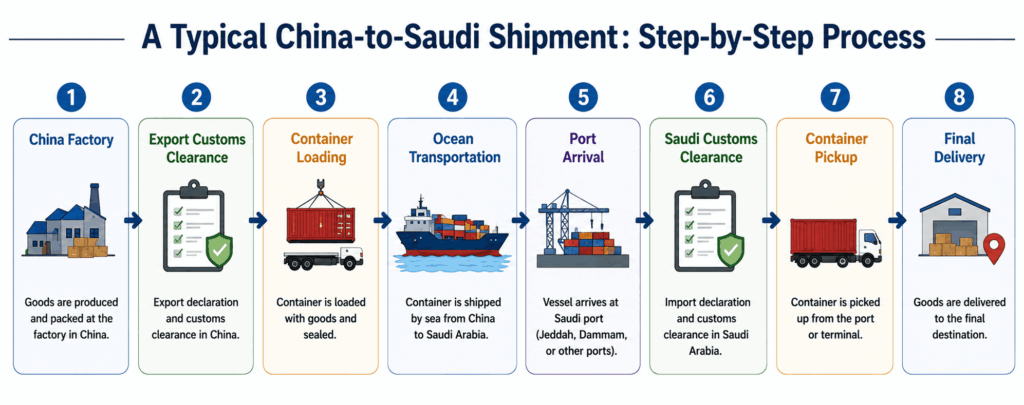
The security situation may change during any stage.
A shipment that was normal when booked may face different conditions weeks later.
This is why experienced importers evaluate risk before cargo departure.
2. If You Have Not Shipped Yet: Evaluate These Questions First
Before booking your next container from China to Saudi Arabia, ask yourself:
Question 1: How urgent is this shipment?
Is this cargo needed immediately?
Or can your business wait several weeks?
For example:
A retailer preparing for a major sales season may have a strong reason to ship.
However, an importer simply building inventory without urgent demand may have more flexibility.
Question 2: How much unexpected cost can your business absorb?
This is often overlooked.
Many companies calculate:
“Can I afford today’s freight rate?”
But the better question is:
“Can I afford additional costs if conditions change?”
Potential unexpected costs may include:
- Additional carrier surcharges
- Longer storage time
- Delayed delivery
- Extra inland transportation
- Inventory financing costs
- Customer compensation caused by delays
A shipment with a small profit margin has much less tolerance for unexpected expenses.
3. For Low-Margin or Low-Value Goods: Waiting May Be a Reasonable Strategy
For some products, delaying shipment can be a practical business decision.
Examples:
- General consumer products
- Low-margin household items
- Basic furniture
- Commodity products
- Products without urgent delivery deadlines
Why?
Because the transportation risk may exceed the business benefit of immediate shipment.
For example:
Imagine an importer saves $500 by booking this week.
However, if a route disruption later creates:
- Additional charges
- Longer storage
- Delivery delays
- Lost sales opportunities
The original saving may disappear quickly.
In this situation, waiting for clearer market conditions may protect cash flow.
This does not mean every importer should stop shipping.
It means:
The value of avoiding risk may sometimes be higher than the value of shipping immediately.
4. For High-Value or Time-Sensitive Cargo: Waiting May Create Bigger Problems
Not every business can delay shipments.
Some importers may need to continue shipping because the cost of delay is higher.
Examples:
Industrial Equipment
A factory waiting for machinery cannot simply postpone delivery indefinitely.
A delayed shipment may affect:
- Production schedules
- Construction projects
- Customer contracts
Seasonal Products
Products linked to specific sales periods may lose their commercial value if they arrive too late.
Examples:
- Promotional products
- Holiday items
- Seasonal inventory
Customer Commitments
If your customers are already waiting, delaying shipment may damage long-term relationships.
In these cases, the solution may not be “stop shipping.”
The solution may be:
- Choose a more reliable route
- Increase delivery buffer
- Split shipments
- Consider air freight for critical items
5. Should You Switch From Sea Freight to Air Freight?
Many importers immediately think:
“The sea route has uncertainty, so I should use air freight.”
However, this decision should be calculated carefully.
Air freight is not a replacement for every shipment.
It is usually suitable for:
✅ High-value products
✅ Urgent spare parts
✅ Samples
✅ Small-volume shipments
✅ Products where delay costs exceed transportation costs
Sea freight remains more suitable for:
✅ Full container shipments
✅ Large-volume goods
✅ Heavy products
✅ Products with flexible delivery schedules
The question is not:
“Which transportation method is cheaper?”
The question is:
“Which transportation method creates the lowest total business risk?”
6. Do Not Ignore DDP Shipping Risks During Uncertain Periods
Many Saudi importers choose DDP (Delivered Duty Paid) shipping because it simplifies the process.
Under DDP, the logistics provider usually manages:
- Transportation
- Customs clearance
- Import procedures
- Final delivery
However, importers should understand:
DDP does not eliminate transportation risks.
A professional DDP provider should still evaluate:
- Shipping route stability
- Customs requirements
- Documentation accuracy
- Emergency handling capability
During uncertain periods, choosing the cheapest DDP quotation can create problems if the provider has limited experience handling unexpected situations.
When selecting a DDP partner, ask:
- Who handles Saudi customs clearance?
- Do you have local Saudi partners?
- How do you manage unexpected port delays?
- How are additional costs handled?
- Do you provide shipment updates?
A reliable logistics partner should have a clear answer.
7. Five Mistakes Saudi Importers Should Avoid Right Now
Mistake 1: Booking Based Only on the Lowest Freight Rate
The cheapest quotation may not be the cheapest final cost.
A slightly higher freight rate with better operational reliability may protect your business.
Mistake 2: Waiting Until Cargo Is Finished Before Booking
During uncertain periods, vessel space and schedules can change quickly.
Planning transportation only after production is completed creates unnecessary pressure.
Better approach:
Discuss shipping options before your goods are ready.
Mistake 3: Assuming Insurance Covers Everything
Insurance policies vary.
Do not assume unexpected logistics costs will automatically be reimbursed.
Review your coverage before shipping valuable cargo.
Mistake 4: Ignoring Saudi Import Compliance
A shipment delayed because of missing certification is especially costly during unstable logistics conditions.
Prepare:
- SABER requirements
- Product certificates
- HS code confirmation
- Customs documents
before cargo departure.
Mistake 5: Treating Every Shipment the Same
A container of low-value products and a container of expensive machinery should not have the same risk strategy.
Good logistics decisions start with understanding your specific cargo.
8. Kisun Shipping’s Practical Recommendation for Saudi Importers
At Kisun Shipping, we believe logistics decisions should be based on business reality, not panic.
Our recommendation for Saudi importers is:
If your cargo is not urgent and your profit margin is limited:
Consider waiting until the situation becomes clearer.
The potential cost of an unexpected disruption may outweigh the benefit of shipping immediately.
If your cargo is urgent:
Do not simply stop shipping.
Instead:
- Review route options
- Prepare additional delivery time
- Confirm documentation
- Choose experienced logistics partners
If your cargo is already produced:
Evaluate the total risk.
Ask:
- What happens if delivery is delayed?
- What happens if additional costs appear?
- Can my business absorb the impact?
The right decision depends on your situation.
Final Thoughts: Smart Importers Manage Risk Before Problems Happen
International trade always involves uncertainty.
Weather, port congestion, policy changes, and geopolitical events can all affect supply chains.
The difference between experienced importers and inexperienced importers is not that experienced companies avoid every risk.
It is that they identify risks earlier and prepare solutions before problems happen.
For Saudi businesses importing from China, the current Middle East situation is a reminder:
The cheapest shipment is not always the most economical shipment.
A reliable supply chain is built by balancing:
- Cost
- Speed
- Risk
- Flexibility
Before your next shipment leaves China, make sure you understand not only the freight price, but also the potential risks behind that price.

China Logistics Expert
About the Author
Katherine Kang is a China-based logistics consultant with over 11 years of experience in international trade and freight forwarding. Specializing in helping SMEs import from China to the USA, Canada, and Europe, she focuses on compliant, cost-effective solutions to avoid delays, tariffs, and hidden fees. From anti-dumping guidance to CNY planning, Katherine has managed hundreds of shipments, saving clients 15-30% on average.
Connect with Katherine on LinkedIn or contact Kisun Shipping for a free import consultation.