
Shipping Cosmetics from China to Saudi Arabia in 2026: Why Your SABER Strategy is a Direct Ticket to Customs Rejection (The Ultimate SFDA Guide)
The Middle Eastern beauty and personal care market is currently experiencing an unprecedented gold rush. Driven by Vision 2030, a young, digitally native population, and sky-high disposable income, Saudi Arabia has become the ultimate “blue ocean” for cosmetics brands exporting out of manufacturing hubs like Guangzhou, Shenzhen, and Yiwu.
But behind the high profit margins lies a brutal logistics reality. Every week, dozens of containers filled with high-end serums, sheet masks, and perfumes from China are seized, delayed, or forced into expensive re-exportation at the ports of Jeddah and King Abdulaziz in Dammam.
The number one reason for these logistical disasters? Importers and factories try to process cosmetics through the standard SABER platform. If you treat a bottle of foundation the same way you treat a plastic phone case or a piece of furniture, your shipment will fail Saudi Arabia customs clearance. Cosmetics, personal care, and perfumery products do not belong to the SASO/SABER pipeline. They are strictly regulated by the Saudi Food and Drug Authority (SFDA) under an entirely separate, uncompromising ecosystem.
This comprehensive guide breaks down the exact mechanics of shipping from China to Saudi Arabia when dealing with regulated cosmetics, updated for the strict compliance landscape of 2026.
1. The Multi-Million Dollar Trap: SABER vs. SFDA Explained
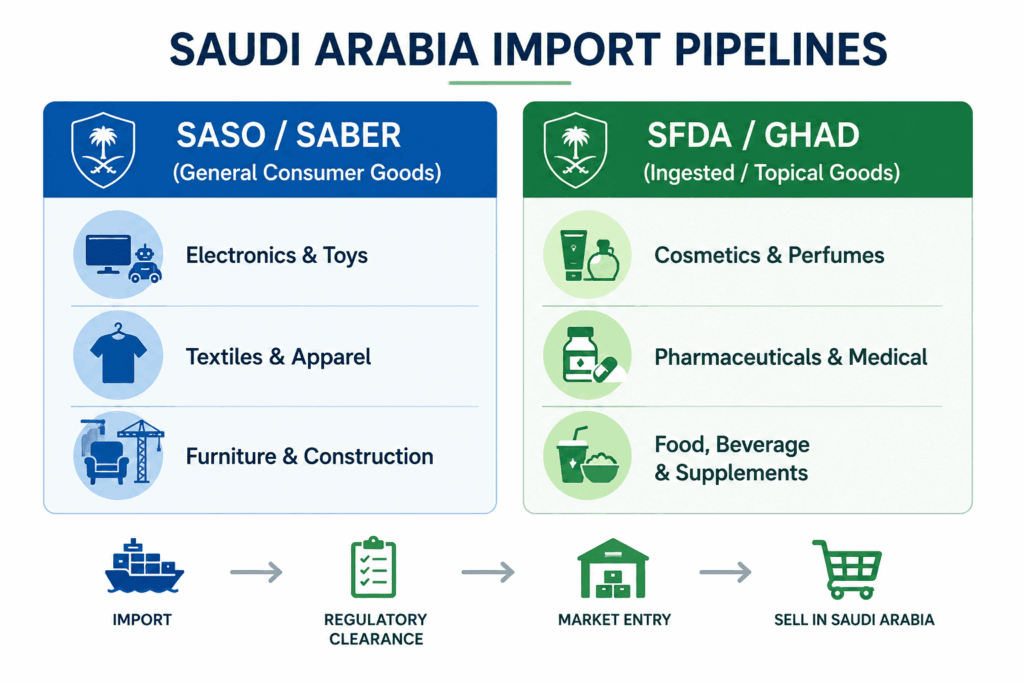
To navigate Saudi logistics without losing your shirt, you must understand the jurisdictional boundary between the Saudi Standards, Metrology and Quality Organization (SASO) and the Saudi Food and Drug Authority (SFDA).
SAUDI ARABIA IMPORT PIPELINES
| SASO / SABER (General Consumer Goods) | SFDA / GHAD (Ingested / Topical Goods) |
| Electronics & Toys Textiles & Apparel Furniture & Construction | Cosmetics & Perfumes Pharmaceuticals & Medical Food, Beverage & Supplements |
When you hire a standard freight forwarder from China to Saudi Arabia, their default operational mode is to ask for a SABER Certificate of Conformity (CoC). However, if your cargo touches human skin, hair, or teeth, trying to generate a SABER certificate is a regulatory dead end.
The SFDA operates via its own unified digital network called the GHAD system, paired with the FASEH platform for consignment clearance. If your logistics provider doesn’t understand this distinction, find one who does.
2. The Core Standard: SFDA.CO/GSO 1943:2016 & The 2026 Restricted Ingredients Upgrade
Every cosmetic product landing in the Kingdom must fully comply with the technical regulation SFDA.CO/GSO 1943:2016. This document outlines strict chemical safety, heavy metal thresholds, packaging integrity, and product claims.
The 2026 Zero-Tolerance Ingredient Enforcement
If you are sourcing formulas from Chinese contract manufacturers (OEM/ODMs), you must run an immediate ingredient audit. Following circulars issued by the SFDA, a strict ban on 21 new cosmetic ingredients went into full effect on January 1, 2026.
- Banned Key Substances: Dibutyltin maleate, dibutyltin oxide, 4-nitrosomorpholine, and 4-methylimidazole are now completely prohibited.
- The Consequence: Any cosmetic shipment showing trace amounts of these chemicals during random port testing will be denied entry, blacklisted, and destroyed at the importer’s expense.
Furthermore, mouthwashes containing alcohol are absolute contraband in Saudi Arabia. If your Chinese supplier uses standard ethanol formulations for oral care, the shipment will face immediate criminal seizure at customs. Similarly, any skin-whitening products containing hydroquinone are strictly banned from commercial importation under cosmetic codes (they are treated as restricted pharmaceuticals).
3. The Definitive SFDA Regulatory Scope for Beauty & Personal Care
Don’t guess whether your product requires SFDA certification for cosmetics. Review this comprehensive, audited breakdown of categories that must bypass SABER and go through the GHAD system:
Facial Makeup & Eye Cosmetics
- Scope: Foundations, primers, tinted makeup bases, concealers, setting sprays, eyeshadows (powder and liquid), mascaras, eyeliners, eyebrow gels, and eyelash conditioners.
- Logistics Note: Highly pigment-dense cosmetics face intensive heavy metal screening (Lead, Arsenic, Mercury).
Advanced Anti-Aging & Targeted Skincare
- Scope: Anti-wrinkle creams, restorative serums, emulsions, sheet masks, facial oils, and brightening lotions.
- Compliance Trap: Your packaging cannot make “medical claims.” If a serum label says “Heals acne scars” or “Cures eczema,” SFDA will block the product as an unregistered drug. Keep claims restricted to aesthetic improvement (e.g., “Improves skin radiance”).
Daily Cleansing, Bath & Shaving Care
- Scope: Liquid body washes, bath salts, bath gels, hygienic talcum powders, shaving creams, foams, aftershave balms, and specialized antibacterial hand soaps.
Comprehensive Hair Care & Styling
- Scope: Shampoos, hair conditioners, repair masks, styling mousses, hairsprays, hair bleaching powders, and chemical hair dyes/perms.
- Logistics Nuance: Hairsprays and aerosol styling products are classified as Dangerous Goods (DG Class 2: Flammable Gas). They require specialized DG container loading and a valid Material Safety Data Sheet (MSDS) for the ocean leg from Shanghai/Shenzhen to Jeddah.
Fragrances & Perfumery
- Scope: High-concentrate perfumes, Eaux de Parfum, Eaux de Toilette, colognes, and body mists.
- Logistics Nuance: Because perfumes contain high percentages of alcohol, they are classified as Class 3 Flammable Liquids. You cannot ship these via standard air freight or general sea containers. They require proper dangerous goods declarations, UN-approved outer packaging, and ocean reefer/temperature-controlled transport to prevent pressure explosions during transit through the humid Red Sea.
Lip, Nail & Intimate Hygiene
- Scope: Lipsticks, lip balms, lip stains, nail polishes, gel lacquers, polish removers, and topical intimate hygiene washes.
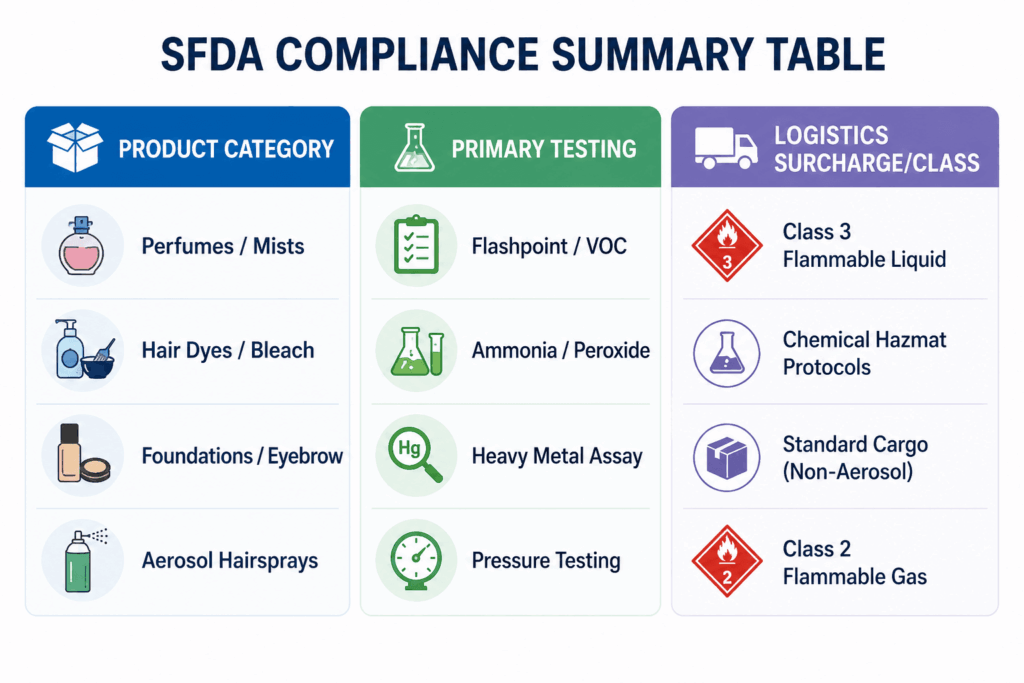
SFDA COMPLIANCE SUMMARY TABLE
| Product Category | Primary Testing | Logistics Surcharge/Class |
| Perfumes / Mists Hair Dyes / Bleach Foundations / Eyebrow Aerosol Hairsprays | Flashpoint / VOC Ammonia / Peroxide Heavy Metal Assay Pressure Testing | Class 3 Flammable Liquid Chemical Hazmat Protocols Standard Cargo (Non-Aerosol) Class 2 Flammable Gas |
4. The 4-Step Blueprint to GHAD Registration and FASEH Port Clearance
Obtaining an SFDA certification for cosmetics is a systematic process. You cannot skip steps, and you cannot rush the digital portal. Here is how Kisun Shipping coordinates this multi-stage workflow with compliant Saudi importers:
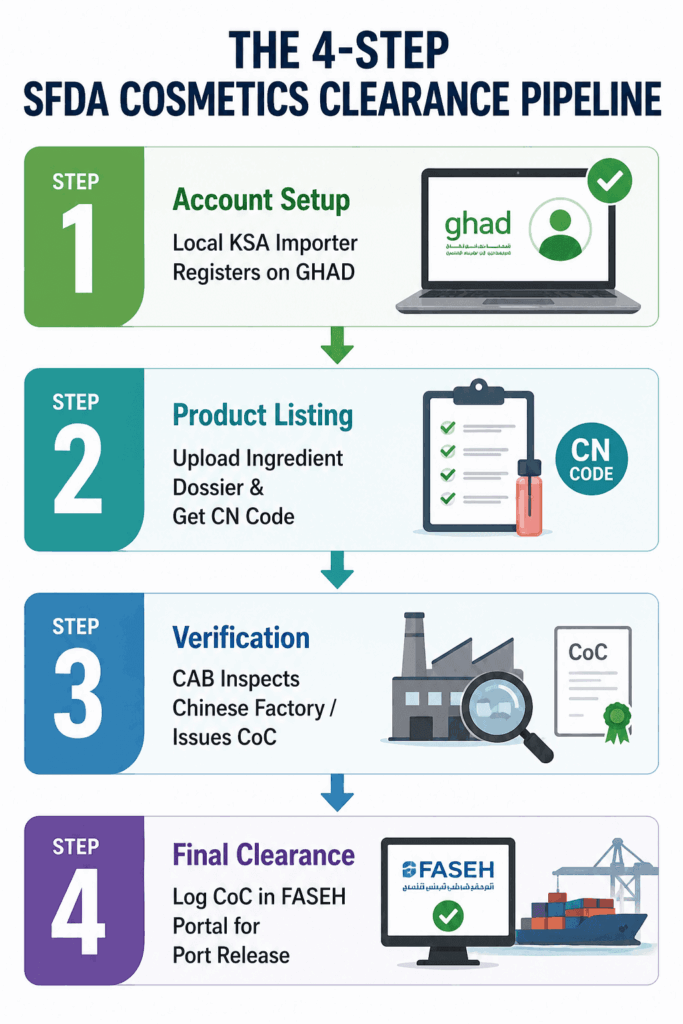
Step 1: The Local Importer Account Setup (GHAD System)
Before any cargo leaves China, your local Saudi partner (consignee) must register an active corporate account on the unified GHAD platform. To do this, the Saudi entity must possess a valid Commercial Registration (CR) that explicitly permits the wholesale or retail trading of cosmetics and medical/food devices.
Step 2: The E-Notification & CN Code Allocation
The importer logs into GHAD to list each individual SKU. This is known as the Cosmetic Product Notification process. The manufacturer in China must supply the importer with an exact Product Information File (PIF), which contains:
- A 100% complete quantitative and qualitative ingredient breakdown (using INCI names).
- A Certificate of Analysis (CoA) from an accredited laboratory.
- Artwork of the product labels (showing Arabic text instructions, shelf-life, and storage parameters).
- Evidence of Good Manufacturing Practices (GMP Certificate conforming to ISO 22716).
Once the SFDA system verifies that the formulation is compliant and free of banned 2026 substances, it generates a unique CN Code (Cosmetic Notification Code) for that specific product.
Step 3: Consignment Verification via a Conformity Assessment Body (CAB)
Once your goods are manufactured and packed in China, you cannot simply put them on a boat. You must contact an SFDA-approved Certification Body (such as SGS, Intertek, or QIMA) in China.
The CAB will cross-verify your physical shipment against the issued CN Code. They conduct a physical inspection of the outer boxes and labeling to ensure that the production batches match the digital files. If everything aligns, the CAB prints and uploads a Consignment Certificate of Conformity (CoC).
Step 4: Digital Port Release via the FASEH Platform
When the container arrives at a Saudi port, your customs broker does not present paper documents. The importer must upload the CAB-issued CoC directly into the FASEH platform. The SFDA customs division reviews the digital file, checks the matching CN code, and marks the shipment as “Approved for Customs Clearance.”
For a deeper dive into overall customs protocols, documentation timelines, and import tariff taxes across general product categories, refer back to our comprehensive guide on Saudi Arabia Customs Clearance.
5. The “Double Clearance” Illusion: The Dangerous DDP Freight Forwarding Trap
Let’s tackle a massive compliance risk that many Chinese factories and small Amazon Saudi/Noon sellers fall into: The “DDP Double Clearance” myth.
Many unaccredited freight forwarders in China offer cheap, all-inclusive DDP rates for cosmetics, claiming: “Don’t worry about SFDA certificates or GHAD codes; we will clear the cargo under our own channels.”
In 2026, this is a surefire way to lose your entire investment. U.S. Customs and Saudi Customs have both upgraded their digital auditing infrastructure. The SFDA enforces strict post-market surveillance.
Because every cosmetic product must have a traceable, legal “Notifier” inside the Kingdom who assumes full civil and criminal liability for the formulation’s safety, you cannot delegate this responsibility to a generic shipping agent. If a freight forwarder attempts to sneak cosmetics through customs by classifying them under a fake, non-regulated HTS code (like plastic bottles or ornaments) to bypass the SFDA barrier, the automated port scanners will flag it.
The results of such a bypass are catastrophic:
- Immediate seizure of the entire container.
- Heavy anti-smuggling financial penalties levied against the importer.
- Permanent blacklisting of the manufacturing facility in China from ever exporting to the Gulf Cooperation Council (GCC) region again.
If you want to build a sustainable, highly profitable beauty brand in Saudi Arabia, do it right. Register your local entity, file your products via GHAD, secure your CN codes, and use an accredited, transparent freight forwarder from China to Saudi Arabia like Kisun Shipping to manage the actual physical movement and customs documentation.
6. Crucial Labeling Rules: The Pitfalls That Freeze Cargo
Even with a valid CN code, your shipment can be rejected at the loading dock if your factory packaging fails basic GSO labeling criteria. Ensure your Chinese production line prints the following details directly onto the cosmetic containers and outer boxes:
- Bilingual Text: The product function, usage instructions, safety warnings, and storage conditions must be written in Arabic and English.
- Country of Origin: A bold, indelible “Made in China” stamp must be visible on the container and the shipping carton.
- Traceability Data: The batch number, production date, and expiration date (or a clear Period After Opening – PAO symbol) must be perfectly clear and match the data logged in the GHAD notification system.
7. Master Checklist for Importers Sourcing Cosmetics from China to KSA
Before you authorize the final balance payment to your Chinese supplier and clear your container for departure, run through this absolute compliance check:
- Importer Verification: Confirm your Saudi buyer has an active e-GHAD account explicitly authorized for cosmetic imports.
- Ingredient Audit: Ensure the production batch is 100% free of banned substances and matches the strict 2026 concentration caps.
- Labeling Compliance: Verify that all safety text, usage instructions, and storage warnings are printed directly onto the retail packaging in flawless Arabic.
- GS1 Barcodes: Ensure the barcode printed on the box is identical to the digital registration number submitted in the SFDA system.
- Thermal Protection: Evaluate whether your cargo requires reefer container transport to survive the maritime routes and Saudi terminal heat.
- Pre-Shipment Inspection: Ensure your third-party inspection agent has verified the cargo and issued the conformity certificate prior to port loading in China.
Summary: Future-Proof Your Saudi Supply Chain with Kisun Shipping
Logistics in 2026 is an exact science. Navigating shipping from China to Saudi Arabia for high-value cosmetic and personal care products requires an absolute commitment to regulatory compliance. Bypassing the system via SABER is impossible, and relying on grey-market DDP lines is a high-stakes gamble that will eventually fail.
At Kisun Shipping, we bridge the gap between Chinese manufacturing powerhouses and strict Middle Eastern border enforcement. We verify your compliance posture, validate your cargo class, optimize your sea/air routing, and ensure your customs documentation passes the FASEH portal without a single day of unneeded port demurrage.
Are you ready to securely scale your beauty brand across the Kingdom? Get a Certified China-to-Saudi Freight Quote Today

China Logistics Expert
About the Author
Katherine Kang is a China-based logistics consultant with over 11 years of experience in international trade and freight forwarding. Specializing in helping SMEs import from China to the USA, Canada, and Europe, she focuses on compliant, cost-effective solutions to avoid delays, tariffs, and hidden fees. From anti-dumping guidance to CNY planning, Katherine has managed hundreds of shipments, saving clients 15-30% on average.
Connect with Katherine on LinkedIn or contact Kisun Shipping for a free import consultation.