

CPSC eFiling Mandatory July 8: The 7 Critical Compliance Realities Every US Importer Must Face
The regulatory framework for importing from China to usa is undergoing its most significant operational shift in over a decade.
Starting July 8, 2026, the U.S. Consumer Product Safety Commission (CPSC) is officially launching its mandatory eFiling requirement via the U.S. Customs and Border Protection (CBP) Partner Government Agency (PGA) Message Set.
This update changes the CPSC from a regulatory body that reviews paper certificates after entry into a real-time digital gatekeeper. If you handle China to usa shipping for regulated consumer goods—especially children’s toys, apparel, or electronics—complying with this rule is no longer optional. A single data error or mismatched field can leave your containers stranded at the port, exposing your business to severe financial penalties.
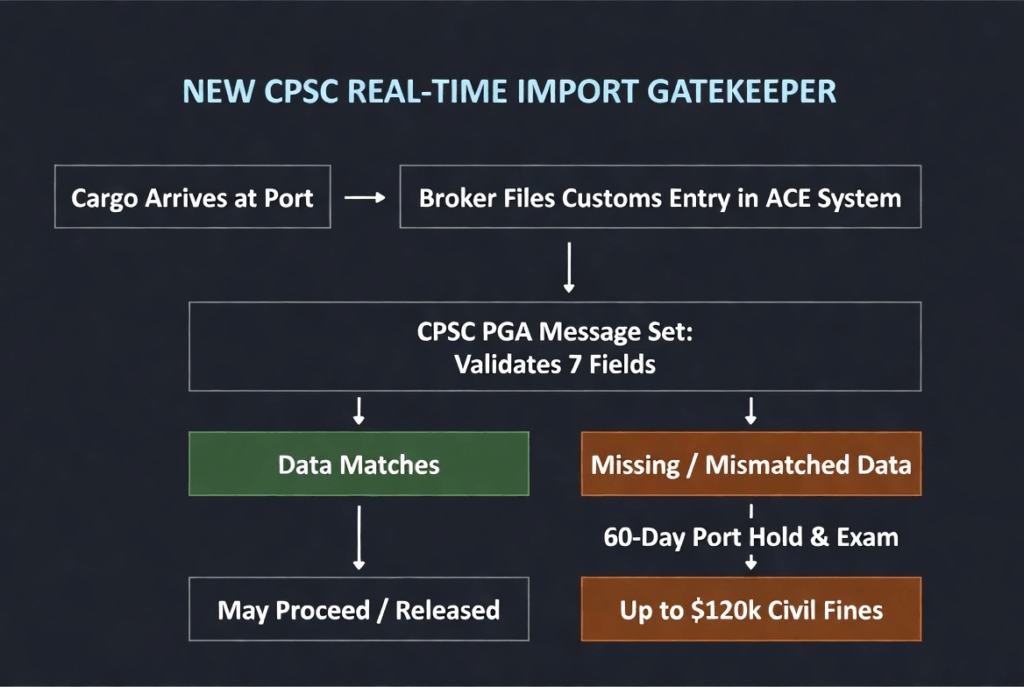
With the July 8 deadline here, many international brands are running into fundamental operational challenges. Let’s break down the essential steps, clear up the most common compliance misunderstandings, and look at how to protect your supply chain from unexpected delays.
The Timeline: Core Deadlines and Scope
The CPSC final ruling sets out a strict implementation schedule that leaves no room for temporary adjustments. Importers should keep two key dates in mind:
| Implementation Date | Regulatory Scope & Coverage | Operational Impact on First-Mile Logistics |
| July 8, 2026 | Mandatory Direct Consumption Entries. Most regulated consumer products enter full enforcement. | All standard entries filed on or after this date must include electronic certificate data at the exact time of entry. |
| January 8, 2027 | Foreign Trade Zone (FTZ) Entries. Delayed implementation for goods entering through an FTZ. | Regulated products admitted into an FTZ and later entered for consumption must complete the full eFiling process. |
If you currently have ocean containers in transit or are calculating your upcoming China to usa freight rates, you cannot afford to wait. The voluntary testing phase is officially closed.
It is also important to note that eFiling does not introduce new safety standards or testing protocols. The underlying legal requirements for your Children’s Product Certificate (CPC) or General Certificate of Conformity (GCC) remain exactly the same. What has changed is how and when this data must be shared with the U.S. government.
Who Holds the Bag? The 6 Key Operational Roles
A frequent mistake brands make when arranging shipping from China to usa is assuming their freight forwarder or customs broker handles all legal compliance. In reality, the automated filing process involves multiple distinct parties, each carrying clear, non-transferable responsibilities.
| Role | Responsibilities |
|---|---|
| CPSC | Establishes consumer product safety regulations and supervises whether products meet safety requirements (does not handle cargo release) |
| CBP | Responsible for import supervision and cargo release |
| IOR (U.S. Importer) | Ultimate legal responsible party; responsible for product compliance, testing basis, authenticity of CPC/GCC certificates, and eFiling data |
| Broker (Customs Broker) | Responsible for submitting electronic declaration data through the ACE system; does not assume product compliance responsibility |
| ACE | U.S. import electronic declaration system; all eFiling data must be submitted through ACE |
| Product Registry | Platform for storing product and certificate information; it is not an electronic declaration system |
The CPSC & CBP (The Regulators)
The CPSC sets consumer safety standards and reviews incoming data streams, while the CBP manages physical cargo access and processes actual entry releases at the border.
The Importer of Record (IOR – The Accountable Party)
The IOR is the U.S. based company named on the formal customs entry. The IOR bears 100% of the legal liability for product compliance, certificate authenticity, and data accuracy. You cannot contractually pass this legal responsibility to a third party.
The Customs Broker (The Transmitter)
Your broker acts as a technical data entry agent. They take the certificate tokens or data fields you provide and enter them into the customs portal. They are not compliance auditors and are not responsible for verifying that your factory’s testing data is accurate.
The ACE System & Product Registry (The Infrastructure)
The Automated Commercial Environment (ACE) is the primary CBP customs network where all entry filings occur. The CPSC Product Registry is a separate, highly secure database where importers can pre-register their certificates to simplify the data submission process.
The Major Risk: If a factory in Shenzhen provides an invalid test report and your customs broker submits it into the ACE system, your broker faces zero penalties. The CPSC will target the IOR with formal enforcement actions, cargo rejections, and potential civil fines of up to $120,500 per individual violation.
Does Your Cargo Require Electronic Filing?
The new requirement does not apply to every single item on a container ship. It is required specifically for consumer products that are legally obligated to carry a CPC or GCC under U.S. consumer protection laws. If you are importing consumer goods, you can verify your compliance requirements using two main approaches.
Method 1: The CPSC Regulatory Robot
The CPSC provides an interactive digital diagnostic tool called the Regulatory Robot. By guiding you through a step-by-step questionnaire about your product’s design, target user base, and materials, it identifies which specific safety standards apply to your cargo. Keep in mind that this tool serves as an administrative guide rather than a definitive legal ruling.
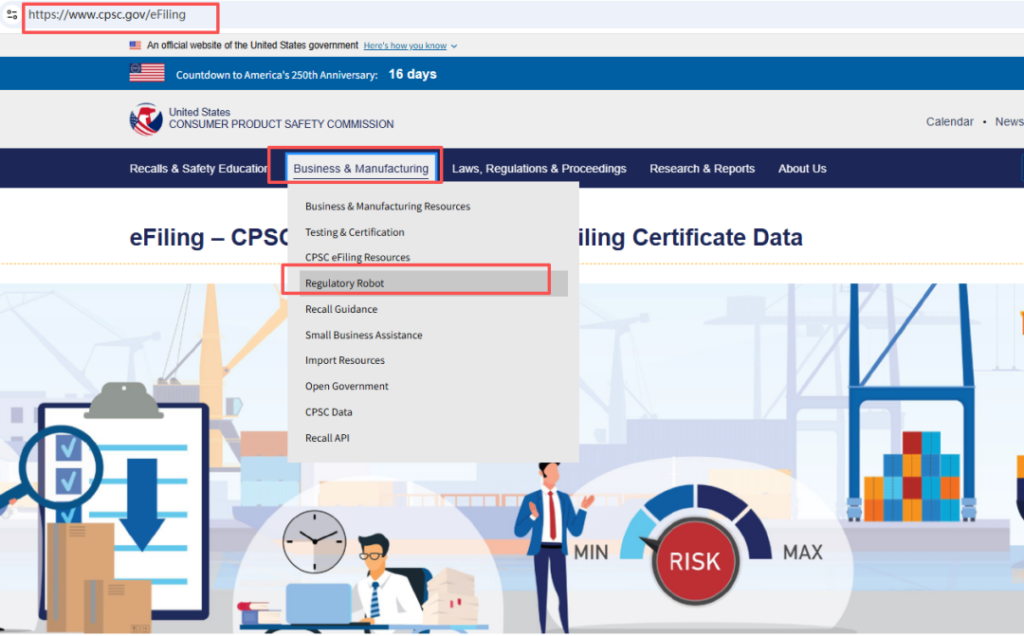
Method 2: High-Risk HTS Code Flagging
The CPSC has flagged roughly 600 Harmonized Tariff Schedule (HTS) codes within the ACE system that automatically prompt users for compliance data. These codes focus heavily on sensitive product segments, including:
- Chapter 95 (Toys & Games): Children’s toys, puzzles, board games, and recreational gear.
- Chapter 61 & 62 (Apparel): Children’s sleepwear, everyday clothing, and specialized textiles.
- Chapter 94 (Furniture): Baby cribs, mattresses, high chairs, and youth furniture.
Full PGA vs. Reference PGA: Choosing Your Filing Path
When preparing your shipments for ocean freight from China, you must decide how your customs broker will transmit your product information. The CPSC provides two distinct submission methods.
| Comparison Item | Full PGA (Complete Declaration) | Reference PGA (Reference Declaration) |
|---|---|---|
| Suitable Enterprises | Fewer SKUs, low shipping frequency | More SKUs, long-term stable shipments |
| Submission Content | Submit complete certificate data for each shipment | Reference product information in Product Registry |
| Pre-preparation | Less preparation required | Requires advance maintenance of Product Registry data |
| Subsequent Operations | Repeat data entry for every shipment | Can be repeatedly referenced later, improving declaration efficiency |
Option A: The Full PGA Message Set (Manual Per-Shipment Entry)
Using this path means your broker must manually type all seven mandatory data elements directly into the ACE platform for every single product line on your commercial invoice.
- Best For: Importers who manage a small number of SKUs, handle occasional or trial shipments, or source limited product runs from varying factories.
- The Downside: This process significantly increases manual data entry requirements for your customs broker, which can raise your clearance costs and increase the risk of minor typing errors that lead to cargo holds.
Option B: The Reference PGA Message Set (Pre-Registered Tokens)
This method allows you to upload all your product certificates and laboratory records directly into the CPSC Product Registry before your goods leave port. Once registered, the system generates three simple identification codes: a Certifier ID, a Product ID, and a Version ID. When your shipment arrives, your broker only needs to submit these three brief codes.
- Best For: Established toy brands, high-volume e-commerce sellers, and companies managing large SKU catalogs with stable, recurring production runs.
- The Advantage: This path streamlines data entry, reduces processing times at the border, and gives you complete control over your product compliance data before your shipments arrive.
The Section 321 De Minimis Misconception
A common misunderstanding among direct-to-consumer (DTC) brands using air express shipping channels is that low-value entries (Section 321 shipments valued under $800) are exempt from these rules. This is incorrect.
If a product falls under the jurisdiction of the CPSC and requires a CPC or GCC by law, it must comply with the eFiling requirement regardless of the shipment’s total dollar value. The safety risk to the consumer remains the same whether an item arrives via an individual air parcel or a full ocean container.
Test Reports, Certificates, and Data Fields
To ensure a smooth customs clearance process, it is helpful to understand how the underlying compliance documentation connects to the digital filing requirements.
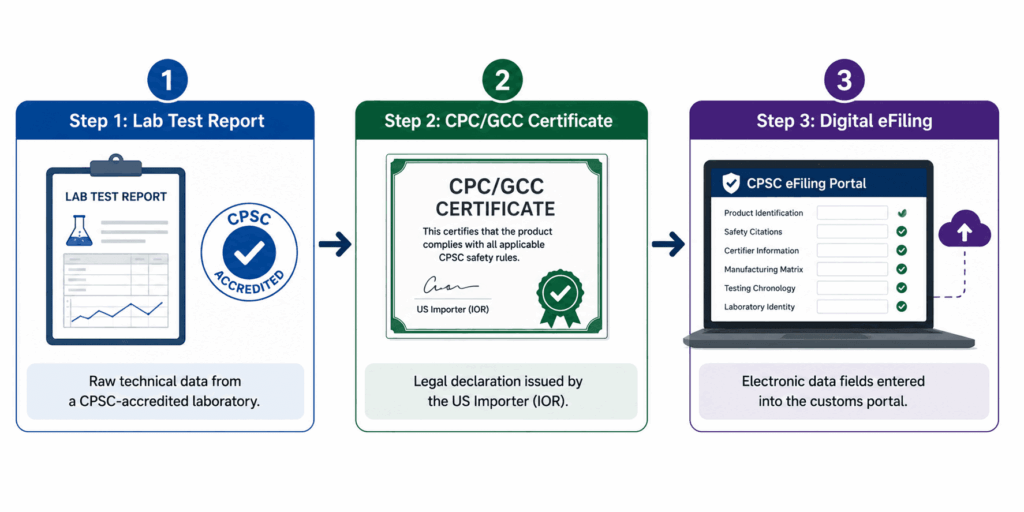
CPC/GCC Certificate
What many enterprises regard as a “CPC certificate” is not, in fact, a certification issued by a third-party agency; it is essentially a declaration of product conformity. In principle, for imported goods, it is issued by the U.S. Importer of Record (IOR) based on test results, whereas for products manufactured domestically in the U.S., it is issued by the U.S. manufacturer.
While third-party agencies can assist in preparing documentation or providing templates, they cannot issue the certificate on behalf of the party legally responsible for it.
What is the difference between CPC and GCC?
| Comparison Item | CPC (Children’s Products) | GCC (General Consumer Products) |
|---|---|---|
| Applicable Scope | Primarily products designed or intended for use by children 12 years and younger | General consumer products |
| Issuing Party | U.S. Importer or U.S. Manufacturer | U.S. Importer or U.S. Manufacturer |
| Testing Requirements | Must be based on test results from CPSC-accredited laboratories | Does not require the use of CPSC-accredited laboratories, but must have a valid testing basis |
The Seven Mandatory Data Elements
When your broker files your entry, the CPSC system validates seven specific data fields in real time. If any of this information is missing, the entry cannot be processed:
- Unique Product Identifier: (GTIN, SKU, UPC, or Model Number).
- Cited Safety Standards: The specific legal citations and safety rules that apply to the product (e.g., 16 CFR Part 1500.48 for sharp edges in toys).
- Date of Manufacture: The exact month and year your production run was completed.
- Place of Manufacture: The city, state/province, and country of the production facility.
- Most Recent Test Date: The calendar date your compliance testing was completed.
- Testing Laboratory Info: The name, physical address, and contact details of the testing facility.
- Records Custodian Info: The name, address, and contact information for the individual responsible for maintaining your supporting compliance documentation.
The New Testing Exclusions Rule (16 CFR Part 1110)
Under the updated 16 CFR Part 1110 framework, if your product relies on an official testing exemption (for example, specific plastics that are known to be free of phthalates), you must explicitly include the corresponding CPSC exclusion code in your electronic filing. Failing to declare a testing exclusion can result in an immediate system mismatch flag.
The Tracking Label Requirement for Children’s Products
If you are importing children’s toys or youth products from China, your items must feature a permanent, visible Tracking Label on both the product itself and its retail packaging. This label must display the manufacturer’s identity, the production location, the exact batch number, and cohort dates.
While the tracking label is a physical packaging requirement rather than a digital certificate field, the CPSC will cross-reference your digital manufacturing dates with the physical packaging layout during random port inspections.
Actionable Implementation Blueprint
To protect your business from costly supply chain disruptions, your team should follow a structured, step-by-step preparation plan before your next container lands.
1.Map Your Product Catalog Against High-Risk Code Flags:
Step 1 — Initial Audit
Review your active inventory against the CPSC’s 600 flagged HTS classifications. Confirm whether each product line requires a Children’s Product Certificate (CPC) or a General Certificate of Conformity (GCC). For deeper compliance context, refer back to our foundational Importer Compliance Guide for CPSC eFiling.
2.Verify Your Testing Laboratory Credentials in China:
Step 2 — Lab Auditing
For all children’s toys and youth apparel, ensure your testing is handled exclusively by a CPSC-accepted third-party laboratory in major production hubs like Shenzhen, Ningbo, or Shanghai. Test reports issued by unaccredited facilities will be rejected by the automated entry system.
3.Choose Your System Integration and Filing Path:
Step 3 — System Strategy
Evaluate your product volume. If you manage an active catalog with recurring shipments, open an account in the official CPSC Product Registry and upload your certificate data in advance to utilize the efficient Reference PGA method.
4.Verify Your Product Barcodes and Physical Tracking Labels:
Step 4 — Physical QC
Ensure the unique Product ID (UPC, SKU, or GTIN) declared in your digital filing perfectly matches the physical barcodes and tracking stamps printed on your product packaging. Mismatched data fields can trigger immediate secondary inspections.
5.Run an ACE Electronic Declaration Test Run:
Step 5 — Customs Simulation
Coordinate with your customs broker to transmit a test data packet through the Automated Commercial Environment (ACE) system before your cargo arrives at the destination port. This helps catch potential formatting or software errors early.
The 7 Deadliest Misunderstandings Avoided
Based on recent consultations with cross-border brands, we have compiled a self-examination checklist to help you identify and resolve common compliance blind spots:
| ❌ Common Misconceptions | ✅ Correct Understanding |
|---|---|
| CPSC is a certificate | CPSC is the U.S. Consumer Product Safety Commission, it is a regulatory agency, not a certificate |
| Finding a third party to handle one CPC is sufficient | Third-party organizations are responsible for testing or providing technical support. CPC/GCC certificates are principally issued by the legal responsible party (Importer) |
| CPC can be created without a test report | For children’s products, CPC must be issued based on test results from CPSC-accredited laboratories |
| Domestic factories can directly issue CPC for imported products | CPC for imported goods should principally be issued by the U.S. Importer (IOR) |
| Registering in Product Registry completes eFiling | The Registry is only for storing product information. Formal declaration must still be completed through ACE |
| If the HTS code is not on the reference list, declaration is definitely not required | Whether declaration is required depends on whether the product is subject to relevant regulations, not solely on the HTS code |
| GCC does not require testing | GCC also requires testing basis. It simply does not mandate the use of CPSC-accredited laboratories |
The Strategic Solution: How Kisun Shipping Protects Your Supply Chain
Managing the transition to digital compliance requires a logistics partner that looks beyond basic ocean freight management. At Kisun Shipping, we act as an active gatekeeper for your supply chain directly at the manufacturing source in China.
By integrating comprehensive Logistics & Quality Control Services for Amazon FBA and standard commercial imports, we help you catch compliance issues before your cargo ever boards a vessel. Our specialized teams across Shenzhen, Ningbo, and Yiwu handle direct packaging reviews, barcode verification, and pre-shipment documentation audits.
Whether you need to optimize your China to usa freight rates through premium expedited ocean lines like Matson and ZIM, or require a dedicated customs broker who understands complex CPSC entry requirements, we provide the infrastructure needed to keep your business growing.
Don’t let regulatory updates disrupt your inventory flow. Connect with the Kisun Shipping Team Today to schedule a professional compliance audit for your product catalog, secure your peak-season container allocations, and build a reliable, hold-free pipeline for your imports.

China Logistics Expert
About the Author
Katherine Kang is a China-based logistics consultant with over 11 years of experience in international trade and freight forwarding. Specializing in helping SMEs import from China to the USA, Canada, and Europe, she focuses on compliant, cost-effective solutions to avoid delays, tariffs, and hidden fees. From anti-dumping guidance to CNY planning, Katherine has managed hundreds of shipments, saving clients 15-30% on average.
Connect with Katherine on LinkedIn or contact Kisun Shipping for a free import consultation.