Master the Amazon AWD Warehouse: The Ultimate Strategy to Bypass FBA Capacity Limits and Eliminate Low-Inventory Fees
For cross-border e-commerce brands, importing from China to Amazon has become a complex operational balancing act.
On one side, you face unpredictable consumer demand and aggressive seasonal peaks. On the other, Amazon constantly adjusts its fulfillment algorithms, slashing your storage allowances and introducing penalizing surcharges.
If you keep your inventory lean to protect your cash flow, Amazon penalizes your listing with a Low-Inventory-Level Fee. If you stock up heavily to prevent going out of stock, you hit a rigid FBA Capacity Limit and face crushing storage fees. During peak seasons, securing an inbound delivery appointment can feel like winning the lottery, leaving your containers stranded at the port for weeks.
To break out of this operational trap, elite Amazon brands are moving away from shipping inventory directly from Asian factories to retail fulfillment centers. Instead, they are restructuring their entire supply networks around Amazon Warehousing and Distribution, commonly known as the Amazon AWD warehouse.
By leveraging this native wholesale storage network alongside an expert Freight Forwarding Service (China to amazon), you can stabilize your supply chain, protect your margins, and ensure your listings stay active year-round. Let’s break down exactly how the AWD ecosystem works.
What is an Amazon AWD Warehouse? (The “Storefront vs. Backroom” Analogy)
At its core, Amazon AWD is an official bulk storage, upstream buffering, and automated replenishment infrastructure managed natively by Amazon. Unlike standard FBA fulfillment centers, AWD facilities do not pack or ship individual orders to retail customers. Their sole existential purpose is to feed your main FBA shelves.
To understand how this operates when arranging your China to amazon shipping, visualize a high-traffic convenience store in the middle of Manhattan:
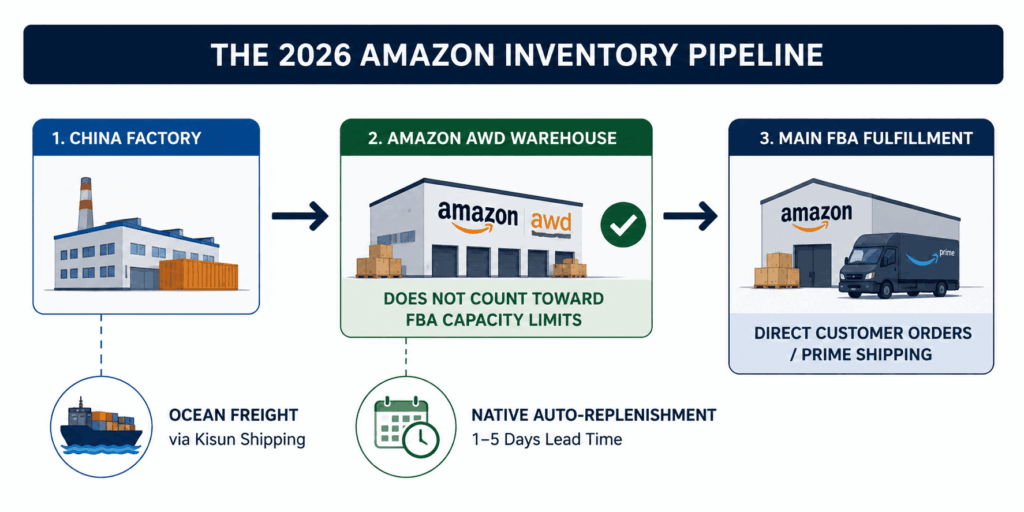
- The Main FBA Warehouse = The Convenience Store Shelf: This is the retail floor. Space is incredibly tight, rents (storage fees) are exorbitant, and it only holds enough stock to fulfill immediate buyer demand.
- The Amazon AWD Warehouse = The Massive Backroom Storeroom: Located just outside the city center, this space is cheap, spacious, and explicitly built for bulk storage. Consumers can’t buy directly from here, but the moment a product on the convenience store shelf drops below a critical threshold, stock is automatically pushed forward.
By using an experienced alibaba shipping agent to amazon to deploy your bulk pallets directly into an AWD warehouse, you effectively separate your long-term storage risk from your short-term fulfillment velocity. You no longer have to micromanage manual shipping plans, wrestle with the Amazon Carrier Central appointment system, or worry about your listings going dark during seasonal gridlocks.
The Strategic Benefits: Why Top Sellers Use AWD
Using AWD is no longer just an alternative storage option; it has become a powerful tool for protecting your profit margins. Integrating this model into your Amazon FBA inventory management unlocks several major structural advantages.
Benefit 1: Complete Immunity from FBA Capacity Limits
Amazon determines your monthly FBA capacity allowances using an updated Inventory Performance Index (IPI) score, historical sales velocity, and broader macroeconomic projections. If your score dips, Amazon can instantly throttle your storage space, preventing you from sending in fresh inventory.
The AWD Loophole: Cargo stored inside an Amazon AWD warehouse does not count toward your FBA capacity limits.
Even better, when Amazon’s internal algorithm triggers an Amazon inventory replenishment transfer to move stock from AWD into the main FBA network, these incoming units completely bypass your FBA capacity ceilings. This allows you to maintain a safe, 90-day inventory cushion upstream while keeping a lean, fast-moving 30-day footprint on your retail shelves.
Benefit 2: Automatic Waivers on Low-Inventory-Level Fees
To keep its fulfillment centers running efficiently, Amazon penalizes listings that carry less than 28 days of historical supply relative to consumer demand. These Low-Inventory-Level Fees can quickly eat into your product margins.
AWD provides an official escape hatch from these penalties. Under Amazon’s current policy, if an ASIN maintains an Auto-Replenishment ratio of 70% or higher over a rolling 90-day window (meaning at least 70% of its FBA restocks are handled automatically via AWD transfers), Amazon completely waives the Low-Inventory-Level Fee for that product.
Additionally, this automated setup exempts the ASIN from the Storage Utilization Surcharge and the Aged Inventory Surcharge for goods sitting between 181 to 365 days downstream.
Benefit 3: Protection Against Seasonal Storage Fee Spikes
During the high-volume Q4 holiday rush (October through December), standard FBA storage fees undergo a steep 3x markup, climbing up to $2.40 per cubic foot for standard-size goods. Storing oversized or slow-moving products in FBA during this period can quickly erode your profitability.
AWD provides a much more stable, predictable cost structure. While it does include modest seasonal adjustments, its baseline storage rates remain significantly discounted compared to standard FBA. This allows you to ship your holiday inventory early and let the system drip-feed the FBA network on a just-in-time basis.
Ground Reality: The 2026 Amazon AWD Fee Matrix
Amazon modified its AWD pricing architecture to implement strict regional pricing, heavily penalizing inventory that congests the West Coast entry nodes. To evaluate your accurate landed costs when tracking China to amazon freight rates, you must use the updated cost matrix:
| Service Element | Region / Program Type | 2026 Base Fee (Standard Period) |
| Monthly Bulk Storage | West Region (California, Washington, etc.) | $0.57 per cubic foot / month |
| Monthly Bulk Storage | East / Central / South Regions | $0.48 per cubic foot / month |
| Inbound Processing Fee | All Regions (Standard Cartons) | $1.40 per box |
| Inbound Processing Fee | West Coast Palletizable Promotion (Through Dec 31, 2026) | $1.05 per box (25% off promotional discount) |
| Outbound Processing Fee | All Regions | $1.40 per box |
| Internal Transportation | Base Program Rate | $1.40 per cubic foot |
| Internal Transportation | Amazon-Managed Carrier Flow | $1.26 per cubic foot (10% Smart Storage discount) |
Logistical Insider Tip from Kisun Shipping: To maximize the 10% Smart Storage discount or the up-to-20% Managed Storage discount, your supply chain data must be pristine. Amazon’s algorithm rewards consistent, predictable velocity signals. If you run erratic product lines or unverified test SKUs, you will be locked into the higher base rates. For a deeper breakdown of cross-border linehaul expenses, review our comprehensive analysis on China to FBA Amazon 2026 Current Costs & Faster Routes.
AWD vs. FBA vs. Traditional 3PL: A Side-by-Side Comparison
Many sellers setting up their first first-mile shipments ask: “Is this simply an Amazon-branded independent overseas warehouse?” While they share some basic storage functions, the operational mechanics and platform integrations are fundamentally different.
The table below breaks down how these options compare across key supply chain metrics:
| Operational Feature | Standard Amazon FBA | Amazon AWD Warehouse | Traditional 3PL Overseas Warehouse |
| Primary Functional Purpose | B2C Order Fulfillment & Prime Delivery | Upstream Bulk Storage & Auto-Replenishment | Multi-Channel Storage & Flexible Distribution |
| FBA Capacity Cap Impact | Highly Restricted. Directly limited by your IPI score. | 100% Exempt. Does not impact your capacity caps. | Restricted. Creates a cap hit as soon as an FBA shipment is booked. |
| Restocking Mechanics | Manual creation of inbound shipping plans. | Fully Automated. System algorithm handles internal transfers. | Manual intervention required via manual truck bookings. |
| Low-Inventory Fee Waiver | Subject to standard penalization structures. | Eligible for 100% Waiving (requires $\ge 70\%$ auto-replenishment). | Subject to standard penalization structures. |
| FBA Prep & Labeling Assistance | Chargeable backend automated prep options. | Zero Service. Will not fix upstream labeling errors. | Full Service. Offers re-labeling, kitting, and product sorting. |
| Multi-Channel Flexibility | Multi-Channel Fulfillment (MCF) with extra fees. | Restrictive. Built primarily for the Amazon platform. | High Flexibility. Directly ships to TikTok, Walmart, Shopify. |
The Critical Bottleneck: Why Factory-Side Quality Control is Non-Negotiable for AWD
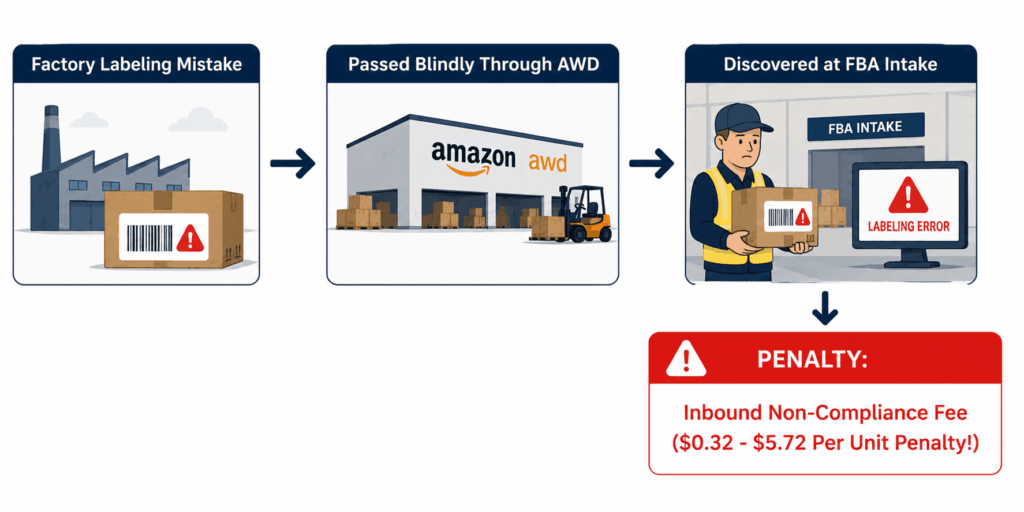
Here is the absolute danger zone that Amazon hides in the fine print: Amazon AWD is a zero-touch, pass-through storage matrix. It will not perform FBA prep, it will not fix torn barcodes, and it will not rectify sorting mistakes made by your factory in Shenzhen or Ningbo.
If your factory fails to utilize Amazon-compliant case labeling or sends mis-barcoded SKUs, those boxes will bypass human evaluation at the AWD intake dock and sit blindly on a bulk pallet. The true nightmare surfaces weeks later: when the automated algorithm pushes that stock forward to a retail FBA fulfillment center, the scanning systems will flag the non-compliance.
The cost of this error is devastating in 2026. Amazon’s updated Inbound Non-Compliance Fees will slap your account with a penalty of $0.32 to $1.74 per unit for standard-size items, and up to a staggering $5.72 per unit for bulky products.
This is why experienced importers realize that relying on a generic, hands-off alibaba shipping agent to amazon is an operational hazard. To successfully navigate AWD, you need an integrated partner that blends a premier Freight Forwarding Service (China to amazon) with comprehensive Logistics & Quality Control Services for Amazon FBA.
At Kisun Shipping, we act as your physical gatekeeper in China before your freight ever boards a vessel. Our specialized origin teams handle:
- Palletization and Advanced Carton Auditing: Ensuring every single master carton meets exact AWD dimensional and structural specifications to avoid warehouse rejections.
- FNSKU and Box Label Validation: Verifying scannability, proper placement, and tracking code accuracy against your active Seller Central manifests.
- Pre-Shipment Random Sampling: Inspecting production outputs to verify structural integrity, protecting your brand from downstream product defects and costly Amazon customer returns.
Step-by-Step Blueprint: Sourcing from China to Amazon AWD
Ready to implement an AWD framework? Here is the exact operational sequence required to execute the workflow flawlessly:
Step 1: Confirm ASIN Eligibility in Seller Central
Log into your account, navigate to Inventory -> Supply Chain -> Amazon Warehousing & Distribution (AWD). Verify that your account has active access and check if your specific product line is approved. Note that hazardous materials (Hazmat), perishable goods, and highly irregular oversized profiles are structurally restricted from entering the AWD grid.
Step 2: Create your Upstream Inbound Plan
When building a new cargo plan within the Send to Amazon workflow, explicitly select Ship to Amazon Warehousing and Distribution (AWD) instead of routing directly to standard fulfillment nodes. The system will process your SKU metrics and output a specialized AWD destination address (typically clustered near strategic port gateways like Los Angeles/Long Beach or New York/New Jersey).
Step 3: Secure Specialized First-Mile Ocean Freight
Do not book standard, unverified freight channels. Secure a reliable partner capable of executing optimized ocean freight from China with dedicated custom clearance assets. At Kisun Shipping, we synchronize your commercial invoice data with your Importer of Record (IOR) profile and handle the complexities of PGA message sets (such as mandatory CPSC eFilings) to guarantee your ocean containers clear customs without localized terminal hold-ups.
Step 4: Configure the Auto-Replenishment Guardrails
Once your ocean freight lands at the AWD center and is checked in, navigate to your AWD dashboard to establish your inventory thresholds. You can choose to hand total control to Amazon’s automated machine-learning model, or you can input manual overrides by establishing strict Minimum and Maximum FBA unit limits. For example, you can set a rule stating: “If my retail FBA warehouse inventory drops below 200 units, automatically pull 100 units from my AWD pallet buffer.”
Real-World Case Study: How a Bulky Home Decor Brand Saved 64% in Overhead
To ground this strategy in reality, let’s look at the financial turnaround of an active enterprise partner who shifted their logistics strategy to Kisun Shipping.
The Profile:
A manufacturer based in Shenzhen specializing in solid-wood vanity organizers and small accent furniture pieces.
- Product Dimensions: Bulky, large standard-size tiers.
- Historical FBA Peak Storage Fee: $15.00 per unit per month during Q4.
- The Pain Point: In late 2025, their FBA capacity limit was suddenly cut by 70% due to an unseasonal sales dip that temporarily lowered their IPI score. They faced an existential crisis: they had three full 40HQ containers of high-margin holiday inventory ready to ship via ocean freight from China, but no FBA capacity to receive them. Running out of stock in November meant forfeiting their keyword rankings to competitor brands.
The Kisun Shipping AWD Intervention:
Instead of forcing a direct-to-FBA entry or parking the cargo in an expensive California 3PL that would require manual transport management, we restructured their pipeline:
- Origin Quality Control: Kisun’s logistics team intercepted the inventory at our Shenzhen consolidation warehouse, re-verifying every single palletized carton layout to ensure compliance with AWD automated scanning gates.
- Strategic Ocean Routing: We shipped the three containers via a premium sea route directly into an Amazon AWD facility located in the West Region.
- Algorithmic Automated Restocking: The inventory safely cleared customs and entered the AWD network without affecting their restricted FBA capacity limits. We helped them configure a lean 14-day safety threshold in their Seller Central backend.
The Financial Outcome:
- Their baseline storage costs plummeted from the projected peak FBA rate of $15.00 per unit down to the AWD bulk storage rate of $0.57 per unit.
- Even after accounting for the internal Amazon transportation transfer rate of $1.26/cu ft and the standard box-handling processing fees, the brand recorded a net savings of 64% in total operational overhead.
- Their stockout rate over the entire Q4 holiday season was exactly 0%. Because their AWD auto-replenishment ratio tracking remained above the 70% threshold, Amazon completely waived their low-inventory penalties.
Quick Fire Q&A: Master the AWD Blueprint
Q: Can I use inventory stored inside an AWD warehouse to fulfill orders on TikTok Shop or Shopify via MCF?

A: While Amazon has rolled out limited pilot updates regarding Multi-Channel Fulfillment (MCF) directly from AWD networks, it remains highly restrictive compared to an independent 3PL. AWD is structurally designed to feed the domestic Amazon FBA grid. If multi-platform distribution is your main operational engine, a hybrid model using a private 3PL or Kisun's flexible overseas warehousing options is superior.
Q: What happens if Amazon loses or damages my pallets while they are inside an AWD facility?
A: Because AWD is an official corporate facility owned and operated directly by Amazon, your inventory is fully covered under the standard FBA Lost and Damaged Inventory Reimbursement Policy. You can file systematic reconciliation claims inside Seller Central just as you would for a standard retail fulfillment center.Q: Can my factories in China ship individual, loose unpalletized boxes to AWD?
A: AWD thrives on standardized bulk input. While loose master cartons are accepted if they conform to explicit box processing parameters ($1.40/box handling fee structure), shipping pre-palletized cargo optimized for forklift cross-docking radically accelerates intake speeds and reduces the risk of inbound transit damage.Summary: Is Amazon AWD Right for Your Business?
Deciding whether to integrate AWD into your supply chain comes down to simple math. Take your monthly FBA storage fees, add your projected costs from low-inventory penalties, and factor in the revenue lost to peak-season stockouts. Compare that total against the steady, lower costs of bulk AWD storage.
If you sell bulky or oversized products, manage multiple SKUs with consistent sales trends, or frequently run into FBA capacity caps, moving to an AWD model is a highly effective way to protect your margins and scale your business.
Logistics isn’t just about moving boxes from point A to point B—it is a powerful tool for protecting your bottom line. Stop letting capacity restrictions and unexpected fees slow down your growth.
Ready to optimize your Amazon supply chain? Connect with the Kisun Shipping Team Today. Let’s calculate your optimal freight routing, set up a reliable plan of shipping from China to Amazon, and build a streamlined pipeline that keeps your business growing.

China Logistics Expert
About the Author
Katherine Kang is a China-based logistics consultant with over 11 years of experience in international trade and freight forwarding. Specializing in helping SMEs import from China to the USA, Canada, and Europe, she focuses on compliant, cost-effective solutions to avoid delays, tariffs, and hidden fees. From anti-dumping guidance to CNY planning, Katherine has managed hundreds of shipments, saving clients 15-30% on average.
Connect with Katherine on LinkedIn or contact Kisun Shipping for a free import consultation.