
Shipping Batteries from China 2026: UN38.3, MSDS, Transport Report & DG Packaging Guide
Imagine this scenario: You’ve spent months negotiating with a supplier in Guangzhou or Ningbo for a hot new line of consumer electronics, smart home devices, or electric mobility tools. You run your landed cost projections based on standard ocean freight metrics, wire the initial deposit, and wait for production to wrap up.
Then, your factory finishes production, and you hand the booking over to your logistics provider. Suddenly, the entire supply chain grinds to a screeching halt.
Your agent asks for an MSDS, a UN38.3 Test Summary, a Transport Conditions Identification Report, and a Dangerous Goods Packaging Certificate (危包证). You call your factory, only to discover they have never heard of these documents, or they tell you, “We only supply the domestic Chinese market; we don’t have export hazardous certificates.”
This is the exact moment when thousands of international importers realize they aren’t just shipping general cargo—they are legally transporting regulated hazardous materials.
When shipping from China, attempting to sneak products containing lithium batteries or chemical compounds onto an aircraft or a container vessel without these four pillars of compliance is no longer a minor logistical hiccup. In 2026, it is a high-stakes gamble that carries heavy port penalties, immediate cargo seizures, and potential criminal liability for undeclared dangerous goods.
This masterclass guide breaks down the technical differences between these four frequently confused certifications, maps out the strict regulatory updates enforced by the 67th Edition of the IATA Dangerous Goods Regulations (DGR), and provides an operational blueprint so you can audit your Chinese suppliers before you wire a single dollar of your procurement budget.
Quick Cheatsheet for E-commerce Sellers:
- Built-in Li-ion Batteries (e.g., iPhone, Smart Watch): Usually NEITHER Dangerous Packaging Certificate NOR Class 9 Hazmat label is required. (Section II Exempted).
- Loose Batteries / Power Banks / E-Scooters: Mandatory Dangerous Packaging Certificate (危包证) + Class 9 DG Booking. No exceptions in 2026.
The Core Distinctions: Four Certificates, Four Distinct Legal Protections
Many foreign trade managers and e-commerce business owners use these four terms interchangeably. That is a foundational error. Each document answers an entirely separate question asked by ocean carriers, airline safety inspectors, and customs authorities at the border.
THE HAZMAT DOCUMENT FUNCTIONAL MATRIX
| Document Name | Core Question It Answers |
| UN38.3 Test Summary | Is the battery cell structurally safe to fly? |
| MSDS / SDS | What chemical hazards exist if this burns? |
| Transport Identification | Is this specific lot general or dangerous? |
| Dangerous Packaging Cert | Is the box certified to contain an explosion? |
1. UN38.3 Certification: The Battery’s Structural Safety Pass
What is it?
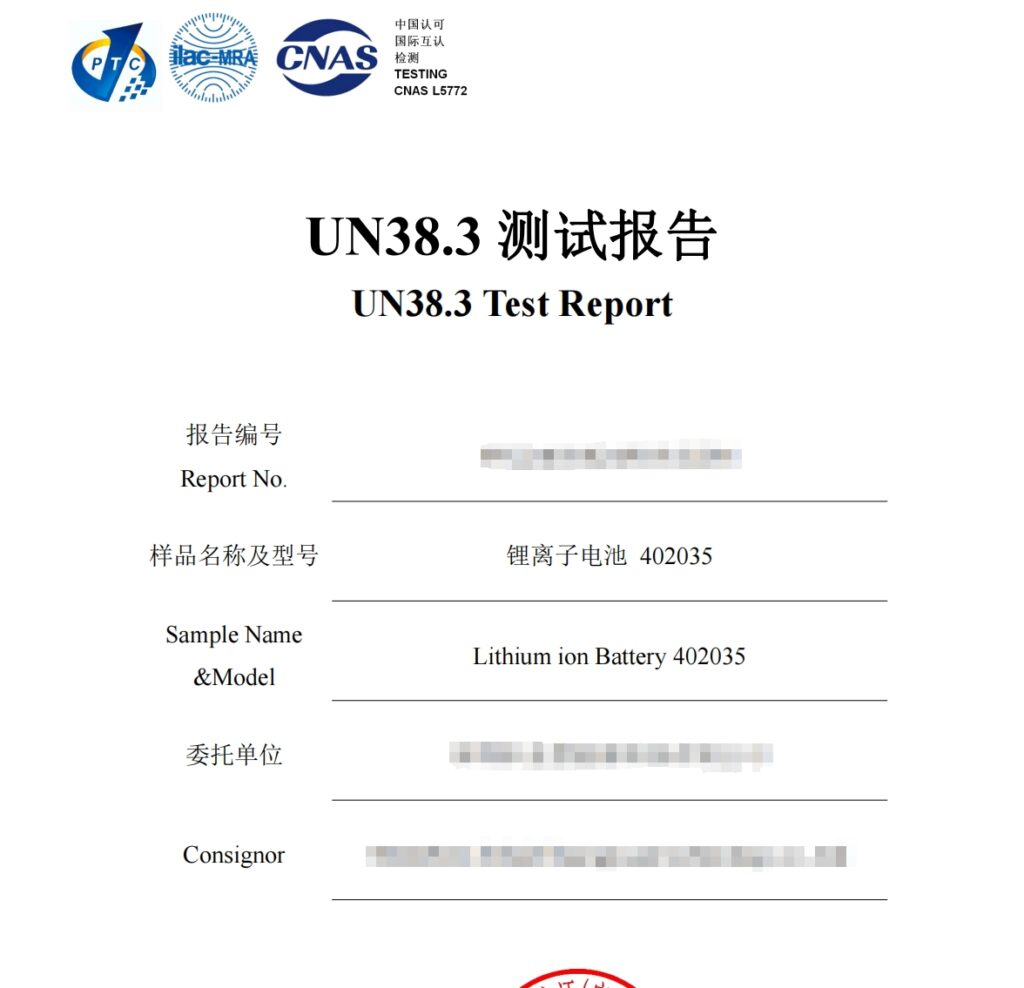
UN38.3 refers to Section 38.3 of the United Nations Manual of Tests and Criteria. It is not a simple paperwork disclosure; it is a brutal, physical battery health check. Below is a sample of the UN38.3 certification.
Why it exists
Lithium-ion and lithium-metal batteries pack an immense amount of energy into tiny footprints. If a battery cell suffers from an internal design defect, bad separators, or low-quality electrolyte mixtures, it can experience thermal runaway—an unstoppable self-heating loop that causes catastrophic fires and explosive venting. UN38.3 proves that the battery cell can withstand the physical, thermal, and pressure stresses of an international transit environment.
The 8 Mandatory Physical Tests (T.1 to T.8)
To secure an authentic UN38.3 certification, sample cells from your Chinese factory must survive eight highly destructive tests in an accredited laboratory:
- T.1: Altitude Simulation: Simulates the unpressurized cargo holds of an aircraft at 11,600 meters. The cell is stored at extremely low atmospheric pressure 11.6 kPa for six hours. It must not leak, rupture, or lose mass.
- T.2: Thermal Test: The batteries are repeatedly shocked by extreme temperature swings, moving from -40℃ up to +72℃ within minutes, holding each extreme for six hours.
- T.3: Vibration: Simulates the relentless mechanical vibrations of a transpacific container ship or long-haul cargo plane. The batteries are subjected to a sine wave frequency sweep for a grueling total of nine hours.
- T.4: Shock: Simulates rough handling, port drops, and container turbulence. The cells face a massive peak acceleration of 150g.
- T.5: External Short Circuit: The battery is heated to +55℃, and its external terminals are short-circuited. The cell temperature cannot exceed +170℃, and it cannot explode or ignite within six hours of the test.
- T.6: Impact / Crush: A heavy weight is dropped onto the cell, or it is crushed between hydraulic plates to simulate crushing forces inside a packed container.
- T.7: Overcharge: For rechargeable lithium-ion cells, the battery is forced to accept twice its maximum rated charging current for 24 hours to test its built-in safety circuits.
- T.8: Forced Discharge: The cell is forced into a deep negative discharge state using an external power source to ensure it won’t violently ignite when completely drained.
Issuing Authority & Validity
This report cannot be self-certified by the manufacturer. It must be issued by an independent, third-party testing house accredited by bodies like CNAS (China National Accreditation Service for Conformity Assessment) or CMA.
A UN38.3 report is technically valid indefinitely provided the chemical formulation, internal safety architecture, and Battery Management System (BMS) of the cell remain completely unchanged. If your factory switches cell suppliers to save five cents a unit, the existing UN38.3 report becomes instantly void.
2. MSDS (SDS): The Chemical Component Safety Disclosure
What is it?
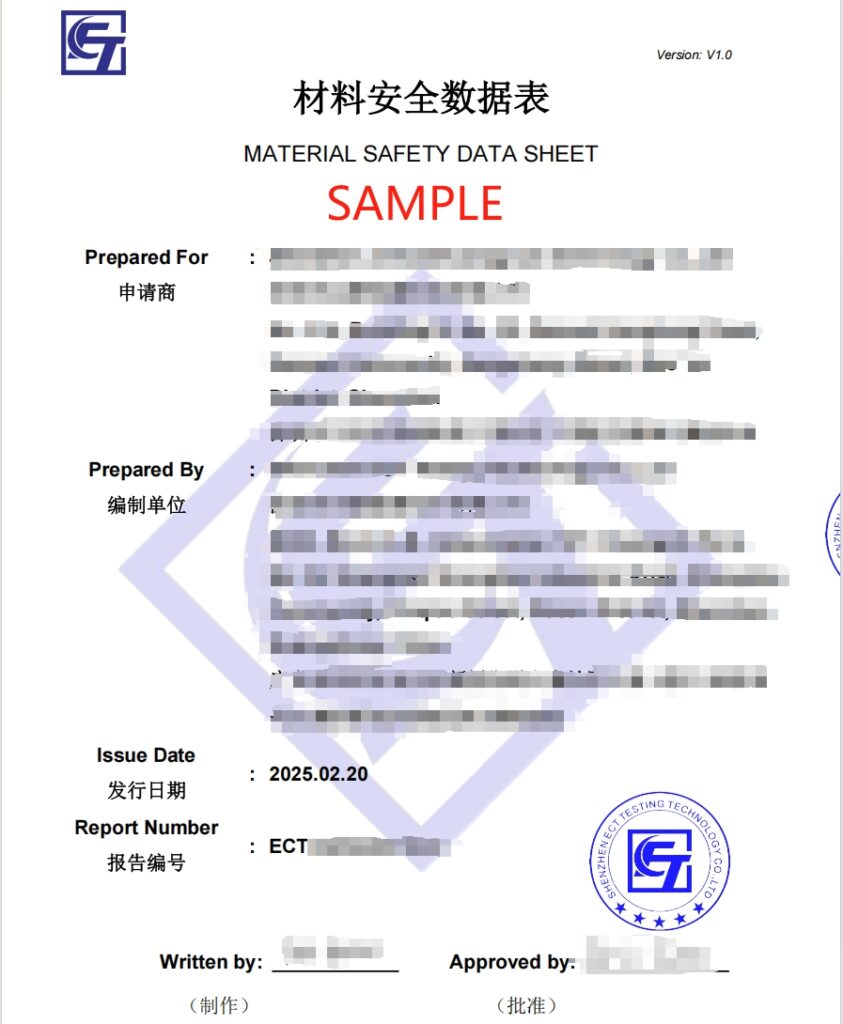
The Material Safety Data Sheet (now globally standardized under the Globally Harmonized System as simply SDS—Safety Data Sheet) is the master safety manual for your cargo. Below is a sample of the MSDS.
Why it exists
If a container catches fire at sea or a pallet begins to emit a strange odor in an air freight terminal, emergency response personnel cannot afford to guess what is inside your products. The MSDS is a comprehensive 16-section legal document that details exactly what the product is made of, how dangerous it is, and exactly how to put out a fire if it ignites.
The 16 Standardized Sections of a Valid SDS
Every compliant MSDS when importing from China must follow a strict, unalterable structure:
- Identification of the substance and supplier details.
- Hazards identification (GHS classification and labeling pictograms).
- Composition/information on ingredients (exact CAS numbers and chemical percentages).
- First-aid measures (what to do if eyes, skin, or lungs are exposed).
- Fire-fighting measures (identifying the correct extinguishing media—e.g., standard water will worsen a lithium metal fire).
- Accidental release measures (spill containment procedures).
- Handling and storage (temperature and humidity limits).
- Exposure controls and personal protection parameters.
- Physical and chemical properties (flashpoints, boiling points).
- Stability and reactivity (identifying incompatible materials).
- Toxicological information.
- Ecological information (environmental toxicity).
- Disposal considerations.
- Transport information (This is the section carriers look at first—identifying the UN Number and Proper Shipping Name).
- Regulatory information.
- Other information (revision dates).
Issuing Authority & Validity
Unlike the UN38.3, an MSDS does not require a laboratory physical test. It is a data compilation document. A factory with qualified chemical engineers can draft its own MSDS internally, though most reliable manufacturers hire certified regulatory firms to generate them.
It has no fixed expiration date, but it must be updated the moment international transport laws alter hazard classification frameworks.
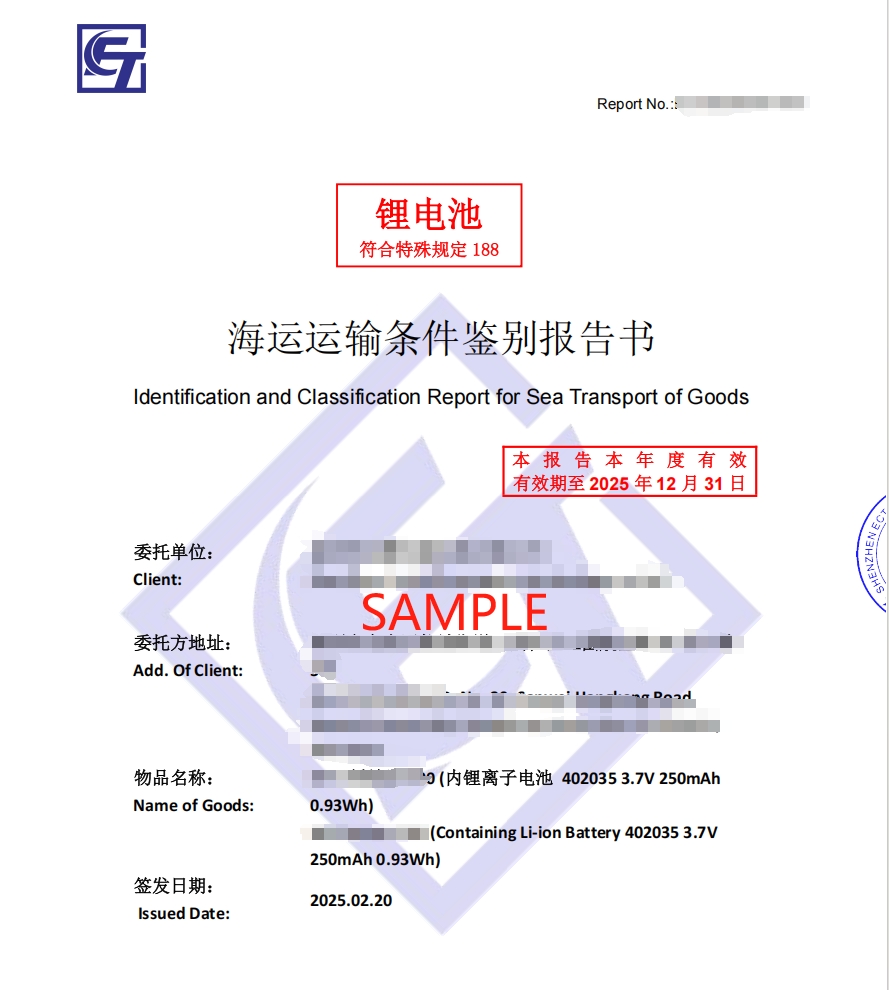
3. The Transport Conditions Identification Report: Your Logistics Passport
What is it?
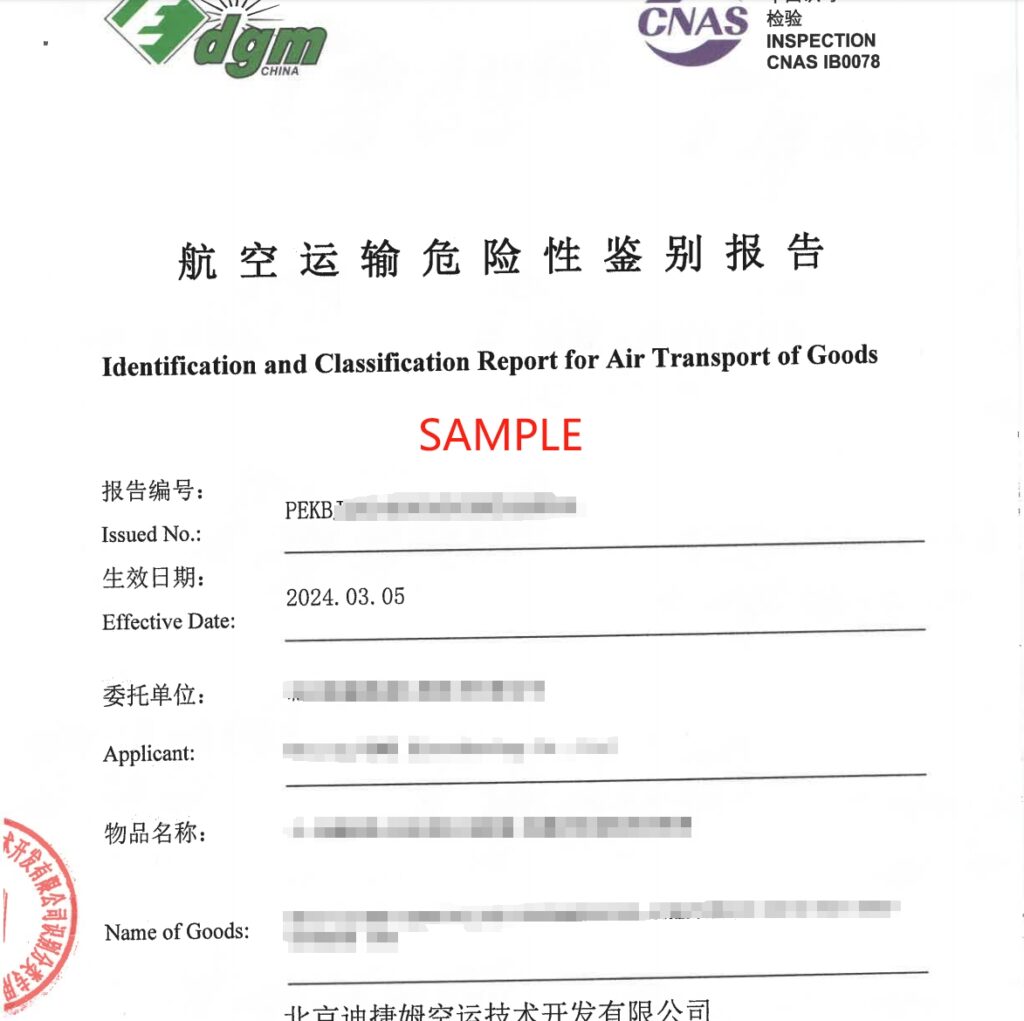
Known in the Chinese logistics industry as the 航空/海运运输条件鉴定书, this document is an official evaluation that states: “Based on the current rules of this specific calendar year, this exact cargo is safe to transport via this specific method under these conditions.” Below is a sample of Identification and Classification Report for Sea Transport of Goods and Air Transport of Goods.
Why it exists
International transport regulations change with extreme frequency. For example, the International Air Transport Association (IATA) updates its Dangerous Goods Regulations every single year on January 1st. An MSDS written in 2023 cannot account for strict shipping mandates implemented in 2026.
The Transport Conditions Identification Report takes your raw UN38.3 test data, cross-references it with your MSDS, looks at the specific packing configuration of your shipment, and issues a definitive operational ruling for the current year. It determines whether your goods are classified as:
- General Cargo (普货): Requires no special hazmat surcharges or specialized containers.
- Dangerous Goods (危险品): Must be booked under strict Class 9 or Class 4 profiles, requiring specialized container positioning or restricted cargo-aircraft-only routing.
Prerequisites & Validity
You cannot get a Transport Identification Report unless you already possess a valid UN38.3 test report and a matching MSDS. The testing institutes in China (such as the Shanghai Research Institute of Chemical Industry or DGM) require these documents as baseline evidence before they will stamp an identification report.
Crucial Note on Validity: This document is strictly valid for one calendar year. Because it evaluates cargo against the active regulations of the current year, a report issued in 2025 automatically expires on December 31, 2025. If you are executing air freight from China in 2026, you must secure a 2026-stamped report.
4. The Dangerous Goods Packaging Certificate (危包证)
What is it?
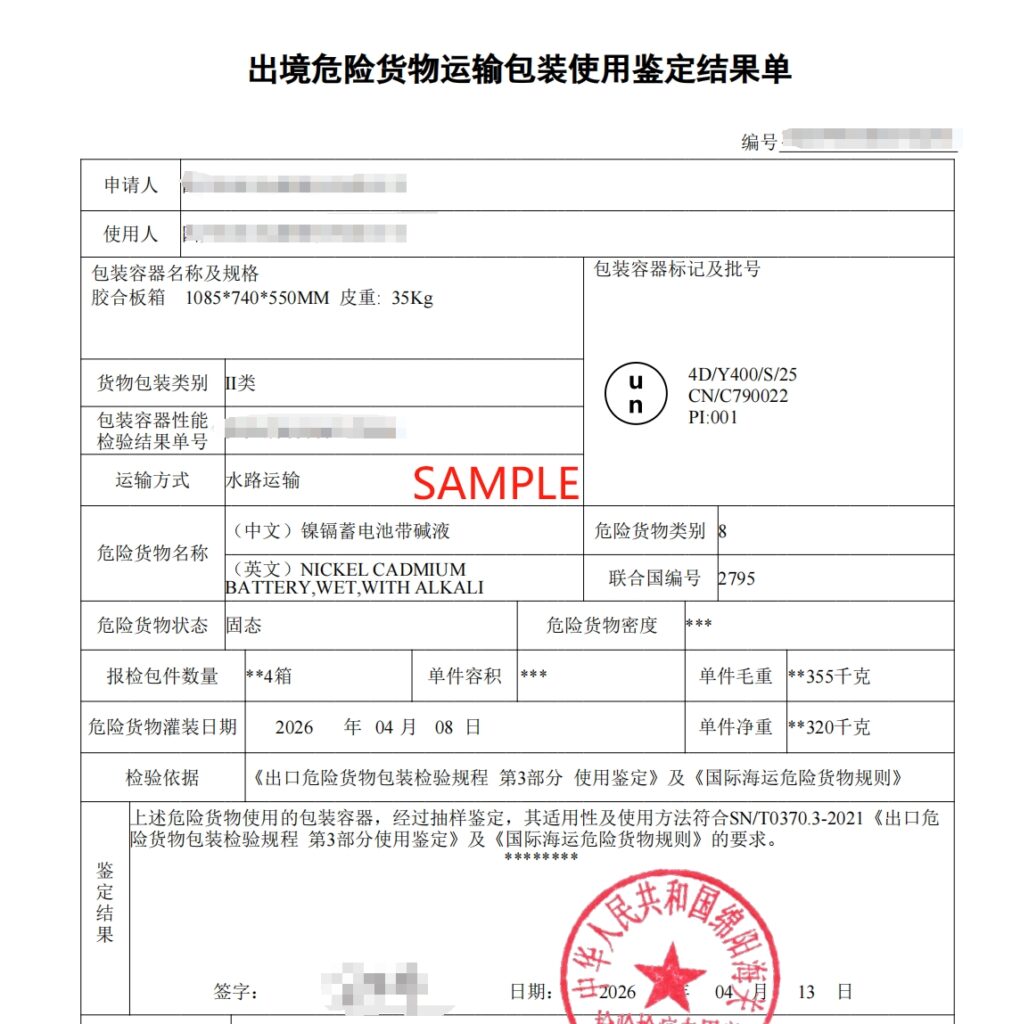
Formally titled the 出境危险货物运输包装使用鉴定结果单 (Identification Result Sheet for the Use of Packaging for Export Hazardous Cargo), this is an official customs certificate issued by the General Administration of Customs of China (GACC). Below is a sample of Dangerous Goods Packaging Certificate.
Why it exists
If your product is classified as fully regulated dangerous goods (for instance, loose standalone power banks under UN3480, or high-capacity industrial battery packs), the box you pack them in must be robust enough to survive structural damage. If a standard cardboard box gets damp, collapses, and allows lithium battery terminals to crush against one another, a massive container fire is inevitable.
The Dangerous Packaging Certificate proves two things:
- The Performance Test (出境危险货物包装性能检验结果单): The packaging factory proved that their boxes can pass drop tests, stacking tests, and hydraulic pressure tests. The box receives a permanent, stamped UN specification mark (e.g.,
UN 4G/Y15/S/26). - The Use Evaluation (危包证使用证): Customs inspectors physically verified that your specific manufacturing factory packed the dangerous cargo into those certified UN boxes correctly, utilizing proper insulation, short-circuit protection, and interior shock absorbers.
When is it mandatory vs. exempted?
This is where many importers lose time. They assume every product with a battery needs a Dangerous Packaging Certificate. That is incorrect.
- Exempted (Section II Compliance): If your batteries are low capacity (e.g., under $100 \text{ Wh}$ for lithium-ion cells) and are fully installed inside the device (like a standard smartphone or a smart watch under UN3481, PI967), the shipment can generally clear customs without a Dangerous Packaging Certificate, provided the packaging prevents accidental activation.
- Mandatory (Section I/IA/IB Compliance): If you are shipping high-power battery packs, electric vehicles (scooters/bikes under UN3556), standalone lithium batteries (UN3480), or loose batteries packed alongside a device in the same box (UN3481, PI966), a formal, stamped Dangerous Packaging Certificate is non-negotiable for sea freight from China. Without it, Chinese maritime customs will block the container from loading at the terminal gates.
The Master 2026 Regulatory Update: The 67th Edition IATA DGR Shakeup
If your logistics workflow is operating on pre-2026 assumptions, you are exposed to significant financial risk. On January 1, 2026, the 67th Edition of the IATA Dangerous Goods Regulations (DGR) went into full effect. It introduced two structural updates that have radically altered the landscape of air freight from China:
1. The Mandatory 30% State of Charge (SoC) Expansion
For several years, standalone lithium-ion batteries (UN3480) were forced to ship at a maximum State of Charge (SoC) of 30% of their rated capacity to reduce thermal runway risks during flight.
Starting January 1, 2026, this 30% limit is no longer a recommendation—it is a strict mandatory law for:
- UN3481 (PI966): Lithium-ion batteries packed together with equipment where the cell/battery rating exceeds 2.7Wh.
- UN3556 (PI952): Battery-powered electric vehicles where the total battery system exceeds 100 Wh.
If your Chinese factory tests and packages a drone, an electric scooter, or a power tool kit with the batteries charged to 80% or 100%, airlines like Lufthansa, Air France, and Cathay Pacific will run random multi-meter spot-checks at the airport. Non-compliant shipments face instant grounding, heavy terminal rejection fees, and mandatory reverse-logistics extraction.
2. Mandatory Physical Test Summaries at Check-In
Carriers have completely eliminated reliance on simple external package stickers. Airlines now demand a signed, digital or physical UN38.3 Test Summary Document containing clear manufacturer validation, signature credentials, and explicit watt-hour specifications matching the active master airway bill (MAWB) data strings.
The Golden Order: The Sequential Blueprint for Dangerous Cargo Approval
You cannot process these documents simultaneously or backward. If you attempt to apply for certificates out of order, you will waste thousands of dollars in redundant service fees and experience severe production delays. The regulatory workflow follows a strict sequential dependency:
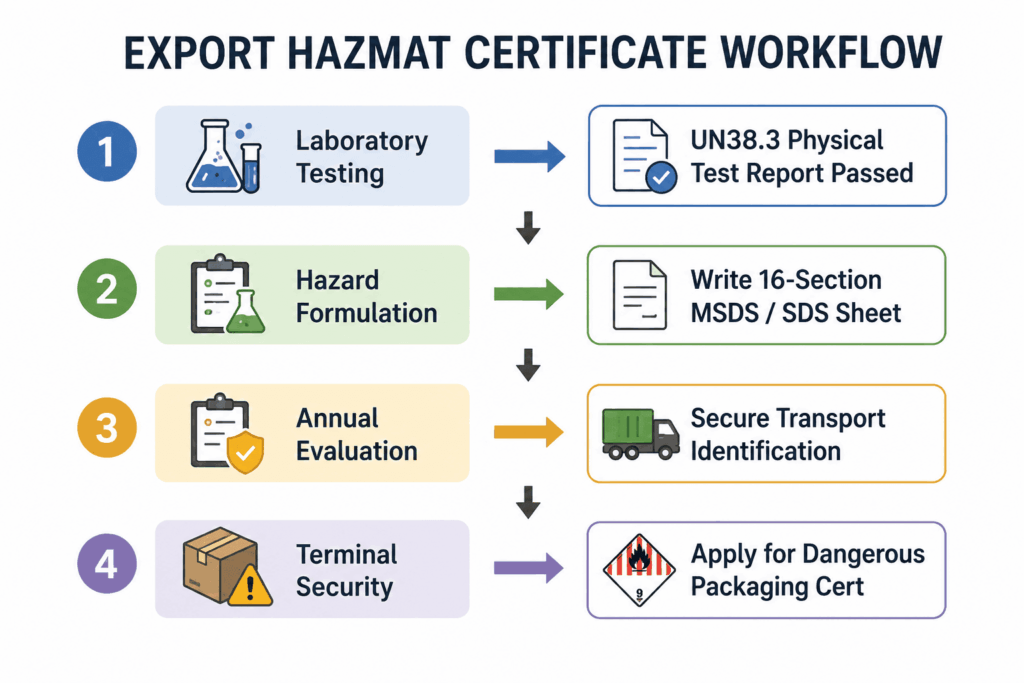
If your Chinese supplier claims they can provide a Transport Identification Report but confesses they don’t have a UN38.3 test summary, they are lying. The authorized institutes in China will not even open a file application for a transport appraisal unless the certified UN38.3 lab data is linked to the submission.
Why Your Freight Forwarder Can’t “Fix” a Non-Compliant Factory
The single most common question our customer service desk receives is this: “I found a cheap supplier on an online sourcing directory for heated massage jackets. They don’t have an MSDS or a UN38.3 report. Can Kisun Shipping just handle the certificates for me at the port?”
Let’s address this directly: No freight forwarder can magically manufacture these certificates for you. Here is why:
- Legal Liability of the IOR (Importer of Record): Under international maritime law and US/European Customs regulations, misdeclaring hazardous materials or providing fraudulent chemical statements is a major offense. If a forwarder tries to use a generic, “borrowed” MSDS to push a batch of uncertified batteries through a port, and that container suffers a thermal event at sea, the criminal and civil liability falls entirely on the importer and the shipper.
- The Source of the Dangerous Goods Packaging Certificate: Because the Dangerous Goods Packaging Certificate (危包证) requires local China Customs officers to physically inspect the factory’s packing standards and audit the batch number against the production run, it can only be generated at the place of manufacture.
If you are serious about maintaining an unshakeable supply chain when importing from China, compliance is your responsibility. You must integrate a rigorous compliance audit into your initial supplier sourcing framework.
Before signing a purchase contract or paying a deposit, issue a formal demand to the factory: “Provide an active UN38.3 Test Summary and an SDS showing compliance with current international standards for this exact product model.” If they stall, give you excuses, or send you low-resolution files belonging to a completely different factory, walk away from the deal. The cheap unit price is a trap.
The Compliance Trap: Why Gray-Market DDP Options Will Destroy Your Inventory
When faced with the rigorous paperwork requirements of dangerous goods transportation, many international buyers look for shortcuts. They fall victim to unaccredited freight forwarders offering cut-rate, all-inclusive “DDP General Cargo” lines, promising: “Just give us the boxes; we don’t need any MSDS or UN38.3 certificates. We will handle all customs clearances through our own special methods.”
In the current global supply chain climate, this is an existential threat to your business.
Customs agencies globally have dramatically scaled up their automated scanning infrastructure. Customs bureaus use high-fidelity electronic auditing systems to run real-time text-parsing analytics across cargo manifests.
If a low-cost logistics provider attempts to hide lithium batteries or chemical materials inside a general container by declaring them as generic “plastic toys,” “metal ornaments,” or “hardware accessories” to bypass the dangerous goods surcharge, the automated systems will flag the entry.
The consequences of this intentional misdeclaration are swift and permanent:
- Immediate Port Quarantine: The entire container is pulled off the vessel manifest at Chinese transit gates or international gateway terminals like Los Angeles or Rotterdam.
- Exorbitant Demurrage and Penalties: The importer faces massive anti-smuggling penalties that can easily scale to tens of thousands of dollars per occurrence.
- The 9H Electronic Block: For North American-bound lanes, as we broke down in our specialized playbook on the US Customs 9H Hold, CBP will instantly freeze the Importer of Record (IOR) identity across the ACE network for an electronic audit. Your entire supply chain freezes because of one misdeclared pallet.
- Permanent Blacklisting: The manufacturing facility in China is placed on global security watchlists, effectively preventing it from ever securing a compliant ocean bill of lading or air waybill to Western markets again.
Master Checklist for Importers Sourcing Battery-Powered Goods from China
To safeguard your capital and ensure seamless execution when booking sea freight from China or managing fast-turnaround air cargo loops, utilize this absolute compliance timeline:
- Sourcing Phase: Demand verified copies of the factory’s UN38.3 report and SDS sheet before signing production contracts.
- Technical Audit: Calculate the exact Watt-hour rating (Wh = V times Ah) to determine whether full Dangerous Goods rules or Limited Quantity exceptions apply.
- Appraisal Launch: Instruct the factory to submit the documentation to an accredited Chinese institute to obtain the current year’s Air or Sea Transport Identification Report.
- Packaging Verification (If >100Wh): Confirm the factory has secured a valid Dangerous Goods Packaging Certificate (危包证) from local China Customs.
- Artwork Check: Verify that the outer shipping boxes display the Class 9 Hazard Label, the proper UN Number, and the mandatory emergency contact information.
- Booking Alignment: Ensure your freight forwarder books the cargo under the correct UN designation with carrier hazardous teams, preventing severe misdeclaration penalties.
The Pre-Shipment Pre-Check: Preventing Costly Port Rejections
Before your container locks or your air pallets are built, verify that your shipment passes this comprehensive pre-check. A single mismatch across these data points will cause carrier automated booking systems or customs networks to reject the shipment.
1. The Nomenclature & Specification Alignment Audit
Cross-reference your document files and ensure absolute alignment across these fields:
- Does the Battery Model Number printed on the physical item match the model number listed on the UN38.3 test summary down to the last digit?
- Does the Manufacturer Name on the MSDS match the corporate entity listed on the factory’s export invoices?
- Does the Watt-hour (Wh) specification stamped on the product casing match the calculation verified in Section 14 of the MSDS?
2. The Physical Short-Circuit Protection Audit
Even if your paperwork is flawless, an aggressive port inspector opening the container for a spot check can hold your cargo if the physical packaging violates international insulation guidelines.
- Terminal Isolation: Battery terminals must be completely insulated. They must be wrapped in non-conductive individual plastic baggies, or separated by structural cardboard dividers to prevent cells from touching each other or metallic objects during transit vibration.
- The Shake Test: Products containing batteries cannot be loose inside the master carton. If the retail boxes can shift dynamically when the carton moves, the packaging fails compliance.
3. The Date & Transition Verification
- Ensure your Transport Identification Report shows a current calendar year validity. If you are shipping inside 2026, a report stamped for previous years is completely void.
- Verify that any product containing integrated batteries has the Lithium Battery Mark applied to the outer carton with the correct UN code legibly printed. For sodium-ion products, ensure the packaging artwork reflects the newly enforced 2026 Class 9 design adaptations.
This focus on digital data alignment mirrors the strict compliance shift we analyzed in our deep-dive guide on the US Customs 9H Hold Crisis, where customs networks began leveraging automated algorithms to flag and freeze shipments at the software level before the vessel even completes berthing. In modern logistics, paperwork accuracy is operational speed.
Summary: Future-Proof Your Logistics with Kisun Shipping
Succeeding in international commerce means managing risk just as aggressively as you manage your unit margins. Battery-powered goods and chemical products represent some of the highest-growth categories in global e-commerce and industrial procurement, but they require technical precision to move across international borders safely.
At Kisun Shipping, we don’t guess, and we don’t cut corners. We analyze your factory’s UN38.3 reports, verify your MSDS chemistry logs against active 2026 IATA data fields, evaluate your packaging configurations, and coordinate seamless container bookings directly with carrier hazmat desks. We ensure your shipments pass terminal gates smoothly, keeping your brand protected from unnecessary customs delays and surprise port fines.
Are you preparing to import a battery-powered product run from China? Connect with a Kisun Hazmat Logistics Specialist Today to run a comprehensive pre-shipment compliance check.

China Logistics Expert
About the Author
Katherine Kang is a China-based logistics consultant with over 11 years of experience in international trade and freight forwarding. Specializing in helping SMEs import from China to the USA, Canada, and Europe, she focuses on compliant, cost-effective solutions to avoid delays, tariffs, and hidden fees. From anti-dumping guidance to CNY planning, Katherine has managed hundreds of shipments, saving clients 15-30% on average.
Connect with Katherine on LinkedIn or contact Kisun Shipping for a free import consultation.