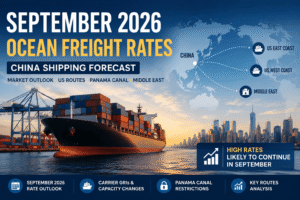

China to USA Shipping Costs Are Rising Again: Should You Ship Now or Wait? (August 2026 Update)
If you’ve been planning to ship goods from China to the United States this month, you’ve probably noticed one thing:
Freight rates are moving up again.
Over the past few weeks, many importers have been asking us the same question:
“Should I book my shipment now, or wait another week in case rates come down?”
It’s a fair question.
Ocean freight prices don’t move in a straight line, and no one wants to pay more than necessary.
However, August is traditionally one of the busiest periods for trans-Pacific shipping. As retailers prepare inventory for the Back-to-School season, Black Friday, and Christmas, demand for container space typically increases, giving carriers more confidence to push through higher rates.
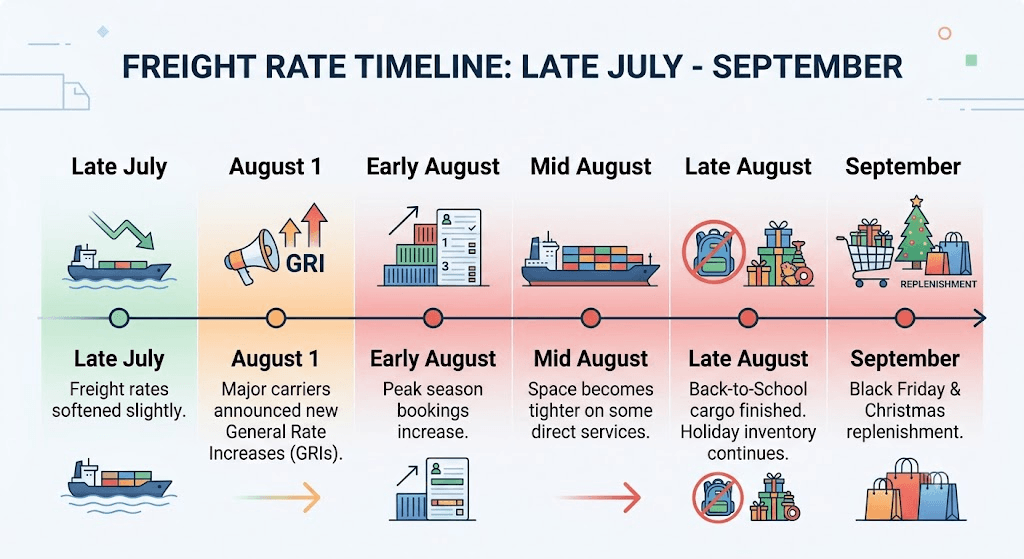
At the same time, many major shipping lines have announced new General Rate Increases (GRIs) effective from the beginning of August. Whether every announced increase will be fully accepted by the market remains uncertain, but the direction of the market has clearly become more volatile.
For importers, the question is no longer simply “How much is shipping today?”
A more important question is:
“Will waiting actually save money—or could it end up costing even more?”
In this article, we’ll break down the latest market data, explain what’s driving the recent freight rate movements, and share what we’re seeing from our own shipments at Kisun Shipping to help you make a better shipping decision.
Quick Answer: Should You Book Your Shipment Now?
Our Recommendation
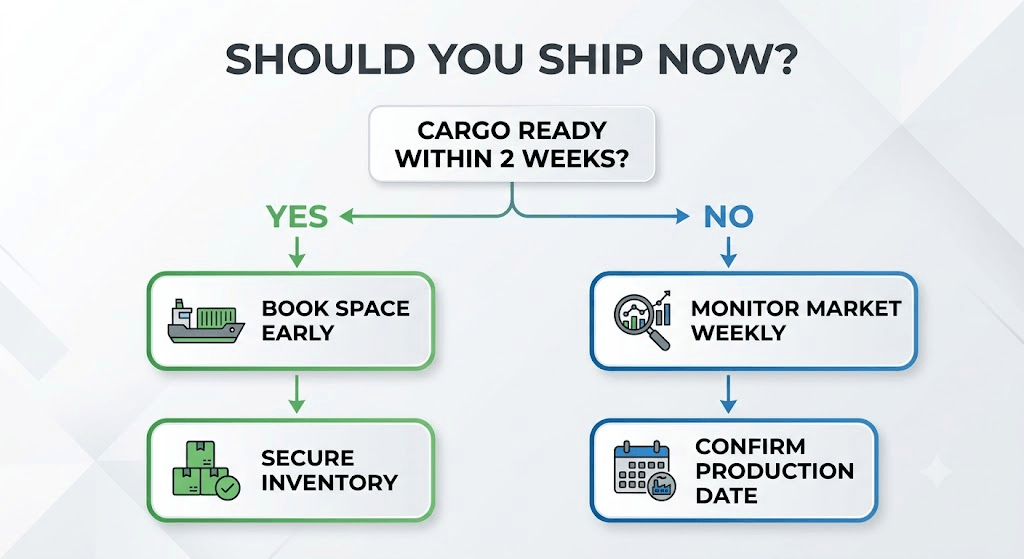
If your cargo will be ready within the next one to two weeks, we generally recommend booking your shipment as early as possible rather than waiting for a lower rate.
Why?
Because during August, importers face two risks at the same time:
- Freight rates may increase further if announced GRIs are successfully implemented.
- Available vessel space may become tighter as more businesses prepare inventory for the second half of the year.
While nobody—including freight forwarders—can accurately predict freight rates every week, delaying a shipment in hopes of saving a few hundred dollars per container may ultimately result in:
- Higher transportation costs
- Longer booking lead times
- Cargo rolling to the next vessel
- Delayed inventory arrivals
For seasonal products, missing your planned selling window often costs far more than paying a slightly higher freight rate.
Mid-July Market Dip vs. August 1st GRI Reality
In mid-to-late July, indices like Drewry’s World Container Index (WCI) showed spot rates easing slightly—Shanghai to Los Angeles dropped 6% to around $5,878/FEU, while Shanghai to New York dipped to $7,598/FEU. Many cargo owners assumed the market was cooling off after an early summer rush.
However, carriers treated this minor dip as a brief window to reset before applying their August peak season surcharges. Driven by strong booking volumes for Q3 retail inventory, major global shipping lines issued aggressive GRI adjustments:
| Shipping Carrier | Announced August 1st GRI (per FEU) | Target Market Spot Range (USWC / USEC) |
| Evergreen / HMM | +$3,000 / FEU | Top-tier peak allocation pricing |
| CMA CGM / Yang Ming / ZIM | +$2,000 / FEU | $7,800 – $8,800 (WC) / $9,800 – $10,300 (EC) |
| COSCO Shipping | +$1,500 / FEU | Baseline rate restoration push |
The speed with which these increases took hold caught many importers off guard. However, a closer look at fleet deployment reveals that this surge is backed by strong market mechanics.
Why Are Carriers Announcing Another Round of Rate Increases?
This is where many importers become confused.
They see freight indices falling one week…
Then suddenly receive notices from carriers announcing significant General Rate Increases (GRIs) for August.
Isn’t that contradictory?
Not necessarily.
A GRI announcement is not the same as the actual market price.
Shipping lines frequently publish new target rates before the beginning of each month. Whether those increases are fully accepted depends on actual booking demand, available vessel capacity, and competitive market conditions.
That’s why experienced importers pay attention to both market indices and carrier announcements.
Looking at only one side of the picture can be misleading.
What We’re Seeing at Kisun Shipping
Market reports are useful—but they don’t always reflect what happens in day-to-day operations.
Based on the shipments we’re handling, we’ve noticed several trends over the past two weeks:
- More customers are confirming bookings earlier instead of waiting until production is fully completed.
- Direct vessel space to the U.S. West Coast has become noticeably tighter on some sailings.
- Several customers have asked us to reserve space in advance because they’re concerned about August peak-season availability.
- Some carriers are accepting bookings but delaying final freight confirmation until cargo enters the warehouse, reflecting continued market uncertainty.
These observations don’t mean every route is experiencing shortages.
However, they do suggest that many importers are becoming more cautious and are choosing to secure vessel space earlier rather than risking delays.
Why Are Ocean Freight Rates Rising Again in August 2026?
Freight rates rarely increase because of a single reason.
Instead, the container shipping market is influenced by multiple factors happening at the same time.
Some are driven by demand.
Others are controlled by shipping lines.
And some are completely outside the industry’s control.
Understanding these factors won’t help you predict freight rates with perfect accuracy—but it will help you make better shipping decisions.
Let’s look at what’s happening behind the current market.
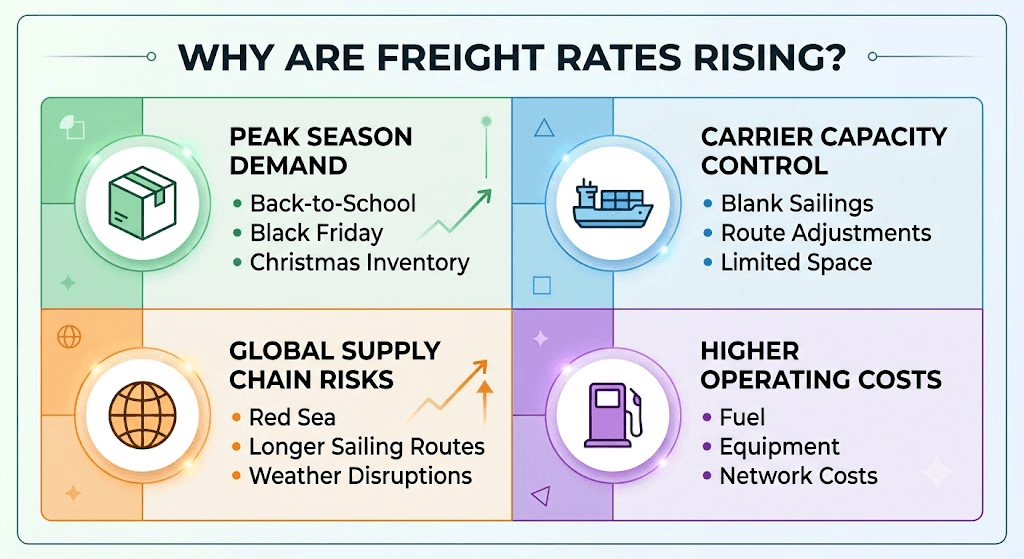
1. Peak Season Demand Is Returning
Every year, August marks the beginning of one of the busiest shipping periods for cargo moving from Asia to North America.
Many retailers and importers are now preparing inventory for:
- Back-to-School sales
- Halloween
- Black Friday
- Cyber Monday
- Christmas
- Year-end inventory replenishment
For businesses selling seasonal products, shipping delays during August can have a much bigger financial impact than paying a slightly higher freight rate.
That’s why many experienced importers choose to secure vessel space early instead of waiting for prices to fall.
As booking demand increases, carriers naturally gain more confidence to push through higher freight rates.
2. Shipping Lines Continue to Manage Capacity Carefully
One of the biggest changes in the container shipping industry over the past few years is how carriers manage capacity.
Instead of allowing freight rates to fall sharply during periods of weaker demand, shipping lines have become much more proactive in balancing supply and demand.
One common method is the use of blank sailings.
A blank sailing means a scheduled voyage is cancelled or skipped.
Although this reduces available vessel space in the short term, it also helps carriers prevent excessive price competition.
According to Drewry’s recent market observations, carriers continue adjusting sailing schedules as market conditions change, using capacity management as one of the tools to stabilize freight rates.
For importers, this means that vessel schedules may change even if cargo demand remains relatively stable.
3. Global Shipping Risks Have Not Completely Disappeared
Although the supply chain has become more stable than during the pandemic years, international shipping still faces several ongoing uncertainties.
These include:
- Security risks affecting Red Sea shipping routes
- Continued vessel diversions around the Cape of Good Hope on some services
- Weather-related disruptions
- Port congestion at certain locations
- Operational adjustments by shipping alliances
Longer sailing distances increase:
- Fuel consumption
- Vessel operating costs
- Equipment utilization
- Schedule complexity
These factors don’t automatically cause freight rates to increase.
However, they reduce the market’s flexibility and make rapid price changes more likely whenever demand rises.
4. General Rate Increases (GRIs) Are Back
Another important reason many importers are seeing higher quotations is the return of General Rate Increases (GRIs).
Several major carriers have announced new GRI programs effective from the beginning of August.
It’s important to understand one thing:
A GRI announcement is not a guaranteed market price.
Instead, it represents the carrier’s target pricing.
Whether those increases are fully accepted depends on:
- Actual booking demand
- Available vessel capacity
- Competitor pricing
- Market confidence
That’s why you may receive different quotations from different freight forwarders—even on the same shipping route.
If demand weakens, some carriers may discount rates again.
If demand remains strong, the announced increases are more likely to be reflected in actual market pricing.
What Does This Mean for Importers?
Instead of asking:
“Will freight rates increase another $500?”
A better question is:
“How much would a shipping delay cost my business?”
For many businesses, freight is only one part of the total cost.
Waiting too long could mean:
- Missing a sales season
- Running out of inventory
- Delaying Amazon FBA replenishment
- Losing wholesale customers
- Paying higher air freight later to recover stock shortages
Trying to perfectly time the freight market is extremely difficult—even for experienced logistics professionals.
That’s why many successful importers focus on supply chain stability rather than trying to book at the absolute lowest freight rate.
Should You Wait for Freight Rates to Fall?
This is probably the question we receive most often.
The honest answer is:
Nobody knows with certainty.
If someone tells you exactly what freight rates will be next month, they’re making a prediction—not stating a fact.
What we do know is this:
Historically, freight rates during August are often supported by peak-season demand.
Whether they continue rising depends on factors such as:
- Retail inventory demand in North America
- Carrier capacity management
- Port congestion
- Geopolitical developments
- Fuel prices
- New vessel deployments
Because these factors can change quickly, making decisions based only on today’s freight rate may not produce the best business outcome.
Our Advice: Focus on Your Inventory Timeline, Not Just Freight Rates
Here’s a simple example.
Imagine you’re importing furniture for Black Friday.
You decide to wait another two weeks because freight rates might fall by US$300 per container.
But while you’re waiting:
- Vessel space becomes limited.
- Your shipment rolls to the next sailing.
- Your inventory arrives after your sales promotion has already started.
Did you actually save money?
Probably not.
In many cases, protecting your inventory availability is worth far more than chasing the lowest possible freight rate.
That’s why our advice to customers is always based on their business schedule, not just the freight market.
What We’re Advising Our Customers This Month
Based on current market conditions, we’re recommending that customers:
✅ Finalize production schedules as early as possible.
✅ Book vessel space before cargo is completely ready whenever practical.
✅ Leave extra time for warehouse receiving appointments.
✅ Monitor carrier announcements—but don’t make decisions based on headlines alone.
✅ Discuss shipping plans with your freight forwarder before making purchasing decisions.
Freight rates will always move up and down.
Good supply chain planning is what keeps your business competitive.
7 Practical Ways to Reduce Shipping Costs During the August Peak Season
When freight rates start rising, many importers immediately ask one question:
“How can I reduce my shipping costs?”
The truth is, you can’t control the market—but you can control many of the decisions that affect your total logistics cost.
After helping importers ship thousands of containers from China, we’ve found that the companies with the lowest overall logistics costs aren’t always the ones paying the lowest freight rates.
They’re usually the ones who plan ahead.
Here are seven practical ways to reduce shipping costs, even during the busy August shipping season.
1. Book Your Shipment Earlier—Not Just When Production Is Finished
One of the most common mistakes we see is waiting until every carton has been packed before contacting a freight forwarder.
By that time:
- Your preferred vessel may already be full.
- Only more expensive sailings may be available.
- Your factory may miss the cargo cutoff date.
- Your shipment could be rolled to the following week.
Instead, contact your freight forwarder as soon as you know your estimated cargo ready date.
Even if production isn’t finished, early communication gives you more flexibility to:
- Compare sailing schedules.
- Reserve space.
- Prepare shipping documents.
- Adjust your shipping plan if market conditions change.
You don’t have to book months in advance—but waiting until the last minute rarely creates more options.
2. Don’t Choose a Freight Forwarder Based Only on the Lowest Price
It’s natural to compare freight quotations.
But the cheapest quotation isn’t always the lowest-cost solution.
For example:
Option A
- Ocean freight: US$5,800
- One transshipment
- Estimated transit time: 38–42 days
Option B
- Ocean freight: US$6,100
- Direct service
- Estimated transit time: 26–30 days
At first glance, Option A saves US$300.
However, if your products arrive two weeks later than expected, the impact on inventory, sales, or warehouse planning could easily exceed that amount.
Instead of asking only:
“Which quotation is cheaper?”
Also ask:
- Is this a direct service?
- Which carrier operates this route?
- How reliable is the sailing schedule?
- What’s included in the quotation?
Looking at the total value—not just the freight rate—often leads to better decisions.
3. A Small Delay Can Become a Much Bigger Expense
Many importers try to save a few hundred dollars by waiting for freight rates to fall.
Sometimes that works.
Sometimes it doesn’t.
We’ve seen businesses delay booking in hopes of a lower ocean freight rate, only to discover that inventory arrived too late for their planned sales campaign.
In some cases, they later had to replenish stock by air freight to avoid running out of inventory.
Air freight can cost several times more than ocean freight.
While every shipment is different, it’s worth asking yourself:
If my shipment arrives two weeks late, how much will that cost my business?
For seasonal products, inventory availability is often more important than achieving the lowest freight rate.
4. Know When It’s Time to Upgrade from LCL to FCL
Many growing businesses continue using LCL (Less than Container Load) simply because that’s how they started.
However, as shipment volume increases, FCL (Full Container Load) often becomes the more economical option.
An FCL shipment can offer several advantages:
- Lower shipping cost per cubic meter.
- Less cargo handling.
- Reduced risk of damage.
- Faster destination processing.
- More predictable transit.
The exact break-even point depends on your cargo dimensions, destination, and shipping route.
Rather than assuming LCL is always cheaper, ask your freight forwarder to compare both options.
Sometimes the difference is smaller than many importers expect.
5. Consolidate Shipments Whenever Possible
If you’re purchasing from multiple suppliers in China, shipping each order separately can quickly increase logistics costs.
In many cases, consolidating cargo into a single shipment can help reduce:
- Multiple origin handling fees.
- Repeated customs documentation.
- Separate destination delivery charges.
- Warehouse receiving costs.
At Kisun Shipping, we regularly help customers consolidate cargo from different factories before export.
This approach doesn’t suit every shipment, but for many importers it provides a practical way to improve overall shipping efficiency while reducing total logistics costs.
6. Pay Attention to Costs Beyond Ocean Freight
Many first-time importers compare quotations using only the ocean freight price.
However, international shipping involves much more than the freight itself.
Depending on your shipping terms, you may also need to consider:
- Destination handling charges.
- Customs clearance fees.
- Import duties and taxes.
- Container delivery costs.
- Warehouse receiving fees.
- Forklift or unloading costs.
- Storage or detention charges if delays occur.
A quotation that looks cheaper at first may end up costing more if these additional expenses aren’t clearly understood.
Always ask for a complete breakdown of the costs included in your quotation.
7. Work with a Freight Forwarder Who Helps You Plan—Not Just Ship
The best freight forwarder isn’t necessarily the one offering the lowest rate.
It’s the one who helps you avoid unnecessary costs before they happen.
A good logistics partner should be able to help you answer questions like:
- Should I choose LCL or FCL?
- Is this carrier suitable for my shipment?
- When should I book?
- Is my warehouse ready to receive the cargo?
- Are there any seasonal risks I should prepare for?
Sometimes, a 15-minute discussion before booking can prevent delays, extra charges, or costly last-minute changes.
International shipping is about much more than moving containers from one port to another.
Good planning is often the biggest cost-saving strategy of all.
Peak Season Cost-Saving Checklist
Before your shipment leaves China, take a few minutes to review this checklist.
| Checklist | Why It Matters |
|---|---|
| ✅ Confirm your cargo ready date | Helps secure suitable vessel space earlier. |
| ✅ Compare transit times, not just freight rates | A faster service may reduce inventory risk. |
| ✅ Ask whether FCL is more economical than LCL | Larger shipments may benefit from full-container shipping. |
| ✅ Consolidate cargo from multiple suppliers when practical | Can reduce handling and delivery costs. |
| ✅ Understand every cost included in the quotation | Avoid unexpected destination charges. |
| ✅ Confirm your warehouse is ready for delivery | Prevent truck waiting charges and delivery delays. |
| ✅ Leave buffer time during peak season | Helps reduce the impact of schedule changes or port congestion. |
The Lowest Freight Rate Doesn’t Always Mean the Lowest Total Cost
One lesson we’ve learned after years of handling international shipments is this:
Successful importers don’t focus only on the freight rate.
They look at the total landed cost, the reliability of the shipping plan, and whether their inventory will arrive when their business needs it.
A freight rate that is US$200 or US$300 lower may look attractive today.
But if it results in delayed sales, emergency air freight, or warehouse disruptions, it may not be the best business decision.
The goal isn’t simply to spend less on shipping.
The goal is to build a supply chain that supports your business as it grows.
Frequently Asked Questions About China–USA Shipping in August 2026
Every week, our logistics team receives dozens of questions from importers planning shipments from China to the United States.
Below are some of the most common questions we’re hearing this August.
Will ocean freight rates continue to increase in August?
No one can predict freight rates with certainty.
While several carriers have announced General Rate Increases (GRIs) for August, the actual market will depend on factors such as:
- Booking demand
- Available vessel capacity
- Blank sailing programs
- Carrier pricing strategies
- Port congestion
- Geopolitical developments
Freight rates can move quickly in either direction, which is why we recommend making shipping decisions based on your inventory timeline rather than trying to perfectly time the market.
Should I wait for lower freight rates?
It depends on your business—not just the freight market.
If your products are needed for:
- Back-to-School sales
- Black Friday
- Christmas
- Amazon FBA replenishment
- Customer purchase orders
waiting for slightly lower freight rates could create a much larger business risk if your inventory arrives late.
On the other hand, if your shipment isn’t time-sensitive and your production schedule is still several weeks away, monitoring the market before booking may be reasonable.
The right decision depends on your cargo ready date, sales plan, and inventory level.
Is August still a good time to ship from China?
Yes—but planning becomes more important.
August has traditionally been one of the busiest months for trans-Pacific shipping because many importers are preparing inventory for the fourth quarter.
During this period, you should expect:
- Longer booking lead times on some services
- Greater competition for vessel space
- More schedule adjustments by carriers
- Increased demand for warehouse appointments after arrival
Booking earlier and building extra time into your supply chain can help reduce unnecessary stress later.
How early should I book my shipment?
There is no single rule that fits every shipment.
As a general recommendation, once you know your estimated cargo ready date, it’s worth discussing your shipment with your freight forwarder.
Early planning allows you to:
- Compare multiple sailings.
- Reserve vessel space if necessary.
- Prepare export documentation.
- Adjust your shipping plan if market conditions change.
Even if production isn’t complete, early communication gives you more flexibility.
Key Takeaways
If you only remember a few points from this article, let them be these:
- Freight rates are influenced by both market demand and carrier capacity management—not by a single factor.
- Peak season affects more than pricing; it also impacts vessel availability and scheduling.
- Booking early doesn’t always mean paying more—it often gives you more shipping options.
- The lowest freight rate isn’t always the lowest total logistics cost.
- Good planning can often save more money than trying to predict short-term freight rate movements.
International shipping is most successful when importers focus on preparation rather than reaction.
How Kisun Shipping Helps Importers Navigate Peak Season
Every shipment is different.
Some customers are shipping their first LCL order from China.
Others are moving multiple full containers every month.
Rather than offering the same solution to everyone, we work with customers to understand:
- Your cargo ready date.
- Your destination.
- Your preferred transit time.
- Your inventory deadline.
- Your delivery requirements.
Based on that information, we can help you compare shipping options and identify potential risks before your cargo leaves China.
Our services include:
- Sea Freight (FCL & LCL)
- Air Freight
- DDP Door-to-Door Shipping
- Amazon FBA Shipping
- Customs Clearance Coordination
- Cargo Consolidation
- Warehouse & Last-Mile Delivery Solutions
Whether you’re shipping to Los Angeles, New York, Houston, Chicago, Toronto, Vancouver, London, Sydney, or other international destinations, our goal is simple:
Help you move cargo safely, efficiently, and with fewer surprises.
Need Advice for Your August Shipment?
If you’re planning to import goods from China and aren’t sure whether to book now, compare carriers, or choose between LCL and FCL, we’d be happy to help.
Tell us:
- What products you’re shipping
- Your cargo ready date
- The destination country and city
- Approximate shipment size (CBM or container)
- Whether you need door-to-door service or port-to-port shipping
Our team will review your shipment and provide practical recommendations based on your specific situation—not a one-size-fits-all answer.
Recommended Reading
To help you plan future shipments, you may also find these guides useful:
- Shipping from China to the USA: Complete 2026 Guide
- DDP Shipping Explained: Responsibilities, Costs & Common Mistakes
- Does DDP Shipping Include Unloading? A First-Time Importer’s Guide
- FCL vs. LCL Shipping: Which Is Right for Your Business?
(Add internal links to these articles to strengthen topical authority and improve on-site SEO.)
Final Thoughts
Ocean freight rates will always rise and fall.
No freight forwarder can promise the lowest rate every week, and no one can accurately predict every market movement.
What experienced importers do differently is focus on the factors they can control:
- Planning earlier.
- Understanding market trends.
- Preparing documentation in advance.
- Choosing the right shipping solution.
- Working with logistics partners who provide honest, practical advice.
At Kisun Shipping, we believe our job isn’t just to move containers.
It’s to help our customers make better logistics decisions that support long-term business growth.
Whether you’re shipping one pallet or one hundred containers, informed decisions today can save both time and money tomorrow.

China Logistics Expert
About the Author
Katherine Kang is a China-based logistics consultant with over 11 years of experience in international trade and freight forwarding. Specializing in helping SMEs import from China she focuses on compliant, cost-effective solutions to avoid delays, tariffs, and hidden fees. From anti-dumping guidance to CNY planning, Katherine has managed hundreds of shipments, saving clients 15-30% on average.
Connect with Katherine on LinkedIn or contact Kisun Shipping for a free import consultation.